At a Glance
| Attribute | Detail |
|---|---|
| Scientific name | Spinosaurus aegyptiacus |
| Pronunciation | SPY-no-SOR-us ee-JIP-tee-ah-kus |
| Name meaning | “Egyptian spine lizard” |
| Period | Late Cretaceous (Cenomanian, ~100–94 Ma) |
| Lived | ~100–94 million years ago |
| Found in | North Africa (Morocco, Algeria, Egypt) |
| Diet | Primarily fish; opportunistic terrestrial feeding |
| Estimated length | ~14–16 m (estimates vary) |
| Estimated weight | ~6–9 tonnes (model-dependent) |
| Classification | Theropoda; Spinosauridae |
| Discovery | Described by Ernst Stromer (1915); holotype destroyed in 1944 |
Quick Answer: Spinosaurus was the largest predatory dinosaur known to science — longer than T. rex, adapted for life in and around water, and built to hunt fish rather than land prey. It lived in North Africa roughly 95–100 million years ago. Its fossil history is among the most dramatic of any dinosaur: the original specimens were destroyed in a WWII bombing raid, and the species had to be scientifically reconstructed largely from scratch.
Picture an animal the length of a school bus, wading chest-deep through a Cretaceous river delta, its elongated skull tracking the movement of a two-metre sawfish just beneath the surface. This was Spinosaurus — not the land-stalking monster of Jurassic Park III, but something stranger and more interesting: the largest known predatory dinosaur, and one adapted to a semi-aquatic world that no other theropod of its size had claimed.
What Was Spinosaurus?
| Field | Detail |
|---|---|
| Group | Large theropod dinosaur; spinosaurid |
| Closest living relatives | Birds (all theropods); crocodilians share convergent features |
| Size context | Longest known predatory dinosaur; probable rival to Carcharodontosaurus in mass |
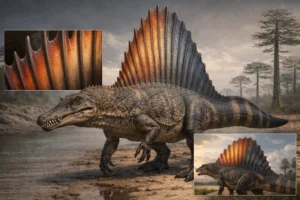
| Defining features | Elongated dorsal neural spines forming a sail or hump; long narrow skull; conical teeth |
| Ecological role | Semi-aquatic apex predator; riverine fish specialist |
Spinosaurus belonged to the spinosaurid family — a group of theropods characterised by elongated, crocodilian-like skulls and conical teeth adapted for fish-eating. It was the largest member of this family by a considerable margin, and currently holds the record as the longest predatory dinosaur in the fossil record, though size estimates remain subject to significant uncertainty given the fragmentary nature of the material.
How Big Was Spinosaurus?
| Field | Detail |
|---|---|
| Estimated length | ~14–16 m (estimates vary) |
| Estimated weight | ~6–9 tonnes (model-dependent) |
| Skull length | Estimated ~1.5–1.7 m (approximate; varies by reconstruction) |
| Comparison | Longer than T. rex; mass comparison genuinely uncertain |
| Limiting factor | No complete skeleton exists; estimates depend heavily on body model used |
Spinosaurus is generally considered one of the longest predatory dinosaurs yet discovered, though estimates vary depending on reconstruction models. Its mass remains one of the most contested figures in palaeontology, as the fragmentary fossil record means different body reconstructions produce significantly different weight estimates. Length estimates are better constrained than mass estimates, but should still be treated as approximations pending more complete material.
What Did Spinosaurus Eat?
| Field | Detail |
|---|---|
| Primary prey | Fish, including sawfish (Onchopristis), lungfish, sharks, coelacanths |
| Key evidence | Conical interlocking teeth; oxygen isotope ratios; jaw morphology |
| Modern analogue | Gharial — elongated skull, conical teeth, fish specialist |
| Opportunistic feeding | Probable; evidence for terrestrial prey not excluded |
Spinosaurus’s teeth are the most direct evidence of its diet: conical, interlocking, and unserrated — the toolkit of an animal that grips slippery prey, not one that slices through flesh or crushes bone. Isotopic analysis places it ecologically in the aquatic column, closer to crocodilians than to terrestrial theropods of comparable size. For the full breakdown of prey species, feeding evidence, and the piscivory debate, see our complete Spinosaurus diet guide.
Did Spinosaurus Live in Water?
| Field | Detail |
|---|---|
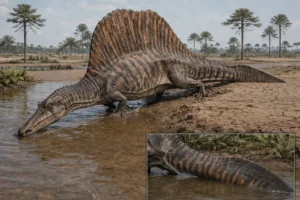
| Lifestyle | Semi-aquatic; strong evidence for regular aquatic activity |
| Key 2020 finding | Paddle-like tail described in a 2020 Nature study by Ibrahim et al. |
| Bone density | Dense, compact bone tissue reduces buoyancy — as in diving birds and hippos |
| Hind limbs | Short relative to body size; inconsistent with fast terrestrial locomotion |
| Habitat | Kem Kem river delta, North Africa — vast braided river system |
The 2020 description of Spinosaurus’s paddle-like tail — combining with earlier evidence of dense bones and short hind limbs — shifted the scientific consensus firmly toward semi-aquatic or actively aquatic behaviour. Whether Spinosaurus was a wading ambush predator or an active pursuit swimmer in open water remains debated. The full evidence, including the Kem Kem habitat reconstruction and comparisons with modern semi-aquatic predators, is covered in our aquatic lifestyle guide.
What Was the Sail on Spinosaurus For?
| Field | Detail |
|---|---|
| Structure | Elongated neural spines on dorsal vertebrae, reaching approximately 1.6–1.7 m in height |
| Leading hypothesis | Thermoregulation, or sexual display / species recognition |
| Alternative hypothesis | Fat or muscle hump rather than a thin sail |
| Further alternative | Hydrodynamic stabilisation during swimming |
| Consensus | No consensus; all major hypotheses remain active |
The dorsal sail is Spinosaurus’s most visually distinctive feature, but its function is genuinely unresolved. The competing hypotheses — thermoregulation, display, fat storage, and hydrodynamic function — each have anatomical and ecological arguments in their favour, and none has been definitively ruled out. The full synthesis of evidence for each hypothesis is in our sail guide.
How Was Spinosaurus Discovered?
| Field | Detail |
|---|---|
| First described | Ernst Stromer von Reichenbach, 1915 |
| Original material | Bahariya Oasis, Egypt, 1912 expedition |
| Holotype fate | Destroyed, Munich, 24–25 April 1944 (WWII bombing) |
| Modern redescription | Nizar Ibrahim et al. (2014), partial skeleton from the Kem Kem Beds (Morocco) |
| 2026 development | New spinosaurid material reported from the central Sahara (2026; interpretation ongoing) |
Few dinosaurs have a fossil history as dramatic as Spinosaurus. The original specimens survived two world wars — barely — before being destroyed in a single night. The animal was scientifically rebuilt from fragments and inference until a 2014 partial skeleton fundamentally changed how researchers understood its anatomy and lifestyle. The complete story, including the WWII holotype destruction and the 2026 S. mirabilis announcement, is in our discovery guide.
How Did Spinosaurus Become Extinct?
| Field | Detail |
|---|---|
| Extinction timing | Late Cenomanian (~100–94 Ma, last known occurrence near ~94 Ma) |
| General cause | Part of broader Cenomanian-Turonian extinction event |
| Specific driver | Probable habitat disruption as North African river systems changed |
| Evidence quality | Indirect; no direct fossil evidence of extinction cause |
| Note | Species-specific extinction data is limited — this is inference from stratigraphy |
Spinosaurus is last known from the fossil record at roughly the Cenomanian–Turonian boundary, a period associated with significant environmental change, including marine transgressions that would have altered the North African river systems it depended on. The evidence for any species-specific extinction cause is indirect, and this question is better understood at the ecosystem level than for Spinosaurus individually.
Spinosaurus vs Tyrannosaurus Rex
| Feature | Spinosaurus | T. rex |
|---|---|---|
| Temporal overlap | None — ~30 million years apart | — |
| Geographic overlap | None — different continents | — |
| Estimated length | ~14–16 m (estimates vary) | ~12–13 m |
| Ecological role | Semi-aquatic fish specialist | Terrestrial apex predator |
Spinosaurus and T. rex never coexisted — they were separated by roughly 30 million years and an ocean. The matchup is a product of Jurassic Park III, not palaeontology. What the fossil evidence does support is a detailed comparison of two very different apex predators, each extraordinary in its own ecological context. The full scientific comparison, including the Jurassic Park correction, is in our Spinosaurus vs T. rex guide.
Spinosaurus vs Carcharodontosaurus
| Feature | Spinosaurus | Carcharodontosaurus |
|---|---|---|
| Geographic overlap | Yes — both from Kem Kem Beds, North Africa | — |
| Temporal overlap | Approximate — both ~95–100 Ma | — |
| Estimated length | ~14–16 m (estimates vary) | ~12–13 m |
| Niche | Semi-aquatic; fish | Terrestrial; large herbivores |
Unlike the T. rex matchup, the Spinosaurus vs Carcharodontosaurus comparison is grounded in actual fossil evidence of coexistence. Both animals are known from the same North African formation and were almost certainly alive at the same time. Current evidence suggests they partitioned the ecosystem between them — Spinosaurus in the rivers, Carcharodontosaurus on the land. The full ecological analysis is in our Spinosaurus vs Carcharodontosaurus guide.
Related and Contemporary Species
Baryonyx walkeri — a spinosaurid from Early Cretaceous England and one of Spinosaurus’s closest relatives; its well-preserved skull provided the clearest early evidence that spinosaurids were fish specialists.
Suchomimus tenerensis — a large African spinosaurid from Niger, ecologically similar to Spinosaurus and from broadly the same Cretaceous African river context; useful comparative reference for spinosaurid niche use.
Irritator challengeri — a Brazilian spinosaurid whose discovery confirmed that the family had a wide Gondwanan distribution; it expands the picture of spinosaurid diversity beyond Africa.
Carcharodontosaurus saharicus — not a spinosaurid but Spinosaurus’s most significant ecological contemporary; shared the Kem Kem river delta and almost certainly competed for overlapping resources at the habitat margins.
Sarcosuchus imperator — a massive Cretaceous crocodilian from the same North African river system; shared aquatic habitat with Spinosaurus and may have competed for some of the same prey.
Common Questions About Spinosaurus
Was Spinosaurus the biggest dinosaur ever?
Spinosaurus was the largest predatory dinosaur known to science, longer than T. rex and currently holding the record for the longest carnivorous dinosaur. It was not, however, the largest dinosaur overall. Sauropods such as Patagotitan mayorum and Argentinosaurus were significantly more massive, though they were plant-eaters. Spinosaurus holds the record among meat-eaters only.
Why does Spinosaurus look so different from other large theropods?
Spinosaurus belongs to the spinosaurid family, which evolved a specialist fish-eating ecology very different from the large terrestrial predators most people picture when they think of theropods. Its long, narrow skull, conical teeth, short hind limbs, and dense bones are all adaptations to a semi-aquatic lifestyle — a fundamentally different evolutionary path from the T. rex lineage.
How do we know what Spinosaurus looked like if the original fossils were destroyed?
The 1915 description by Ernst Stromer included detailed drawings and written measurements of the original specimens. These records survived even though the fossils did not. Subsequent discoveries — particularly the 2014 partial skeleton described by Nizar Ibrahim — added skeletal data that was impossible to infer from Stromer’s material alone, including the short hind limbs and dense bone tissue that changed the reconstruction significantly.
Is Spinosaurus still being studied?
Yes—actively. The 2020 tail description and the ongoing debate about wading versus active swimming behaviour both reflect a genus that remains a focus of current research. The fragmentary fossil record means that new material has historically produced significant reinterpretations, and further discoveries are likely to do the same.
How fast was Spinosaurus?
Speed estimates for Spinosaurus are highly uncertain and should be treated with caution. Biomechanical modelling suggests it was likely not a fast terrestrial runner, as its short hind limbs and body proportions are inconsistent with the locomotor anatomy of fast-moving large theropods. In water, its paddle-like tail suggests genuine swimming capability, but quantified speed estimates are not well established in the literature.