

There are more types of dinosaurs alive today than there were during the Cretaceous Period. That statement sounds wrong — but it is scientifically accurate. Modern birds are dinosaurs in the full evolutionary sense, and with roughly 10,000 living bird species compared to an estimated 700–900 known non-avian dinosaur species in the fossil record, the group is more diverse now than it has ever been. Dinosaurs did not end. They transformed.
Understanding the types of dinosaurs — both extinct and living — means understanding how one of the most successful vertebrate groups in Earth’s history organised itself across 160 million years of evolution. This guide covers the major clades, subclades, and families, and explains what made each group distinct.
What Is a Dinosaur Clade?

Before exploring the different types, it helps to understand how paleontologists organise them.
A clade is a group that includes a common ancestor and every one of its descendants. Classification works this way because shared ancestry is more scientifically meaningful than shared appearance. Two animals can look almost identical and belong to completely different branches of life. Two animals can look nothing alike and be closely related.
This is why the word “dinosaur” is more precise than most people realise. Not every large prehistoric reptile was a dinosaur. Pterosaurs — the flying reptiles — were not dinosaurs. Plesiosaurs and mosasaurs were not dinosaurs. They lived during the same periods, but they belonged to separate reptile lineages. True dinosaurs belong to the clade Dinosauria, which appeared during the Late Triassic Period approximately 230 million years ago and is defined by specific skeletal features involving the pelvis, limbs, and ankle structure.
Within Dinosauria, paleontologists recognise two major branches that form the foundation for every well-known species.
The Two Major Branches: Saurischia and Ornithischia

Early in their evolution, dinosaurs split into two great lineages: Saurischia and Ornithischia. These names translate roughly as “lizard-hipped” and “bird-hipped” — and one of the most counterintuitive facts in paleontology is that birds evolved from the lizard-hipped branch, not the bird-hipped one.
Saurischia produced two of the most ecologically dominant groups in dinosaur history: the theropods and the sauropodomorphs. It is the branch that connects directly to every living bird.
Ornithischia was dominated by herbivores and includes the most heavily armoured, horned, and structurally defended animals of the Mesozoic. Stegosaurs, ankylosaurs, ceratopsians, hadrosaurs, and pachycephalosaurs all belong here.
Together, these two branches account for the full ecological range of non-avian dinosaurs — from apex predators to giant browsers to walking tanks.
Theropoda: Predators, Feathered Hunters, and the Ancestors of Birds
Theropoda is arguably the most consequential dinosaur clade in Earth’s history, because it is still alive. Every bird on the planet — every sparrow, eagle, penguin, and crow — is a theropod dinosaur.
Most theropods were bipedal, with strong hind limbs, grasping forelimbs, and skulls adapted for predation. The group includes some of the most powerful carnivores in the fossil record: Tyrannosaurus rex, Allosaurus, Giganotosaurus, and Spinosaurus. But theropods were never exclusively giant predators. The clade also includes small feathered hunters, omnivores, and lineages that evolved entirely herbivorous diets.
Modern fossil evidence has fundamentally changed how theropods are understood. Feathers were not a late or unusual feature — they were widespread across many theropod lineages, particularly within the coelurosaurs. What was once imagined as a uniformly scaly, reptilian group is now understood to have been far more bird-like in anatomy, physiology, and likely behaviour than early reconstructions suggested.
Coelurosauria: The Path to Birds
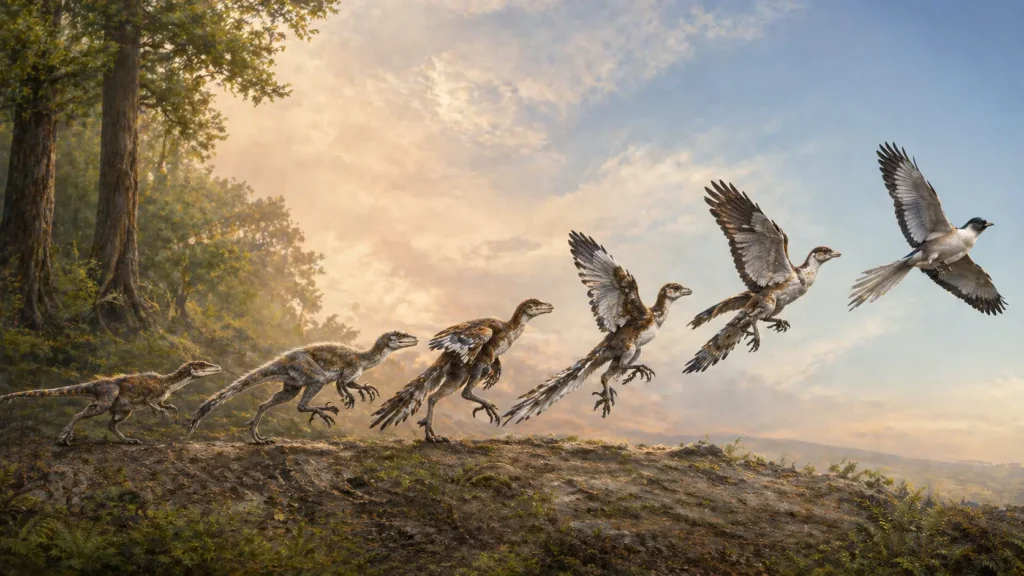
Within Theropoda, Coelurosauria represents the branch closest to modern birds. This subgroup includes tyrannosaurs, dromaeosaurids, troodontids, ornithomimosaurs, and ultimately the avian lineage itself.
Coelurosaurs generally show a trend toward smaller body size, more complex feathering, advanced sensory systems, and increasingly bird-like skeletal anatomy. Velociraptor — significantly smaller and more feathered than its film depictions — belongs here, as does Microraptor, a four-winged dromaeosaurid that demonstrated flight-related anatomy in non-avian dinosaurs.
The evolutionary transition from non-avian coelurosaurs to birds was not a sudden leap. It was a gradual accumulation of features — wishbones, hollow bones, feathers, brooding behaviour, advanced respiratory systems — many of which were already present in non-avian theropods long before flight evolved.
Key Theropod Families
| Family | Famous Species | Signature Trait |
|---|---|---|
| Tyrannosauridae | Tyrannosaurus rex | Massive skull, bone-crushing bite force, reduced forelimbs |
| Dromaeosauridae | Velociraptor, Deinonychus | Feathered integument, enlarged retractable sickle claw |
| Spinosauridae | Spinosaurus, Baryonyx | Elongated crocodile-like snout, semi-aquatic adaptations |
| Ornithomimidae | Gallimimus | Toothless beak, long legs, ostrich-like body plan |
| Oviraptorosauria | Oviraptor, Citipati | Crested skulls, strong beaks, confirmed brooding behaviour |
Sauropodomorpha: The Giants of the Mesozoic
Sauropodomorpha produced the largest land animals in Earth’s history. These long-necked, long-tailed, quadrupedal herbivores reached body masses that no terrestrial animal before or since has matched. Argentinosaurus is estimated to have weighed between 65 and 80 tonnes. Patagotitan mayorum, described in 2017, is among the largest individuals yet documented from reasonably complete material.
Their ecological strategy was built around scale. Long necks allowed efficient feeding across large vertical and horizontal ranges without moving the body. Enormous body size made adult individuals effectively immune to predation. Evidence from vertebral pneumatisation — air-filled cavities within the vertebrae — indicates that sauropods likely possessed bird-like air sac respiratory systems, which may have been essential to sustaining their metabolic demands at such extreme size.
Early sauropodomorphs, sometimes grouped under the informal label “prosauropods,” were smaller and more bipedally capable. Over time, the lineage trended strongly toward larger body size and obligate quadrupedalism.
Key Sauropod Families
| Family | Famous Species | Signature Trait |
|---|---|---|
| Diplodocidae | Diplodocus, Apatosaurus | Extremely long necks and whip-like tails |
| Brachiosauridae | Brachiosaurus, Giraffatitan | Tall high-browsing body plan, forelimbs longer than hindlimbs |
| Titanosauria | Argentinosaurus, Patagotitan | Widest geographic range, includes the largest known individuals |
Ceratopsia: Horns, Frills, and Powerful Jaws
Ceratopsia includes some of the most structurally elaborate skulls in vertebrate history. The group ranges from small, early forms like Psittacosaurus — a bipedal herbivore the size of a large dog — to the large-bodied, frill-bearing ceratopsids of the Late Cretaceous.
Triceratops is the most recognisable example, but the family Ceratopsidae contains dozens of species, many with dramatically different horn and frill configurations. Styracosaurus carried a frill edged with long spikes. Pachyrhinosaurus had a broad bony boss where a nasal horn might be expected. Kosmoceratops bore an extraordinary array of hooks and projections around its frill margin.
The function of ceratopsian horns and frills has been debated at length. Direct fossil evidence supports roles in species recognition and display. Defensive use against predators remains plausible but is harder to confirm directly from the fossil record. The honest answer is that these structures likely served multiple functions simultaneously.
Ceratopsians also evolved powerful jaw mechanics. Their teeth were arranged in stacked dental batteries capable of shearing tough vegetation, and their beaks allowed the cropping of low-growing plants with precision.
Hadrosauria and Ornithopoda: The Successful Grazers
Ornithopoda is a broad clade of bipedal to facultatively quadrupedal herbivores that includes some of the most ecologically successful dinosaurs of the Cretaceous. Within it, Hadrosauria — the duck-billed dinosaurs — represents the peak of ornithopod evolution.
Hadrosaurs evolved dental batteries of remarkable complexity: hundreds of teeth packed into interlocking columns that continuously replaced each other as they wore down. This allowed them to process fibrous, abrasive plant material that most other herbivores could not efficiently consume. It is one of the most sophisticated dental systems in dinosaur history.
Many hadrosaurs also developed elaborate cranial crests. Parasaurolophus carried a long hollow crest that likely functioned in vocal communication, producing low-frequency resonant calls. Corythosaurus and Lambeosaurus had differently shaped crests that would have produced distinct sound profiles, suggesting crests played a role in species recognition as well.
Fossil evidence, including trackways, bonebed assemblages, and nesting sites, suggests that at least some hadrosaur species were gregarious, moving in groups and potentially exhibiting parental care. Maiasaura — whose name translates as “good mother lizard” — is associated with nesting evidence that helped shift scientific understanding of dinosaur parental behaviour in the 1970s.
Ankylosauria: Armour, Clubs, and Extreme Defence
Ankylosauria represents one of the most extreme passive and active defence strategies in vertebrate history. These low-bodied, quadrupedal herbivores were protected by osteoderms — bony elements embedded directly in the skin — that formed continuous armour across the back, flanks, and sometimes the skull.
Ankylosaurus, the largest known ankylosaur, carried a tail club formed from fused vertebrae and large terminal osteoderms. Biomechanical modelling suggests the club was capable of delivering forces sufficient to fracture the bones of large theropods. This makes ankylosaurs not merely passive armoured animals but active defenders.
Two main families divide the group. Ankylosauridae, which includes Ankylosaurus, typically carried tail clubs. Nodosauridae, which includes Borealopelta and Edmontonia, lacked tail clubs but often developed prominent shoulder spines instead. A specimen of Borealopelta markmitchelli described in 2017 preserved soft tissue in extraordinary detail, including skin colour evidence suggesting countershading — darker dorsally and lighter ventrally — consistent with camouflage despite the animal’s heavy armour.
Stegosauria: Plates, Spikes, and an Ongoing Debate
Stegosauria is defined by two features that have generated more scientific discussion than almost any other dinosaur structures: the dorsal plates of Stegosaurus stenops and the tail spikes — called thagomizers — present across the family.
The plates of Stegosaurus stenops were not solid bone. They were highly vascularised structures with a surface network of grooves, suggesting a rich blood supply. Thermoregulation, display, and species recognition have all been proposed as functions. Current evidence does not decisively favour one over the others, and the plates likely served more than one purpose.
The thagomizer — the arrangement of tail spikes — is better understood as a defensive weapon. Fossil evidence includes Allosaurus vertebrae with puncture wounds matching stegosaur spike dimensions, providing direct documentation of their use.
Stegosaurs were most diverse during the Jurassic Period and declined significantly before the end of the Cretaceous. Stegosaurus stenops itself lived approximately 155–150 million years ago, meaning it is separated from Tyrannosaurus rex by more time than T. rex is separated from us.
Pachycephalosauria: Dome Heads and Contested Behaviour
Pachycephalosauria is among the most morphologically unusual dinosaur groups. These small to medium-sized bipedal herbivores are defined by dramatically thickened skull domes — in Pachycephalosaurus wyomingensis, the dome reached roughly 25 centimetres (10 inches) of solid bone.
The function of these domes has been debated since the group was first described. Head-butting behaviour analogous to modern bighorn sheep has been proposed repeatedly, but biomechanical analysis has raised questions about whether the skull structure was optimised for direct axial impact. Flank-butting or display use have been proposed as alternatives.
Histological analysis of pachycephalosaur skull domes has shown evidence of bone remodelling consistent with stress loading, which provides some support for contact behaviour. The debate is not resolved, and current literature treats the question as open.
Pachycephalosaurs are a reminder that not all dinosaur evolution was oriented toward size or defence. Some of the most distinctive adaptations in the group appear to have been social and communicative.
Why Dinosaurs Dominated for 160 Million Years
Dinosaurs did not succeed through a single strategy. They succeeded through diversification.
Sauropods mastered gigantism and transformed feeding efficiency at a scale no other land animal has replicated. Theropods refined predation across an enormous range of body sizes, from 60-kilogram dromaeosaurids to 8-tonne tyrannosaurs. Ornithischians developed armour, horns, dental batteries, and herd behaviour that made them among the most ecologically resilient herbivores in Mesozoic ecosystems.
Different body plans, different feeding strategies, different defensive systems — all evolved within a single clade over geological time. That adaptability is what made Dinosauria one of the most successful vertebrate radiations in the history of life on Earth.
Birds: The Dinosaurs Still Among Us
The non-avian dinosaurs — every species covered in this article — disappeared approximately 66 million years ago following the Chicxulub impact event. But Dinosauria as a clade survived.
Birds evolved from small feathered theropods and carry forward an unbroken evolutionary lineage from the Mesozoic. Feathers, wishbones, hollow bones, air sac respiratory systems, brooding behaviour — all of these features connect living birds directly to their dinosaur ancestors. They are not merely descended from dinosaurs. They are dinosaurs.
With approximately 10,000 living species distributed across every continent, including Antarctica, birds represent the most species-rich group of land vertebrates on Earth today. The types of dinosaurs did not end with the Cretaceous. They diversified into every ecological niche that flight made available.
That is the full scope of dinosaur history: 160 million years of non-avian dominance, followed by 66 million years — and counting — of avian continuation. Understanding the types of dinosaurs means understanding both halves of that story.