
Introduction
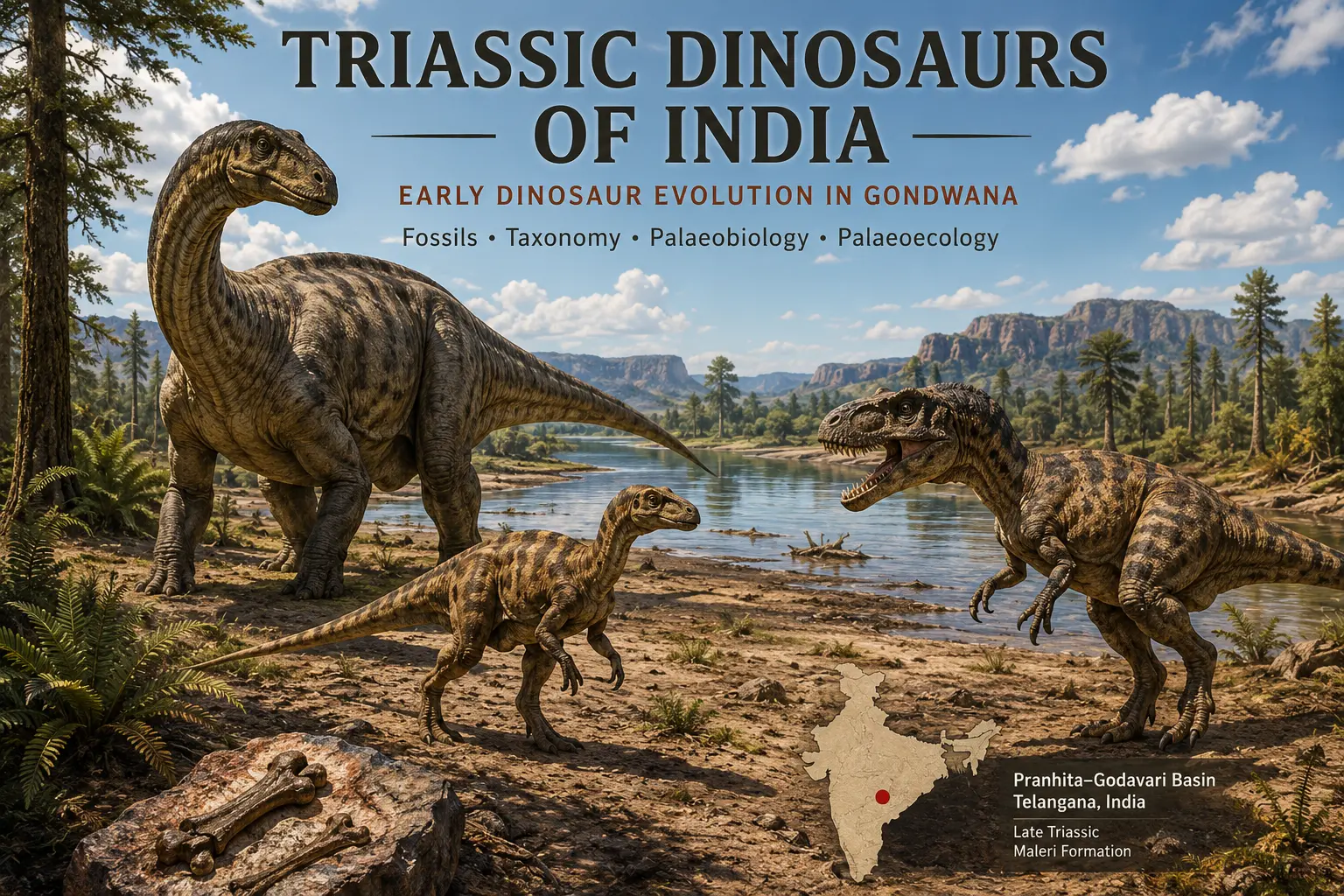
India preserves an important record of the earliest stages of dinosaur evolution. Triassic dinosaur fossils from the Indian subcontinent are particularly significant because they document dinosaur diversification within Gondwana, when India was still part of the southern supercontinent and was geographically connected to other regions that now form separate continents.
The Indian Triassic record is concentrated principally in the Pranhita–Godavari Basin of Telangana, especially within the Maleri Formation. These deposits preserve a diverse vertebrate assemblage that includes early dinosaurs and other archosaurs, providing an important window into terrestrial ecosystems during the Late Triassic.
Among the dinosaurs and dinosauriforms historically reported from Triassic India are Alwalkeria maleriensis, Nambalia roychowdhurii and Jaklapallisaurus asymmetricus. More recently, Maleriraptor kuttyi has added a distinctive herrerasaurian theropod to the Indian record. Together, these taxa demonstrate that dinosaur evolution in India was already producing multiple evolutionary lineages by the Late Triassic.
The Indian Triassic record is also important because several of its taxa have complicated taxonomic histories. Some species are known from incomplete material, and their relationships have changed as new anatomical and phylogenetic evidence has become available. Consequently, the scientifically useful approach is not simply to count historical dinosaur names, but to distinguish well-supported taxa from names whose identity or relationships remain uncertain.
This article examines the Triassic dinosaur record of India in its geological and evolutionary context. It considers the principal dinosaur taxa, their anatomy and evolutionary relationships, the environments in which they lived, and the significance of the Indian fossils for understanding the early diversification of Dinosauria.
India During the Triassic
Gondwana and the Indian Landmass
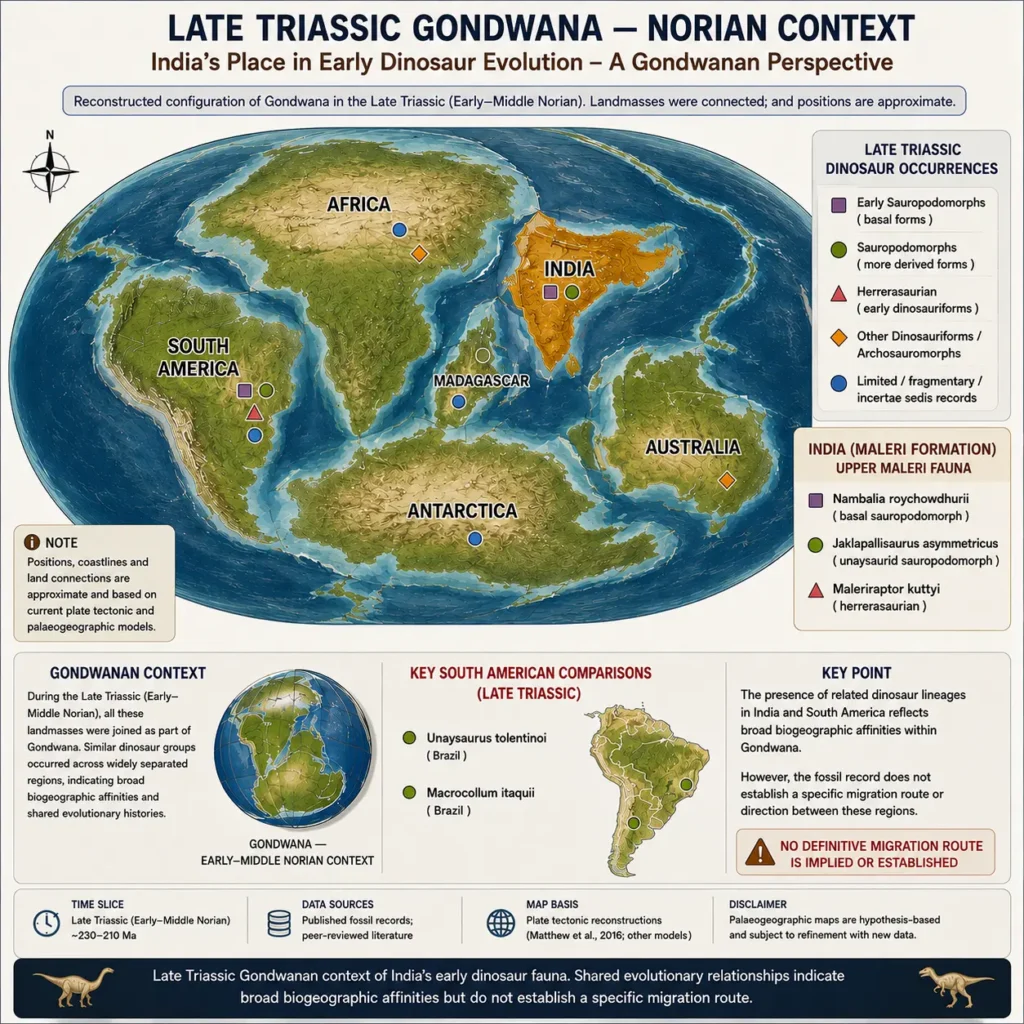
During the Triassic, India was not an isolated landmass in the modern sense. It formed part of Gondwana, the southern portion of the larger Pangaean supercontinent. India was geographically connected to what are now Africa, Madagascar, Antarctica, Australia, and South America, although the exact configuration and internal geography of Gondwana changed through the Triassic and Jurassic.
This geographical setting is essential for interpreting India’s earliest dinosaurs. The animals preserved in the Indian fossil record were members of continental ecosystems that occupied a much larger Gondwanan landscape. Their evolutionary relationships can therefore provide evidence about the distribution and diversification of early dinosaurs across southern Pangaea.
The Late Triassic was a particularly important period in dinosaur evolution. Dinosaurs had originated earlier in the Triassic, but during the Late Triassic they began to diversify into several major evolutionary lineages. Early sauropodomorphs, theropods, and other dinosauriforms became increasingly represented in continental ecosystems.
India’s fossil record provides one regional expression of this broader evolutionary process.
The Maleri Formation of the Pranhita–Godavari Basin is particularly important. Its Late Triassic sediments preserve a diverse vertebrate assemblage and provide the geological context for several of India’s earliest named dinosaurs. The formation therefore represents more than a collection of isolated dinosaur fossils: it records a terrestrial ecosystem within Gondwana during a critical phase of early dinosaur diversification.
The palaeogeographic relationships of these dinosaurs must nevertheless be interpreted cautiously. Similarities between Indian and other Gondwanan dinosaurs may reflect common ancestry within an interconnected continental landscape, while differences may reflect evolutionary divergence, local ecological conditions, sampling, or a combination of these factors.
The Indian Triassic record is consequently valuable not because it represents an isolated evolutionary experiment, but because it provides a Gondwanan perspective on the early global history of dinosaurs.
As additional Triassic discoveries are made and existing specimens are reassessed, the Indian record can help clarify when particular dinosaur lineages appeared, how widely they were distributed, and how their early diversification was related to the changing environments of Late Triassic Gondwana.
Triassic Geological Record of India
| Geological unit | Approximate age | Principal significance | Dinosaur evidence |
|---|---|---|---|
| Maleri Formation | Late Triassic | Major Triassic vertebrate succession | Early dinosaur and dinosauriform material |
| Upper Maleri Formation | Late Triassic | Important dinosaur-bearing interval | Nambalia, Jaklapallisaurus, Maleriraptor |
| Lower Dharmaram Formation | Late Triassic–Early Jurassic transition | Extends the dinosaur record | Sauropodomorph and other dinosaur material |
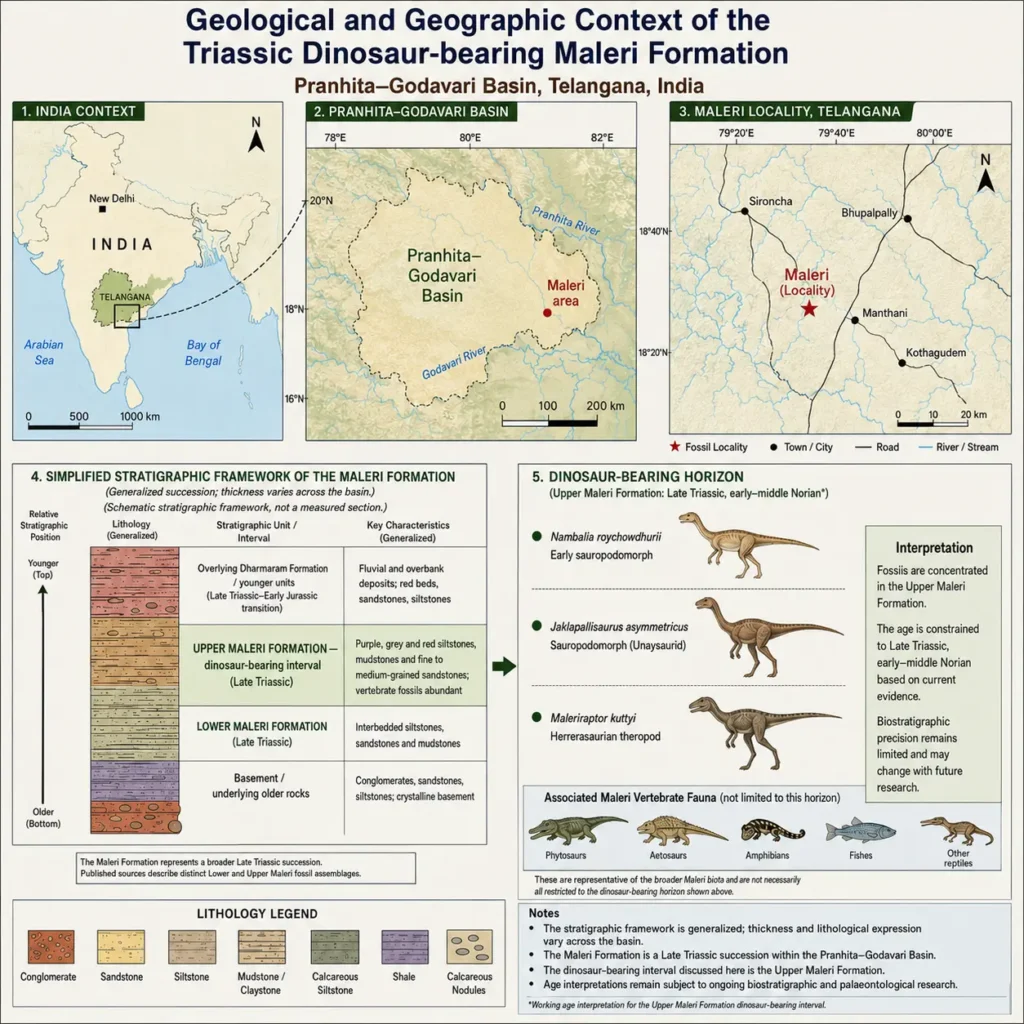
India’s Triassic dinosaur record is concentrated in a relatively small number of continental basins, of which the Pranhita–Godavari Basin is the most important for the earliest known dinosaur assemblages. The basin contains a succession of continental rocks ranging from the Middle Triassic into the Early Jurassic and preserves a diverse vertebrate record.
For the dinosaur record discussed here, the Maleri Formation is particularly important. It is traditionally divided into lower and upper faunal assemblages, with the dinosaur-bearing Upper Maleri Formation yielding an early-middle Norian assemblage. Recent work places the Upper Maleri dinosaur-bearing interval broadly within the early to middle Norian.
The precise age of the dinosaur-bearing Maleri succession remains debated. Different biostratigraphic and chronostratigraphic frameworks have placed the relevant horizons at different positions within the Late Triassic, and recent work continues to refine their age.
The Maleri Formation preserves considerably more than dinosaurs. Its vertebrate assemblage includes amphibians, phytosaurs, aetosaurs and other archosaurs, together with fishes and other components of a Late Triassic terrestrial ecosystem. Plant remains and sedimentological evidence provide additional environmental context.
This broader fossil assemblage is important when interpreting the dinosaurs. The Indian Triassic record should not be viewed simply as a succession of isolated dinosaur species; it represents communities in which dinosaurs lived alongside numerous other vertebrates within a changing Gondwanan landscape.
Lower and Upper Maleri Faunas
The Maleri Formation contains distinct faunal assemblages that are important for understanding the temporal development of India’s Triassic vertebrate communities.
The lower fauna is older and includes the historically problematic material traditionally associated with Alwalkeria maleriensis. Recent taxonomic work has demonstrated that the material historically grouped under that name is more complicated than previously recognized. The femoral material has been reassessed as belonging to a distinct lagerpetid taxon, while an associated astragalus shows saurischian affinities; another set of appendicular remains represents a probable theropod.
The upper fauna contains a better-defined assemblage of early dinosaurs, including Nambalia roychowdhurii, Jaklapallisaurus asymmetricus and the herrerasaurian now named Maleriraptor kuttyi. Other dinosauriform and sauropodomorph material remains unnamed or indeterminate.
This distinction is important because the Indian Triassic record has sometimes been presented as though all of these animals belonged to one contemporaneous assemblage. They do not. The fossils represent different horizons and, in some cases, different stages of Late Triassic dinosaur evolution.
The Lower Dharmaram Formation
The overlying Lower Dharmaram Formation extends the Indian dinosaur record beyond the Maleri Formation. It contains additional sauropodomorph material and other dinosaur remains, although much of this material has not yet been described at the same taxonomic level as the named Maleri dinosaurs.
The Upper Maleri and Lower Dharmaram assemblages are consequently important for documenting the transition from early Late Triassic dinosaur communities toward the more diverse sauropodomorph-dominated faunas that become increasingly evident in the succeeding Jurassic record.
A Record Still Being Refined
The Triassic dinosaur record of India remains comparatively small but scientifically important. Several taxa were originally described from limited material, and subsequent anatomical and phylogenetic studies have substantially changed their interpretation.
A 2025 biogeographical analysis emphasized the strong affinities between Indian Late Triassic dinosaurs and contemporaneous South American dinosaurs, while also proposing new hypotheses concerning Late Triassic dispersal routes. Such interpretations remain dependent on the continuing discovery and reassessment of fragmentary fossils.
The geological record should therefore be understood as a developing evidence base rather than a fixed catalogue. New specimens, improved dating and reanalysis of historical collections may alter both the number of recognized taxa and their inferred evolutionary relationships.
Triassic Dinosaur Fossils of India
| Taxon | Major group | Geological unit | Significance | Evidence confidence |
|---|---|---|---|---|
| Alwalkeria maleriensis | Problematic early dinosaurian taxon | Maleri Formation | Historically important; original material subsequently reassessed | Moderate / taxonomically problematic |
| Nambalia roychowdhurii | Sauropodomorpha | Upper Maleri Formation | Early sauropodomorph | Strong |
| Jaklapallisaurus asymmetricus | Sauropodomorpha | Upper Maleri Formation | Early plateosaurian/unaysaurid | Strong |
| Maleriraptor kuttyi | Herrerasauria | Upper Maleri Formation | Early-diverging saurischian | Strong |
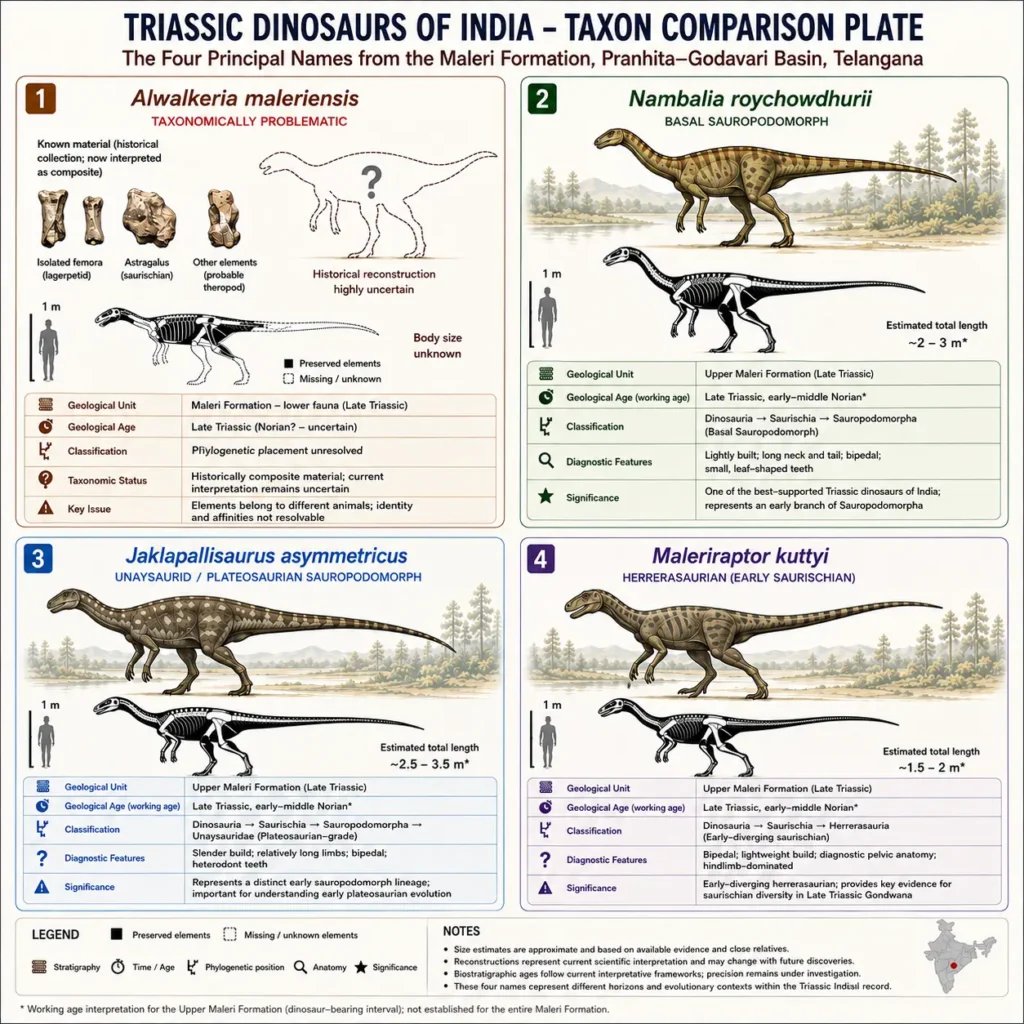
The named dinosaur fauna considered here includes four particularly important taxa:
- Alwalkeria maleriensis
- Nambalia roychowdhurii
- Jaklapallisaurus asymmetricus
- Maleriraptor kuttyi
They do not represent a single evolutionary lineage. Instead, they encompass different branches of early dinosaur evolution, including early sauropodomorphs and herrerasaurians.
Their scientific importance lies partly in their age. The Upper Maleri assemblage belongs to a relatively poorly sampled interval of early Norian dinosaur evolution, between the earliest dinosaur faunas of the Carnian and the more diverse middle-to-late Norian and Rhaetian assemblages known from several parts of the world.
Alwalkeria maleriensis
| Name / material | Current interpretation |
|---|---|
| Walkeria maleriensis Chatterjee, 1987 | Original generic combination; Walkeria preoccupied |
| Alwalkeria maleriensis Chatterjee & Creisler, 1994 | Correct nomenclatural combination |
| Alickmeron maleriensis Sen & Ray, 2025 | Objective junior synonym of Alwalkeria |
| Historical Alwalkeria hypodigm | Composite material; elements require separate interpretation |
Alwalkeria maleriensis has one of the most complicated taxonomic histories among India’s Triassic dinosaurs.
The species was originally described by Sankar Chatterjee in 1987 under the name Walkeria maleriensis. Because Walkeria was already occupied by another animal, Chatterjee and Creisler subsequently established the replacement genus Alwalkeria.
For many years, Alwalkeria was interpreted as a small early dinosaur, although its precise position within Dinosauria remained uncertain. The fragmentary nature of the original material made comparisons with other Late Triassic dinosaurs difficult.
More recent research has demonstrated that the historical Alwalkeria assemblage cannot safely be treated as the remains of a single animal. A 2025 reassessment concluded that the femora previously attributed to Alwalkeria represent a new lagerpetid taxon, while the associated astragalus is consistent with a saurischian dinosaur. Another set of appendicular remains from the same lower Maleri fauna represents a probable theropod.
This creates an important distinction between the historical name Alwalkeria maleriensis and the biological identity of the individual fossils originally assembled under that name.
A further nomenclatural development occurred in 2025–2026. The replacement name Alickmeron maleriensis, proposed during the taxonomic reassessment, was subsequently demonstrated to be an objective junior synonym of Alwalkeria. The correct generic combination therefore remains Alwalkeria maleriensis.
For a modern article, Alwalkeria should consequently be presented as a historically important but taxonomically problematic Triassic dinosaur name, rather than as an unquestionably well-established small theropod.
Its importance is nevertheless considerable. The material comes from the lower Maleri fauna and demonstrates how re-examination of historical collections can substantially change interpretations of early dinosaur diversity.
Nambalia roychowdhurii
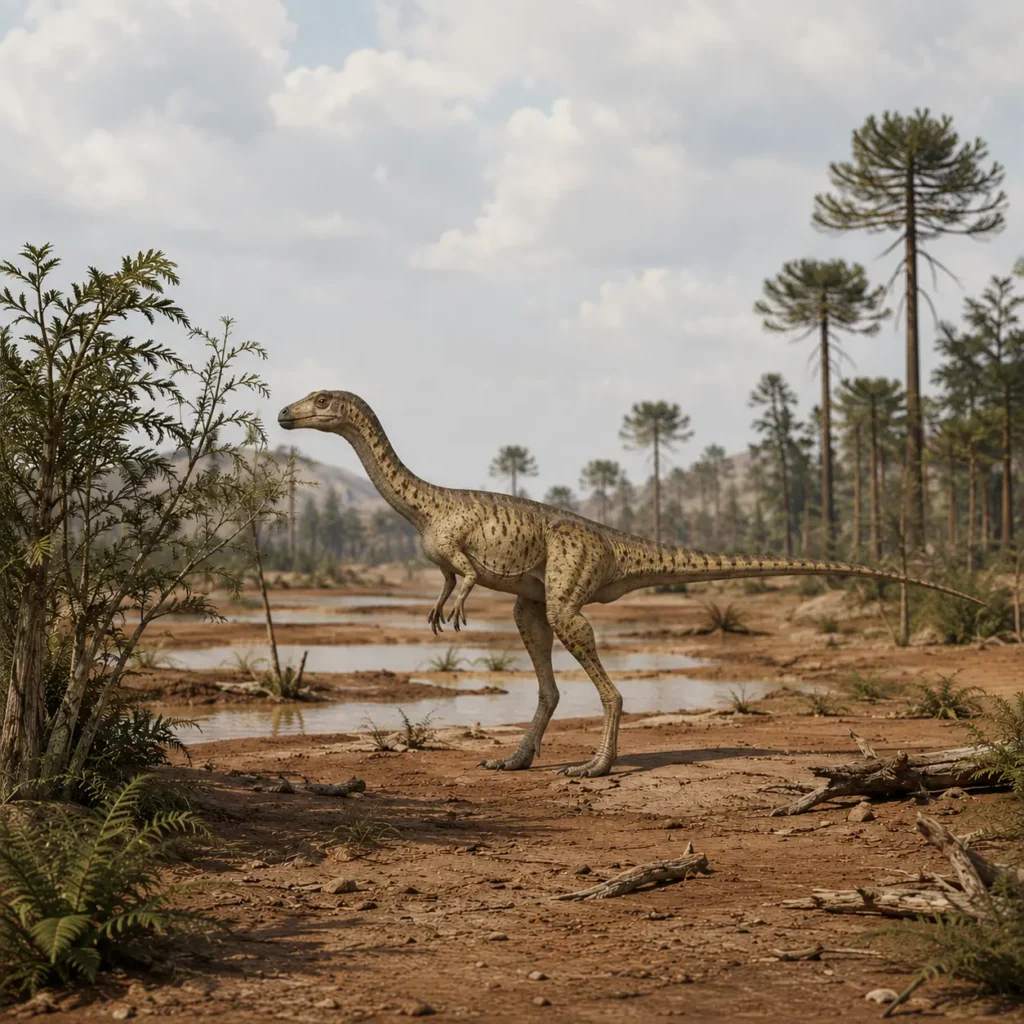
Nambalia roychowdhurii is an early sauropodomorph from the Upper Maleri Formation.
The species was named from material collected near Nambal village in the Pranhita–Godavari Basin. Its holotype and associated material include elements of the pelvis and hind limb, together with vertebrae and bones of the hands and feet. The fossil association provides considerably more anatomical information than is available for many fragmentary Triassic Indian taxa.
Nambalia is interpreted as a basal sauropodomorph, representing an early member of the evolutionary radiation that eventually produced the much larger sauropod dinosaurs of the Jurassic.
Its anatomy is important because early sauropodomorphs were still relatively diverse during the Late Triassic, before the emergence of the enormous, fully specialized sauropods that would dominate many Jurassic herbivore communities.
The species is also significant palaeogeographically. Its presence in the early Norian of India contributes to evidence that sauropodomorph dinosaurs were already distributed across widely separated regions of Gondwana and southern Pangaea.
Nambalia should therefore not be viewed simply as a small precursor to Jurassic sauropods. It represents an early branch within sauropodomorph evolution, preserving anatomical characteristics that help reconstruct how the group diversified before the evolution of the classic long-necked sauropod body plan.
Jaklapallisaurus asymmetricus
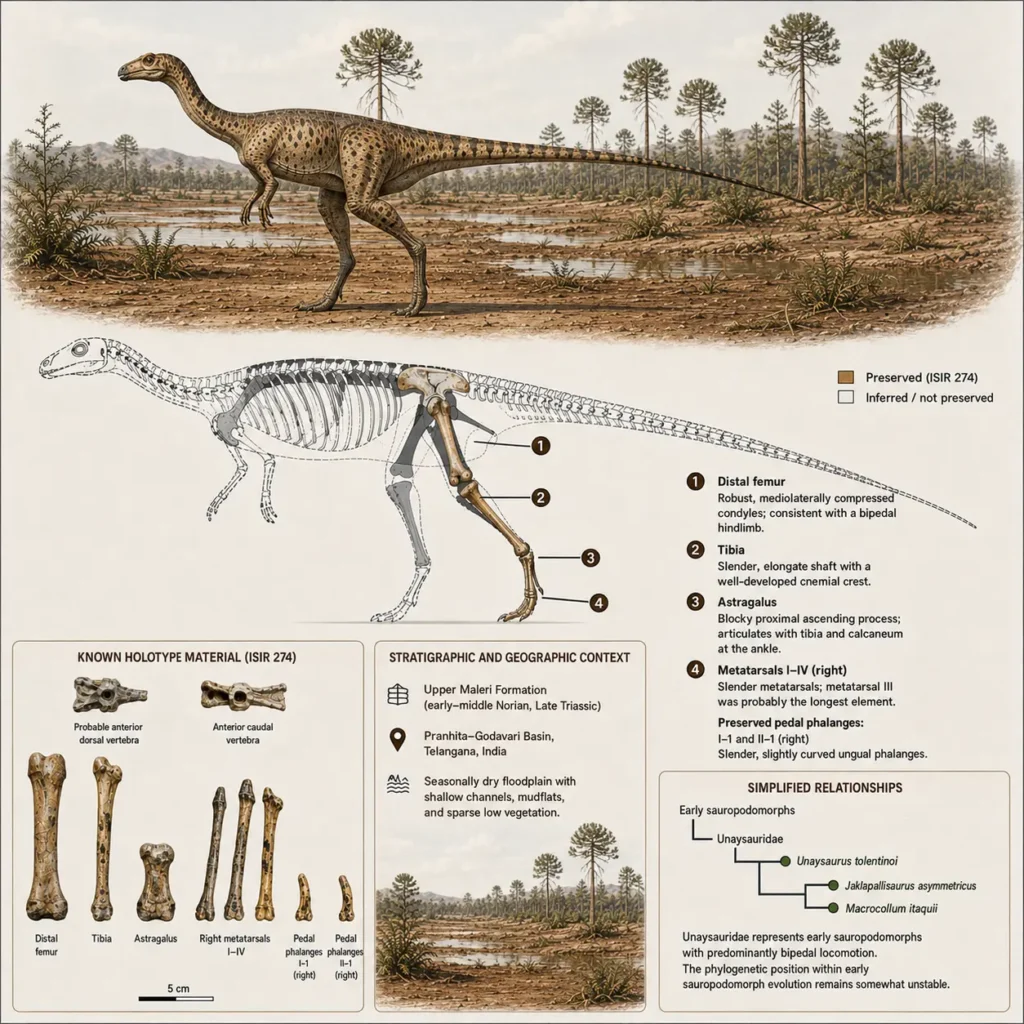
Jaklapallisaurus asymmetricus is another early sauropodomorph from the Upper Maleri Formation.
The species was originally described from postcranial material, but its anatomy has subsequently been examined in much greater detail. A comprehensive 2024 study reassessed the skeleton and phylogenetic relationships of the species.
The holotype, ISIR 274, includes vertebral and hind-limb material, including portions of the femur, tibia, astragalus, and metatarsals. The specimen shows evidence of skeletal maturity, although its precise ontogenetic stage cannot be determined.
The 2024 analysis recovered Jaklapallisaurus within Unaysauridae, at the base of Plateosauria, together with Macrocollum itaquii and Unaysaurus tolentinoi from the early Norian of Brazil.
This result is particularly significant because it demonstrates a close evolutionary relationship between an Indian sauropodomorph and contemporaneous South American forms.
The species also illustrates how modern anatomical reassessment can change the interpretation of an older fossil. The original description was comparatively brief, whereas the more detailed 2024 study identified a much larger set of anatomical characters and incorporated them into an updated phylogenetic analysis.
The geological age is also significant. The type horizon is the Upper Maleri Formation, correlated with the early–middle Norian, approximately 225–215 million years ago.
Jaklapallisaurus therefore provides evidence for a relatively early stage in the diversification of plateosaurian sauropodomorphs and strengthens the biogeographic connection between Late Triassic dinosaur faunas of India and South America.
Maleriraptor kuttyi
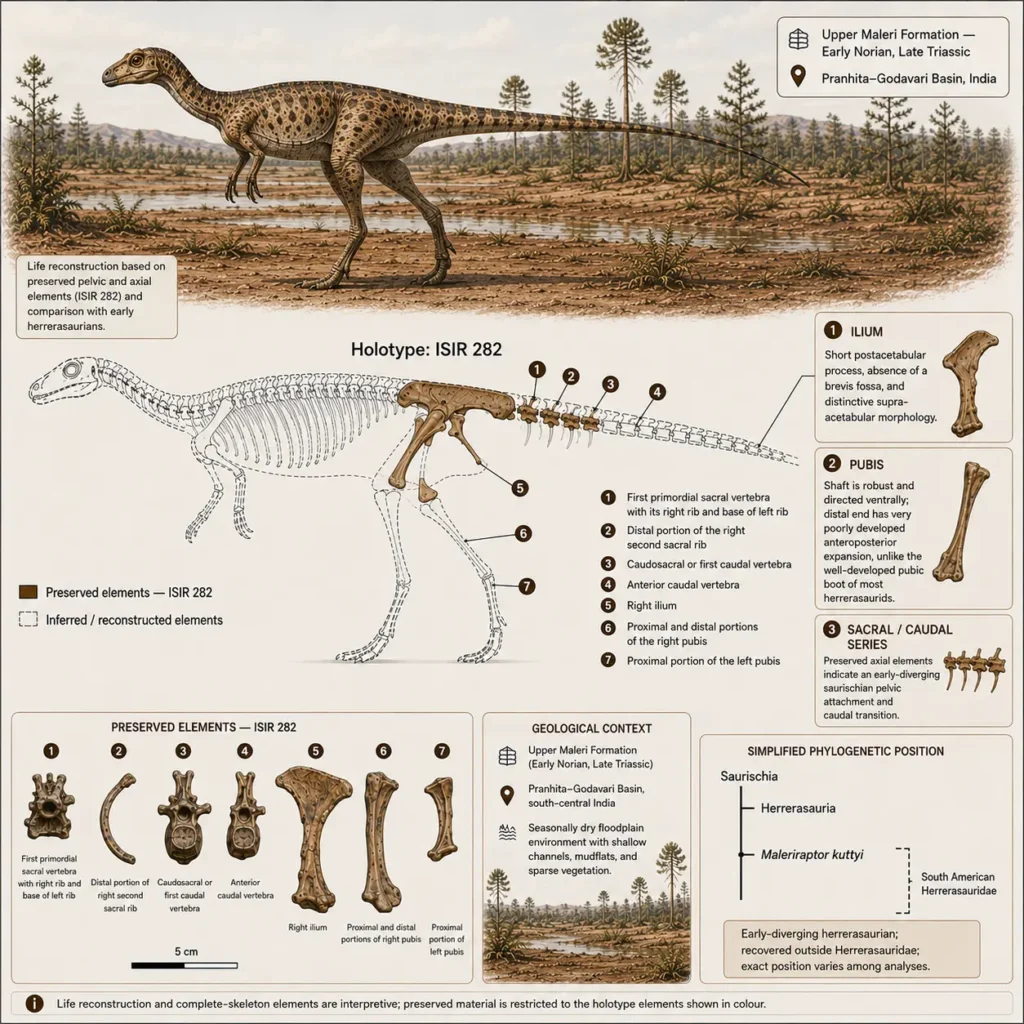
Maleriraptor kuttyi is the most recently named dinosaur in this group and substantially expands the known taxonomic diversity of the Upper Maleri assemblage.
The species was described from specimen ISIR 282, a partial skeleton recovered from the Upper Maleri Formation of the Pranhita–Godavari Basin. The material includes vertebral and pelvic elements and portions of the hind limbs.
Phylogenetic analysis identifies Maleriraptor as a member of Herrerasauria, an early-diverging saurischian lineage. The discovery is significant because herrerasaurian dinosaurs are important for understanding the early evolutionary history of saurischians and the divergence of the principal dinosaur lineages.
The Upper Maleri Formation is particularly valuable in this respect. Its dinosaur assemblage belongs to an interval shortly after the initial Late Triassic diversification of dinosaurs, but before the much richer dinosaur communities of the later Norian and Rhaetian. The occurrence of a herrerasaurian together with early sauropodomorphs provides evidence for multiple dinosaur lineages living in the same broad region of Gondwana.
The discovery also demonstrates the importance of revisiting historical museum collections. ISIR 282 had been known for decades but was initially interpreted more cautiously as an indeterminate dinosauriform or dinosaurian specimen. Its later reassessment revealed distinctive herrerasaurian affinities and led to the establishment of Maleriraptor kuttyi.
This makes Maleriraptor particularly valuable for the history of Indian palaeontology: a specimen can remain scientifically important for decades even when its evolutionary significance is not immediately apparent.
The Triassic Indian Dinosaur Assemblage
Taken together, these taxa demonstrate that Late Triassic India supported more than one dinosaur lineage.
Nambalia and Jaklapallisaurus represent early sauropodomorph evolution, while Maleriraptor represents the herrerasaurian branch of early saurischian evolution. Alwalkeria, meanwhile, illustrates the difficulties involved in interpreting fragmentary material from the older lower Maleri fauna.
The assemblage is consequently important not because it contains a large number of species, but because each taxon contributes information about a different part of early dinosaur evolution.
The combination of Indian and South American sauropodomorphs is particularly significant. The close relationships of Jaklapallisaurus with South American unaysaurids provide evidence that these early dinosaur lineages had already achieved broad Gondwanan distributions by the early Norian.
At the same time, the taxonomic history of Alwalkeria demonstrates why estimates of Triassic dinosaur diversity must remain conservative. The discovery of Maleriraptor and the reassessment of older specimens show that the composition of the Indian fauna can change substantially as historical material is re-examined.
India’s Triassic dinosaurs therefore provide a valuable combination of evolutionary diversity, Gondwanan biogeography and continuing taxonomic discovery.
Triassic Dinosaur Palaeobiology
The Triassic dinosaurs of India were generally smaller and more lightly built than the giant sauropods that would dominate many Jurassic ecosystems. Their anatomy reflects an early stage in dinosaur evolution, when several distinct body plans and locomotor adaptations were already emerging, but the extreme gigantism and ecological dominance associated with later sauropods had not yet developed.
The available Indian fossils are mostly incomplete, so palaeobiological reconstruction must remain conservative. Skeletal anatomy can provide evidence for locomotion, body proportions and broad dietary categories, while behaviours such as hunting strategy, social organization and parental care generally cannot be established directly.
Body Size and Anatomy
The named Indian Triassic dinosaurs represent relatively small-bodied forms compared with later Jurassic sauropods.
Nambalia and Jaklapallisaurus were early sauropodomorphs. Their anatomy indicates predominantly bipedal animals capable of moving efficiently on the hind limbs. They retained relatively primitive proportions compared with later sauropods and lacked the massive, fully quadrupedal body architecture that characterized many Jurassic members of the group.
Maleriraptor, by contrast, was a herrerasaurian. Its anatomy and phylogenetic position place it among early-diverging saurischian dinosaurs rather than within Sauropodomorpha.
The distinction is important because the Late Triassic Indian assemblage was not a single ecological or evolutionary group. It contained dinosaurs occupying different evolutionary positions and presumably different ecological roles.
Locomotion
The early sauropodomorphs represented by Nambalia and Jaklapallisaurus were primarily bipedal animals.
This represents an important stage in sauropodomorph evolution. Later members of the lineage evolved increasingly robust, columnar limbs and ultimately became obligate quadrupeds, but the earliest sauropodomorphs retained a more lightly built, predominantly bipedal construction.
Maleriraptor, as a herrerasaurian, was also a bipedal dinosaur. Its hind limbs were the principal weight-bearing structures, consistent with the general locomotor configuration of early predatory saurischians.
The fossils do not, however, provide sufficient evidence for precise running speeds or specific hunting techniques.
Feeding and Diet
The early sauropodomorphs were herbivorous or predominantly plant-eating dinosaurs. Their dentition and broader sauropodomorph relationships support a plant-based feeding ecology, although the Indian fossils do not normally allow individual plant species consumed by these animals to be identified.
Their relatively small heads and leaf-shaped teeth were suited to processing vegetation, although the precise feeding mechanics of individual taxa remain incompletely understood.
The dietary ecology of Maleriraptor was different. As a herrerasaurian theropod-line saurischian, it was a predatory dinosaur. Its anatomy places it within an early radiation of carnivorous dinosaurs.
It would nevertheless be inappropriate to reconstruct a specific prey list for Maleriraptor. No direct feeding association currently demonstrates that it hunted a particular Indian Triassic vertebrate.
Growth and Development
The Indian Triassic dinosaur record provides limited direct evidence for growth and ontogeny.
Some skeletal material can be assessed for relative maturity from the degree of bone fusion and other anatomical features, but the available sample is insufficient to establish complete growth trajectories for the named taxa.
This limitation is particularly important for early dinosaurs because body size and proportions can change substantially during growth. A fragmentary specimen should therefore not automatically be treated as representing the adult morphology of its species.
Evolutionary Biology
The Indian Triassic dinosaurs are especially important for understanding the early evolutionary diversification of Dinosauria.
Nambalia and Jaklapallisaurus document early sauropodomorph evolution, while Maleriraptor represents a much more basal saurischian lineage. Their coexistence demonstrates that dinosaur diversification was already producing distinct evolutionary branches by the early–middle Norian.
The phylogenetic position of Jaklapallisaurus is particularly informative because its relationship with South American unaysaurids provides evidence for a geographically widespread Gondwanan radiation of early sauropodomorphs.
The significance of these animals therefore extends beyond India. They help reconstruct the evolutionary history of dinosaurs across southern Pangaea.
Behaviour
Direct behavioural evidence from Indian Triassic dinosaurs is extremely limited.
There are currently no Indian Triassic dinosaur nesting sites, trackways or exceptional behavioural associations comparable to some later dinosaur records that would allow confident reconstruction of specific social or reproductive behaviours.
Consequently, claims concerning herd formation, coordinated hunting, parental care or migration should be regarded as speculative unless supported by independent evidence.
The strongest palaeobiological conclusions come from skeletal anatomy, phylogenetic position and associated geological evidence, rather than behavioural reconstruction.
Triassic Palaeoecology
| Taxon/group | Broad ecological role | Evidence basis |
|---|---|---|
| Nambalia | Herbivorous | Sauropodomorph anatomy |
| Jaklapallisaurus | Herbivorous | Sauropodomorph anatomy |
| Maleriraptor | Predatory | Herrerasaurian/theropod-line anatomy |
| Other Maleri vertebrates | Diverse herbivorous, predatory and aquatic roles | Associated fauna |
The Triassic dinosaur fossils of India formed part of a much broader terrestrial ecosystem. The Maleri Formation preserves a diverse vertebrate assemblage that included dinosaurs alongside other archosaurs, amphibians and aquatic organisms.
The ecological importance of the formation therefore lies not simply in the presence of dinosaurs, but in the evidence for a functioning Late Triassic terrestrial community within Gondwana.
The Maleri Ecosystem
The Maleri Formation records continental environments in which dinosaurs lived alongside numerous other vertebrates.
The fauna included early dinosaurs and dinosauriforms together with phytosaurs, aetosaurs and other archosaurian reptiles, as well as amphibians and fishes. The precise composition varied between stratigraphic levels.
This diversity indicates that dinosaurs were already participating in ecosystems containing multiple competing and interacting vertebrate lineages.
Dinosaurs should therefore not be portrayed as having suddenly replaced all other terrestrial reptiles during the Triassic. Their ecological expansion was gradual and occurred within ecosystems that already contained diverse archosaur communities.
Herbivores and Plant Resources
Early sauropodomorphs such as Nambalia and Jaklapallisaurus were among the herbivorous dinosaurs of Late Triassic India.
Their presence indicates that dinosaurs were exploiting terrestrial plant resources alongside other herbivorous vertebrates.
The available fossil evidence does not permit a detailed reconstruction of resource partitioning between individual herbivore species. Nevertheless, differences in body size, jaw morphology and locomotor anatomy could have reduced direct competition by allowing animals to exploit different food resources or habitats.
Such ecological differentiation remains an inference rather than something directly demonstrated for every Indian Triassic taxon.
Predators
The occurrence of Maleriraptor demonstrates that predatory dinosaurs were part of the Late Triassic Indian ecosystem.
However, Maleriraptor was not necessarily the dominant predator. The Maleri vertebrate assemblage contained several other predatory or potentially predatory archosaurs, and the relative importance of different predators probably varied according to body size, habitat, and prey availability.
This is an important distinction because the presence of a theropod does not automatically establish a simple predator-dominated food web.
Aquatic and Semi-Aquatic Components
The Maleri ecosystem also included aquatic and semi-aquatic vertebrates.
Fishes and amphibians indicate the presence of water-dependent habitats, while phytosaurs occupied predatory ecological roles associated with aquatic or water-margin environments.
These animals provide indirect evidence that the terrestrial environments inhabited by the dinosaurs were connected to water bodies or periodically inundated settings.
The exact nature and permanence of individual water bodies would have varied through the depositional history of the formation.
Environmental Conditions
Sedimentological and palaeontological evidence indicates that the Maleri Formation represents a continental environment influenced by seasonal changes in water availability.
The ecosystem was therefore not a uniform landscape. Rivers, floodplains, ponds, or other water-associated settings could have created environmental heterogeneity, allowing different vertebrates to exploit different parts of the landscape.
This environmental mosaic is important when interpreting dinosaur diversity. The coexistence of several dinosaur lineages does not necessarily mean that they occupied identical habitats.
Dinosaur Community Structure
The Indian Late Triassic dinosaur assemblage demonstrates an early division of ecological roles.
Broadly:
- Early sauropodomorphs occupied herbivorous niches.
- Herrerasaurians and other predatory dinosaurs occupied carnivorous niches.
- Other archosaurs represented additional herbivorous, omnivorous, and predatory roles.
- Aquatic vertebrates occupied water-associated environments.
This structure demonstrates that dinosaurs were already becoming ecologically differentiated before the Jurassic radiation of large sauropods and more diverse theropod communities.
India and the Wider Gondwanan Ecosystem
The ecological significance of the Maleri fauna becomes clearer when viewed alongside contemporaneous deposits elsewhere in Gondwana.
The close evolutionary relationship between Jaklapallisaurus and South American unaysaurids demonstrates that early sauropodomorph communities were distributed across widely separated regions of southern Pangaea.
These similarities should not be interpreted as evidence that the Indian and South American ecosystems were identical. Local climate, vegetation, hydrology, and other environmental factors would have influenced the composition of individual communities.
Instead, the similarities indicate that dinosaur lineages could disperse across the Gondwanan continental landscape, while local ecosystems subsequently developed their own distinctive combinations of species.
Ecological Significance of the Triassic Record
The Indian Triassic record captures an important stage in dinosaur ecological evolution.
Dinosaurs had not yet reached the enormous body sizes characteristic of later sauropods, nor had they become the overwhelmingly dominant terrestrial vertebrates of many later Mesozoic ecosystems. Nevertheless, multiple dinosaur lineages were already present and occupying distinct ecological roles.
The Maleri Formation therefore records a transitional phase in dinosaur history: dinosaurs were established members of Gondwanan terrestrial ecosystems, but their subsequent Jurassic expansion and diversification had only begun.
The Indian fossils are consequently important not only for identifying early dinosaur species, but also for understanding how dinosaurs became integrated into terrestrial ecosystems during the Late Triassic.
India’s Place in Early Dinosaur Evolution
| Taxon | Evolutionary position | Broader significance |
|---|---|---|
| Alwalkeria | Uncertain/problematic | Demonstrates difficulties with fragmentary Triassic material |
| Nambalia | Early Sauropodomorpha | Early diversification of sauropodomorphs |
| Jaklapallisaurus | Unaysauridae / early plateosaurian sauropodomorph | Gondwanan sauropodomorph relationships |
| Maleriraptor | Herrerasauria | Early saurischian diversification |
India’s Triassic dinosaur record is important not because it contains the largest number of early dinosaur species, but because its fossils document multiple evolutionary lineages within a Gondwanan setting during a critical stage of dinosaur diversification.
The Late Triassic was a period in which dinosaurs were expanding from their relatively early origins into a broader range of ecological and anatomical forms. The Indian record captures part of this process through early sauropodomorphs such as Nambalia and Jaklapallisaurus and the herrerasaurian Maleriraptor.
A Gondwanan Perspective
During the Late Triassic, India formed part of Gondwana and was connected to the other southern continental landmasses. Indian dinosaurs therefore belonged to a wider Gondwanan biogeographic system rather than evolving in geographical isolation.
The close relationship between Jaklapallisaurus and South American unaysaurids is particularly significant. Phylogenetic analyses have recovered Jaklapallisaurus together with Macrocollum and Unaysaurus within Unaysauridae, providing evidence for a geographically broad radiation of early sauropodomorphs during the early Norian.
This relationship demonstrates that similar dinosaur lineages were distributed across parts of Gondwana at a relatively early stage of sauropodomorph evolution.
It does not, however, establish a particular migration route between India and South America. Fossil distributions can result from several processes, including dispersal before continental fragmentation, shared ancestry within an interconnected Gondwanan landscape, and subsequent regional diversification.
Early Sauropodomorph Diversification
The Indian taxa are especially relevant to the early history of Sauropodomorpha.
Nambalia represents an early sauropodomorph, while Jaklapallisaurus provides evidence for the diversification of plateosaurian sauropodomorphs by the early Norian. Their anatomy predates the highly specialized sauropod body plan that became prominent during the Jurassic.
This is important because sauropod evolution was not an abrupt transition from small bipedal dinosaurs to enormous quadrupedal animals. Instead, the lineage underwent a prolonged evolutionary process involving changes in body size, limb proportions, vertebral architecture, feeding anatomy, and locomotion.
The Indian Triassic fossils represent some of the early stages of that broader evolutionary trajectory.
Early Saurischian Diversity
Maleriraptor kuttyi provides a different perspective on early dinosaur evolution.
Its placement within Herrerasauria demonstrates that the Late Triassic Indian dinosaur fauna included an early-diverging saurischian lineage in addition to sauropodomorphs. This is significant because herrerasaurians occupy an important position near the early diversification of saurischian dinosaurs.
The coexistence of Maleriraptor with early sauropodomorphs therefore demonstrates that dinosaur diversification had already produced distinct evolutionary branches in India by the early–middle Norian.
India Was Part of a Larger Evolutionary Pattern
The Indian fossils should not be interpreted as evidence that dinosaur evolution occurred independently within India.
Instead, they form part of a much broader pattern of Late Triassic diversification documented across Pangaea.
Comparisons with contemporaneous faunas from South America and elsewhere show that early dinosaurs and dinosauriforms had already achieved substantial geographical distributions. India’s position within Gondwana makes its fossil record particularly useful for testing hypotheses about how these lineages were distributed across southern Pangaea.
The Indian record therefore contributes to questions such as:
- How early did particular dinosaur lineages become geographically widespread?
- When did sauropodomorphs diversify into distinct evolutionary groups?
- How were Gondwanan dinosaur communities related to one another?
- Did continental geography influence early dinosaur diversification?
- How much of the apparent distribution reflects genuine biogeography versus uneven fossil sampling?
These questions remain important because the Triassic fossil record is incomplete, and the discovery of new specimens can substantially alter phylogenetic and biogeographic interpretations.
The Significance of the Maleri Assemblage
The Upper Maleri Formation is particularly valuable because it preserves multiple dinosaur lineages within a relatively restricted geological interval.
The presence of Nambalia, Jaklapallisaurus and Maleriraptor demonstrates that early dinosaurs were already ecologically and phylogenetically differentiated in this part of Gondwana.
At the same time, the reassessment of historical material associated with Alwalkeria demonstrates that apparent dinosaur diversity can be misleading when fragmentary fossils are grouped without sufficient anatomical evidence.
The Maleri assemblage therefore provides two complementary lessons:
First, early dinosaurs were already diverse and geographically widespread.
Second, the true magnitude of that diversity can only be established through careful anatomical and taxonomic analysis.
India’s Broader Evolutionary Importance
India’s Triassic dinosaur record also provides a geological bridge to its Jurassic history.
The early sauropodomorphs of the Maleri Formation precede the large sauropods of the Early Jurassic, including Barapasaurus and Kotasaurus. The Indian record therefore preserves an unusually useful sequence for investigating the transition from early sauropodomorphs to later sauropod-dominated ecosystems.
This does not mean that Nambalia or Jaklapallisaurus directly evolved into Barapasaurus. They represent different branches within a much larger evolutionary radiation.
Nevertheless, the succession demonstrates that India preserves evidence from several stages of the early evolutionary history of Sauropodomorpha.
An Incomplete but Valuable Record
The Triassic dinosaur record of India remains relatively limited compared with some better-sampled regions of South America and Europe. This means that conclusions about diversity, ecology and biogeography remain sensitive to future discoveries.
That limitation should not diminish its importance.
The Indian fossils provide evidence that, by the Late Triassic, dinosaurs were already:
- represented by multiple evolutionary lineages;
- distributed across Gondwanan continental environments;
- occupying herbivorous and predatory ecological roles;
- and undergoing diversification that would become much more extensive during the Jurassic.
India consequently occupies an important position in reconstructing the early evolutionary and biogeographic history of Dinosauria.
Taxonomic Uncertainty and Historical Names
The Triassic dinosaur record of India also illustrates one of the central challenges of vertebrate palaeontology: a fossil name does not necessarily represent a securely established biological entity.
Early dinosaur discoveries were frequently based on isolated or incomplete bones. In some cases, specimens collected from the same general locality were assumed to belong to the same animal even when their anatomical association was uncertain. Subsequent research can therefore alter not only the classification of a species but also the identity of the fossils originally assigned to it.
This is particularly important in the Indian Triassic record.
Alwalkeria maleriensis
The history of Alwalkeria maleriensis is the clearest example.
The taxon was originally established from material from the Maleri Formation and subsequently became widely recognized as a small early dinosaur. However, reassessment of the original material has shown that the historical assemblage cannot safely be treated as representing a single animal.
A 2025 study concluded that the femora traditionally referred to Alwalkeria represent a lagerpetid, while an associated astragalus is saurischian and additional appendicular material represents a probable theropod. This means that the historical Alwalkeria hypodigm was composite rather than anatomically coherent.
This distinction is critical. It does not mean that the name Alwalkeria maleriensis should simply be deleted from the history of Indian palaeontology. Instead, it means that its fossil basis and biological interpretation must be treated with caution.
Alwalkeria and Alickmeron
The nomenclature of the taxon has also undergone a recent change.
A 2025 study introduced the replacement name Alickmeron maleriensis during its reassessment of the historical material. Subsequent nomenclatural analysis demonstrated that Alickmeron is an objective junior synonym of Alwalkeria.
The correct current combination is therefore:
Alwalkeria maleriensis
This distinction is important when searching the literature because recent publications may contain both names even though they refer to the same nomenclatural entity.
Fragmentary Fossils and Taxonomic Confidence
The problem illustrated by Alwalkeria extends more broadly across the Triassic fossil record.
A fragmentary bone can sometimes preserve enough anatomical information to establish a taxon confidently. In other cases, the available morphology may only permit assignment to a broader group such as:
- Dinosauria indet.
- Saurischia indet.
- Sauropodomorpha indet.
- Theropoda indet.
Such designations are not failures of palaeontology. They are scientifically appropriate expressions of the limits imposed by the fossil evidence.
A conservative identification is preferable to creating a species name that cannot subsequently be tested reliably.
Historical Names versus Valid Taxa
Historical literature may therefore contain more dinosaur names than are currently supported by the evidence.
This article distinguishes between:
historically proposed names, which remain important for understanding the development of Indian palaeontology,
and
currently defensible taxa, for which the available anatomical evidence provides a sufficiently strong basis for recognition.
This distinction is particularly important when comparing older publications with modern reviews. Apparent differences in dinosaur diversity may sometimes result from taxonomic revision rather than from disagreement about the underlying fossil discoveries.
Why Taxonomic Revision Matters
Taxonomic revision is not simply an exercise in changing names.
When researchers re-examine a historical specimen, they may discover that:
- two apparently different taxa represent the same biological species;
- material attributed to one species actually belongs to several animals;
- a fossil has been assigned to the wrong evolutionary group;
- previously overlooked anatomical characters change its phylogenetic position;
- or the available material is insufficient for species-level identification.
The recent reassessment of Alwalkeria demonstrates several of these problems simultaneously.
It also shows why museum collections remain scientifically valuable decades after their original discovery. New analytical methods and improved comparative datasets can reveal information that was not recognized when the fossils were first described.
A Conservative Interpretation of India’s Triassic Diversity
The Indian Triassic dinosaur record should therefore not be evaluated simply by counting published species names.
A scientifically meaningful inventory should consider:
- the quality of the preserved material;
- whether the specimens are anatomically associated;
- whether diagnostic characters distinguish the taxon from related forms;
- whether subsequent research has challenged the original interpretation;
- and whether the taxon remains supported by current phylogenetic and anatomical evidence.
Using these criteria produces a more conservative but more reliable picture of India’s Triassic dinosaurs.
The importance of the Indian record ultimately does not depend on maximizing the number of species names. Its value lies in the quality of the evolutionary information that securely identified fossils can provide.
For the Late Triassic, Nambalia, Jaklapallisaurus and Maleriraptor provide particularly useful evidence for early dinosaur diversification, while the complex history of Alwalkeria demonstrates why taxonomic caution is essential.
This combination of discoveries, historical reassessment and increasingly rigorous phylogenetic analysis continues to refine our understanding of India’s earliest dinosaurs.
Frequently Asked Questions
When did dinosaurs first appear in India?
The Indian dinosaur record extends back to the Late Triassic. The best-known early dinosaur assemblages occur in the Maleri Formation of the Pranhita–Godavari Basin, where fossils of early sauropodomorphs and other early-diverging dinosaur lineages have been recovered.
The exact age and taxonomic interpretation of individual specimens remain important considerations because the Triassic record is fragmentary and some historical assignments have subsequently been revised.
Where are Triassic dinosaur fossils found in India?
The most important Triassic dinosaur-bearing area is the Pranhita–Godavari Basin, particularly the Maleri Formation in present-day Telangana.
The Maleri Formation preserves a diverse Late Triassic vertebrate assemblage that includes dinosaurs as well as numerous other reptiles and aquatic vertebrates.
How old are the Indian Triassic dinosaurs?
The principal dinosaur-bearing Upper Maleri Formation is generally assigned to the early–middle Norian, approximately 225–215 million years ago.
The broader Maleri succession contains older and younger deposits, so the age should be specified for the particular fossil-bearing horizon rather than applied indiscriminately to the entire formation.
Which Triassic dinosaurs are known from India?
Important named taxa include:
- Alwalkeria maleriensis
- Nambalia roychowdhurii
- Jaklapallisaurus asymmetricus
- Maleriraptor kuttyi
These animals do not all belong to the same evolutionary lineage. Nambalia and Jaklapallisaurus are early sauropodomorphs, whereas Maleriraptor is a herrerasaurian.
Alwalkeria has a particularly complicated taxonomic history and requires qualification.
What was Alwalkeria maleriensis?
Alwalkeria maleriensis is a historically important name from the Maleri Formation. Its fossil basis has been reassessed in recent research, which concluded that the material historically assembled under the name does not represent a single anatomically coherent animal.
Some of the femora originally attributed to Alwalkeria have been interpreted as belonging to a lagerpetid, while other associated elements have saurischian or probable theropod affinities.
The name should therefore be discussed with taxonomic caution, rather than presented as an unproblematic small theropod.
Is Alickmeron maleriensis a different dinosaur?
No.
Alickmeron maleriensis was introduced during the recent reassessment of the historical Alwalkeria material, but subsequent nomenclatural analysis established Alickmeron as an objective junior synonym of Alwalkeria.
The currently correct combination is Alwalkeria maleriensis.
What was Nambalia roychowdhurii?
Nambalia roychowdhurii was an early sauropodomorph from the Upper Maleri Formation.
It represents an early stage in sauropodomorph evolution, before the emergence of the enormous, fully quadrupedal sauropods that became prominent during the Jurassic.
What was Jaklapallisaurus asymmetricus?
Jaklapallisaurus asymmetricus was an early sauropodomorph from the Upper Maleri Formation.
Phylogenetic analyses have placed it within Unaysauridae, alongside South American forms including Unaysaurus and Macrocollum. Its occurrence in India provides evidence for a broad Gondwanan distribution of early sauropodomorph lineages during the Norian.
What was Maleriraptor kuttyi?
Maleriraptor kuttyi is a Late Triassic dinosaur from the Upper Maleri Formation.
It was described in 2025 and interpreted as a herrerasaurian, representing an early-diverging saurischian lineage.
Its discovery is particularly significant because it demonstrates that the Upper Maleri dinosaur assemblage included both early sauropodomorphs and a distinct predatory saurischian lineage.
Were Triassic dinosaurs in India herbivores or carnivores?
Both.
The early sauropodomorphs represented by Nambalia and Jaklapallisaurus were herbivorous or predominantly plant-eating dinosaurs, whereas Maleriraptor belonged to a predatory dinosaur lineage.
This indicates that early dinosaur communities in India already contained differentiated feeding roles.
Were Indian Triassic dinosaurs very large?
No. The named Indian Triassic dinosaurs were generally much smaller than the giant sauropods that became prominent during the Jurassic.
Their relatively modest body sizes reflect the early stage of dinosaur and sauropodomorph evolution represented by these fossils.
Did Indian Triassic dinosaurs live in herds?
There is currently insufficient direct evidence to establish herd behaviour for the named Indian Triassic dinosaurs.
Claims concerning social organization should therefore remain speculative unless supported by trackways, mass assemblages or other direct behavioural evidence.
Did Triassic dinosaurs in India have feathers?
There is currently no direct fossil evidence from India’s Triassic dinosaur record demonstrating feathers or other filamentous integument.
The absence of preserved feathers should not be interpreted as evidence that early dinosaurs universally lacked integumentary structures. It simply reflects the current fossil record.
What did Triassic dinosaurs in India eat?
Early sauropodomorphs were primarily plant-eaters, while predatory forms such as Maleriraptor consumed animal prey.
However, the Indian fossil record does not generally preserve direct associations between a named dinosaur and particular food items. Specific prey or plant species should therefore not be assigned without supporting evidence.
What other animals lived alongside India’s Triassic dinosaurs?
The Maleri Formation preserves a diverse vertebrate assemblage including phytosaurs, aetosaurs, other archosaurs, amphibians and fishes, in addition to dinosaurs.
This demonstrates that dinosaurs were part of complex terrestrial and aquatic ecosystems rather than living in isolation.
Was India connected to South America when these dinosaurs lived?
India was part of Gondwana, and the southern continents formed a much more interconnected continental system than they do today.
The close evolutionary relationship between Jaklapallisaurus and South American unaysaurids provides evidence that related dinosaur lineages occurred across different parts of Gondwana.
However, the fossils do not establish a specific migration route between India and South America.
Did dinosaurs originate in India?
There is no evidence that Dinosauria originated specifically in India.
The earliest dinosaur fossils currently known come from several regions, and the origin and earliest diversification of Dinosauria involve a broader Pangaean context.
India instead provides an important Gondwanan record of early dinosaur diversification.
Why is India’s Triassic record important?
Its importance comes from several factors:
- it preserves early dinosaur lineages;
- it records sauropodomorph diversification during the Late Triassic;
- it preserves an early-diverging saurischian lineage;
- it provides evidence for Gondwanan biogeographic connections;
- and it illustrates how taxonomic interpretations can change as historical fossils are re-examined.
India therefore contributes significantly to understanding the early evolutionary history of dinosaurs even though its Triassic fossil record is relatively limited.
Evidence Interpretation
| Question | Current evidence | Confidence |
|---|---|---|
| Multiple dinosaur lineages present in Late Triassic India? | Nambalia, Jaklapallisaurus, Maleriraptor | High |
| Early sauropodomorph diversification? | Multiple sauropodomorph taxa | High |
| Gondwanan biogeographic connections? | Phylogenetic relationships with South American taxa | Strong |
| Specific predator–prey interactions? | No direct association | Low |
| Herding/social behaviour? | No direct evidence | Low |
| Exact age of every dinosaur-bearing horizon? | Stratigraphic interpretations differ | Moderate / unresolved |
Conclusion
India’s Triassic dinosaur record provides an important window into the early diversification of Dinosauria within Gondwana.
The principal fossil-bearing sequence, the Maleri Formation of the Pranhita–Godavari Basin, preserves dinosaurs within a broader Late Triassic vertebrate ecosystem. The fossils demonstrate that dinosaurs were already represented by multiple evolutionary lineages during the early–middle Norian.
Early sauropodomorphs such as Nambalia roychowdhurii and Jaklapallisaurus asymmetricus document the diversification of the lineage that would eventually produce the giant sauropods of the Jurassic. Maleriraptor kuttyi, meanwhile, demonstrates the presence of an early-diverging herrerasaurian lineage within the same broad Late Triassic ecosystem.
The record also provides an important lesson in taxonomic methodology. Alwalkeria maleriensis shows how fragmentary fossils can be historically assembled into a taxon that later proves anatomically heterogeneous. Its reassessment demonstrates why dinosaur diversity should be evaluated through anatomical evidence rather than by simply counting names published in historical literature.
The Indian fossils also have significance beyond the subcontinent. The close relationship between Jaklapallisaurus and South American unaysaurids indicates that related early sauropodomorphs were distributed across Gondwana during the Norian. India therefore contributes to a broader picture of dinosaur evolution in southern Pangaea.
At the ecological level, the Maleri Formation demonstrates that early dinosaurs were already integrated into complex terrestrial ecosystems containing other archosaurs, amphibians and aquatic vertebrates. Herbivorous sauropodomorphs and predatory dinosaurs occupied different ecological roles, although the available evidence does not permit detailed reconstruction of their behaviour or specific predator–prey interactions.
The Triassic dinosaur record of India is consequently valuable not because it represents an exceptionally large fauna, but because its fossils capture an important early stage in dinosaur evolution. They show dinosaurs becoming established members of Gondwanan ecosystems while their major evolutionary lineages were still diversifying.
As discoveries are made and historical collections are re-examined, the Indian Triassic record will likely continue to change. That is not a weakness of the science; it is a characteristic feature of palaeontology. Each new specimen has the potential to refine the age, anatomy, evolutionary relationships and geographical distribution of some of the earliest dinosaurs known from the Indian subcontinent.
India’s Triassic dinosaurs therefore form an important part of the larger story of how Dinosauria emerged from its early Triassic origins and began the evolutionary expansion that would ultimately shape terrestrial ecosystems throughout the Jurassic and Cretaceous.
References
- Chatterjee, S. (1987). A new theropod dinosaur from India with remarks on the Gondwana–Laurasia connection in the Late Triassic. In G. D. McKenzie (Ed.), Gondwana Six: Stratigraphy, Sedimentology and Paleontology (Geophysical Monograph 41, pp. 183–189). American Geophysical Union.
- Chatterjee, S., & Creisler, B. S. (1994). Alwalkeria (Theropoda) and Morturneria (Plesiosauria), new names for preoccupied Walkeria Chatterjee, 1987 and Turneria Chatterjee & Small, 1989. Journal of Vertebrate Paleontology, 14(1), 142.
- Novas, F. E., Ezcurra, M. D., Chatterjee, S., & Kutty, T. S. (2011). New dinosaur species from the Upper Triassic Upper Maleri and Lower Dharmaram formations of central India. Earth and Environmental Science Transactions of the Royal Society of Edinburgh, 101(3–4), 333–349. https://doi.org/10.1017/S1755691011020093.
- Ezcurra, M. D., Müller, R. T., Novas, F. E., & Chatterjee, S. (2024). Osteology of the sauropodomorph dinosaur Jaklapallisaurus asymmetricus from the Late Triassic of central India. The Anatomical Record, 307(4), 1093–1112. https://doi.org/10.1002/ar.25359.
- Sen, A., & Ray, S. (2025). Taxonomic reassessment of archosaurs with dinosaurian affinities from the lower fauna of the Upper Triassic Maleri Formation of India and their significance. Journal of Vertebrate Paleontology, 45(3). https://doi.org/10.1080/02724634.2025.2546434.
- McDavid, S. N., Marchant, C. J., & Reid, I. J. (2026). Alickmeron Sen & Ray (2025 is an objective junior synonym of Alwalkeria Chatterjee & Creisler (1994. Journal of Vertebrate Paleontology, 45(5), e2604088. https://doi.org/10.1080/02724634.2025.2604088.
- Khosla, A., & Lucas, S. G. (2025). Triassic–Jurassic dinosaurs from India, their ages and palaeobiogeographic significance. Historical Biology, 37(4), 838–863. https://doi.org/10.1080/08912963.2024.2336992.
- Bandyopadhyay, S. (1999). Gondwana vertebrate faunas of India. Proceedings of the Indian National Science Academy, 65(3), 285–313.
- Ezcurra, M. D., García, M. S., Novas, F. E., Müller, R. T., Agnolín, F. L., & Chatterjee, S. (2025). A new herrerasaurian dinosaur from the Upper Triassic Upper Maleri Formation of south-central India. Royal Society Open Science, 12(5), 250081. https://doi.org/10.1098/rsos.250081