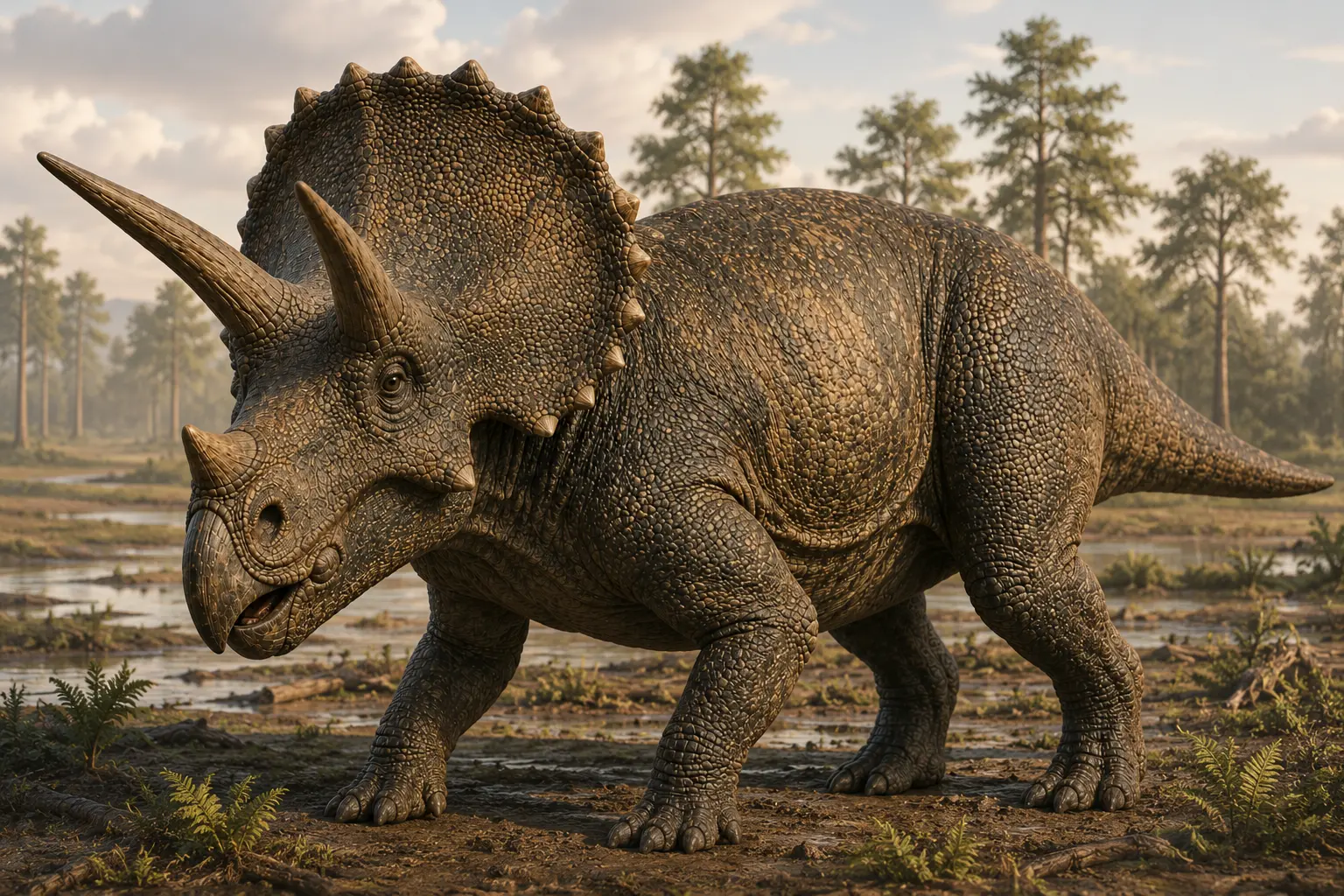
At a Glance
| Attribute | Detail |
|---|---|
| Scientific name | Triceratops horridus |
| Pronunciation | try-SER-ah-tops HOR-ih-dus |
| Name meaning | “Three-horned face”; horridus — rough or bristly |
| Period | Late Cretaceous |
| Lived | 68–66 Ma |
| Found in | Hell Creek Formation (Montana); Lance Formation (Wyoming); Denver Formation (Colorado) |
| Diet | Herbivore — low-growing fibrous vegetation |
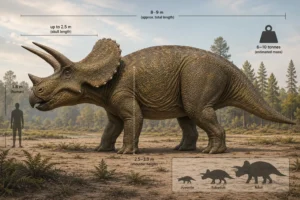
| Length | 8–9 m (26–30 ft) |
| Weight | 6–10 metric tons |
| Classification | Ceratopsidae, Chasmosaurinae |
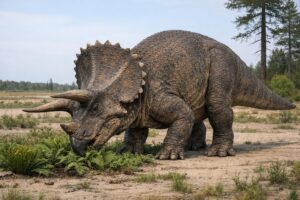
Quick Answer: Triceratops horridus was a large, heavily built herbivore that lived in North America during the final two million years of the Cretaceous period. It is best known for its three facial horns and wide solid frill, which current evidence suggests were used primarily for display and intraspecific combat. It shared its environment — and at least occasionally its interactions — with Tyrannosaurus rex.
Triceratops was one of the last non-avian dinosaurs on Earth, and one of the most heavily armed herbivores the fossil record has produced. A solid-boned frill up to a metre across, brow horns that could reach the same length, and a skull built to absorb and deliver force made it unlike almost anything alive before or since. Six entries below cover the science in full.
Diet and Feeding
| Field | Detail |
|---|---|
| Diet type | Strict herbivore |
| Primary food sources | Flowering plants, cycads, ferns, palms, conifers |
| Beak type | Parrot-like; used to crop and shear fibrous vegetation |
| Tooth count | 432–800 teeth arranged in dental batteries |
| Tooth mechanism | Scissor-action shear; teeth replaced continuously |
For the full breakdown of feeding anatomy and behaviour, see our Triceratops diet entry.
Horns and Frill
| Field | Detail |
|---|---|
| Brow horn length | Up to ~1 m (fossil core); longer in life with keratin sheath |
| Nasal horn | Shorter and more conical in T. horridus than in T. prorsus |
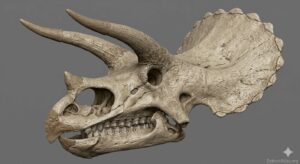
| Frill width | Up to ~1 m across; solid bone, no openings |
| Epoccipitals | 19–26 small bony projections bordering the frill margin |
| Primary function | Display and mate selection; intraspecific combat also evidenced by healed skull fractures |
Defensive use against predators is possible, but not established as the main function. See our Triceratops horns and frill entry for the full evidence.
Discovery and Fossil History
| Field | Detail |
|---|---|
| First specimen | 1887, Denver Formation, Colorado — collected by George Lyman Cannon |
| Initial identification | Misidentified as a giant prehistoric bison by Othniel Charles Marsh |
| Formally named | 1889 by Othniel Charles Marsh |
| Type specimen | YPM 1820, Lance Formation, Wyoming — collected by John Bell Hatcher, 1888 |
| Key fossil site | Hell Creek Formation, Montana |
| Notable modern specimen | “Horridus” — approximately 85% complete; Melbourne Museum, Australia |
See our Triceratops discovery entry for the full fossil history.
Taxonomy and the Torosaurus Debate
| Field | Detail |
|---|---|
| Current consensus | Triceratops and Torosaurus most likely separate genera |
| 2010 proposal | Torosaurus was a fully mature Triceratops with frill openings developed through ontogeny |
| Counter-evidence | Young Torosaurus individuals identified; major structural frill differences difficult to explain by growth |
| Status | Debate remains open; separate genera is the current working position |
See our Triceratops taxonomy and the Torosaurus debate entry for the full analysis.
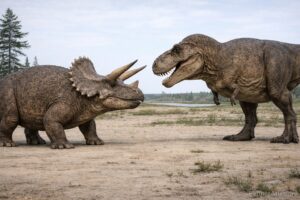
Triceratops vs Tyrannosaurus rex
| Feature | Triceratops horridus | Tyrannosaurus rex |
|---|---|---|
| Period | Late Cretaceous (68–66 Ma) | Late Cretaceous (68–66 Ma) |
| Length | 8–9 m (26–30 ft) | ~12 m (40 ft) |
| Weight | 6–10 metric tons | ~8–14 metric tons |
| Key weapon | Three horns, solid skull, low centre of gravity | Bone-crushing bite; serrated teeth up to 30 cm |
| Fossil interaction evidence | Healed bite marks on brow horn and frill; T. rex tooth marks on pelvis | Tooth embedded in Triceratops; feeding marks on carcass bones |
Healed bite marks confirm that at least one Triceratops survived a T. rex attack. What the fossil record does not show is who routinely prevailed — outcomes likely varied by size, health, and circumstance. See our Triceratops vs T. Rex entry for the full fossil evidence.
Related and Contemporary Species
- Torosaurus latus — a large ceratopsid from the same period and region, most likely a separate genus, though its relationship to Triceratops was the subject of a significant reclassification debate in 2010.
- Nedoceratops hatcheri — a single-specimen ceratopsid from the Lance Formation sometimes proposed as an intermediate growth stage between Triceratops and Torosaurus; taxonomic status remains contested.
- Anchiceratops — an earlier ceratopsid from Canada showing the evolutionary development of the open-fenestrated frill that distinguishes many relatives from the solid-frilled Triceratops.
- Styracosaurus — a ceratopsid notable for its elaborate frill spikes, frequently compared to Triceratops when discussing the display versus defence functions of ceratopsian headgear.
- Pachycephalosaurus — a contemporary of Triceratops in the Hell Creek Formation, relevant as an example of another heavily modified skull structure in the same ecosystem whose primary function is also debated.
Common Questions About Triceratops
Was Triceratops the last dinosaur?
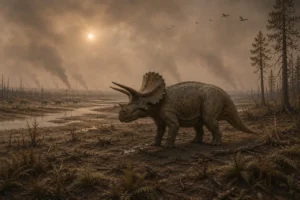
Triceratops was among the very last non-avian dinosaurs, living right up to the Cretaceous–Palaeogene extinction event 66 million years ago. Fossils have been recovered within an estimated 40,000 years of the boundary, making it one of the latest-surviving large dinosaur genera currently known.
How many Triceratops species are there?
Two species are currently recognised: Triceratops horridus and Triceratops prorsus. The two differ in horn proportions — T. prorsus has a longer nasal horn — and may represent an evolutionary sequence within the Hell Creek Formation rather than fully separate lineages. Other named species have been synonymised over time.
Did Triceratops live in herds?
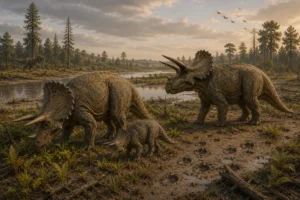
The evidence is inconclusive. A small number of multi-individual bonebeds have been reported, which some researchers interpret as evidence of at least occasional gregarious behaviour. However, Triceratops is far more commonly found as an isolated individual, and no clear consensus on herding behaviour exists.
Did Triceratops have any predators other than T. rex?
T. rex is the only large theropod confirmed to have interacted with Triceratops by direct fossil evidence. Juveniles may have been vulnerable to smaller predators present in the Hell Creek ecosystem, but no fossil evidence of such interactions has been confirmed.
🧠 Behavior
🦴 Fossil History
Triceratops Discovery
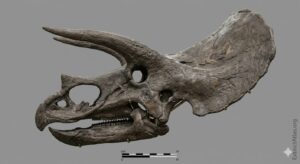
How Triceratops was discovered, misidentified as a bison, and later named during the Bone Wars.
Explore Guide →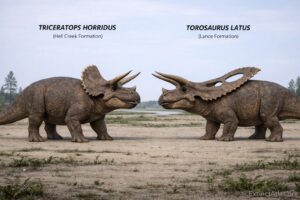
Triceratops Taxonomy and the Torosaurus Debate
The scientific debate over whether Torosaurus is a distinct genus or a mature Triceratops.
Explore Guide →🌍 Habitat
⚖️ Comparison
🌿 Diet
Featured Museum Collections
Museum-quality paleoart and educational poster
collections based on evidence-informed prehistoric
Life reconstructions.