
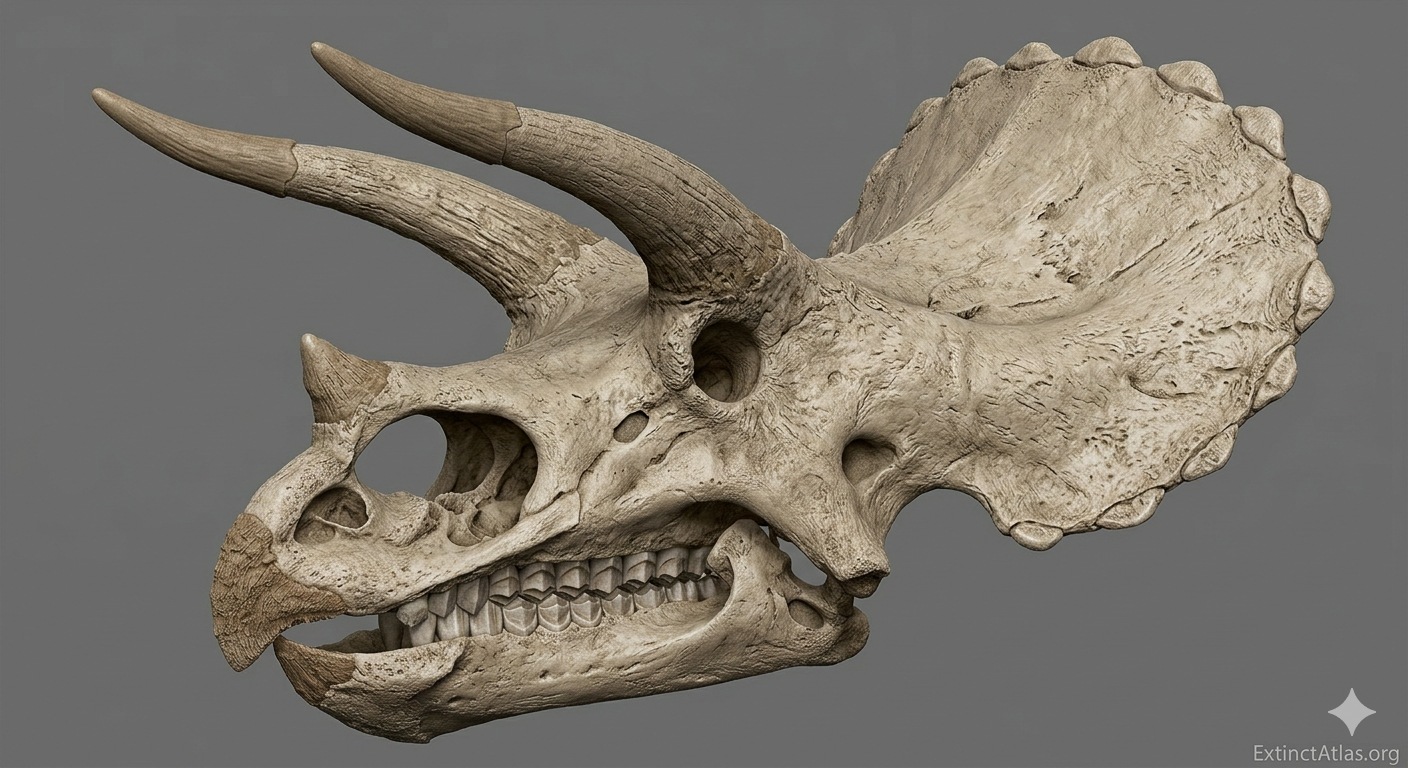
What Were Triceratops Horns and Frill For? The Science Behind the Headgear
| Field | Information |
|---|---|
| Species | Triceratops horridus |
| Period | Late Cretaceous (68–66 Ma) |
| Brow horn length | Up to ~1 metre (fossil core); longer in life with keratin sheath |
| Nasal horn length | Shorter and more conical in T. horridus than in T. prorsus |
| Frill width | Up to ~1 metre across; solid bone, no openings |
| Epoccipitals on frill | 19–26 small bony spikes bordering the frill margin |
| Hub page | /species/triceratops-horridus/ |
Quick Answer: Scientists currently believe the horns and frill of Triceratops served multiple functions — most likely display and mate selection as the primary purpose, with intraspecific combat (fighting other Triceratops) also evidenced by healed skull fractures. Defensive use against predators is possible but not established as the main driver of these structures.
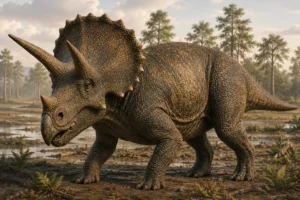
The two brow horns of Triceratops horridus could reach roughly a metre in length from the bony core — and that is the fossil. In life, a sheath of keratin covered each horn, extending them further and sharpening them considerably. Whatever these structures were for, they were not trivial ornaments.
What Were Triceratops Horns and Frill For?
The functions of the Triceratops horns and frill have been debated for over a century and remain a topic of active discussion in ceratopsian palaeontology. Research currently favours courtship display and mate selection as the primary function of the frill, with intraspecific combat (fighting between individuals of the same species) supported by physical evidence in the skull fossil record. Defensive use against predators such as Tyrannosaurus is possible, but is no longer considered the main evolutionary driver.
[Image asset flag: anatomy diagram recommended — labelled skull showing brow horns, nasal horn, frill, epoccipitals, and squamosal region; size comparison with a person]
Evidence for Intraspecific Combat
Comparative pathology provides the strongest direct evidence that Triceratops individuals engaged in combat. A landmark study by Andrew A. Farke and colleagues (2009) analyzed large samples of cranial elements from Triceratops and the related ceratopsian Centrosaurus.
The result was highly asymmetrical:
- Triceratops skulls exhibit ~10× higher frequencies of lesions on the squamosal bone
- Centrosaurus shows a comparatively low incidence of similar injuries
The squamosal, located along the lower lateral margin of the frill, is precisely where stress and trauma would be expected if two animals engaged in a frontal lock, with their brow horns locked and pushed.
This injury distribution is biomechanically consistent with a jousting or horn-locking combat strategy, broadly analogous to behaviors observed in extant ungulates such as deer, elk, and bighorn sheep. In such systems, cranial appendages are used not primarily for lethal strikes but for controlled force application, pushing contests, and dominance interactions.
Corroborating specimen-level evidence further strengthens this interpretation. The individual known as “Big John,” a large Triceratops horridus, preserves a healed perforation in the squamosal, consistent in size and morphology with penetration by a conspecific horn. The advanced healing indicates survival post-injury, reinforcing that these interactions were recurrent and not always fatal.
Interpretation
Taken together, the data support the conclusion that Triceratops horns functioned in intraspecific combat, most plausibly in contexts of:
- Mate competition (sexual selection)
- Territorial or dominance disputes
The anatomical configuration—forward-projecting brow horns, reinforced frill margins, and robust cranial architecture—aligns closely with this behavioral model, indicating that combat was a routine and evolutionarily significant aspect of Triceratops biology.
Evidence for Courtship Display
Comparative analyses of ceratopsian ornamentation increasingly support sexual selection as the primary driver of frill and horn evolution. A broad-scale study by David W. E. Hone and Michael J. Benton (2018) examined variation in cranial display structures across ceratopsians and tested whether ornamentation correlated with species co-occurrence (a proxy for species-recognition function).
The result was negative:
- No consistent relationship between ornament complexity and sympatry (species living in the same geographic region)
- This weakens the hypothesis that horns and frills evolved primarily for species recognition
Instead, the data are more consistent with ceratopsian headgear functioning as sexually selected display structures—specifically, “honest signals” that convey information about an individual’s health, maturity, or genetic quality.
Ontogenetic Evidence
Independent support comes from developmental changes within Triceratops itself:
- Juveniles:
- Brow horns curve backward
- Frill is relatively small and often more ornamented or irregular
- Adults:
- Brow horns curve forward
- Frill becomes larger, smoother, and more expanded
This pronounced ontogenetic transformation closely parallels patterns seen in modern animals where display structures develop or intensify at sexual maturity (e.g., antlers in cervids, horns in bovids, ornamental plumage in birds).
Functional Interpretation
Taken together, the evidence supports a model in which Triceratops cranial ornamentation served a dual role:
- Primary: Visual display for mate attraction and assessment
- Secondary: Use in intraspecific combat (as supported by cranial trauma data)
Under this framework, the frill and horns function as multifunctional socio-sexual structures, shaped by both mate choice and competitive interactions, rather than purely defensive or taxonomic signaling features.
Was the Frill Used for Defence?
The solid construction of the Triceratops frill — unlike the fenestrated, hole-bearing frills of ceratopsians like Torosaurus — gave it more structural integrity. Fossil evidence does show Tyrannosaurus bite marks on Triceratops frills, confirming the frill was a target during predation attempts. However, early theories that the frill evolved primarily as a predator shield have been largely set aside by modern researchers. The frill appears too large and metabolically costly to be explained by defence alone, and the pattern of injuries in the fossil record points more strongly to intraspecific use.
Early proposals that the frill functioned as a radiator for thermoregulation have also been largely rejected by current research.
What Did the Horns Look Like in Life?
Fossil horn cores preserve only the bony inner structure. In life, Triceratops horns were covered in a keratin sheath — the same material as human fingernails — which would have made them longer, sharper, and more pointed than the fossil cores suggest. The keratin does not preserve, so the full living horn dimensions cannot be stated with precision. The nasal horn of T. horridus was shorter and more horizontally oriented compared to T. prorsus, which had a longer, more upright nasal horn.
Related and Contemporary Species
These comparisons are relevant to understanding Triceratops horn function:
- Centrosaurus — a ceratopsian with an enlarged nasal horn and small brow horns; its skull shows far fewer frill lesions than Triceratops, suggesting a different combat style or more visual display
- Styracosaurus — notable for elaborate spikes radiating from the frill margin; likely primarily a display structure
- Pachyrhinosaurus — replaced the nasal horn with a flat boss of bone; demonstrates how horn morphology varies across ceratopsians.
- Torosaurus — closely related to Triceratops with a fenestrated frill; currently debated as either a separate genus or the fully mature form of Triceratops
Frequently Asked Questions
Did Triceratops use its horns to fight T. rex?
Fossil evidence shows that T. rex did attack Triceratops — healed bite marks on a T. horridus brow horn confirm that at least one individual survived such an encounter. Whether Triceratops actively used its horns offensively against T. rex in return is not directly evidenced. Palaeontologist Peter Dodson has suggested a charging Triceratops could inflict fatal wounds on a T. rex, but this is an analysis based on anatomy, not direct fossil evidence.
Why was the Triceratops frill solid and not holey like Torosaurus?
The solid frill of Triceratops is one of the key anatomical differences between it and Torosaurus (the other ceratopsian it is most closely compared to). In Triceratops, the parietal bone forming the frill is a continuous sheet. Research suggests this solid construction may have provided more structural support during horn-locking combat — a function less relevant in ceratopsians that relied more on visual display.
Did both male and female Triceratops have horns?
Research indicates that both sexes had horns and frills of similar development. Unlike some modern deer, where only males carry antlers, Triceratops fossil evidence does not show strong sexual dimorphism in horn size or frill shape. This pattern is more consistent with mutual mate-choice signalling — where both sexes advertise fitness — than with exclusively male-competition weaponry.
Conclusion
The horns and frill of Triceratops were almost certainly multifunctional — built for jousting rivals, signalling fitness to potential mates, and providing some protection against predators. The fossil record is clear that these were not decorative: healed fractures, lesions, and bite marks tell a story of structures used hard throughout an individual’s life.
References
Farke AA, Wolff EDS, Tanke DH. 2009. Evidence of combat in Triceratops. PLoS ONE. 4(1):e4252.
Hone DWE, Naish D, Cuthill IC. 2012. Does mutual sexual selection explain the evolution of head crests in pterosaurs and dinosaurs? Lethaia. 45(2):139–156.
Hone DWE, Benton MJ. 2018. Behavioural ecology of ornamentation in dinosaurs. Biological Reviews. 93(2):789–808.
Scannella JB, Horner JR. 2010. Torosaurus marsh, 1891, is Triceratops marsh, 1889 (Ceratopsidae: Chasmosaurinae): synonymy through ontogeny. Journal of Vertebrate Paleontology. 30(4):1157–1168.
Hatcher JB, Marsh OC, Lull RS. 1907. The Ceratopsia. United States Geological Survey Monograph 49. Washington, DC: Government Printing Office.
Dodson, P. 1996. The Horned Dinosaurs: A Natural History. Princeton: Princeton University Press.
Horner JR, Goodwin MB. 2006. Major cranial changes during Triceratops ontogeny. Proceedings of the Royal Society B: Biological Sciences. 273(1602):2757–2761.
Happ J. 2008. An analysis of predator-prey behavior in a head-to-head encounter between Tyrannosaurus rex and Triceratops horridus. In: Larson P, Carpenter K, editors. Tyrannosaurus rex, the Tyrant King. Bloomington: Indiana University Press. p. 355–368.
Sullivan RM. 2006. A taxonomic review of the Pachyrhinosaurini (Dinosauria: Ceratopsidae). In: Lucas SG, Sullivan RM, editors. Late Cretaceous Vertebrates from the Western Interior. New Mexico Museum of Natural History and Science Bulletin 35. p. 347–363.
Recommended Paleontology & Natural History Books
As an Amazon Associate, Extinct Atlas may earn from qualifying purchases.
The Rise and Fall of the Dinosaurs
A compelling history of dinosaurs, tracing their origins, diversification, 200-million-year reign, extinction, and enduring legacy.
Dinosaurs and Prehistoric Life
A richly illustrated visual reference exploring dinosaurs, fossils, evolution, and prehistoric life across geological time.
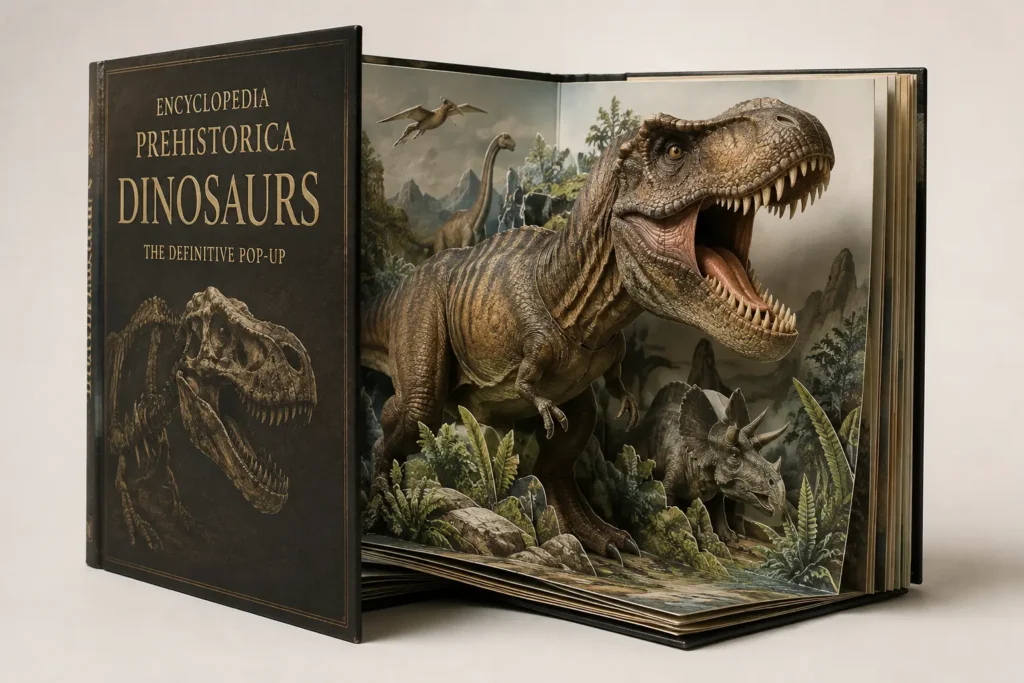
Encyclopedia Prehistorica: Dinosaurs
An interactive dinosaur book featuring spectacular three-dimensional pop-ups, particularly suited to young readers and families.
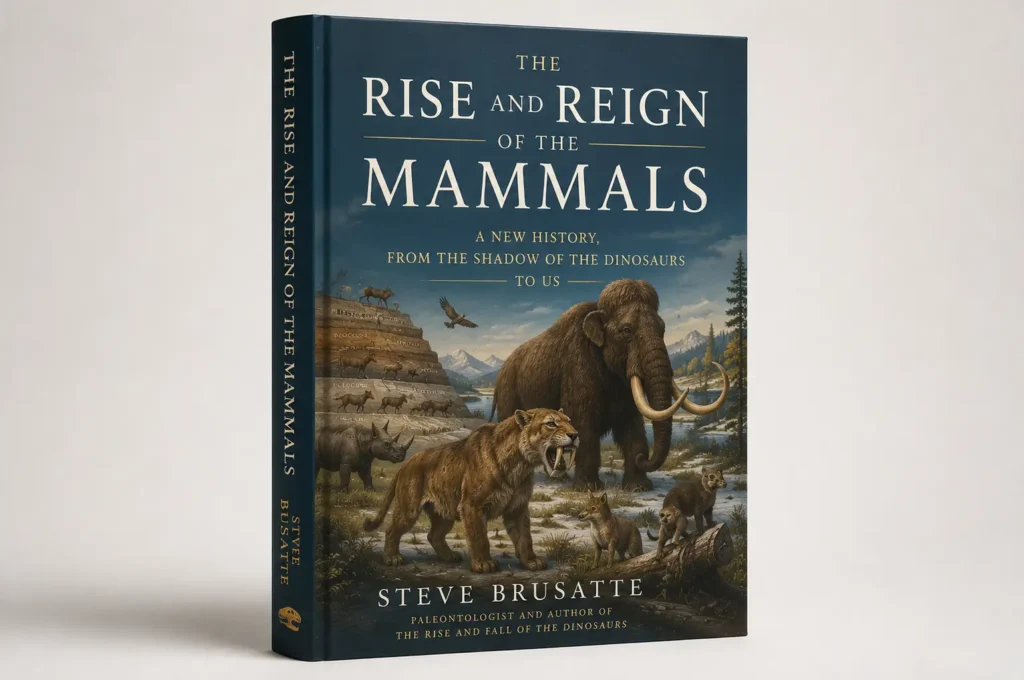
The Rise and Reign of the Mammals
A sweeping history of mammalian evolution, from their origins alongside dinosaurs through the Cenozoic and the emergence of humans.