
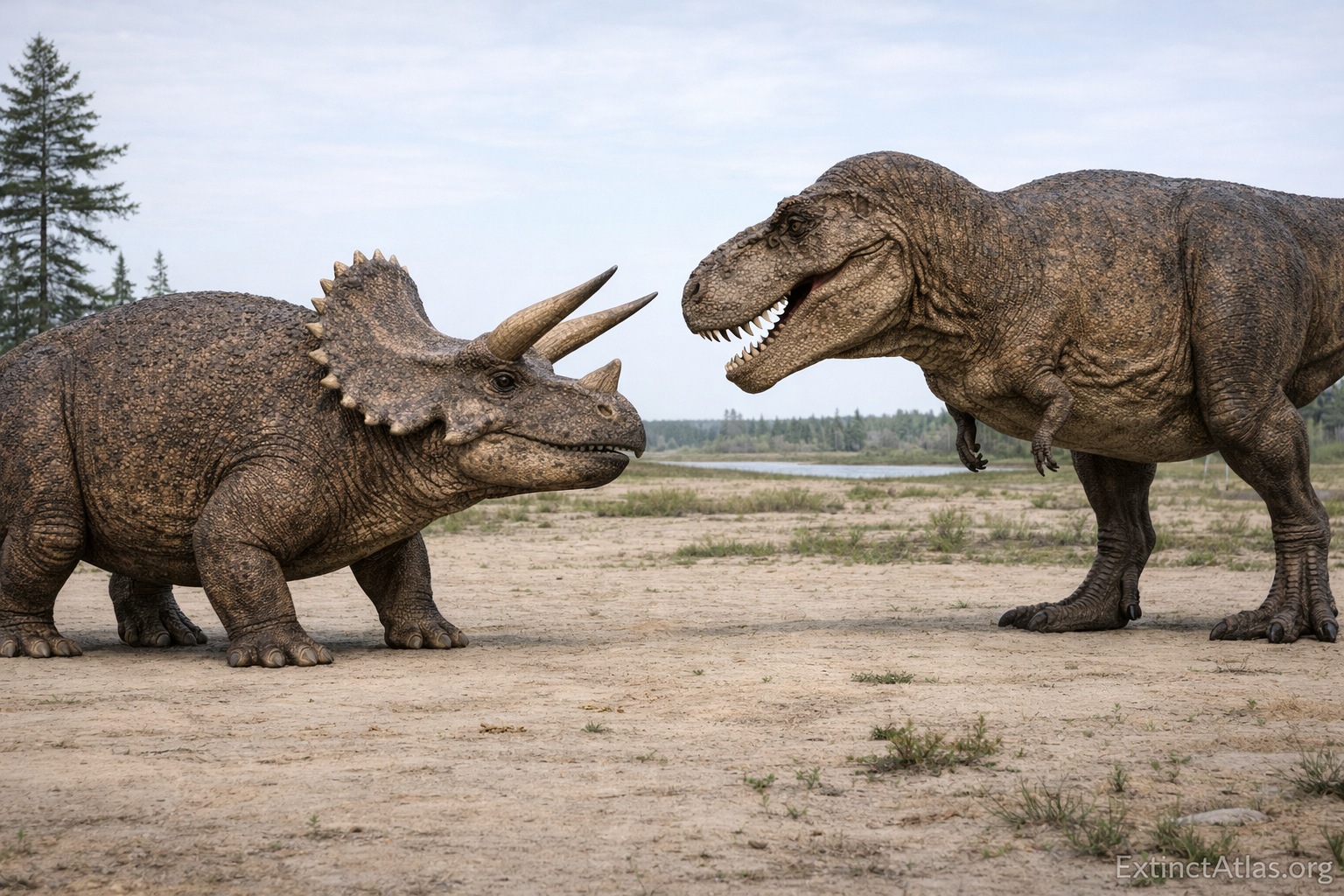
Did Triceratops Fight Tyrannosaurus rex – What Does the Fossil Evidence Actually Show?
| Feature | Triceratops horridus | Tyrannosaurus rex |
|---|---|---|
| Period | Late Cretaceous (68–66 Ma) | Late Cretaceous (68–66 Ma) |
| Length | 8–9 m (26–30 ft) | ~12 m (40 ft) |
| Weight | 6–10 metric tons | ~8–14 metric tons |
| Diet | Herbivore | Apex carnivore |
| Key weapon | Three horns, solid skull, low centre of gravity | Bone-crushing bite force; serrated teeth up to 30 cm |
| Fossil interaction evidence | Healed bite marks on Triceratops brow horn and frill; T. rex tooth marks on Triceratops pelvis | Tooth embedded in Triceratops; feeding marks on carcass bones |
Quick Answer: Fossil evidence confirms that Tyrannosaurus and Triceratops genuinely encountered each other — healed bite marks show at least one Triceratops survived a T. rex attack. What the fossil record does not tell us is who routinely won. Outcomes likely varied by size, health, age, and circumstance of the encounter.
The brow horn core recovered from the Hell Creek Formation in Montana bears two deep depressions from an adult T. rex, and then healed bone growth. Whatever happened that day in the Late Cretaceous, the Triceratops walked away. This single fossil is the clearest direct evidence of a live confrontation between the two most iconic dinosaurs ever to share a landscape.
How Did Triceratops and T. rex Compare?
T. rex and Triceratops were near-contemporaries at the very end of the Cretaceous period, sharing the Laramidia landmass — broadly corresponding to present-day western North America — between roughly 68 and 66 million years ago. They were ecological neighbours in the Hell Creek environment, and size-wise, they were broadly matched as adults. T. rex was longer, but Triceratops was built heavier and lower, with a much larger skull relative to body size.
What Does the Fossil Record Show?
Direct fossil evidence of interaction between the two species is rare but exists:
Healed Triceratops brow horn: A partial Triceratops fossil recovered in 1997 includes a brow horn with the tip missing. Two depressions on the remaining shaft match the spacing and radius of adult T. rex teeth. The bone shows subsequent healing — confirming the animal survived the bite. This is currently the clearest evidence of a live predation attempt.
Bite marks on a Triceratops frill: Tooth marks consistent with T. rex have been found on Triceratops frill specimens. Researchers have noted that the frill carried little meat, suggesting that T. rex may have used the frill as a lever to pull the skull from the carcass rather than feeding on the frill itself. This evidence is more consistent with scavenging or post-kill feeding than with the original kill event.
Feeding marks on a Triceratops pelvis and sacrum: Deep tooth-scored marks consistent with T. rex have been documented on Triceratops hip and lower-back bones. These marks show a T. rex stripping meat, but do not indicate whether the animal was killed by T. rex or found already dead.
The Dueling Dinosaurs fossil — discovered in the Hell Creek Formation in 2006 and now at the North Carolina Museum of Natural Sciences — consists of associated skeletons of a tyrannosaur and a Triceratops horridus. Research published in 2025 identified the tyrannosaur as Nanotyrannus lancensis rather than T. rex, complicating what had been cited as a direct encounter fossil. The specimen does include a tyrannosaur tooth embedded in the Triceratops.
Who Would Win? An Honest Assessment
This question is popular, but it does not have a single answer — and presenting one as settled would misrepresent the evidence.
In a speculative, hypothetical encounter between healthy adults, both species carried potentially lethal weapons. A T. rex bite force estimated at around 35,000 N — broadly considered the most powerful of any known land animal — could shatter bone. A charging Triceratops with metre-long keratin-sheathed horns could, in principle, penetrate a T. rex chest cavity. Palaeontologist Peter Dodson has argued that an adult Triceratops in a frontal charge would have the advantage; others point to T. rex as an ambush hunter that would rarely take on a fully alert, healthy adult of any species directly.
What the fossil record more plausibly suggests, according to researchers including Riley Black at the Smithsonian, is that T. rex preferentially targeted young, old, sick, or isolated Triceratops rather than engaging healthy adults in frontal combat. The healed horn bite shows that direct attacks did occur, and that Triceratops could survive them. The feeding marks on carcasses show that T. rex definitely ate Triceratops — but whether it killed them or scavenged them cannot be determined from bone marks alone.
Both species were last-of-their-line Late Cretaceous survivors. The fossil record documents their interaction as real and repeated — but the outcome of any individual encounter, speculatively, depended on size, health, terrain, and chance.
Overlap in Time and Place
Both species are recovered from the same rock unit — the Hell Creek Formation — and are stratigraphically associated in Montana, Wyoming, South Dakota, and adjacent areas of Canada. Research confirms they lived at the same time and in the same environment. Triceratops is actually the most commonly recovered dinosaur from the uppermost Cretaceous deposits of western North America, making it very likely that any T. rex in the region encountered Triceratops regularly.
Related and Contemporary Species
Other large Hell Creek animals that provide context for the Triceratops–T. rex dynamic:
- Edmontosaurus — a large hadrosaur that also shared this environment and bears T. rex tooth marks, suggesting it too was regular prey
- Ankylosaurus — heavily armoured herbivore sharing the Hell Creek habitat; also a potential prey or competitor for T. rex attention
- Nanotyrannus lancensis — a smaller tyrannosaur (its exact status relative to juvenile T. rex is actively debated); the Dueling Dinosaurs specimen has now been assigned to this taxon by some researchers
Frequently Asked Questions
Did T. rex hunt Triceratops?
Fossil evidence shows T. rex fed on Triceratops remains, including deeply tooth-scored pelvic and hip bones. A healed bite on a T. horridus brow horn confirms at least one live predation attempt. Whether T. rex actively hunted Triceratops as a primary prey species, or scavenged them opportunistically, cannot be resolved from current evidence — most researchers believe it did both, as appears true for T. rex‘s predatory behaviour generally.
Is there any fossil of a T. rex and Triceratops that died together?
The short answer is: there is no confirmed case of a Tyrannosaurus rex and Triceratops horridus demonstrably dying together in combat—but there is one exceptionally important specimen that comes close.
The “Dueling Dinosaurs” Specimen
The so-called “Dueling Dinosaurs,” discovered in 2006 in the Hell Creek Formation, consists of a tyrannosaur and a Triceratops preserved together in the same sandstone block, with remarkable articulation and minimal post-mortem disturbance.
Key observations:
- The two skeletons are closely associated and partially intertwined
- The Triceratops shows traumatic injuries, including a tyrannosaur tooth embedded in bone
- The tyrannosaur specimen also preserves cranial and postcranial damage
These features strongly indicate interaction before death, most plausibly a predatory or defensive encounter.
Taxonomic Reassessment (2025)
A detailed recent study (2025) concluded that the theropod in the block is best identified as Nanotyrannus lancensis, rather than a juvenile Tyrannosaurus rex.
This interpretation remains controversial, as many paleontologists continue to regard Nanotyrannus as representing juvenile T. rex rather than a distinct genus. The taxonomic status of the specimen is therefore still under active debate.
Did They Die Fighting?
Despite the dramatic preservation, a definitive “fight-to-the-death” scenario cannot be confirmed. Several taphonomic factors must be considered:
- Rapid burial (e.g., flood or sediment collapse) could have entombed both animals together after an interaction
- The injuries demonstrate contact, but not necessarily that both individuals died simultaneously from combat
- Alternative scenarios include predation followed by burial, or post-mortem association with minimal transport
Current Interpretation
The “Dueling Dinosaurs” specimen represents:
- The strongest known fossil evidence of direct interaction between a tyrannosaurid and Triceratops
- A rare case of associated large dinosaur skeletons with behavioral context
- An ambiguous death scenario, where combat is plausible but not conclusively demonstrated
Bottom Line
- ✔ Evidence of interaction: Yes (strong)
- ✔ Same burial event: Very likely
- ✖ Proven mutual combat death: Not confirmed
- ✖ Confirmed T. rex specifically: Unresolved (taxonomic debate ongoing)
How fast was Triceratops compared to T. rex?
Speed estimates for both animals are inferred from skeletal anatomy and biomechanical modelling, not direct fossil evidence — treat all figures as speculative. Research suggests T. rex reached speeds of roughly 12–25 km/h; Triceratops is generally estimated at a lower range. Neither was particularly fast for their size. Speculatively, this reduces the likelihood of sustained pursuit scenarios and increases the plausibility of ambush or scavenging in T. rex encounters.
Conclusion: Triceratops and T. rex met in the real world — the fossil evidence is unambiguous about that. What the bones cannot tell us is who came out on top with any regularity. Both animals were highly adapted to their ecological roles, and the evidence indicates that encounters with variable outcomes.
References
Barrett PM. 2005. The diet of ostrich dinosaurs (Theropoda: Ornithomimosauria). Palaeontology. 48(2):347–358.
Kobayashi Y, Barsbold R. 2005. Anatomy of Harpymimus okladnikovi Barsbold and Perle 1984 (Dinosauria: Theropoda) of Mongolia. Journal of Vertebrate Paleontology. 25(2):378–400.
Makovicky PJ, Kobayashi Y, Currie PJ. 2004. Ornithomimosauria. In: Weishampel DB, Dodson P, Osmólska H, editors. The Dinosauria. 2nd ed. Berkeley: University of California Press. p. 137–150.
Norell MA, Makovicky PJ, Currie PJ. 2001. The beaks of ostrich dinosaurs. Nature. 412:873–874.
Zanno LE, Makovicky PJ. 2011. Herbivorous ecomorphology and specialization patterns in theropod dinosaur evolution. Proceedings of the National Academy of Sciences. 108(1):232–237.
Britt BB. 1993. Pneumatic postcranial bones in dinosaurs and other archosaurs. PhD dissertation. University of Calgary.
Nicholls EL, Russell AP. 1985. Structure and function of the pectoral girdle and forelimb in Struthiomimus altus (Theropoda, Ornithomimidae). Palaeontology. 28(4):643–677.
Osborn HF. 1916. Skeletal adaptations of Ornitholestes, Struthiomimus, Tyrannosaurus. Bulletin of the American Museum of Natural History. 35:733–771.
Recommended Paleontology & Natural History Books
As an Amazon Associate, Extinct Atlas may earn from qualifying purchases.
The Rise and Fall of the Dinosaurs
A compelling history of dinosaurs, tracing their origins, diversification, 200-million-year reign, extinction, and enduring legacy.
Dinosaurs and Prehistoric Life
A richly illustrated visual reference exploring dinosaurs, fossils, evolution, and prehistoric life across geological time.
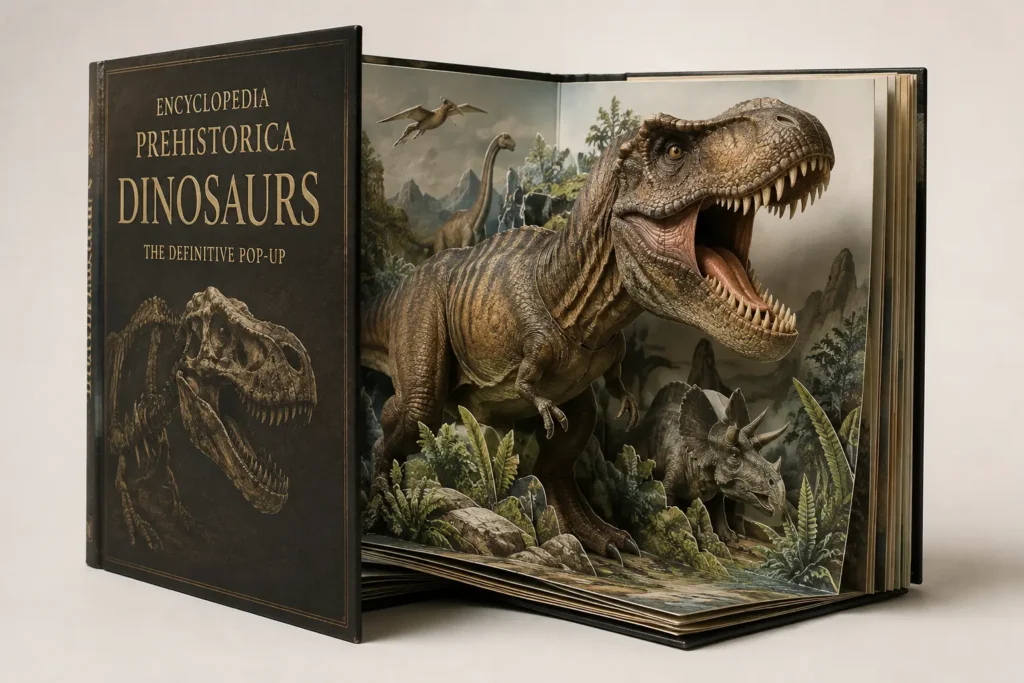
Encyclopedia Prehistorica: Dinosaurs
An interactive dinosaur book featuring spectacular three-dimensional pop-ups, particularly suited to young readers and families.
The Rise and Reign of the Mammals
A sweeping history of mammalian evolution, from their origins alongside dinosaurs through the Cenozoic and the emergence of humans.