

What Did Triceratops Eat? Diet, Teeth, and Feeding Behaviour Explained
| Field | Information |
|---|---|
| Species | Triceratops horridus |
| Period | Late Cretaceous (68–66 Ma) |
| Diet | Herbivore — low-growing fibrous vegetation |
| Key feeding adaptations | Parrot-like beak, dental batteries of 432–800 teeth, scissor-action shear |
| Confirmed food types | Flowering plants (angiosperms), cycads, ferns, palms, conifers |
Quick Answer: Triceratops was a strict herbivore that fed on tough, fibrous vegetation — primarily low-growing flowering plants, cycads, ferns, and palms. It used a sharp, parrot-like beak to crop and shear plant material, backed by hundreds of continuously-replacing teeth arranged in dense rows. It did not eat meat.
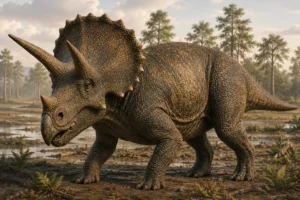
Picture the inside of a Triceratops skull: up to 800 individual teeth, stacked five deep in each column, constantly pushing upward as old ones wore out. No other herbivore in the Late Cretaceous had a chewing system quite like it. That extraordinary dental machinery tells us a great deal about what this animal was eating — and how.
What Did Triceratops Actually Eat?
Triceratops was a dedicated herbivore. Research suggests its diet centred primarily on angiosperms (flowering plants), which had become dominant across western North America during the Late Cretaceous. Fossil plant evidence from the Hell Creek Formation — the same rock unit that preserves most Triceratops remains — shows abundant cycads, ferns, palms, conifers, and broad-leaved flowering plants. Current evidence indicates that Triceratops exploited all of these, with fibrous, tough vegetation likely forming the bulk of its diet.
Grass was not on the menu. Grasses did not evolve until the Cenozoic, after the extinction of non-avian dinosaurs.
How Did Triceratops Feed? Beak, Teeth, and Jaw Mechanics

The Beak
The front of the Triceratops skull formed a narrow, horn-covered beak — structurally similar to a parrot’s rostral bone. This beak was used to crop and shear vegetation, probably stripping leaves or snapping off woody stems. Its narrowness suggests Triceratops was a more selective feeder than broad-mouthed herbivores such as Edmontosaurus.
The Dental Battery
Behind the beak sat one of the most sophisticated tooth systems in dinosaur evolution. Teeth were arranged in batteries of 36–40 columns per jaw side, with 3–5 teeth stacked vertically in each column. Research indicates a total range of 432–800 teeth at any given time, continuously replaced throughout the animal’s life as worn teeth are pushed out by new ones growing from below.
Critically, Triceratops teeth did not press together — they sheared past each other in a near-vertical scissor action. This is biomechanically unusual and particularly effective at slicing through tough, woody material. Tooth-wear studies on related ceratopsians suggest this system was used to process dense, fibrous browse rather than soft fruit or grass.
Head Position and Feeding Height
Triceratops was a low-headed quadruped: its shorter forelimbs angled the skull toward the ground, positioning it naturally for feeding on low-growing vegetation. Research suggests it could, however, angle its head upward to reach somewhat higher vegetation. Some scientists have proposed that Triceratops may have used its horns and frill to bulldoze through dense undergrowth when foraging.
How Much Did Triceratops Eat Each Day?
No direct fossil evidence records daily food intake. Extrapolation from body mass — adults weighed roughly 6–9 metric tons — and comparisons with large modern herbivores suggest Triceratops needed to consume very large quantities of vegetation daily to sustain itself. Researchers from McGill University’s Redpath Museum have proposed that it consumed entire branches and tough stems, not just leaves and soft growth. This is consistent with the robust jaw musculature and the scissor-tooth design optimised for processing fibrous material. However, specific daily intake figures remain speculative and should be treated as inference, not direct evidence.
Related and Contemporary Species
Triceratops horridus shared its Late Cretaceous environment with several other large herbivores, each occupying a slightly different dietary niche:
- Edmontosaurus — a hadrosaur (duck-billed dinosaur) with broad, flat teeth suited to grinding softer vegetation; likely fed at different heights and on different plant types than Triceratops
- Ankylosaurus — an armoured herbivore with a low-browsing posture; probably ate ground-level vegetation, potentially overlapping with Triceratops’ food sources
- Torosaurus — a ceratopsian closely related to Triceratops (and possibly the same genus at a later growth stage), with similar dental and beak anatomy,y suggesting a comparable diet
- Pachycephalosaurus — a dome-headed herbivore sharing the Hell Creek habitat, likely feeding on lower-growing, softer plant material
Did Triceratops Have the Most Complex Teeth of Any Dinosaur?
Triceratops dental batteries are among the most sophisticated in the entire fossil record. The scissor-shear action of its teeth was highly specialised for woody, fibrous vegetation that other herbivores could not efficiently process. Some researchers argue this gave Triceratops access to a dietary resource — dense, mature vegetation — that hadrosaurs and ankylosaurs were less equipped to exploit, reducing direct dietary competition despite sharing the same landscape.
[Freshness flag: review if new comparative tooth-wear analysis published]
Frequently Asked Questions
Did Triceratops eat meat?
No. Fossil evidence, jaw mechanics, tooth morphology, and beak structure all confirm that Triceratops was a strict herbivore. Some researchers have speculatively raised the possibility that ceratopsians may have opportunistically consumed small animals, as some modern herbivores occasionally do, but no direct evidence supports this for Triceratops, and it is not the mainstream view.
What plants did Triceratops eat most?
Current evidence indicates angiosperms (flowering plants) were probably the dominant food source, supplemented by cycads, ferns, palms, and conifers. The Hell Creek Formation preserves all of these plant types alongside Triceratops fossils. Specific proportions cannot be determined from the fossil record.
How many teeth did Triceratops have?
Research indicates Triceratops had between 432 and 800 teeth at any given time, arranged in dense vertical stacks called dental batteries. Only a fraction was in active use at once; new teeth continuously replaced worn ones from below throughout the animal’s life.
Conclusion: Triceratops horridus was built to eat plants that other dinosaurs struggled with — tough, fibrous vegetation that demanded a beak like a pair of bolt cutters and a tooth factory that never stopped running.
References
Marsh OC. 1889. Notice of new American Dinosauria. American Journal of Science. 38(224):173–175.
Ostrom JH. 1966. Functional morphology and evolution of the ceratopsian dinosaurs. Evolution. 20(3):290–308.
Tanoue K, Setoguchi T. 1998. Tooth replacement in Triceratops (Ceratopsidae: Ornithischia). Journal of Vertebrate Paleontology. 18(1):12–18.
Dodson P, Forster CA, Sampson SD. 2004. Ceratopsidae. In: Weishampel DB, Dodson P, Osmólska H, editors. The Dinosauria. 2nd ed. Berkeley: University of California Press. p. 494–513.
Fastovsky DE, Weishampel DB. 2005. The Evolution and Extinction of the Dinosaurs. 2nd ed. Cambridge: Cambridge University Press.
Scannella JB, Fowler DW, Goodwin MB, Horner JR. 2014. Evolutionary trends in Triceratops from the Hell Creek Formation, Montana. Proceedings of the National Academy of Sciences. 111(28):10245–10250. https://doi.org/10.1073/pnas.1313334111
Recommended Paleontology & Natural History Books
As an Amazon Associate, Extinct Atlas may earn from qualifying purchases.
The Rise and Fall of the Dinosaurs
A compelling history of dinosaurs, tracing their origins, diversification, 200-million-year reign, extinction, and enduring legacy.
Dinosaurs and Prehistoric Life
A richly illustrated visual reference exploring dinosaurs, fossils, evolution, and prehistoric life across geological time.
Encyclopedia Prehistorica: Dinosaurs
An interactive dinosaur book featuring spectacular three-dimensional pop-ups, particularly suited to young readers and families.
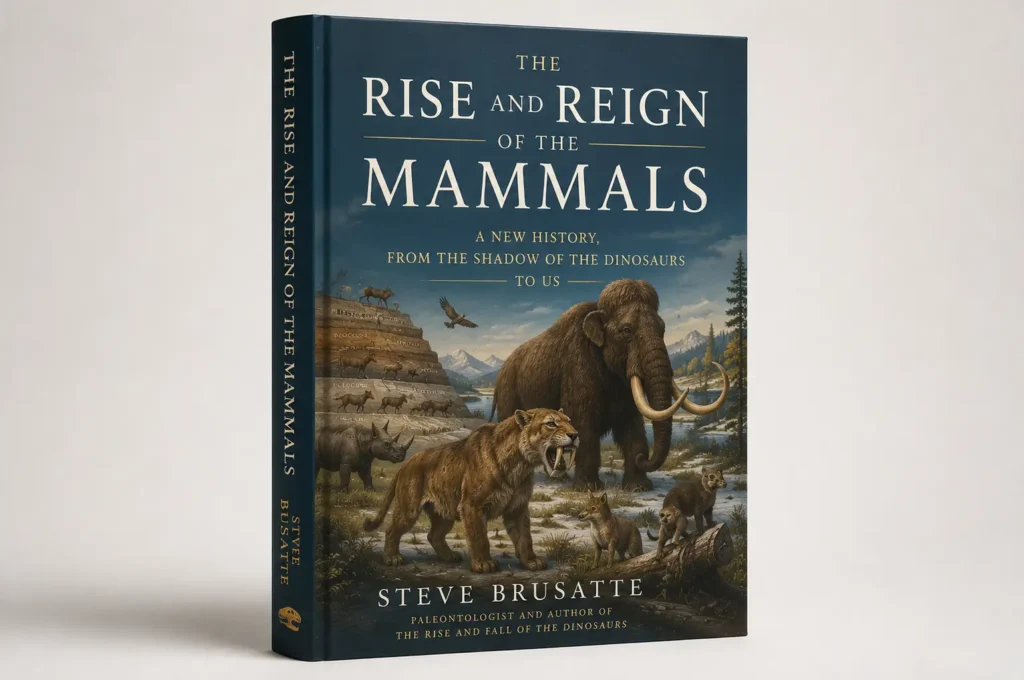
The Rise and Reign of the Mammals
A sweeping history of mammalian evolution, from their origins alongside dinosaurs through the Cenozoic and the emergence of humans.