

Who Discovered Triceratops? The Fossil History of Triceratops horridus
| Field | Information |
|---|---|
| Species | Triceratops horridus |
| Period | Late Cretaceous (68–66 Ma) |
| First specimen found | 1887, Denver Formation, Colorado (George Lyman Cannon) |
| Formally named | 1889 by Othniel Charles Marsh |
| Type specimen | YPM 1820, Lance Formation, Wyoming |
| Key fossil site | Hell Creek Formation, Montana |
| Notable modern specimen | “Horridus” — ~85% complete; Melbourne Museum, Australia |
Quick Answer: The first Triceratops remains were found in 1887 near Denver, Colorado, by fossil collector George Lyman Cannon — but they were initially misidentified as a giant prehistoric bison by palaeontologist Othniel Charles Marsh. It took a more complete skull discovery in 1888, collected by John Bell Hatcher in Wyoming, for Marsh to recognise and formally name the genus Triceratops in 1889.
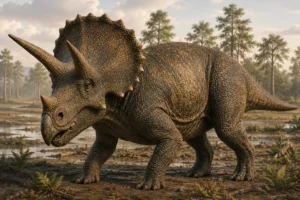
A cowboy threw a lasso at a skull poking out of a Wyoming ravine wall. The horn snapped off. The skull tumbled. A palaeontologist named it after a bison. This is how one of the most recognisable animals in Earth’s history entered the scientific record.
Who Discovered Triceratops?
The formal discovery of Triceratops unfolded across several years and involved multiple people before the genus was properly understood.
In the spring of 1887, fossil collector George Lyman Cannon found a pair of brow horns attached to a skull roof near Denver, Colorado. He sent them to Othniel Charles Marsh at Yale University. Marsh was then one of the most prominent palaeontologists in North America, but the horns puzzled him. The rock they came from appeared to be Pliocene in age, and no horned dinosaurs had yet been recognised from North America. Marsh concluded the horns belonged to an exceptionally large bison and named the animal Bison alticornis — “high-horned bison.”
He was significantly wrong.
In 1888, cowboy Edmund B. Wilson was startled by a large skull projecting from the side of a ravine on the property of rancher Charles Arthur Guernsey in Wyoming. Wilson attempted to lasso and recover it; the horn broke off when the rope pulled tight, and the skull crashed to the bottom of the ravine. Guernsey happened to show Wilson’s recovered horn to fossil collector John Bell Hatcher, who recognised its significance and alerted Marsh. Marsh dispatched Hatcher to locate and excavate the skull.
When the skull was prepared and examined, it revealed two large brow horns and — crucially — a third, shorter horn on the nasal region. Marsh realised this was not a bison but a new and previously unknown type of horned dinosaur. He named it Triceratops (“three-horned face”) in 1889 and designated the first species T. horridus — from the Latin for “rough” or “rugose,” describing the texture of the type specimen’s bone surface.
The Bone Wars and the Proliferation of Species
Between 1889 and 1891, Hatcher collected a further thirty-one Triceratops skulls for Marsh under considerable physical hardship — the Hell Creek badlands are remote and brutal terrain. The skulls varied substantially in horn shape, frill morphology, and nasal horn length, prompting Marsh to name multiple new species. At the height of this taxonomic enthusiasm, seventeen different species of Triceratops had been formally named.
This phase was part of the broader “Bone Wars” rivalry between Marsh and Edward Drinker Cope — a decade-long competitive rush to name as many new dinosaur species as possible from the American West. Speed and volume were the priorities; careful taxonomy was not. It created a sprawling, contradictory species list that palaeontologists spent most of the twentieth century trying to untangle.
Consolidating the Taxonomy: From Seventeen Species to Two
By the mid-twentieth century, the proliferation of named Triceratops species (once totaling more than a dozen) had been steadily reduced as researchers recognized that much of the apparent diversity reflected ontogeny (growth stages), individual variation, and taphonomic distortion rather than true taxonomic separation.
A major consolidation was proposed by John H. Ostrom and Peter Wellnhofer (1986), who argued that all known material could be referred to a single species, Triceratops horridus. Their interpretation emphasized the high degree of morphological variability within ceratopsid populations and the lack of consistently discrete diagnostic boundaries across specimens.
This single-species model was subsequently challenged by Catherine A. Forster, whose comprehensive reassessment of cranial morphology demonstrated that two morphologically and stratigraphically distinct species could be reliably recognized:
- Triceratops horridus — generally characterized by shorter brow horns and a more primitive cranial configuration
- Triceratops prorsus — exhibiting longer, forward-projecting brow horns and derived cranial proportions
Further support came from work by John Scannella and Denver Fowler (2009), who demonstrated that these two morphotypes are also stratigraphically segregated within the Hell Creek Formation:
- T. horridus occurs exclusively in lower stratigraphic levels
- T. prorsus occurs exclusively in upper stratigraphic levels
This vertical separation strongly supports a chronospecies interpretation, in which one species gradually evolves into another over time. The transition from T. horridus to T. prorsus is estimated to have occurred over approximately 1–2 million years near the end of the Late Cretaceous.
Current Taxonomic Consensus
The prevailing view in ceratopsian systematics recognizes two valid species of Triceratops:
- Triceratops horridus (earlier, more basal form)
- Triceratops prorsus (later, more derived form)
This framework reflects a synthesis of morphological, stratigraphic, and evolutionary evidence, replacing earlier over-splitting with a more constrained and phylogenetically coherent taxonomy.
Key Specimens and Where to Find Them
YPM 1820 (Type Specimen, T. horridus)
The holotype of Triceratops horridus, catalogued as YPM 1820, is housed at the Yale Peabody Museum of Natural History in New Haven, Connecticut.
The specimen was excavated in 1888 in Wyoming by John Bell Hatcher and formally described in 1889 by Othniel Charles Marsh. It serves as the defining reference specimen for the species, anchoring all subsequent taxonomic work on Triceratops.
“Horridus” (Melbourne Specimen)
Nicknamed “Horridus,” this exceptionally complete Triceratops horridus specimen was discovered in 2014 in Saskatchewan, Canada, by paleontologist Kyle Pfister of Great Plains Paleontology.
- Approximately 85% complete overall
- Skull approximately 98% complete
It is one of the most complete Triceratops specimens ever recovered. The fossil is now on permanent display at the Melbourne Museum, Australia, as the centrepiece of the Triceratops: Fate of the Dinosaurs exhibition.
“Big John”
“Big John” is a large Triceratops horridus individual notable for a healed perforation in the squamosal (frill) bone, interpreted as trauma likely caused by the horn of another Triceratops. The extent of healing indicates the animal survived the injury for a significant period, supporting evidence of intraspecific combat.
The specimen was auctioned in Paris in 2021 for approximately €6.65 million, making it one of the most expensive dinosaur fossils sold in Europe.
“Kelsey”
“Kelsey” is a named Triceratops horridus specimen measuring approximately 6.7–7.3 metres in length. It is held by the Black Hills Institute of Geological Research, an organization known for preparing and mounting numerous significant dinosaur specimens and casts.
Geological Context: Hell Creek Formation
Most Triceratops fossils originate from the Hell Creek Formation, a Late Cretaceous (Maastrichtian) geological unit spanning Montana, Wyoming, South Dakota, and adjacent Canadian regions.
This formation is one of the richest sources of Late Cretaceous vertebrate fossils in the world and preserves a diverse ecosystem that includes large herbivores such as Triceratops, apex predators such as Tyrannosaurus rex, and a wide range of other vertebrates and plant life.
The Hell Creek Formation is critical for understanding late-stage dinosaur evolution and the ecosystems that existed immediately before the end-Cretaceous mass extinction.
How Complete Is the Triceratops Fossil Record?
Triceratops has one of the richest fossil records of any large dinosaur. Hundreds of skulls and partial skeletons have been recovered, representing individuals from hatchlings to full adults. The sturdy construction of the skull — solid rather than fenestrated, as in many other ceratopsians — means it preserves exceptionally well.
However, complete skeletons are rare. Most specimens are skulls or partial skull material. Post-cranial bones (the body skeleton from the neck back) are recovered far less frequently. Specimens like “Horridus” are noteworthy precisely because they preserve so much body material alongside a nearly complete skull.
[Freshness flag: review if major new specimens described or Hell Creek Formation sites updated]
Related and Contemporary Species
Understanding the discovery history of Triceratops is enriched by knowledge of the other ceratopsians that shaped how palaeontologists interpreted it:
- Torosaurus — described by Marsh in 1891, two years after Triceratops; its relationship to Triceratops remains debated (see the Taxonomy spoke)
- Ceratops — the genus Marsh originally assigned the Wyoming skull to before recognising the third horn
- Centrosaurus — named around the same period; helped palaeontologists understand ceratopsian diversity during the Bone Wars era
- Nedoceratops hatcheri — named after John Bell Hatcher; its taxonomic status (whether it is a distinct genus or a transitional form) remains contested
Frequently Asked Questions
Where are Triceratops fossils found?
The vast majority of Triceratops fossils come from the Hell Creek Formation of Montana, Wyoming, South Dakota, and North Dakota in the United States, and from adjacent areas of Saskatchewan and Alberta in Canada. These deposits represent the final three million years of the Cretaceous period. Triceratops is described as the most commonly recovered dinosaur from the uppermost Cretaceous of western North America.
Why did scientists think Triceratops was a bison at first?
In 1887, horned dinosaurs were not yet known from North America. When Othniel Charles Marsh received the first Triceratops brow horn cores from Colorado, the only large horned animals he had reference points for were mammals. The Cretaceous origin of the rock layer was not immediately apparent, and the horns were large and bovine in general appearance. It was only after a more complete skull — clearly showing three horns and non-mammalian anatomy — was excavated in Wyoming in 1888 that Marsh revised his identification.
What is the most complete Triceratops fossil?
“Horridus,” discovered in Saskatchewan, Canada, in 2014, is approximately 85% complete with a 98% complete skull — making it one of the most complete Triceratops individuals known. It is now on permanent display at the Melbourne Museum in Australia.
Conclusion: The discovery of Triceratops is a story of genuine scientific confusion, competitive palaeontology, and an extraordinary fossil record that keeps delivering new specimens. From Marsh’s misidentified bison horns to the near-complete “Horridus” now mounted in Australia, the history of T. horridus in science is as interesting as the animal itself.
References
Marsh OC. 1888. Notice of a new fossil mammal. American Journal of Science. 35(208):502.*
Marsh OC. 1889. Notice of new American Dinosauria. American Journal of Science. 38(224):173–175.
Hatcher JB, Marsh OC, Lull RS. 1907. The Ceratopsia. United States Geological Survey Monograph 49. Washington, DC: Government Printing Office.
Forster CA. 1996. Species resolution in Triceratops: cladistic and morphometric approaches. Journal of Vertebrate Paleontology. 16(2):259–270.
Scannella JB, Fowler DW, Goodwin MB, Horner JR. 2014. Evolutionary trends in Triceratops from the Hell Creek Formation, Montana. Proceedings of the National Academy of Sciences. 111(28):10245–10250. https://doi.org/10.1073/pnas.1313334111
Fastovsky DE, Weishampel DB. 2005. The Evolution and Extinction of the Dinosaurs. 2nd ed. Cambridge: Cambridge University Press.
Recommended Paleontology & Natural History Books
As an Amazon Associate, Extinct Atlas may earn from qualifying purchases.

The Rise and Fall of the Dinosaurs
A compelling history of dinosaurs, tracing their origins, diversification, 200-million-year reign, extinction, and enduring legacy.

Dinosaurs and Prehistoric Life
A richly illustrated visual reference exploring dinosaurs, fossils, evolution, and prehistoric life across geological time.

Encyclopedia Prehistorica: Dinosaurs
An interactive dinosaur book featuring spectacular three-dimensional pop-ups, particularly suited to young readers and families.
The Rise and Reign of the Mammals
A sweeping history of mammalian evolution, from their origins alongside dinosaurs through the Cenozoic and the emergence of humans.