
At a Glance
| Attribute | Detail |
|---|---|
| Scientific name | Mosasaurus hoffmannii |
| Pronunciation | MOH-za-SORE-us hoff-MAN-ee-eye |
| Name meaning | “Meuse lizard of Hoffmann” — Latin Mosa (Meuse river) + Greek sauros (lizard) |
| Classification | Squamata > Mosasauridae > Mosasaurus > M. hoffmannii |
| Period | Late Cretaceous, 66–70 Ma |
| Found in | Netherlands, Belgium, Morocco, Russia, North America |
| Diet | Carnivore — apex marine predator consuming fish, cephalopods, marine birds, and other mosasaurids |
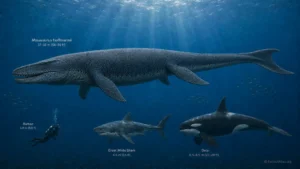
| Length | ~13–14 m (43–46 ft) |
| Weight | ~likely in the range of 14,000–15,000 kg (30,900–33,000 lb) |
| Status | Extinct |
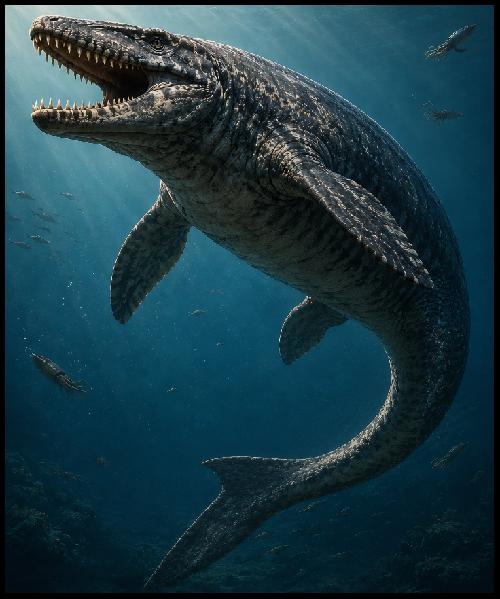
Quick Answer: Mosasaurus facts reveal a massive marine reptile — not a dinosaur — that ruled Late Cretaceous seas roughly 66–70 million years ago. Mosasaurus hoffmannii reached around 13–14 metres (43–46 ft) in length and weighed an estimated likely in the range of 14,000–15,000 kg (30,900–33,000 lb), making it one of the largest predators in its ecosystem. It is classified within Squamata, most closely related to monitor lizards.
The skull of Mosasaurus hoffmannii was first uncovered in a chalk quarry near Maastricht in the 1770s, and that single fossil was enough to help convince the scientific world that extinction was real. This was the specimen Georges Cuvier used to argue that entire species could vanish from the Earth. Today, fossils are known from Europe, Russia, Morocco, and North America. The posts below cover each major aspect of this animal’s biology, history, and ecology in detail.
How Big Was Mosasaurus?
| Feature | Detail |
|---|---|
| Maximum estimated length | ~13–14 m (43–46 ft) based on skull extrapolation |
| Mass estimate | ~likely in the range of 14,000–15,000 kg (30,900–33,000 lb), biomechanically modelled |
| Complete skeletons | Rare — estimates depend on partial material |
| Jurassic World depiction | ~22 m (72 ft) — not supported by fossil evidence |
Earlier estimates of 17–18 m (56–59 ft) are not supported by current evidence; the 22 m (72 ft) version seen in the Jurassic World films is a significant exaggeration.
For more details, see our full analysis on Mosasaurus size.
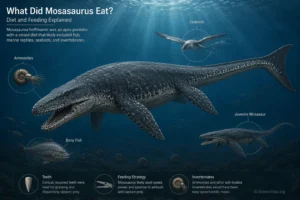
What Did Mosasaurus Eat?
| Feature | Detail |
|---|---|
| Confirmed prey types | Fish, cephalopods, marine birds, other mosasaurids |
| Evidence type | Gut contents and tooth-marked bones (Tier 1) |
| Trophic role | Apex predator |
| Juvenile threat | Cretoxyrhina shark may have preyed on juveniles |
For more details, see our full analysis of the Mosasaurus diet.
Mosasaurus vs. Megalodon
| Feature | Detail |
|---|---|
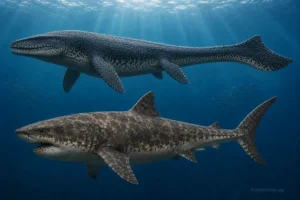
| Temporal overlap | None — approximately 60 Ma separates the two species |
| Size comparison | Megalodon was larger in both length and mass |
| Megalodon bite force | Estimated 108,500–182,200 N (biomechanical modelling) |
| M. hoffmannii bite force | No published biomechanical model exists |
| Encounter possibility | Zero — any matchup is a thought experiment |
For more details, see our full analysis on Mosasaurus vs Megalodon.
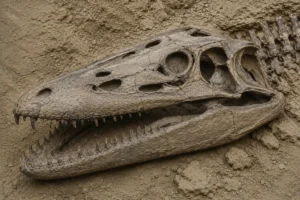
Mosasaurus Teeth and Anatomy
| Feature | Detail |
|---|---|
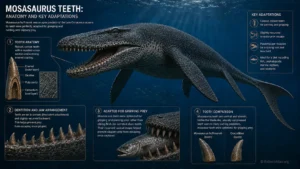
| Tooth type | Conical, recurved, pleurodont |
| Palatal teeth | Pterygoid (palate) teeth present — secondary gripping row |
| Jaw feature | Intramandibular joint for prey manipulation |
| Tooth replacement | Polyphyodont — continuous replacement throughout life |
| Tail | Hypocercal fluke confirmed by skin impressions |
For more details, see our full post on Mosasaurus teeth.
Mosasaurus Discovery and Fossil History
| Feature | Detail |
|---|---|
| Discovery location | St Pietersberg chalk quarries, near Maastricht |
| Discovery period | 1770s |
| Holotype location | Muséum National d’Histoire Naturelle (MNHN), Paris |
| Named by | William Conybeare, 1822 |
| Scientific significance | Cuvier used the specimen to establish the concept of extinction |
Fossil material is now known from the Netherlands, Belgium, Morocco, Russia, and North America.
For more details, see our full post on Mosasaurus discovery.
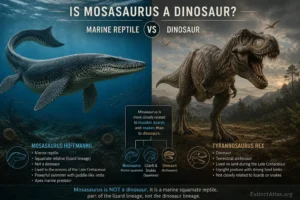
Is Mosasaurus a Dinosaur?
| Feature | Detail |
|---|---|
| Classification | Squamata — not Dinosauria |
| Closest living relatives | Monitor lizards (varanids) |
| Archosaurian ancestry | Absent |
| Coexistence with dinosaurs | Same geological period; not the same ecosystems |
| Phylogenetic placement | Actively debated within varanoid squamates |
For more details, see our full post on whether Mosasaurus is a dinosaur.
Mosasaurus Habitat and Range
| Feature | Detail |
|---|---|
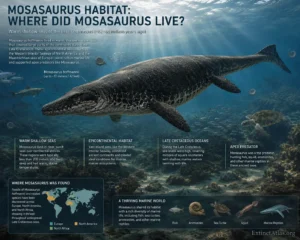
| Primary environment | Marine epicontinental seas |
| Geographic range | Netherlands, Belgium, Morocco, Russia, North America |
| Terrestrial capability | None — fully aquatic |
| Freshwater tolerance | Not confirmed for M. hoffmannii |
| Water conditions | Warm, shallow Late Cretaceous seas |
Freshwater mosasaurids do exist — Pannoniasaurus is a confirmed example — but freshwater tolerance has not been demonstrated for M. hoffmannii specifically.
For more details, see our full post on Mosasaurus habitat.
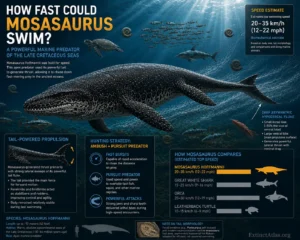
How Fast Was Mosasaurus?
| Feature | Detail |
|---|---|
| Sustained speed estimate | ~2 m/s (~7 km/h) — biomechanical modelling |
| Burst speed | Plausible but not modelled for M. hoffmannii |
| Locomotion method | Lateral tail undulation |
| Tail structure | Hypocercal fluke — confirmed by skin impressions |
Burst speed claims in popular sources lack a peer-reviewed biomechanical basis for this species specifically.
For more details, see our full post on Mosasaurus speed.
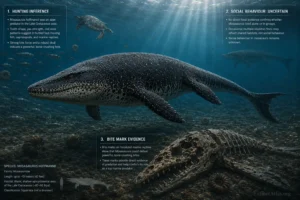
Mosasaurus Behaviour
| Feature | Detail |
|---|---|
| Feeding role | Generalist apex predator — confirmed by fossil evidence |
| Social behaviour | Unknown — no fossil evidence |
| Reproductive mode | Viviparity probable — confirmed in related taxa, not directly in M. hoffmannii |
| Chemosensory detection | Inferred from comparison with varanoid relatives |
Speculatively, the leaping behaviour depicted in the Jurassic World films is not supported by any fossil or biomechanical evidence — this is extrapolation, not direct evidence.
For more details, see our full post on Mosasaurus behaviour.
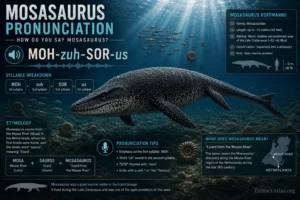
How Do You Pronounce Mosasaurus?
| Feature | Detail |
|---|---|
| Pronunciation | MOH-za-SORE-us |
| Syllable count | Four — MOH · za · SORE · us |
| Species epithet | hoffmannii — hoff-MAN-ee-eye |
| Mosa | Latin for the Meuse river |
| sauros | Greek for lizard |
The name encodes both the place of discovery and the man who found it: the Meuse river runs through Maastricht, and hoffmannii honours fossil collector Johann Leonard Hoffmann.
For more details, see our full post on Mosasaurus pronunciation.
Related and Contemporary Species
- Tylosaurus was a large North American mosasaurid of comparable size that shared Late Cretaceous epicontinental seas, though it is not the same genus as Mosasaurus.
- Prognathodon was a heavily built, broad-snouted mosasaurid known from similar formations across Europe and North Africa.
- Hainosaurus (sometimes synonymised with Tylosaurus) is another large mosasaurid from the Late Cretaceous of Europe.
- Pannoniasaurus is notable as a confirmed freshwater mosasaurid, contrasting with the fully marine habitat of M. hoffmannii.
- Platecarpus was a smaller, more lightly built mosasaurid that occupied a different ecological niche within the same Late Cretaceous seas.
Common Questions About Mosasaurus
Was Mosasaurus the biggest marine reptile ever?
Mosasaurus was not definitively the largest marine reptile ever to have lived. At an estimated 13–14 metres (43–46 ft), M. hoffmannii was among the largest mosasaurids, but Jurassic pliosaurs such as Pliosaurus and the ichthyosaur Shonisaurus also reached comparable or greater sizes. Size comparisons across lineages depend on incomplete material and are subject to ongoing revision.
When did Mosasaurus go extinct?
Mosasaurus went extinct at the end of the Cretaceous period, approximately 66 million years ago, during the mass extinction event that also eliminated non-avian dinosaurs. The cause is widely attributed to the Chicxulub asteroid impact and its cascading environmental effects, which collapsed the marine food chains that apex predators like Mosasaurus depended on.
How was Mosasaurus related to modern animals?
Mosasaurus was related to modern monitor lizards and snakes within the order Squamata. Fossil and molecular evidence places mosasaurids within the varanoid lineage, making the Komodo dragon a distant living cousin — though the exact phylogenetic placement within varanoids remains an active area of research.
Did Mosasaurus live at the same time as T. rex?
Mosasaurus and Tyrannosaurus rex did overlap in geological time, both living during the late Maastrichtian stage of the Late Cretaceous, approximately 66–68 million years ago. They did not, however, share the same environment: T. rex was a terrestrial predator of North American land ecosystems, while Mosasaurus was fully aquatic and inhabited open marine seas.
How do we know what Mosasaurus looked like?
What Mosasaurus looked like is known from fossil skull and skeletal material, supplemented by soft-tissue skin impressions from related mosasaurids. Fossil evidence confirms the general body plan — elongated, paddle-limbed, and tail-finned. The hypocercal tail fluke is supported by skin impression evidence from mosasaurids, though direct attribution to M. hoffmannii specifically carries some uncertainty.
References
- Conybeare, W.D. (1822). Additional notices on the fossil genera Ichthyosaurus and Plesiosaurus. Transactions of the Geological Society of London.
- Cuvier, G. (1808). Sur le grand animal fossile des carrières de Maastricht. Annales du Muséum national d’Histoire naturelle.
- Grigoriev, D.V. (2014). Giant Mosasaurus hoffmannii (Squamata, Mosasauridae) from the Late Cretaceous (Maastrichtian) of Penza, Russia. Proceedings of the Zoological Institute RAS.
- Lindgren, J., Caldwell, M.W., Konishi, T., & Chiappe, L.M. (2010). Convergent evolution in aquatic tetrapods: insights from an exceptional fossil mosasaur. PLoS ONE.
- Polcyn, M.J., & Bell, G.L. (2005). Russellosaurus coheni n. gen., n. sp., a 92 million-year-old mosasaur from Texas. Netherlands Journal of Geosciences.
- Russell, D.A. (1967). Systematics and morphology of American mosasaurs. Bulletin of the Peabody Museum of Natural History.
🦴 Fossil History
🦷 Anatomy
Featured Museum Collections
Museum-quality paleoart and educational poster
collections based on evidence-informed prehistoric
Life reconstructions.