At a Glance
| Field | Information |
|---|---|
| Species | Mosasaurus hoffmannii — Squamata, Mosasauridae |
| Period | Late Cretaceous, 82–66 Ma |
| Locomotion type | Subcarangiform to anguilliform — tail-driven |
| Tail structure | Hypocercal fluke — directly evidenced in mosasaurids |
| Speed estimate | Biomechanical estimates vary; see body section |
| Burst vs. sustained | Likely higher burst than cruising speed — comparative inference |
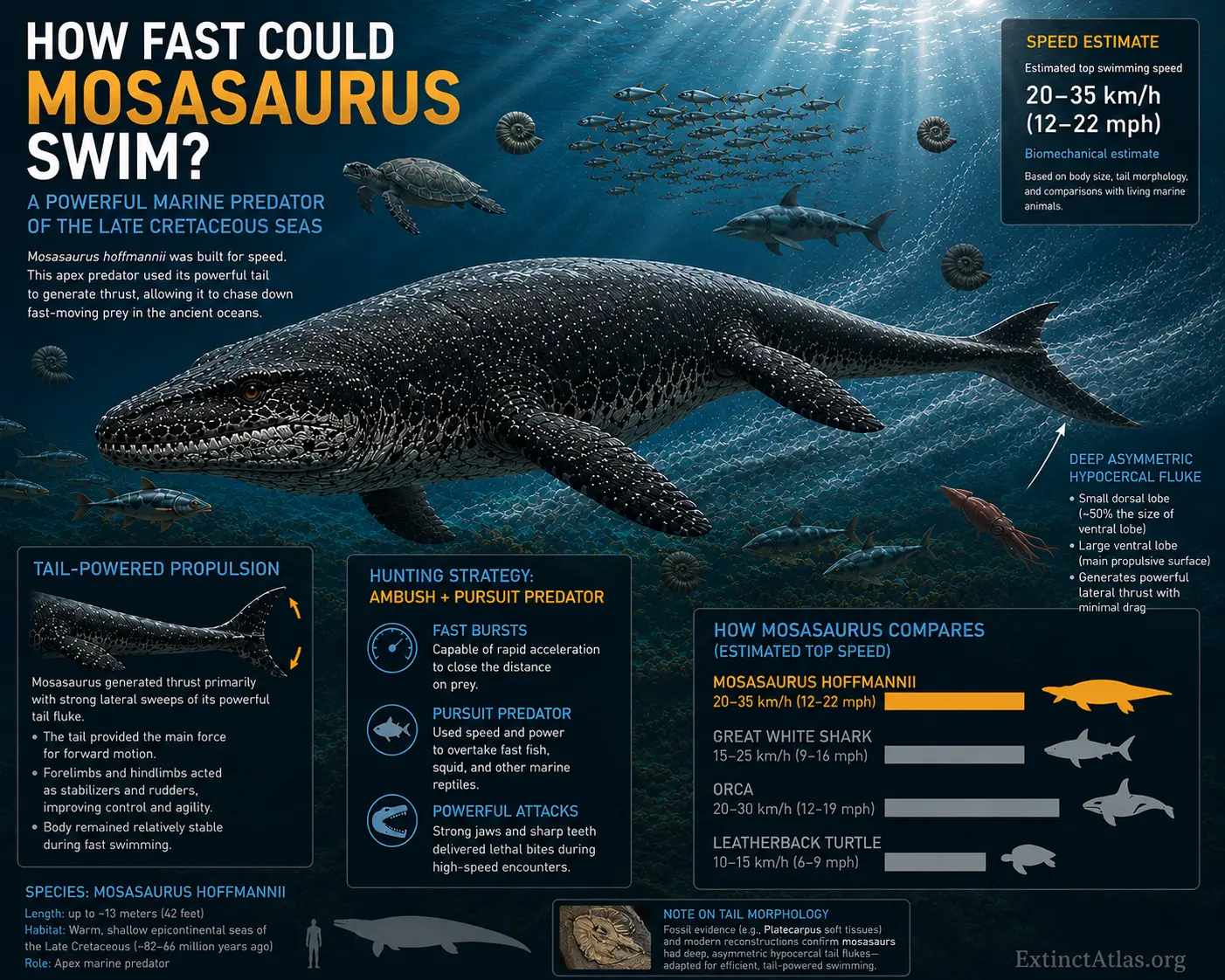
Quick Answer: Mosasaurus speed has not been directly measured from fossil evidence, but biomechanical modelling applied to its body plan and hypocercal tail fluke suggests swimming speeds in the range of approximately 2 metres per second (around 7 km/h or 4.5 mph) for sustained travel, with higher burst speeds plausible but not yet precisely modelled for M. hoffmannii specifically.
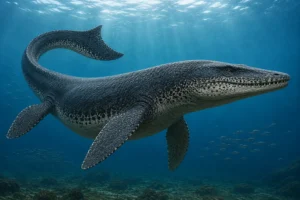
Speed in the fossil record is rarely directly measurable — but the tail tells much of the story. The confirmation that Mosasaurus carried a hypocercal tail fluke, rather than the simple eel-like tail assumed for most of the twentieth century, fundamentally changed how its locomotion is understood.
How Fast Was Mosasaurus hoffmannii?
Mosasaurus’ speed cannot be directly measured from fossil material. No trackways exist for fully marine animals, and soft tissues such as muscle do not preserve in a way that allows direct locomotor measurement. As a result, all speed estimates are derived from biomechanical modelling and comparison with living analogues.
Current modelling approaches—based on body proportions, estimated mass, and the geometry of the hypocercal tail fluke—suggest sustained swimming speeds on the order of ~2 metres per second (approximately 7 km/h or 4.5 mph). These values are best interpreted as approximate ranges, not precise measurements, and may vary depending on the assumptions used in different models.
Higher short-duration (burst) speeds, relevant to prey capture, are considered plausible. Comparisons with living tail-driven swimmers—such as Crocodylus porosus—indicate that animals with similar locomotor mechanics can exceed their cruising speeds significantly during rapid acceleration events. By analogy, Mosasaurus likely possessed a burst capacity above its sustained swimming speed.
However, no peer-reviewed biomechanical study has produced a species-specific burst speed estimate for M. hoffmannii. Consequently, any precise burst-speed figures reported in non-scientific or popular sources should be treated with caution.
What Locomotor Style Did Mosasaurus Use?
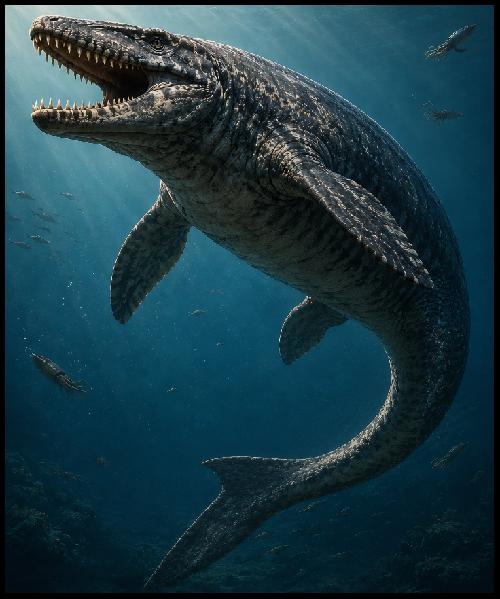
The locomotor style of Mosasaurus was primarily tail-driven, using lateral undulation of the posterior body and tail — a pattern described as subcarangiform to anguilliform depending on the degree of body flexion involved. This is inferred from body proportions directly evidenced in fossil skeletal material and from the confirmed presence of a hypocercal tail fluke, which produces thrust most efficiently through lateral sweeping rather than dorsoventral movement.
The hypocercal tail fluke — where the vertebral column deflects downward into the lower lobe of a vertical crescent-shaped fin — is directly evidenced in mosasaurid fossil skin impressions. Its geometry is broadly comparable to that of sharks rather than dolphins, meaning Mosasaurus swept its tail laterally rather than vertically. This distinction is directly relevant to speed and manoeuvrability estimates: lateral tail sweepers generally produce efficient sustained thrust but may be less agile in three-dimensional manoeuvring than dorsoventral swimmers like cetaceans.
For full details on tail anatomy, see our full post on Mosasaurus teeth and anatomy.
How Does Mosasaurus Speed Compare to Modern Marine Animals?
Placing Mosasaurus speed in context requires comparison with living animals of broadly similar body form — all Tier 3 comparative inference:
| Animal | Sustained speed | Burst speed | Locomotor style |
|---|---|---|---|
| Mosasaurus hoffmannii | ~2 m/s (7 km/h / 4.5 mph) — modelled estimate | Not precisely modelled | Lateral tail undulation |
| Saltwater crocodile | ~1–2 m/s (3.6–7.2 km/h / 2.2–4.5 mph) sustained | ~5 m/s (18 km/h / 11 mph) burst | Lateral tail undulation |
| Great white shark | ~1.5 m/s (5.4 km/h / 3.4 mph) sustained | ~3–4 m/s (11–14 km/h / 7–9 mph) burst | Thunniform |
| Leatherback sea turtle | ~1.8 m/s (6.5 km/h / 4 mph) sustained | ~2.5 m/s (9 km/h / 5.6 mph) burst | Foreflipper-driven |
These comparisons suggest Mosasaurus was a capable sustained swimmer with burst potential, but probably not among the fastest marine predators in absolute terms. Its competitive advantage as an apex predator almost certainly relied on size, ambush capability, and prey availability rather than raw speed. This is comparative inference — not direct evidence.
Did Mosasaurus Chase Its Prey?
Whether Mosasaurus actively chased prey or used ambush tactics is not directly evidenced in the fossil record. Speculatively, its body plan — large, robust, laterally undulating — is more consistent with ambush predation or slow pursuit than with high-speed open-water chasing of fast prey. Comparison with living large-bodied predators of similar locomotor style, such as saltwater crocodiles, supports an ambush or opportunistic pursuit model. This is Tier 3 comparative inference combined with Tier 4 speculation; neither is supported by direct behavioural fossil evidence. For broader behaviour, see our full post on Mosasaurus behaviour.
Related and Contemporary Species
- Platecarpus tympaniticus is the mosasaurid for which the most detailed soft-tissue tail evidence was described, providing the key locomotor model applied to mosasaurids generally.
- Tylosaurus proriger, with its longer, more slender body plan, may have been a faster, sustained swimmer than M. hoffmannii based on body proportion comparison.
- Cretoxyrhina mantelli, the contemporaneous Ginsu shark, used a thunniform locomotor style and was likely faster in open-water pursuit.
- Plotosaurus bennisoni was a late mosasaurid with a highly streamlined body plan and well-developed tail fluke, representing the most hydrodynamically refined mosasaurid known.
Frequently Asked Questions
How fast could Mosasaurus swim?
Mosasaurus’ swimming speed, based on biomechanical modelling of its body dimensions and tail fluke geometry, is estimated at approximately 2 metres per second (roughly 7 km/h or 4.5 mph) for sustained travel. Higher burst speeds are plausible based on comparison with living analogues, but have not been precisely modelled for M. hoffmannii in the peer-reviewed literature. All speed figures carry significant uncertainty.
Was Mosasaurus faster than a shark?
Whether Mosasaurus was faster than a shark depends on which shark and which speed metric. Biomechanical estimates place sustained Mosasaurus speed broadly comparable to, or slightly above, great white shark cruising speeds. However, thunniform swimmers like sharks likely had superior burst speed capability. Mosasaurus used lateral tail undulation rather than the more efficient thunniform style used by large sharks. This is comparative inference, not direct measurement.
How did Mosasaurus swim?
Mosasaurus swam using lateral undulation of its posterior body and tail — a subcarangiform to anguilliform style driven primarily by the hypocercal tail fluke. Fossil evidence directly confirms the tail fluke’s presence in mosasaurids. This style produces efficient sustained thrust through lateral sweeping, broadly comparable to how large crocodilians swim, rather than the vertical tail-beat used by dolphins and whales.
Conclusion
Mosasaurus hoffmannii was a competent, tail-driven swimmer whose confirmed hypocercal fluke substantially revised earlier reconstructions. Biomechanical estimates suggest modest sustained speeds, with burst potential above that, but precise figures remain unmodelled for this species specifically. Its dominance as an apex predator depended far more on size and opportunity than on outswimming its prey.
References (Publication Version)
- Lindgren et al. 2010 mosasaur soft tissue study
Lindgren, J., Caldwell, M.W., Konishi, T., & Chiappe, L.M. (2010). Convergent evolution in aquatic tetrapods: insights from an exceptional fossil mosasaur. PLOS ONE, 5(8), e11998. https://doi.org/10.1371/journal.pone.0011998 - Motani 2002 marine reptile swimming speed model
Motani, R. (2002). Swimming speed estimation of extinct marine reptiles: an energetic approach revisited. Paleobiology, 28(2), 251–262. https://doi.org/10.1666/0094-8373(2002)028<0251:SSEOEMR>2.0.CO;2 - Fish 1998 cetacean hydrodynamics study
Fish, F.E. (1998). Comparative kinematics and hydrodynamics of odontocete cetaceans: morphological and ecological correlates with swimming performance. Journal of Experimental Biology, 201(20), 2867–2877.
Featured Museum Collections
Museum-quality paleoart and educational poster
collections based on evidence-informed prehistoric
Life reconstructions.