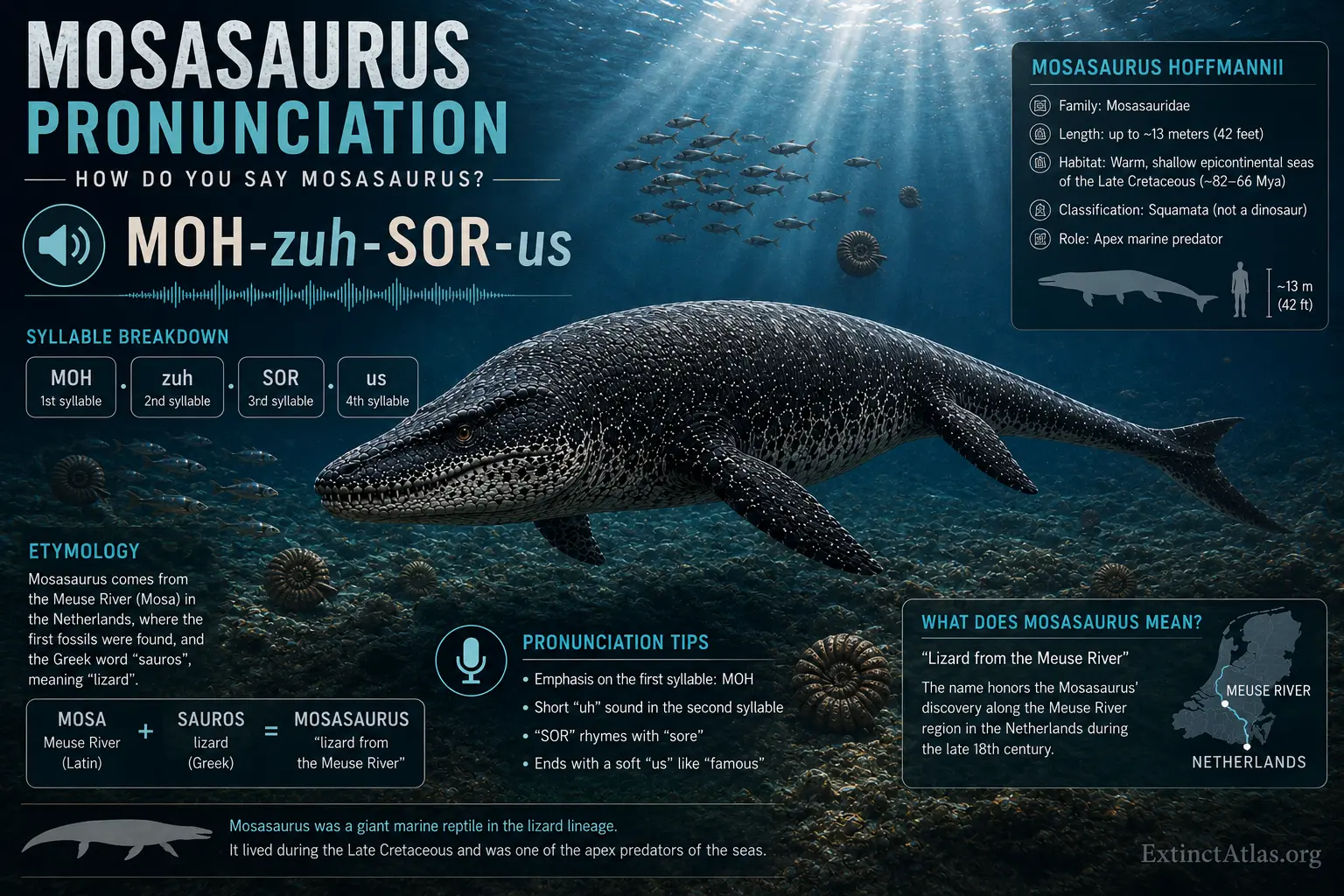
At a Glance
| Field | Information |
|---|---|
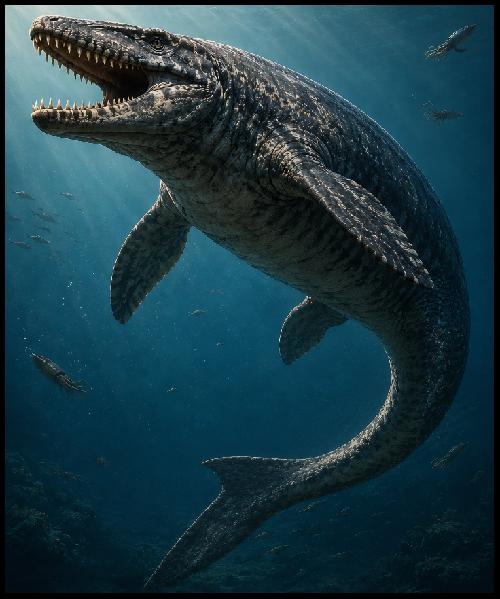
| Species | Mosasaurus hoffmannii — Squamata, Mosasauridae |
| Period | Late Cretaceous, 82–66 Ma |
| Pronunciation | MOH-za-SORE-us |
| Syllable breakdown | Mo · sa · sau · rus (4 syllables) |
| Name origin | Latin Mosa (Meuse river) + Greek sauros (lizard) |
| Species name | hoffmannii — pronounced hoff-MAN-ee-eye |
Quick Answer: Mosasaurus pronunciation is MOH-za-SORE-us, with four syllables: Mo-sa-sau-rus. The stress falls on the first and third syllables. The name combines the Latin word for the Meuse river (Mosa), near where the first specimen was discovered in the Netherlands, with the Greek word for lizard (sauros).
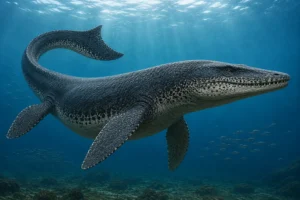
The name Mosasaurus has been mispronounced so consistently — even in documentary voiceovers — that the correct version can sound wrong on first hearing. Four syllables, stress on the first and third: MOH-za-SORE-us.
How Do You Pronounce Mosasaurus?
Mosasaurus is pronounced MOH-za-SORE-us. The four syllables break down as follows:
- Mo — rhymes with “go” — long O sound (MOH)
- sa — short, unstressed — “za” sound
- sau — the core of sauros, Greek for lizard — rhymes with “more” (SORE)
- rus — short, unstressed — “us” sound
The full pronunciation: MOH-za-SORE-us
Primary stress falls on the first syllable (MOH) and secondary stress on the third (SORE). The middle syllable sa is unstressed and passes quickly. The most common mispronunciation places equal stress across all syllables or emphasises the second syllable — MOH-ZA-sore-us — which is incorrect.
What Does Mosasaurus Mean?
The name Mosasaurus means “Meuse lizard” — a direct reference to the river and region where the first specimen was discovered. The etymology breaks down as:
- Mosa — Latin name for the Meuse river (Dutch: Maas), which flows through Maastricht in the Netherlands, near the St Pietersberg quarries where the type specimen was found
- sauros — ancient Greek for lizard; the standard suffix used in the naming of reptiles and dinosaurs throughout palaeontology
The genus name was established by William Daniel Conybeare in 1822. The species epithet hoffmannii honours Johann Leonard Hoffmann, the surgeon and fossil collector who first studied the Maastricht skull. Hoffmannii is pronounced hoff-MAN-ee-eye — four syllables with stress on the second.
For the historical details of the discovery that gave Mosasaurus its name, see our full post on the Mosasaurus discovery.
How to Pronounce Related Names
Other mosasaurid and related names that frequently cause difficulty:
| Name | Pronunciation | Meaning |
|---|---|---|
| Mosasauridae | MOH-za-SORE-ih-dee | The mosasaurid family |
| Tylosaurus | TIE-lo-SORE-us | Knob lizard |
| Platecarpus | plat-ee-KAR-pus | Flat wrist |
| Prognathodon | prog-NATH-oh-don | Forward jaw tooth |
| Hainosaurus | HAY-no-SORE-us | Haine lizard (Haine river, Belgium) |
| Maastrichtian | mah-STRIK-tee-an | Of Maastricht — the geological stage |
All pronunciations above follow standard palaeontological convention and classical Latin/Greek phonetics. Minor regional variation exists in the spoken pronunciation of Latin-derived scientific names, particularly between British and American English conventions.
Why Does Pronunciation Matter?
Consistent pronunciation aids communication — particularly for students, educators, and enthusiasts discussing prehistoric life. Scientific names are international by convention, derived from Latin and Greek roots, and their pronunciation follows classical phonetic patterns that apply consistently across the naming system. Once the pattern is understood, sauros always produces SORE-us; don always produces -don — a large proportion of prehistoric animal names become straightforward to pronounce correctly.
The name Mosasaurus also illustrates how palaeontological nomenclature records history: the river, the quarry, the surgeon who first handled the skull — all are encoded in two words. For the full story behind the name, see our full post on Mosasaurus discovery.
Related and Contemporary Species
- Tylosaurus proriger is a well-known North American mosasaurid whose name — TIE-lo-SORE-us — follows the same sauros pattern.
- Platecarpus tympaniticus combines Greek roots for flat wrist and drum — illustrating how anatomical features are sometimes encoded in species names.
- Prognathodon saturator uses Greek dental terminology in its genus name.
- Hainosaurus bernardi references the Haine River in Belgium, parallel to Mosasaurus referencing the Meuse.
- Mosasauridae — the family name — adds the standard Latin family suffix -idae to the genus root.
Frequently Asked Questions
How do you say Mosasaurus?
Mosasaurus is said as MOH-za-SORE-us, with four syllables and primary stress on the first and third. The breakdown is Mo (long O) — sa (unstressed) — sau (rhymes with “more”) — rus (unstressed). The most common error is placing equal stress on all syllables or emphasising the second syllable. The correct version — MOH-za-SORE-us — follows standard classical Latin and Greek phonetic conventions used across palaeontological naming.
What does the name Mosasaurus mean?
The name Mosasaurus means “Meuse lizard.” It combines Mosa, the Latin name for the Meuse river in the Netherlands, near where the first specimen was found, with sauros, the ancient Greek word for lizard. The species name hoffmannii honours Johann Leonard Hoffmann, the surgeon who first studied the original Maastricht skull in the 1770s.
Is it pronounced Mosasaurus or Mosasaurus?
Mosasaurus has one standard pronunciation — MOH-za-SORE-us — regardless of regional accent. Minor vowel variation exists between British and American English conventions for Latin-derived names, but the syllable count (four), the stress pattern (first and third syllables), and the core sounds remain consistent. There is no alternate accepted pronunciation; variations heard in popular media are generally errors rather than legitimate regional variants.
Conclusion
Mosasaurus is pronounced MOH-za-SORE-us — four syllables, stress on the first and third, named for the Meuse river and the Greek word for lizard. Getting the name right is a small thing, but it connects directly to the animal’s real history: a skull found in a Dutch chalk quarry that changed how science understood extinction.
References (Publication Version)
- Conybeare 1822 Mosasaurus naming history
Conybeare, W.D. (1822). Additional notices on the fossil genera Ichthyosaurus and Plesiosaurus. Transactions of the Geological Society of London, 1(2), 103–123. - International Commission on Zoological Nomenclature
International Commission on Zoological Nomenclature (1999). International Code of Zoological Nomenclature (4th ed.). International Trust for Zoological Nomenclature, London. https://www.iczn.org/the-code/the-international-code-of-zoological-nomenclature/ - Street and Caldwell 2017 Mosasaurus redescription
Street, H.P., & Caldwell, M.W. (2017). Rediagnosis and redescription of Mosasaurus hoffmannii (Squamata: Mosasauridae) and an assessment of species assigned to the genus Mosasaurus. Geological Magazine, 154(3), 521–557. https://doi.org/10.1017/S0016756815001090
Featured Museum Collections
Museum-quality paleoart and educational poster
collections based on evidence-informed prehistoric
Life reconstructions.