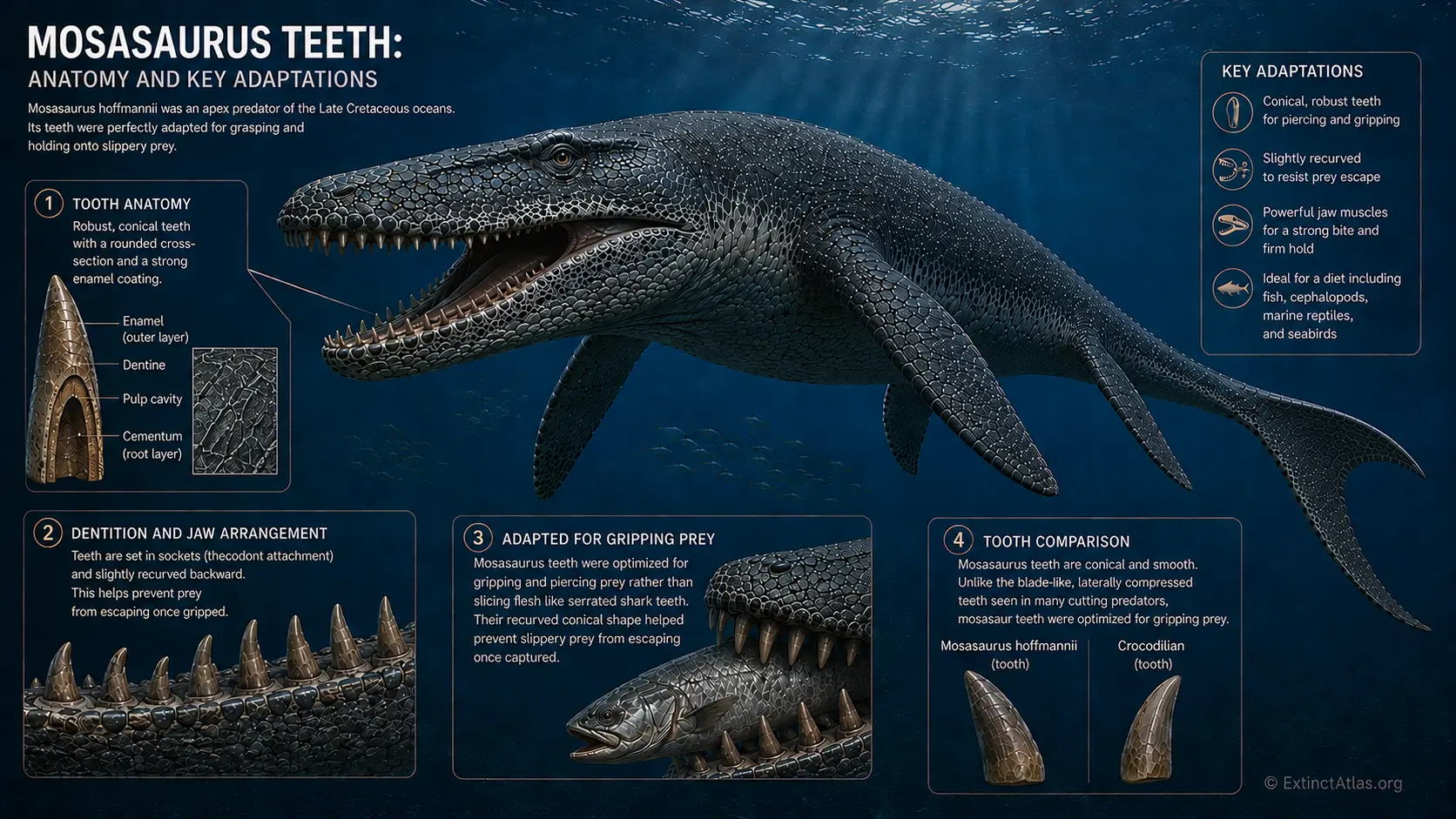
At a Glance
| Field | Information |
|---|---|
| Species | Mosasaurus hoffmannii — Squamata, Mosasauridae |
| Period | Late Cretaceous, 82–66 Ma |
| Tooth type | Conical, recurved, pleurodont attachment |
| Jaw feature | Double-hinged lower jaw — intramandibular joint directly evidenced |
| Tail structure | Hypocercal tail fluke — directly evidenced by fossil skin impressions |
Quick Answer: Mosasaurus teeth were conical and slightly recurved, anchored in a pleurodont attachment along the jaw margin, and suited for gripping and puncturing prey rather than cutting or crushing. The jaws featured a double-hinged structure allowing a wide gape. Fossil evidence also confirms a hypocercal tail fluke, giving Mosasaurus a shark-like swimming profile.
Opening
Until a specimen preserving soft tissue changed everything, scientists had reconstructed Mosasaurus with an eel-like, laterally undulating tail. Then fossilised skin impressions revealed a vertical tail fluke — and the animal’s entire swimming profile had to be reconsidered.
The fossilised jaws of Mosasaurus hoffmannii preserve teeth still locked in their sockets after 66 million years — conical points angled inward, each one a grip rather than a blade, built to seize prey and prevent escape rather than slice it.
Mosasaurus Teeth: Structure and Function
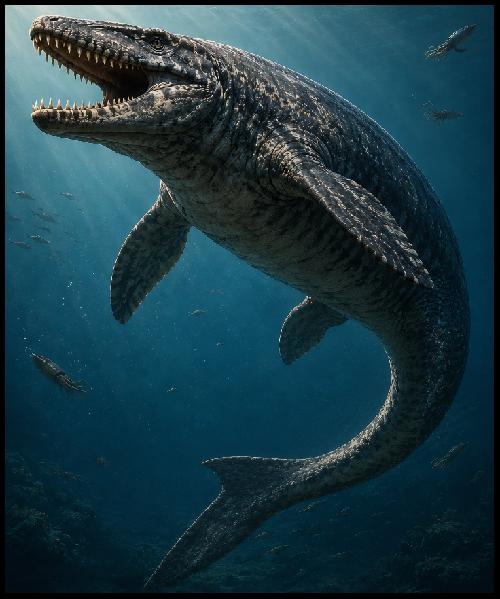
Mosasaurus teeth were conical, slightly recurved, and attached via pleurodont implantation — anchored to the inner side of the jawbone rather than set in deep sockets. Fossil evidence directly shows this tooth form across multiple specimens. The recurved shape directed prey inward rather than allowing it to pull free, functioning as a retention mechanism rather than a cutting tool. Tooth replacement was polyphyodont — new teeth grew continuously to replace worn or lost ones, also directly evidenced in fossil material.
The teeth varied slightly along the jaw. Anterior teeth were more elongated and pointed; posterior teeth were more robust. This gradation is consistent with anterior teeth functioning in initial prey capture and posterior teeth providing additional grip and puncture force. Comparison with living monitor lizards, the closest terrestrial relatives of mosasaurids, supports this functional interpretation, though direct behavioural evidence is unavailable.
Pterygoid Teeth
Fossil evidence shows Mosasaurus bore a second row of teeth on the pterygoid bones of the palate — a feature shared with other mosasaurids and with some living lizards. These palatal teeth functioned to prevent prey from moving forward and escaping through the mouth after initial capture. This double-row arrangement is directly evidenced in well-preserved skull material and represents one of the clearest functional adaptations for prey retention in the group.
The Double-Hinged Jaw
Mosasaurus possessed an intramandibular joint — a flexible hinge within the lower jaw itself, in addition to the primary jaw joint. Fossil evidence directly documents this feature in M. hoffmannii skull material. This joint allowed the lower jaw to flex slightly outward as well as downward, increasing the effective gape and enabling the animal to manoeuvre large prey items into position for swallowing.
This jaw architecture is homologous with the kinetic skull of living snakes and monitor lizards — a shared feature inherited from a common ancestor. Comparison with modern boidae constrictors, which use a similar intramandibular mechanism to swallow large prey whole, supports the inference that Mosasaurus was capable of ingesting prey substantially larger than its jaw width at rest might suggest. This is comparative inference, not direct behavioural evidence.
Did Mosasaurus Have a Tail Fin?
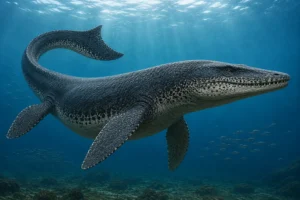
Mosasaurus did have a tail fin — specifically a hypocercal tail fluke, where the vertebral column deflects downward into the lower lobe of a vertical, crescent-shaped fin. This is directly evidenced by fossilised skin impressions from mosasaurid specimens, most notably the landmark study of Platecarpus and subsequently confirmed across multiple mosasaurid taxa. The vertebral downward deflection — the hypocercal bend — is directly visible in articulated fossil skeletons.
This tail form produces thrust similar to that of sharks and ichthyosaurs — a convergent adaptation to high-efficiency swimming in open water. Prior reconstructions showing an eel-like undulating tail without a distinct fluke are now considered outdated. The tail fluke substantially revised the understanding of mosasaurid locomotor capability and speed potential. For speed estimates derived from this locomotor model, see our full post on Mosasaurus speed.
Skull Dimensions and Sensory Anatomy
The skull of Mosasaurus hoffmannii was proportionally large — fossil evidence from the best-known specimens places skull length at approximately 1.4–1.5 metres (4.6–4.9 ft) in the largest individuals. The orbits (eye sockets) were large relative to skull size, consistent with good visual acuity, though inferences about actual visual capability involve comparison with living reptiles and are not directly measurable from bone alone.
The forked tongue of living monitor lizards — used for chemosensory detection — provides a comparative basis for inferring that mosasaurids, including Mosasaurus, may have used a similar Jacobson’s organ system for detecting prey at a distance. This is Tier 3 comparative inference; no direct fossil evidence for soft-tissue chemosensory organs exists for M. hoffmannii.
Related and Contemporary Species
Platecarpus tympaniticus is the mosasaurid for which the most significant soft-tissue tail fluke evidence was described, providing the key comparative basis for Mosasaurus tail reconstruction. Prognathodon saturator had more robust, rounder teeth suited to crushing hard-shelled prey — a dietary specialisation directly reflected in its tooth morphology. Tylosaurus proriger had a distinctive rostral projection at the front of the skull, possibly used in prey stunning. Clidastes propython was a small, agile mosasaurid with a more elongated, flexible body plan. Hainosaurus bernardi was a large European mosasaurid with a similar overall jaw and tooth plan to Mosasaurus.
Frequently Asked Questions
Did Mosasaurus have a tail fin?
Mosasaurus did have a tail fin, directly evidenced by fossilised skin impressions from mosasaurid specimens. The fin was a hypocercal fluke — a vertical, crescent-shaped structure formed as the vertebral column deflected downward into the lower lobe. This feature, now confirmed across multiple mosasaurid taxa, revised earlier reconstructions that depicted a simple eel-like tail without a distinct fin.
How Many Teeth Did Mosasaurus hoffmannii Have?
The exact tooth count of Mosasaurus varied between individuals and depended on the completeness of fossil specimens. Well-preserved skull material shows teeth present along both the dentary (lower jaw) and maxillary (upper jaw) bones, along with an additional row of teeth on the pterygoid bones of the palate.
In mosasaurids, tooth counts are not fixed and can differ slightly between taxa and individuals. However, comparative anatomical studies indicate that each side of the upper and lower jaws typically carried on the order of ~14–18 functional teeth, with variation depending on species and preservation. The pterygoid bones also bore a separate series of smaller teeth used in prey retention.
Because complete skulls of Mosasaurus are relatively rare and tooth replacement was continuous (polyphyodonty), any specific total tooth count should be treated as an approximate range rather than a fixed number.
Why is Mosasaurus related to snakes and lizards?
Mosasaurus is related to snakes and lizards because it belongs to Squamata — the same reptile group that includes all living lizards and snakes. Fossil evidence and molecular analysis of living relatives place mosasaurids within the varanoid lizards, most closely related to monitor lizards. The double-hinged jaw and pleurodont tooth attachment are anatomical features shared with living squamates.
Conclusion
Mosasaurus hoffmannii was anatomically well-documented in its key predatory structures. Its conical teeth gripped prey; its double-hinged jaw widened its gape; its pterygoid teeth prevented escape; and its hypocercal tail fluke drove it efficiently through open water. Together, these features explain both how it hunted and how it dominated Late Cretaceous seas.
References
- Lingham-Soliar 1995 Mosasaurus functional morphology
Lingham-Soliar, T. (1995). Anatomy and functional morphology of the largest marine reptile known, Mosasaurus hoffmannii (Mosasauridae, Reptilia) from the Upper Cretaceous, Upper Maastrichtian of the Netherlands. Philosophical Transactions of the Royal Society B, 347(1320), 155–180. https://doi.org/10.1098/rstb.1995.0019 Lindgren et al. 2010 mosasaur soft tissue and hydrodynamicsConvergent evolution in aquatic tetrapods: insights from an exceptional fossil mosasaur
Lindgren, J., Caldwell, M.W., Konishi, T., & Chiappe, L.M. (2010)..PLOS ONE, 5(8), e11998. https://doi.org/10.1371/journal.pone.0011998
Featured Museum Collections
Museum-quality paleoart and educational poster
collections based on evidence-informed prehistoric
Life reconstructions.