
Introduction
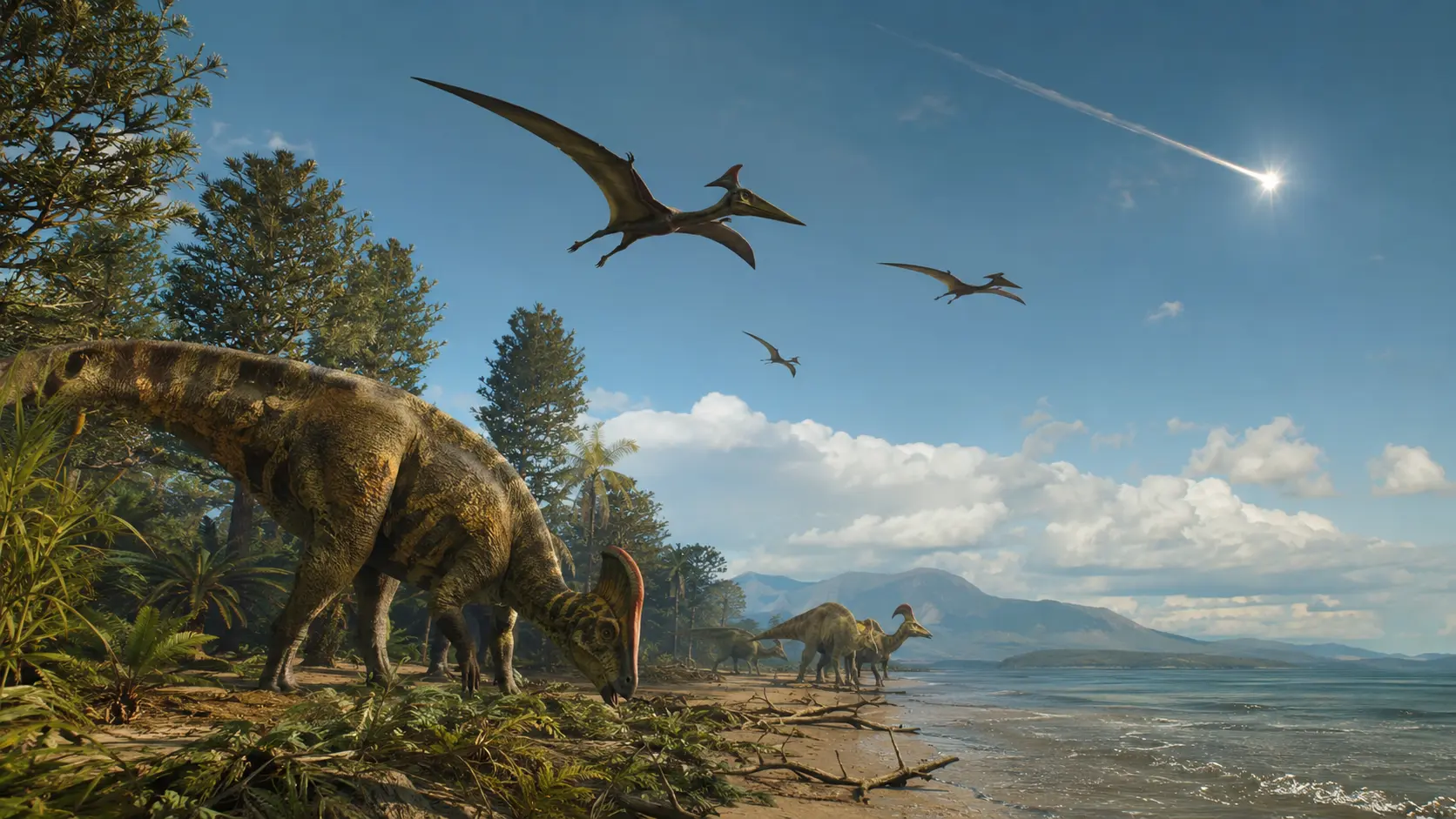
Imagine the last morning of the Cretaceous Period. Along the warm, shallow shores of what is now the Gulf of Mexico, a hadrosaur wades through reeds, pulling at vegetation. Pterosaurs wheel overhead. The sky is blue, the world is green, and the air is thick with the hum of insects. Nothing in the sensory world of that morning suggests that within hours, everything is about to change forever.
Somewhere above the atmosphere, a rock roughly the size of a small mountain is traveling at approximately 20 kilometers per second. It has been journeying through space for billions of years. In the next few seconds, it will end one of the most successful experiments in vertebrate evolution and set the stage for the world we live in today.
The Chicxulub impact event, which occurred approximately 66 million years ago at the boundary between the Cretaceous and Paleogene periods, is the most consequential single moment in the history of complex terrestrial life. In an instant of geological time, roughly 75 percent of all species on Earth were wiped out. Non-avian dinosaurs, which had dominated terrestrial ecosystems for over 165 million years, vanished entirely. Pterosaurs, mosasaurs, ammonites, and countless marine organisms followed them into oblivion.
What survived — small, burrowing, generalist mammals among them — would go on to inherit a transformed planet, eventually giving rise to every large land animal alive today, including us.
This is the story of how it happened, how we know, and why it matters.
Quick Facts
| Attribute | Detail |
|---|---|
| Event Name | Chicxulub Impact Event |
| Extinction Event | Cretaceous–Paleogene (K–Pg) Extinction |
| Age | 66.043 ± 0.011 Ma |
| Impact Location | Yucatán Peninsula, Mexico |
| Crater Diameter | ~180 km |
| Impactor Diameter | ~10–15 km |
| Impact Velocity | ~20 km/s |
| Energy Released | ~10²³ J (~100 million megatons TNT) |
| Extinction Severity | ~75% of all species |
| Major Victims | Non-avian dinosaurs, pterosaurs, mosasaurs, ammonites |
| Major Survivors | Birds, mammals, crocodilians, turtles, amphibians |
| Scientific Consensus | Impact primary cause; volcanism a secondary stressor |
Geological Setting: The Late Maastrichtian World
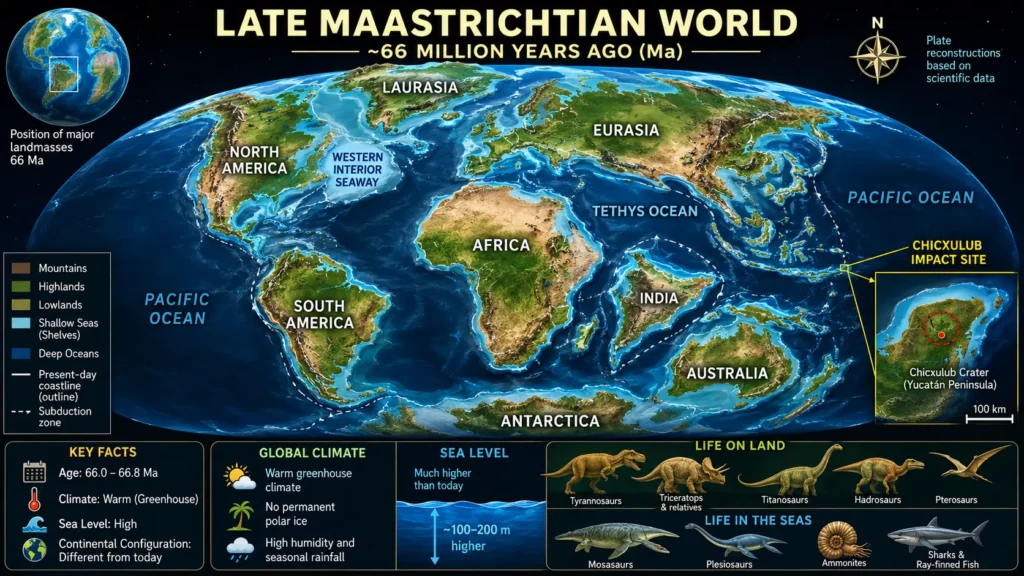
To understand the scale of what was lost and why the Chicxulub impact was so devastating, it is essential to understand the world it struck.
The Maastrichtian Age — the final stage of the Cretaceous Period, spanning roughly 72 to 66 million years ago — was a world fundamentally different from our own. Earth was in a prolonged greenhouse climate state, warmer than today by several degrees, with no permanent polar ice caps and sea levels significantly higher than modern levels. The continents were arranged differently: a broad interior seaway, the Western Interior Seaway, split North America in two. Tropical and subtropical forests extended to far higher latitudes than they do today, and the global climate was relatively stable.
Plate tectonic configurations had important consequences for both biodiversity and extinction itself. The Indian subcontinent was an isolated island moving northward toward Asia, and it hosted one of the most consequential geological events of the Maastrichtian: the onset of the Deccan Traps flood basalt eruptions, which began approximately 66.5 million years ago and continued through the earliest Paleogene. These eruptions released large volumes of carbon dioxide and sulfur dioxide over millions of years and are considered to have placed ecosystems under environmental stress before the impact occurred.
Sea levels in the Maastrichtian were high but had been falling gradually through the final stages of the Cretaceous, exposing continental shelves and reducing the extent of the warm shallow seas that had characterized earlier Cretaceous marine ecosystems. Marine biodiversity, while still extraordinarily rich, showed some evidence of declining diversity in certain groups in the final million years of the period — a pattern that has been debated as either a genuine biological signal or a sampling artifact in the fossil record.
Terrestrial ecosystems were dominated by dinosaurs at every level of the food web. This was the stage for the most diverse assemblage of large vertebrates ever to walk the land: tyrannosaurs, hadrosaurs, ceratopsians, ankylosaurs, and titanosaur sauropods, alongside a supporting cast of smaller theropods, early birds, lizards, snakes, and the small, mostly nocturnal mammals that would eventually inherit the post-impact world.
This was the Maastrichtian world: diverse, complex, geologically stressed by ongoing volcanism, and apparently stable across the timescales visible in the fossil record. And then the asteroid arrived.
Discovery: The Science Behind the Hypothesis
The Alvarez Hypothesis
For most of modern geology’s history, the end-Cretaceous extinction was acknowledged but poorly explained. Paleontologists had long recognized that the fossil record underwent a dramatic turnover at the K–Pg boundary — the thin geological layer separating Cretaceous rocks below from Paleogene rocks above. Below it: dinosaurs, ammonites, mosasaurs. Above it: none of them. But the cause remained deeply uncertain.
The breakthrough came not from a paleontologist, but from a physicist and his geologist son. In the late 1970s, Walter Alvarez was studying the K–Pg boundary layer in the limestone cliffs near Gubbio, Italy. The boundary was marked by a thin band of reddish clay, just a centimeter or two thick, separating two biological worlds. Curious about how long it had taken to deposit, he brought samples to his father, Luis Alvarez, a Nobel Prize-winning physicist at the University of California, Berkeley.
What they found was extraordinary. The clay layer contained iridium at concentrations roughly 30 times higher than the surrounding limestone. Iridium is extraordinarily rare in Earth’s crust — it sinks to the core during planetary formation — but it is relatively abundant in certain types of meteorites and asteroids.
Their conclusion, published in 1980, was audacious: a massive asteroid impact had deposited a global layer of iridium-enriched debris at the K–Pg boundary, and this impact was the cause of the mass extinction.
Initial scientific reaction ranged from skepticism to outright hostility. Geologists were deeply committed to uniformitarianism — the principle that Earth’s history is shaped by slow, gradual processes. Paleontologists argued that the fossil record showed a gradual dinosaur decline over millions of years, inconsistent with a sudden catastrophic impact. The hypothesis was widely dismissed.
But the evidence kept accumulating. Other researchers independently confirmed a global iridium anomaly at the K–Pg boundary — not just in Italy, but in Spain, Denmark, New Zealand, and eventually hundreds of sites worldwide. Shocked quartz crystals, formed only under the extreme pressures of a nuclear explosion or hypervelocity impact, were found in the same layer globally. Tiny glass spherules, formed when molten rock is blasted into the atmosphere and resolidifies, appeared in K–Pg boundary deposits on every continent. The physical fingerprints of a massive impact were written into rock around the entire planet.
But a fundamental problem remained: if there had been an impact large enough to cause a global extinction, there should be a crater. No one had found one.
Discovery of the Crater
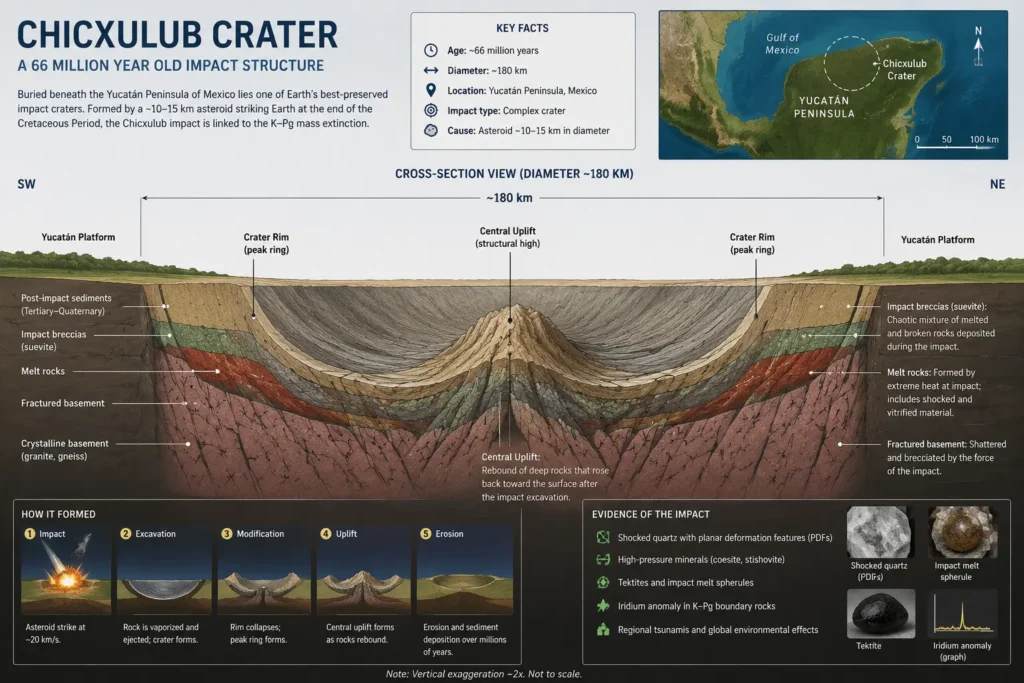
The crater had already been found — but no one had made the connection.
In the late 1970s, geophysicist Glen Penfield was conducting aerial magnetic surveys over the Yucatán Peninsula on behalf of PEMEX, the Mexican national oil company. The surveys revealed a striking subsurface anomaly: a nearly perfect semicircular arc of dense magnetic material buried beneath kilometers of sediment. Penfield suspected an impact crater and attempted to present his findings at a scientific conference in 1981, but the PEMEX data were proprietary, and he could not publish fully. The finding attracted little attention.
The connection was made independently in the late 1980s and early 1990s, when Alan Hildebrand, a graduate student at the University of Arizona, was systematically searching for the source crater. He contacted Penfield, obtained the PEMEX data, and in 1991, they jointly published the identification of the Chicxulub crater as the K–Pg impact site.
The crater is enormous. At roughly 180 kilometers in diameter, it is one of the largest confirmed impact structures on Earth. It sits partly offshore beneath the shallow waters of the Gulf of Mexico and partly buried under the limestone platform of the Yucatán Peninsula. It is not visible at the surface — the impact occurred in a shallow tropical sea, and the crater was subsequently buried under millions of years of sediment — but it is clearly detectable through geophysical surveys, gravity measurements, and drill cores.
Crucially, the age of rocks within the crater, determined through radiometric dating, matches the K–Pg boundary to within measurement uncertainty: 66.043 ± 0.011 million years ago. The crater, the iridium layer, the shocked quartz, and the extinction boundary are all the same event.
Impact Parameters
| Parameter | Estimate |
|---|---|
| Impactor Diameter | 10–15 km |
| Impact Velocity | ~20 km/s |
| Impact Angle | ~45–60° from horizontal |
| Crater Diameter | ~180 km |
| Peak Ring Diameter | ~90 km |
| Transient Crater Depth | ~30 km |
| Energy Released | ~10²³ J |
| TNT Equivalent | ~100 million megatons |
| Event Age | 66.043 ± 0.011 Ma |
| Target Rock Type | Carbonate and sulfate evaporite |
The Day the Asteroid Hit
What follows is a reconstruction based on impact physics, numerical modeling, and geological evidence. No observer was present. But the rocks record it in extraordinary detail.
Immediate Effects (Seconds to Hours)
T = 0: Entry and Impact
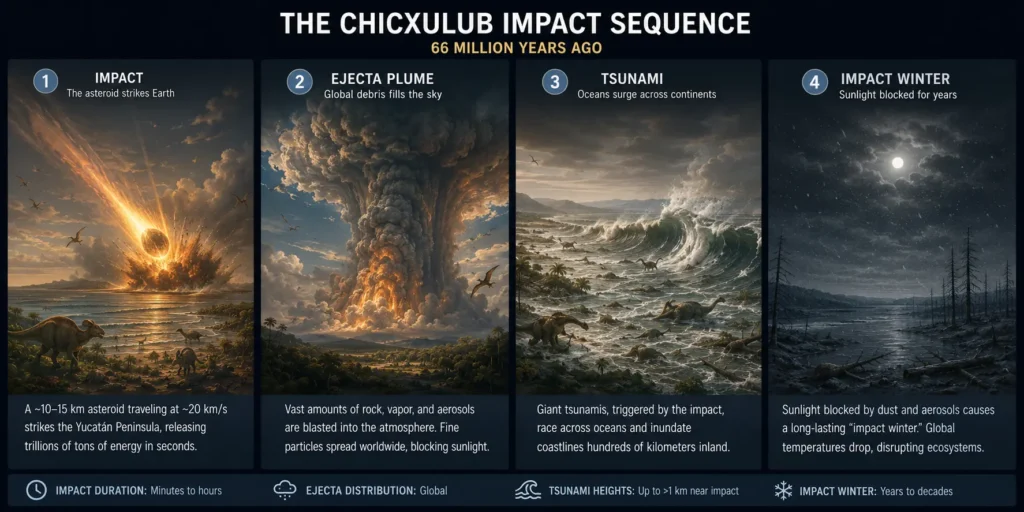
The impactor — most likely a carbonaceous chondrite asteroid approximately 10 to 15 kilometers in diameter — entered Earth’s atmosphere at roughly 20 kilometers per second. At that velocity, the atmosphere provided essentially no braking. The object struck the shallow carbonate and evaporite rocks of the Yucatán shelf, releasing energy equivalent to approximately 100 million megatons of TNT in the first seconds of impact. The explosion excavated a transient crater perhaps 100 kilometers wide and 30 kilometers deep.
The target rocks were catastrophically unfortunate in their composition. The Yucatán platform is composed primarily of limestone and sulfate-rich evaporites — rocks that, when vaporized at impact temperatures, release enormous quantities of carbon dioxide and sulfur dioxide into the atmosphere. Several studies suggest the sulfate-rich nature of these target rocks may have substantially amplified global climatic effects relative to impacts in other geological settings, though the precise magnitude of this amplification remains an area of ongoing research.
T = Minutes: Seismic and Ejecta Events
Within minutes, the impact triggered earthquakes estimated at magnitude 10 or greater across the Western Hemisphere. Simultaneously, an enormous volume of rock, dust, and molten material was ejected into and beyond the atmosphere. Much of this ejecta followed suborbital trajectories, leaving the atmosphere entirely before raining back down across the globe over the following hour.
T = 1 Hour: Tsunamis
The impact on the shallow Gulf of Mexico generated tsunamis of extraordinary scale. Evidence of these waves — chaotic layers of mixed marine sediments, disrupted stratigraphy, and transported debris — has been found as far away as Texas, Alabama, and Cuba.
T = Hours: Thermal Pulse and Wildfires
As ejecta re-entered the atmosphere at high velocity, frictional heating raised atmospheric temperatures enough to potentially ignite vegetation across large areas of the Northern Hemisphere. A globally distributed soot layer in K–Pg boundary sediments indicates that large-scale wildfires occurred in the immediate aftermath, though the precise geographic extent and intensity of these fires remain debated among researchers.
Short-Term Effects (Months to Years)
Impact Winter
The most lethal medium-term consequence of the impact was the sustained reduction of incoming solar radiation caused by stratospheric loading of dust, soot, and sulfate aerosols. Climate models suggest that global average surface temperatures may have dropped substantially within weeks, though the precise magnitude and duration of this cooling continue to be refined as modeling improves. Photosynthesis — the foundation of nearly every food web on the planet — was severely curtailed for months, possibly years.
Acid Rain
The sulfur dioxide volatilized from Yucatán evaporites combined with atmospheric water vapor to produce sulfuric acid aerosols, which fell globally as acid rain. This damaged terrestrial vegetation directly and acidified surface freshwater and shallow marine environments.
Ocean Acidification
Carbon dioxide released by the vaporization of carbonate rocks, combined with sulfur compounds, drove the rapid acidification of the ocean’s surface layer. Evidence for this acidification is preserved in deep-sea sediment cores, which show a sudden disappearance of carbonate-secreting plankton at the K–Pg boundary followed by a biologically impoverished interval — sometimes termed the “Strangelove Ocean” — before recovery began.
Long-Term Effects (Thousands to Millions of Years)
Ecological Collapse and Fern Spike
The collapse of photosynthesis propagated upward through food webs with brutal efficiency. Plants died. Herbivores starved. Carnivores followed. The only ecological roles that continued to function were those based on stored energy, seeds, detritus, and the decomposer organisms — fungi, bacteria, and insects — that subsisted on dead organic matter rather than living plant communities.
One of the most striking signatures of the immediate post-impact world in the plant fossil record is the “fern spike” — a dramatic increase in fern spores immediately above the K–Pg boundary. Ferns are opportunistic colonizers of disturbed environments, among the first plants to recolonize after volcanic eruptions and wildfires. Their sudden proliferation tells us that the post-impact plant communities were pioneer assemblages in a largely denuded landscape.
Climate Instability
Recent research suggests that environmental instability may have persisted for tens of thousands of years after the impact. The impact winter gave way to a period of greenhouse warming as atmospheric CO₂ — released both by the impact and by ongoing Deccan volcanism — accumulated in the absence of a healthy photosynthetic biosphere to draw it down. Ecosystems oscillated between disrupted states before gradually stabilizing.
Ocean Recovery
The “Strangelove Ocean” interval — the period of severely reduced biological productivity in the oceans following plankton collapse — lasted for hundreds of thousands of years. New plankton communities diversified slowly to replace the lineages lost at the boundary, and the full recovery of marine food web complexity took millions of years.
Evidence Supporting the Chicxulub Impact Hypothesis
The Chicxulub impact hypothesis is supported by multiple independent lines of evidence converging on the same conclusion. This evidence base is one of the most robust in the history of palaeontology.
| Evidence Type | Observation | Interpretation |
|---|---|---|
| Iridium Anomaly | Global iridium enrichment at K–Pg boundary (30–160× background) | Extraterrestrial material deposited globally at impact |
| Shocked Quartz | Quartz grains with planar deformation features at K–Pg boundary | Hypervelocity impact pressures; cannot form by volcanism |
| Tektites | Glass beads from melted and resolidified crustal rock | Ejecta from high-energy impact |
| Spherules | Global distribution of impact spherule layer | Atmospheric dispersal of impact melt |
| Tsunami Deposits | Chaotic mixed sediments across Gulf of Mexico region | Catastrophic wave events coincident with impact |
| Chicxulub Crater | 180 km impact structure beneath Yucatán | Physical source of impact event |
| Radiometric Dating | Crater age 66.043 ± 0.011 Ma matches K–Pg boundary | Direct temporal correlation between impact and extinction |
| Osmium Isotopes | Extraterrestrial osmium signature at boundary | Independent confirmation of meteoritic input |
| Carbon Isotope Excursion | Abrupt shift in marine carbon isotopes at boundary | Collapse of marine biological productivity |
The Victims
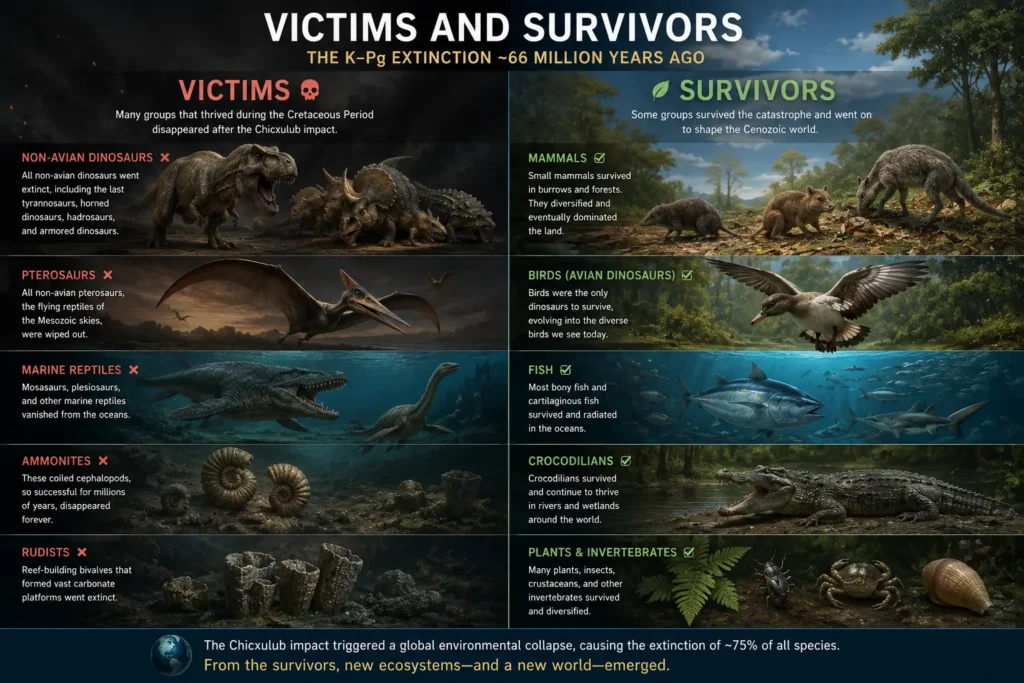
Non-Avian Dinosaurs
Every lineage of non-avian dinosaur disappeared at the K–Pg boundary. Tyrannosaurs, ceratopsians, hadrosaurs, ankylosaurs, sauropods, pachycephalosaurs — the entire non-avian dinosaur fauna, dominant for 165 million years, was eliminated. No non-avian dinosaur species is known to have crossed the boundary into the Paleogene, and claims of “Paleocene dinosaurs” based on reworked fossils have not been substantiated in peer-reviewed literature.
Pterosaurs
Flying reptiles that had ruled Mesozoic skies since the Triassic were completely wiped out. Several large pterosaur species were still thriving at the end of the Cretaceous. None survived.
Mosasaurs
These highly successful marine predators, which had diversified explosively through the Late Cretaceous, were completely exterminated. The largest, exceeding 15 meters in length, were among the most formidable predators in Earth’s history. None crossed the K–Pg boundary.
Ammonites
The ammonites — coiled cephalopod mollusks that had survived three previous mass extinctions across 300 million years of evolutionary history — were eliminated. Their shells are so abundant in Cretaceous rocks that they are among the most commonly encountered macrofossils worldwide. Every species was gone by the close of the Cretaceous.
Marine Plankton
Perhaps the most ecologically devastating losses were at the microscopic level. Foraminifera, coccolithophores, and dinoflagellates — the organisms forming the base of marine food webs — suffered extinction rates exceeding 90 percent at the K–Pg boundary. Without a functioning plankton community, the ocean’s food web collapsed from the bottom up. Recovery took millions of years.
The Survivors
Not everything died. Understanding why certain lineages survived while others perished is as revealing as the extinction itself.
Why Some Organisms Survived: Selectivity Analysis
| Trait | Groups Benefiting | Survival Mechanism |
|---|---|---|
| Small body size | Mammals, lizards, small birds | Lower caloric requirements during food web collapse |
| Burrowing behavior | Mammals, amphibians, insects | Shelter from thermal pulse; buffered microclimate |
| Freshwater habitat | Turtles, freshwater fish, crocodilians | Freshwater ecosystems partially buffered from marine acidification and terrestrial collapse |
| Generalist diet | Mammals, birds, crocodilians | Ability to exploit whatever food sources remained |
| Seed consumption | Small birds, small mammals | Seeds persist in soil for years without photosynthesis |
| Detritivory | Insects, fungi, bacteria | Subsisting on dead organic matter rather than living plants |
| Slow metabolism | Crocodilians, turtles | Ability to survive extended starvation |
| Short generation time | Insects, small vertebrates | Rapid population recovery after bottleneck |
Birds
Birds are avian dinosaurs — the only dinosaur lineage to cross the K–Pg boundary. Several bird lineages survived, likely owing to their small body size, generalist diets including seed consumption, and possibly the ability to exploit detritus-based food chains. All 10,000-plus living bird species are the direct descendants of these survivors. Every bird alive today is, in a precise scientific sense, a dinosaur.
Mammals
Mammals had existed throughout the Mesozoic but remained consistently small and ecologically marginal. This marginality likely contributed to their survival: small bodies required less food, generalist and omnivorous diets were flexible enough to exploit whatever remained, and burrowing behaviors common in small mammals offered protection from the thermal pulse and the worst temperature extremes of the impact winter.
Crocodilians
Crocodilians are among the most puzzling survivors. Large-bodied, slow-reproducing, and ecologically dependent on functioning food webs, they appear poor candidates for mass extinction survival. Their semi-aquatic lifestyle — which placed them at the interface of freshwater and terrestrial ecosystems, with the freshwater system offering some buffering — combined with their extraordinary capacity for extended starvation, likely explains their persistence. Living crocodilians retain a body plan essentially unchanged since the Cretaceous, making them among the most morphologically conservative of all surviving vertebrate lineages.
Turtles and Freshwater Fish
Freshwater ecosystems, while badly disrupted, were somewhat buffered from the worst marine and terrestrial effects. Allochthonous inputs — organic material washing in from terrestrial sources — could sustain freshwater food webs even when terrestrial photosynthesis had collapsed. Turtles and freshwater fish survived at higher rates than their terrestrial or marine counterparts for this reason.
Chicxulub vs. the Deccan Traps
For several decades after the Alvarez hypothesis, a significant scientific faction argued that the end-Cretaceous extinction was caused primarily by massive flood basalt volcanism in what is now India. The Deccan Traps cover roughly 500,000 square kilometers of the Indian subcontinent and represent one of the largest volcanic episodes in Earth’s recent geological history. The eruptions released large volumes of greenhouse gases and aerosols over millions of years and could plausibly have driven ecological stress on a global scale.
Some paleontologists argued that the fossil record showed a gradual dinosaur decline over the final million years of the Cretaceous, more consistent with prolonged volcanic stress than with sudden catastrophic impact.
Modern Consensus
Over the past two decades, increasingly precise dating and more careful fossil record analysis have substantially resolved this debate.
First, the apparent gradual decline in the fossil record has largely been reinterpreted as a sampling artifact. Finding fossils from the final hundreds of thousands of years before a mass extinction boundary is inherently difficult due to preservation biases near such boundaries. When sampling biases are controlled for, the extinctions appear geologically instantaneous.
Second, precise radiometric dating has shown that while Deccan volcanism spanned millions of years, the extinction pulse is concentrated within a narrow interval coinciding with the Chicxulub impact, not with any specific Deccan eruptive phase.
Third, deep-sea sediment cores show that the productivity crash and biological extinction are simultaneous with the impact event, not with the Deccan pulses.
The current scientific consensus is that the Chicxulub impact was the primary trigger of the K–Pg mass extinction. Deccan volcanism likely stressed some ecosystems before the impact and may have influenced post-extinction recovery dynamics, but it is not considered capable of producing the observed extinction pattern independently.
Current Scientific Consensus
Confidence Level: Very High
Current evidence strongly and consistently supports the Chicxulub impact as the primary cause of the Cretaceous–Paleogene mass extinction. Multiple independent lines of physical, chemical, biological, and geochronological evidence converge on this conclusion. Deccan Traps volcanism may have contributed to environmental stress before and after the impact but is not considered by most researchers to have been a sufficient independent cause of the observed extinction. This consensus has strengthened considerably since the 1990s and is reflected across the major peer-reviewed literature in geology, palaeontology, and geochemistry.
Remaining Scientific Questions
Despite the strength of the overall consensus, several important questions remain actively debated in the research literature. A scientifically mature treatment of this event requires acknowledging them.
Impact Angle
The impactor is estimated to have struck at approximately 45 to 60 degrees from horizontal, based on the asymmetric distribution of ejecta deposits. This oblique angle is thought to have maximized the vaporization of sulfur-rich target rocks, potentially amplifying global climatic effects. However, precise reconstruction of the impact trajectory remains difficult.
Wildfire Extent and Intensity
The global soot layer at the K–Pg boundary indicates large-scale wildfires, but the geographic extent, duration, and ecological significance of these fires remain debated. Some researchers argue fires were globally devastating; others contend they were regionally concentrated and that the soot was redistributed atmospherically.
Duration and Magnitude of Impact Winter
Climate models produce a range of outcomes for the impact of winter, depending on assumptions about stratospheric aerosol loading and residence time. The precise temperature drop, its duration, and its geographic variability are still being refined through improved modeling and proxy data.
Relative Contribution of Deccan Volcanism
While the impact is the primary cause, the degree to which Deccan volcanism modulated extinction patterns — either by pre-stressing ecosystems or by influencing post-extinction recovery — is still being actively investigated.
Selectivity Mechanisms
Why some lineages within a given group survived while others did not is not fully understood in all cases. Crocodilian survival in particular lacks a fully satisfying mechanistic explanation.
Recovery: Life Rebuilds
The First Hundred Thousand Years
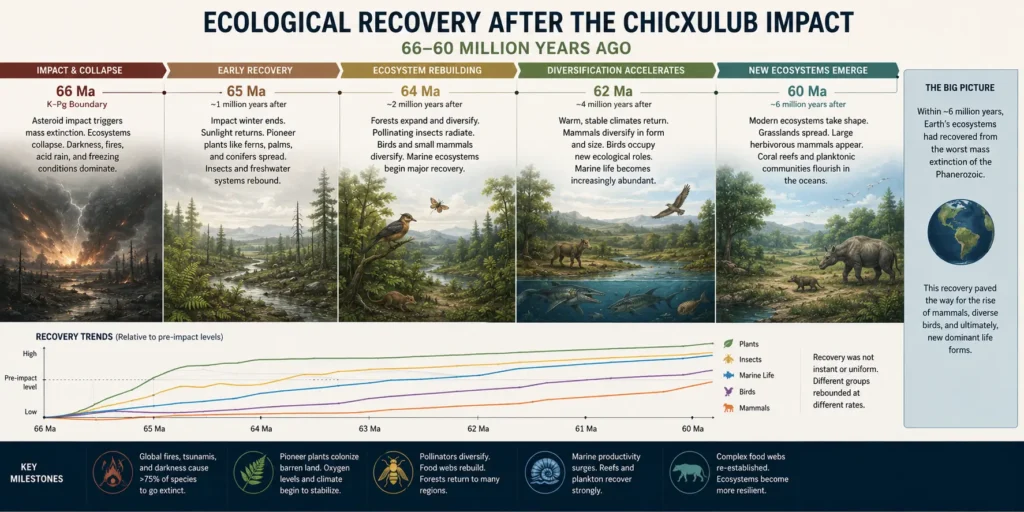
The immediate aftermath was an ecological wasteland. Terrestrial plant communities were reduced to pioneer assemblages dominated by ferns. Marine plankton communities were devastated. The food webs that had supported complex ecosystems for millions of years had collapsed from the base upward.
Climate instability likely persisted for tens of thousands of years, oscillating between the cold of the impact winter and warming pulses driven by elevated atmospheric CO₂ before gradually stabilizing.
Mammalian Radiation
On land, the survivors diversified rapidly by evolutionary standards. Fossil beds in places like the San Juan Basin of New Mexico preserve a detailed record of the earliest post-K–Pg mammalian radiation. In the oldest post-boundary sediments, mammals are small and relatively uniform. Within a few hundred thousand years, the size range expands dramatically as mammals begin occupying ecological roles vacated by non-avian dinosaurs.
Within the first ten million years after the extinction, most modern placental mammal orders were beginning to differentiate. The hoofed mammals, carnivores, primates, rodents, and bats that characterize modern terrestrial ecosystems all trace their origins to this explosive adaptive radiation in the emptied early Paleogene world.
The Rise of the Age of Mammals
The Chicxulub impact did not create mammals — they had existed for over 150 million years before the event. What it did was remove the ecological constraints that had kept them small, nocturnal, and marginal for all of that time.
With non-avian dinosaurs gone, the large-bodied ecological roles — megaherbivore browser, apex predator, cursorial herd animal — were vacant for the first time since the Triassic. Mammals diversified to fill them with remarkable evolutionary speed. Within ten million years of the extinction, mammals as large as modern rhinoceroses had evolved. Within twenty-five million years, the largest land mammals in Earth’s history were walking the plains of Asia.
The implications extend directly to human history. Primates first appear in the fossil record very close to the K–Pg boundary. The entire primate radiation — and with it the eventual evolution of our own species — was contingent on the ecological opening created by the Chicxulub impact. Without the extinction of non-avian dinosaurs, the large-bodied ecological roles that drove mammalian diversification toward intelligence, social complexity, and bipedalism would not have existed to be filled.
What If Chicxulub Never Happened?
This question sits at the boundary between science and informed speculation, but researchers have explored it seriously.
By 66 million years ago, non-avian dinosaurs had been the dominant large land vertebrates for 165 million years. There is no geological evidence that they were in irreversible decline. They had survived three previous mass extinctions and multiple episodes of significant environmental change across their evolutionary history. Without the Chicxulub impact, it is entirely plausible — perhaps probable — that non-avian dinosaurs would have continued to dominate terrestrial ecosystems indefinitely.
In that world, mammals would almost certainly have remained ecologically marginal. The adaptive radiation that produced modern mammalian diversity — including primates, and through them humans — was not inevitable. It was contingent on a single geological accident.
There would, in all probability, be no elephants, no whales, no great apes — and no humans. The universe we inhabit, and our capacity to reflect on it, is in some real sense a consequence of a rock falling from space 66 million years ago.
Origin of the Impactor
The chemical composition of the K–Pg boundary layer — specifically its enrichment in elements characteristic of carbonaceous chondrite meteorites — indicates that the impactor was most likely an asteroid of this type, originating from the outer asteroid belt. Recent research has suggested the impactor may have come from the outermost regions of the main belt, perturbed onto an Earth-crossing orbit by gravitational interactions with Jupiter, though the precise provenance remains uncertain.
A cometary origin has been proposed by some researchers, but the carbonaceous chondrite chemistry of the boundary material is more consistent with an asteroidal source. This question is not fully closed, but the balance of current evidence favors an asteroid.
Why Chicxulub Still Matters Today
Planetary Defense
The recognition that a single impactor could eliminate 75 percent of Earth’s species in a geologically instantaneous event is the founding scientific motivation for modern planetary defense programs. Space agencies worldwide maintain detection programs for near-Earth objects, and active deflection technologies have now been tested, most notably the NASA DART mission, which successfully altered the orbit of the asteroid Dimorphos in 2022.
Mass Extinction Science
The K–Pg event is the most thoroughly studied mass extinction in Earth’s history, and insights gained from its investigation have shaped the understanding of all five major mass extinctions. The mechanisms — photosynthetic collapse, ocean acidification, food web disruption, climate perturbation — recur in varying combinations across multiple extinction events throughout Earth’s history.
Climate Science
The impact of winter dynamics explored in Chicxulub research has direct relevance to nuclear winter modeling — the hypothesis that large-scale nuclear exchange could inject enough soot into the stratosphere to severely disrupt global agriculture. The underlying atmospheric physics are the same; only the ignition source differs.
Understanding Contingency in Evolution
Perhaps most profoundly, Chicxulub is a reminder that the history of life is not a smooth or directional progression. It is a contingent process, shaped by catastrophic accidents as much as by the gradual accumulation of adaptations. The organisms alive today — including humans — are not the inevitable outcomes of evolutionary law. We are the survivors of a lottery, the descendants of animals that happened to possess the right combination of traits at the worst moment in the last quarter-billion years.
Conclusion
Sixty-six million years ago, a rock fell from the sky and changed everything. In a matter of hours, the reign of the dinosaurs ended. In the months and years that followed, the world went dark, cold, and biologically silent. Three-quarters of all species on Earth have disappeared. The seas lost their plankton, their mosasaurs, their ammonites. The land lost its forests, its titanosaurs, its tyrannosaurs.
And then, slowly, life rebuilt. The small and the overlooked — mammals, birds, crocodilians, turtles, insects — emerged from their burrows and refuges and began to diversify into the empty world. Freed for the first time from 165 million years of dinosaurian ecological dominance, mammals expanded to fill every role available to large land animals. Over millions of years, they produced the whales of the ocean, the elephants of the savanna, the primates of the forest canopy — and eventually, us.
The Chicxulub impact is the single most important event in the history of complex animal life since the Cambrian explosion. It is the hinge on which the modern biological world turns. Understanding it is not merely an exercise in palaeontological curiosity. It is an essential part of understanding where we came from, how fragile living systems can be, and what it means that we are here at all.
Frequently Asked Questions
Did all dinosaurs die in the Chicxulub impact?
No. Birds are avian dinosaurs, and several bird lineages survived the K–Pg extinction. What were eliminated were non-avian dinosaurs — the group that includes Tyrannosaurus, Triceratops, and all other large dinosaurs familiar from popular culture. Every bird alive today is a living dinosaur in the precise scientific sense.
How big was the Chicxulub asteroid?
Estimates based on crater size and ejecta distribution suggest an impactor approximately 10 to 15 kilometers in diameter, traveling at roughly 20 kilometers per second. The energy released was equivalent to approximately 100 million megatons of TNT — roughly a billion times the energy of the atomic bomb dropped on Hiroshima.
Why didn’t crocodiles go extinct?
This remains one of the more puzzling aspects of the K–Pg extinction. Crocodilians likely survived due to a combination of semi-aquatic lifestyle, extremely slow metabolism, an ability to survive extended starvation, and a generalist diet. Their freshwater habitats were somewhat buffered from the worst effects of marine acidification and terrestrial ecosystem collapse.
Was Chicxulub the worst extinction in Earth’s history?
No. The end-Permian mass extinction, approximately 252 million years ago, eliminated an estimated 90 to 96 percent of all marine species — substantially more severe than the K–Pg event’s 75 percent species loss. However, Chicxulub is the most consequential for the history of complex terrestrial life, specifically, as it eliminated the dominant land vertebrates and opened the ecological space for the mammalian radiation that eventually produced humans.
Is there another Chicxulub-sized asteroid heading toward Earth?
Not among currently catalogued objects. Planetary defense programs have now identified the large majority of near-Earth objects large enough to pose civilization-level risk, and none of the known objects represent a significant near-term threat. The catalogue for smaller objects remains incomplete, and detection of new objects continues routinely.
Could humans have survived the Chicxulub impact?
Without modern technology and significant preparation, almost certainly not in any meaningful numbers. The collapse of agricultural and ecological systems that support modern civilization would have been catastrophic. With advanced preparation — underground infrastructure, stored food, artificial lighting for plant growth — survival of small populations might have been possible, but the technological and social systems that define modern civilization would have been devastated.
References
- Alvarez, L. W., Alvarez, W., Asaro, F., & Michel, H. V. (1980). Extraterrestrial Cause for the Cretaceous-Tertiary Extinction. Science, 208(4448), 1095–1108.
- Hildebrand, A. R., Penfield, G. T., Kring, D. A., Pilkington, M., Camargo, A., Jacobsen, S. B., & Boynton, W. V. (1991). Chicxulub Crater: A Possible Cretaceous/Tertiary Boundary Impact Crater on the Yucatán Peninsula, Mexico. Geology, 19(9), 867–871.
- Schulte, P., Alegret, L., Arenillas, I., et al. (2010). The Chicxulub Asteroid Impact and Mass Extinction at the Cretaceous–Paleogene Boundary. Science, 327(5970), 1214–1218.
- Gulick, S. P. S., Bralower, T. J., Ormö, J., et al. (2019). The First Day of the Cenozoic. Proceedings of the National Academy of Sciences, 116(39), 19342–19351.
- Hull, P. M., Bornemann, A., Penman, D. E., et al. (2020). On Impact and Volcanism Across the Cretaceous–Paleogene Boundary. Science, 367(6475), 266–272.
- Chiarenza, A. A., Farnsworth, A., Mannion, P. D., et al. (2020). Asteroid Impact, Not Volcanism, Caused the End-Cretaceous Dinosaur Extinction. Proceedings of the National Academy of Sciences, 117(29), 17084–17093.
- Artemieva, N., & Morgan, J. (2020). Quantifying the Release of Climate-Active Gases by Large Meteorite Impacts. Geophysical Research Letters.
Additional Reading
- The Rise and Fall of the Dinosaurs
- The Last Days of the Dinosaurs
- International Ocean Discovery Program Chicxulub drilling reports
- Smithsonian Institution resources on the K–Pg extinction.