At a Glance
| Field | Information |
|---|---|
| Species | Mosasaurus hoffmannii — Squamata, Mosasauridae |
| Period | Late Cretaceous, 82–66 Ma |
| Class | Reptilia |
| Order | Squamata — lizards and snakes |
| Closest living relatives | Monitor lizards (Varanidae) — Tier 3 comparative inference |
| Dinosaur? | No — different reptile lineage entirely |
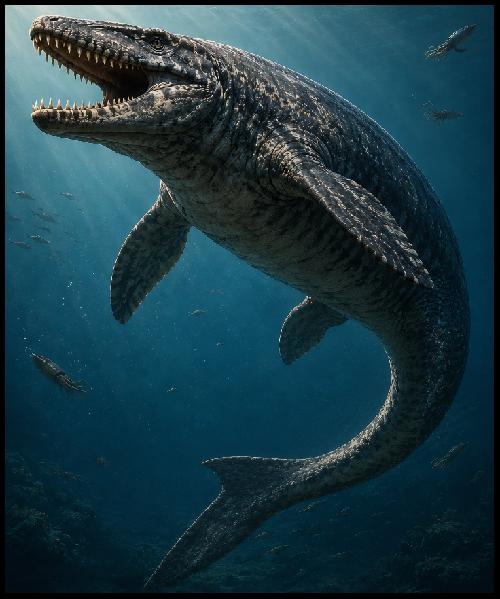
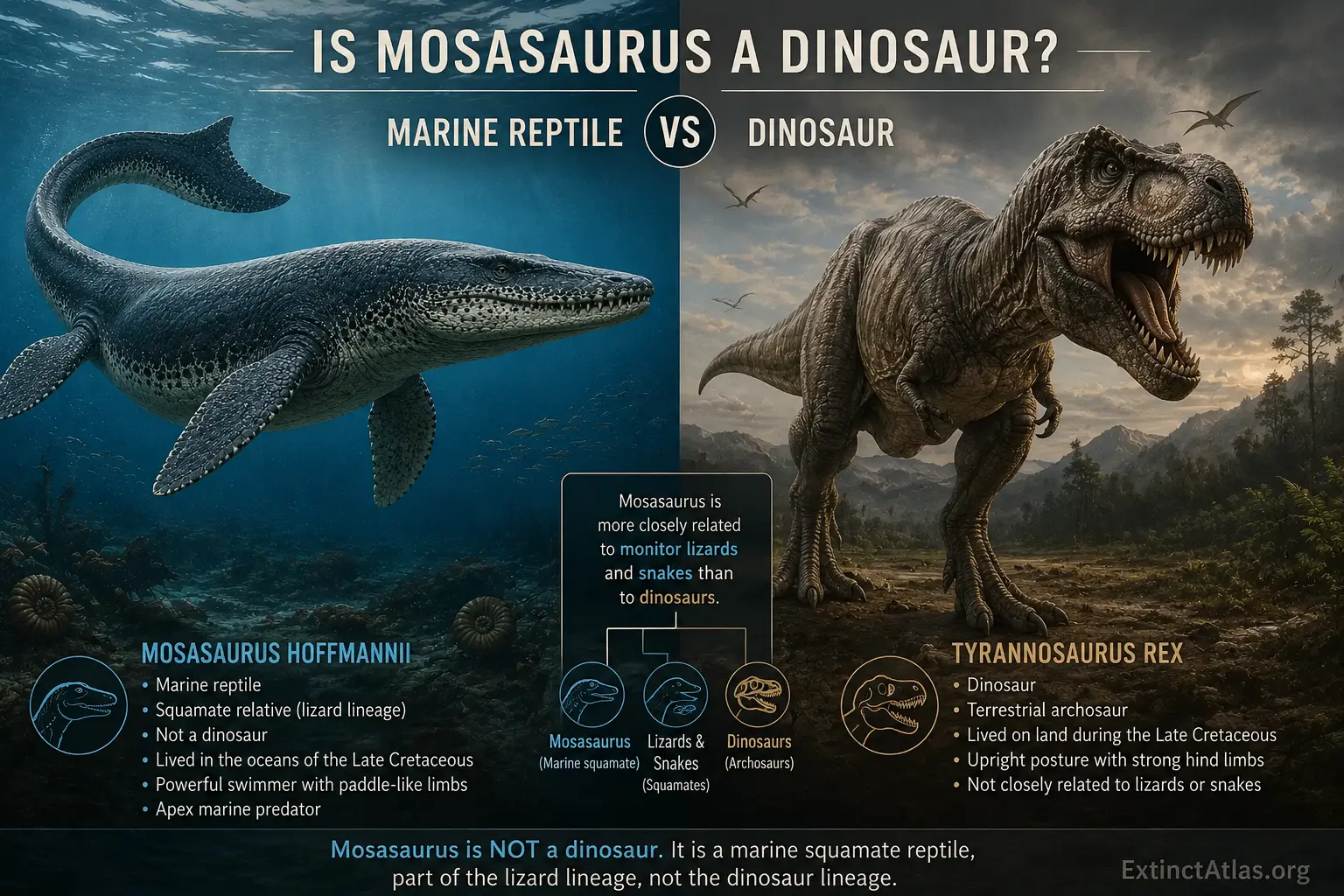
Quick Answer: Mosasaurus is not a dinosaur. It was a mosasaurid — a large marine reptile belonging to Squamata, the same group as living lizards and snakes. Dinosaurs belong to a completely separate reptile lineage, Dinosauria. Although both groups lived during the Cretaceous period, they are not closely related, and mosasaurids are more closely related to modern monitor lizards than to any dinosaur.
The word “dinosaur” gets applied to almost every large prehistoric animal, but Mosasaurus hoffmannii was no more a dinosaur than a modern saltwater crocodile is — and understanding why reveals how the reptile family tree actually branched.
Is Mosasaurus a Dinosaur?
Mosasaurus is not a dinosaur. Fossil evidence and phylogenetic analysis place Mosasaurus hoffmannii firmly within Squamata — the reptile order that contains all living lizards and snakes. Dinosauria is a separate clade entirely, defined by a distinct set of skeletal characteristics including an upright posture and specific hip anatomy that mosasaurids do not share. The two groups share a common ancestor only deep in the Mesozoic reptile tree.
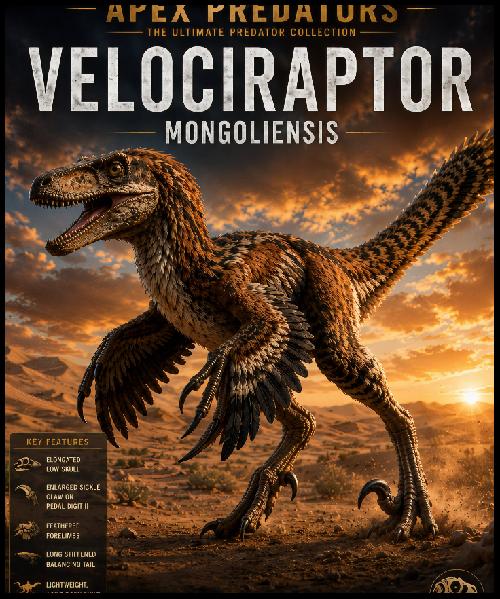
The confusion is understandable. Both dinosaurs and mosasaurids were large Mesozoic reptiles that went extinct at the end of the Cretaceous. They coexisted in time — Mosasaurus was alive during the same period as Tyrannosaurus rex — but occupied entirely different environments. T. rex was a terrestrial predator; Mosasaurus was fully marine. Their ecological separation matched their evolutionary separation.
Why Is Mosasaurus Not a Dinosaur?
Mosasaurus is not a dinosaur because it lacks the defining anatomical features of Dinosauria and belongs to an entirely different reptile lineage. The key distinctions are:
- Posture: Dinosaurs walked with an erect, fully upright stance — a defining characteristic of Dinosauria. Mosasaurids had a sprawling limb posture adapted for aquatic locomotion.
- Hip anatomy: Dinosaurs share a specific hip structure (either saurischian or ornithischian configuration) not present in squamates. Mosasaurid hip anatomy is that of a lizard.
- Skull kinesis: Mosasaurus possessed a highly kinetic skull with an intramandibular joint — a squamate feature not found in dinosaurs. For details on jaw anatomy, see our full post on Mosasaurus teeth.
- Lineage: Dinosauria descended from archosaurian ancestors. Mosasauridae descended from varanoid lizard ancestors — a completely separate branch of the reptile tree.
These distinctions are all directly evidenced in fossil skeletal material, not inferred from behaviour or ecology.
What Group Does Mosasaurus Actually Belong To?
Mosasaurus hoffmannii belongs to the family Mosasauridae, within the order Squamata and the broader clade Lepidosauria. Its closest living relatives are monitor lizards of the family Varanidae — the group that includes the Komodo dragon — based on comparison of skeletal anatomy and molecular analysis of living relatives. This relationship is Tier 3 comparative inference: no soft tissue or DNA from Mosasaurus is available for direct analysis.
Within Squamata, the exact phylogenetic position of mosasaurids remains debated. Some analyses place them as the sister group to snakes; others place them more broadly within varanoid lizards. This is an area of active research, and the precise placement may be revised as analytical methods and available specimens develop.
The full classification string for M. hoffmannii:
- Kingdom: Animalia
- Phylum: Chordata
- Class: Reptilia
- Order: Squamata
- Family: Mosasauridae
- Genus: Mosasaurus
- Species: M. hoffmannii
Were Mosasaurus and Dinosaurs Ever in the Same Place?
Mosasaurus and non-avian dinosaurs coexisted in time — both living during the Late Cretaceous, 82–66 Ma — but occupied different environments. Mosasaurus was a fully marine animal inhabiting open epicontinental seas. Non-avian dinosaurs were terrestrial. Direct interaction between them was not possible in any ecologically meaningful sense. Both groups went extinct at the end-Cretaceous mass extinction event, 66 Ma.
It is worth noting that birds are avian dinosaurs and survived the extinction event. In that strict phylogenetic sense, dinosaurs are not entirely extinct — but the non-avian dinosaurs that coexisted with Mosasaurus were not.
Related and Contemporary Species
- Tylosaurus proriger was a large contemporary mosasaurid — a fellow squamate, not a dinosaur — from the Western Interior Seaway.
- Varanus komodoensis, the Komodo dragon, is among the living animals most closely related to the mosasaurid lineage based on skeletal and molecular comparison.
- Tyrannosaurus rex was a contemporary non-avian dinosaur — same time period as Mosasaurus, entirely different lineage and environment.
- Platecarpus tympaniticus was a smaller contemporary mosasaurid.
- Python reticulatus, the reticulated python, represents the snake lineage that some phylogenetic analyses place as the sister group to mosasaurids.
Frequently Asked Questions
Why is Mosasaurus not a dinosaur?
Mosasaurus is not a dinosaur because it belongs to Squamata — the lizard and snake lineage — rather than to Dinosauria. The two groups are separated by deep evolutionary distance within the reptile tree. Mosasaurids lack the erect posture, hip anatomy, and archosaurian ancestry that define dinosaurs. Mosasaurus is more closely related to a modern monitor lizard than to any dinosaur species.
What type of animal was Mosasaurus?
Mosasaurus was a mosasaurid — a large, fully marine squamate reptile of the Late Cretaceous. It was a member of the lizard and snake lineage rather than the dinosaur lineage, most closely related among living animals to monitor lizards. It was fully aquatic, could not move on land, and was an apex predator in the warm epicontinental seas of its time.
Is Mosasaurus related to modern lizards?
Mosasaurus is related to modern lizards — specifically, fossil and molecular evidence places mosasaurids within or very close to the varanoid lizard group, which includes monitor lizards such as the Komodo dragon. This relationship is based on shared skeletal features and phylogenetic analysis of living squamates. No DNA from Mosasaurus is available; the relationship is inferred from comparative anatomy and cladistic analysis.
Conclusion
Mosasaurus hoffmannii was not a dinosaur — it was a squamate reptile, more closely related to a Komodo dragon than to T. rex. Its classification within Squamata is directly supported by skeletal anatomy and phylogenetic analysis. Understanding what Mosasaurus actually was makes the animal more interesting, not less — a giant lizard that conquered the Late Cretaceous ocean.
References
- Conrad’s 2008 squamate phylogeny study
Conrad, J.L. (2008). Phylogeny and systematics of Squamata (Reptilia) based on morphology. Bulletin of the American Museum of Natural History, 310, 1–182. https://doi.org/10.1206/310.1 - Makádi et al. 2012 basal mosasauroid study
Makádi, L., Caldwell, M.W., & Ősi, A. (2012). The first freshwater mosasauroid (Upper Cretaceous, Hungary) and a new clade of basal mosasauroids. PLOS ONE, 7(12), e51781. https://doi.org/10.1371/journal.pone.0051781 - Reeder et al. 2015 squamate phylogeny integration
Reeder, T.W., Townsend, T.M., Mulcahy, D.G., Noonan, B.P., Wood, P.L., Sites Jr., J.W., & Wiens, J.J. (2015). Integrated analyses resolve conflicts over squamate reptile phylogeny and reveal unexpected placements for fossil taxa. PLOS ONE, 10(3), e0118199. https://doi.org/10.1371/journal.pone.0118199
Featured Museum Collections
Museum-quality paleoart and educational poster
collections based on evidence-informed prehistoric
Life reconstructions.