At a Glance
| Field | Information |
|---|---|
| Species | Spinosaurus aegyptiacus |
| Period | Cretaceous (Cenomanian stage, approximately ~100–94 Ma) |
| Primary diet | Piscivore (fish specialist); opportunistic broader predation likely |
| Key prey | Large lobe-finned fish, sawfish, sharks, lungfish; possibly pterosaurs and smaller dinosaurs |
| Diet evidence type | Isotopic analysis, tooth morphology, gut contents, skull anatomy |
| Feeding habitat | Riverine and estuarine margins, North Africa (Kem Kem/Bahariya formations) |
Quick Answer: Spinosaurus primarily ate fish — including large lobe-finned fish, sawfish, and sharks — as shown by its crocodile-like skull, conical teeth, and isotopic evidence from its bones. It likely also took opportunistic prey on land when available, making it a generalist with a strong aquatic feeding bias rather than a strict fish-only predator.
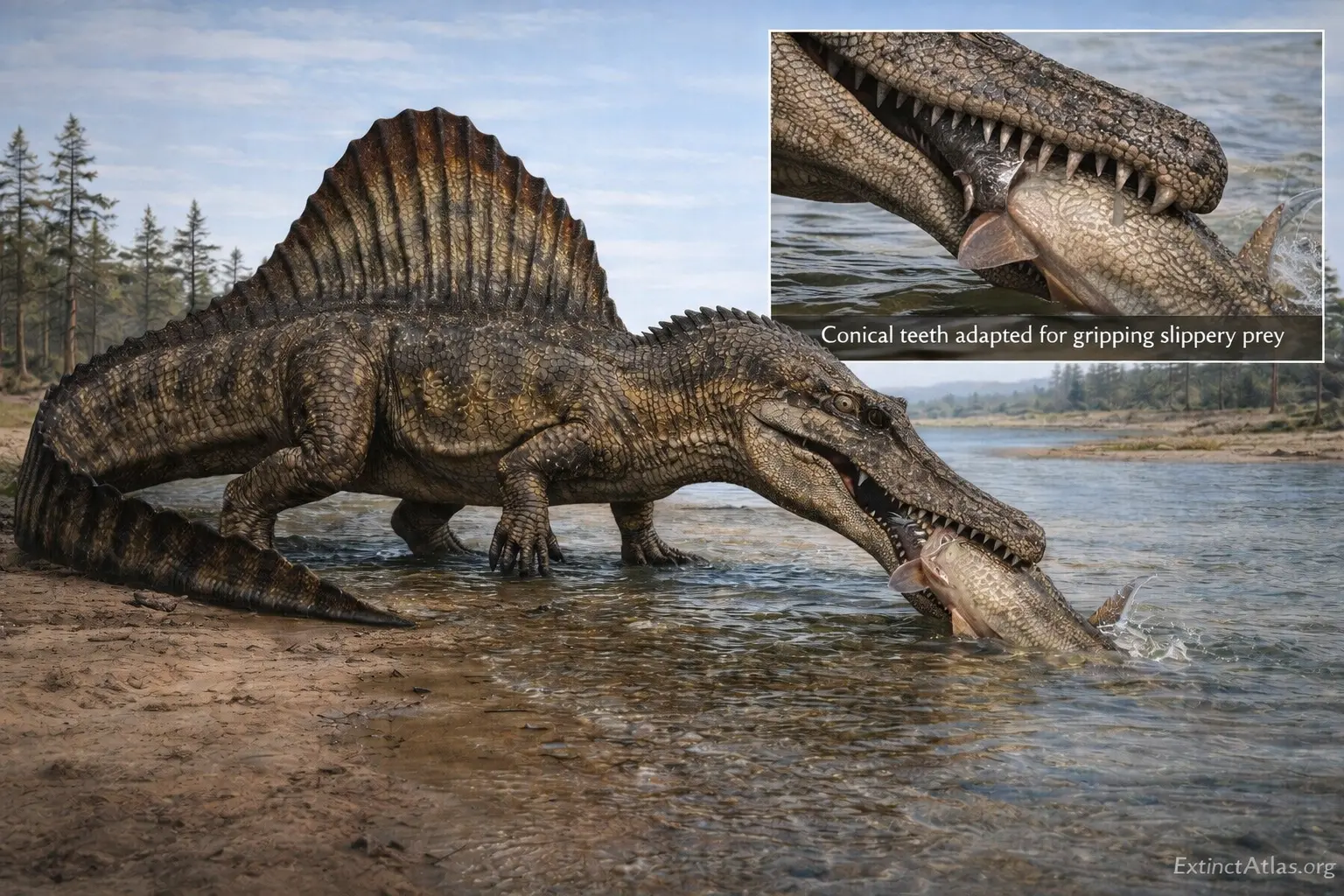
Spinosaurus had a skull built for one thing above all else: seizing slippery, powerful prey from water. Its jaws were long and narrow, its teeth conical and interlocking — a design refined across millions of years that points directly at fish as the dietary core. But the full picture of what this animal ate is more contested than a single label allows.
What Did Spinosaurus Eat? The Fossil Evidence
Spinosaurus was primarily a piscivore — a fish-eating specialist. The evidence for this comes from multiple independent lines.
Skull and Tooth Anatomy
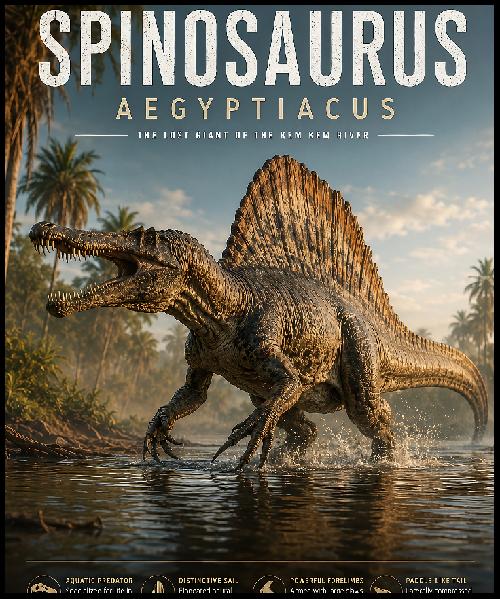
The skull of Spinosaurus is elongated and low, closely resembling that of modern fish-eating crocodilians such as the gharial. The teeth are conical and lack the serrations typical of flesh-cutting predators like Tyrannosaurus or Carcharodontosaurus. This morphology is poorly suited to subduing large, struggling prey on land but highly effective for gripping fish.
A rosette of enlarged teeth at the tip of the snout — also seen in spinosaurids more broadly — is consistent with a fish-snatching strike, allowing the animal to trap prey before it can escape sideways.
Isotopic Evidence
Oxygen isotope analysis of Spinosaurus teeth has been directly compared against other dinosaurs and known aquatic reptiles from the same formations. Oxygen isotope studies suggest the values from Spinosaurus teeth align more closely with those of aquatic animals than with contemporaneous terrestrial theropods, indicating sustained time spent in or around water and consistent aquatic feeding.
Direct Fossil Evidence
Fossil evidence shows fish remains associated with spinosaurid specimens in some cases, though direct gut content preservation is rare. The Kem Kem and Bahariya formations — where Spinosaurus material originates — were dominated by large river systems containing enormous fish: Onchopristis (a giant sawfish), Mawsonia (a large lobe-finned fish), and various sharks. These were available in abundance and at a scale to sustain an animal of Spinosaurus’s size.
Did Spinosaurus Only Eat Fish?
The strict fish-only interpretation, while popular, almost certainly oversimplifies Spinosaurus’s feeding ecology. Research suggests it was a piscivore by primary specialisation but likely an opportunist in practice.
Evidence for Broader Predation
A Spinosaurus tooth was recovered embedded in the neck vertebra of a pterosaur (Coloborhynchus), indicating at minimum occasional predation on flying reptiles — either caught at the water’s surface or scavenged. Current evidence indicates Spinosaurus shared its ecosystem with smaller ornithopods and other reptiles that would plausibly have been taken opportunistically.
The skull, while fish-adapted, was not physically incapable of handling other prey. The jaws were capable of generating meaningful bite force, and the animal’s sheer size meant small to medium terrestrial prey would not have presented a meaningful mechanical challenge.
The Heron Analogy
Scientists frequently compare Spinosaurus’s probable feeding behaviour to modern herons and storks — birds that specialise in aquatic prey but opportunistically take whatever is available near water margins. A 2021 study published in Palaeontologia Electronica framed Spinosaurus’s ecology in precisely these terms: a wading, fish-focused predator that was not a dedicated pursuit hunter of large terrestrial dinosaurs.
This is a useful analogy, but should not be overstated. Spinosaurus was orders of magnitude larger than any heron, and its specific foraging mechanics remain inferred rather than directly observed.
How Did Spinosaurus Catch Its Prey?
The precise mechanics of how Spinosaurus caught fish are not directly preserved in the fossil record, but skull anatomy and comparison with living analogues provide a reasonable framework. Its narrow jaws could be inserted into water with minimal drag, and the forward-facing tooth rosette would trap fish against the roof of the mouth on a rapid closing stroke.
As covered in our guide to Spinosaurus’s aquatic lifestyle, its paddle-like tail and short hind limbs suggest it was capable of sustained movement in water, which would have allowed it to pursue fish in shallow river channels rather than waiting passively at the bank.
Whether Spinosaurus actively pursued large prey underwater or waded and struck opportunistically at the surface remains an open question. Biomechanical estimates suggest the skull was better suited to a rapid surface strike than to sustained underwater pursuit, but this remains modelled inference rather than direct evidence.
How Does Spinosaurus’s Diet Compare to Other Large Predators?
Spinosaurus shared the Kem Kem ecosystem with Carcharodontosaurus — a massive terrestrial apex predator — as well as the abelisaurid Deltadromaeus. The coexistence of these large predators in the same formation is unusual and has prompted significant debate about niche partitioning.
The leading interpretation is that Spinosaurus occupied the aquatic feeding niche while Carcharodontosaurus dominated large terrestrial prey, reducing direct dietary competition between them. This model is consistent with Spinosaurus’s specialised skull and aquatic adaptations, though fossil evidence for active niche partitioning is inferential rather than demonstrated.
Spinosaurus’s feeding ecology was fundamentally different from Tyrannosaurus rex, which had a skull adapted for processing large bone-in carcasses and was primarily a terrestrial apex predator. As covered in our Spinosaurus vs T. rex comparison, the two animals lived on different continents in different time periods and had no ecological overlap.
Related and Contemporary Species
- Baryonyx walkeri — a close spinosaurid relative from Early Cretaceous England, approximately 130 Ma; fish scales and bones recovered from its gut region provide the clearest direct dietary evidence for piscivory within the spinosaurid family, informing interpretations of Spinosaurus’s feeding habits.
- Irritator challengeri — a spinosaurid from Cretaceous Brazil; a pterosaur vertebra found lodged in its jaw provides evidence that spinosaurids occasionally took non-fish prey, supporting the broader opportunistic model applied to Spinosaurus.
- Carcharodontosaurus saharicus — a contemporaneous apex predator from the same North African formations; its contrasting skull morphology and presumed terrestrial hunting niche are central to the dietary niche-partitioning model for the Kem Kem ecosystem.
- Suchosaurus cultridens — a fragmentary spinosaurid known from Europe; its curved, conical teeth closely parallel those of Spinosaurus and are consistent with fish predation, suggesting piscivory was a family-wide trait.
Frequently Asked Questions
Was Spinosaurus a fish eater or a meat eater?
Spinosaurus was both — fish are meat. More precisely, it was a piscivore: a predator specialised for catching fish, as shown by its narrow skull, conical teeth, and isotopic evidence from its bones. It likely took other prey opportunistically, but fish were the dietary foundation.
Could Spinosaurus have killed a T. rex?
This question has no scientific answer because the two animals never coexisted. Spinosaurus lived in North Africa roughly ~100–94 Ma; T. rex lived in North America roughly 68–66 Ma — separated by thousands of kilometres and around 25 million years. The Jurassic Park III fight scene is fiction, not palaeontology.
What fish did Spinosaurus eat?
The Kem Kem and Bahariya formations, where Spinosaurus lived, contained enormous fish, including Onchopristis (a sawfish reaching several metres in length), Mawsonia (a large lobe-finned fish), and various sharks. These were the most plausible primary prey items based on their size, abundance, and co-occurrence in the fossil record.
Spinosaurus was not the land-hunting giant of popular imagination, nor was it a simple fish-only wader. Fossil evidence points to a large predator built around aquatic feeding, with fish as the dietary core and a wider opportunistic range that likely included pterosaurs and smaller prey near the water’s edge.
Featured Museum Collections
Museum-quality paleoart and educational poster
collections based on evidence-informed prehistoric
Life reconstructions.