
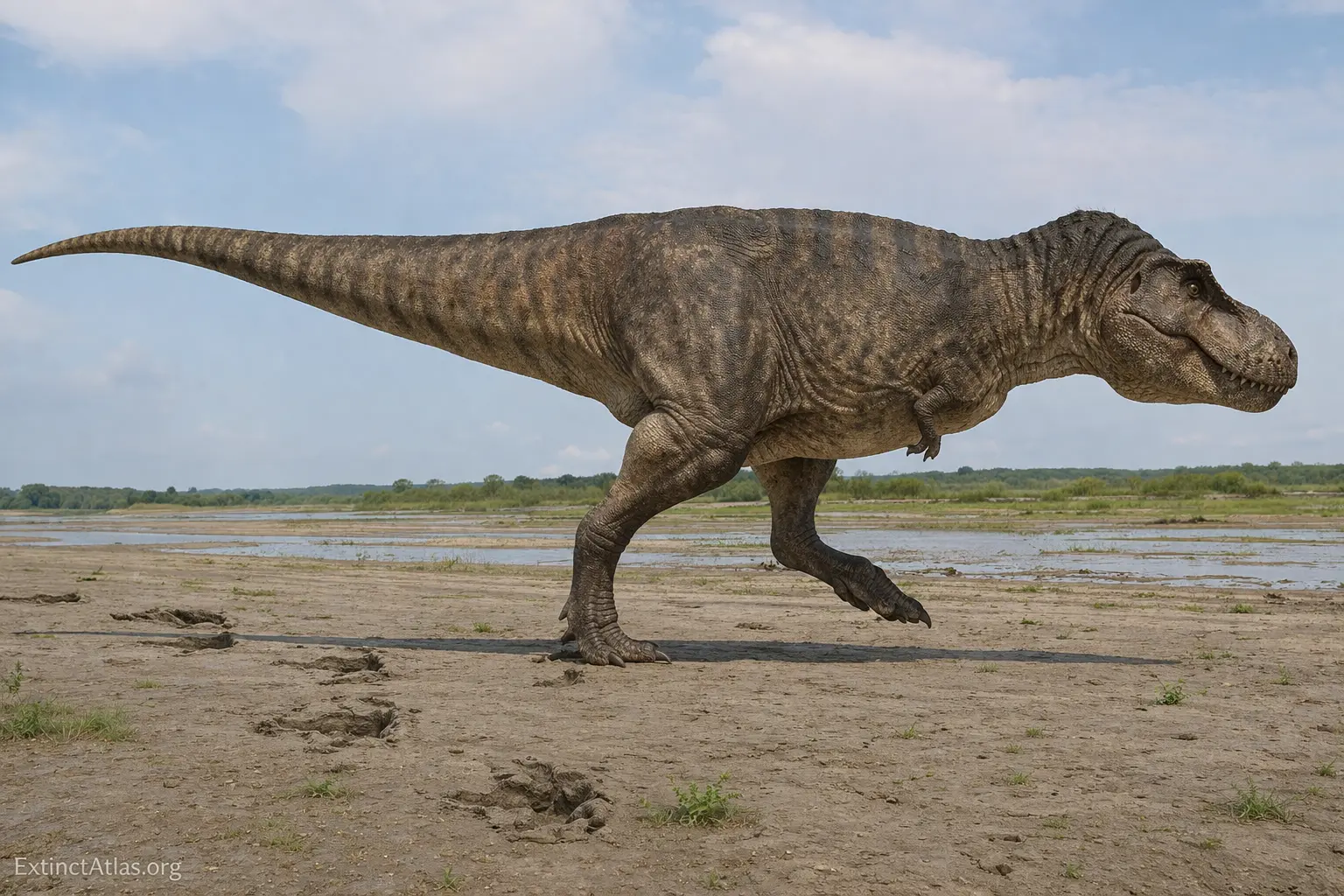
At a Glance
| Field | Information |
|---|---|
| Species | Tyrannosaurus rex |
| Period | Late Cretaceous (68–66 Ma) |
| Estimated top speed | 17–24 km/h (10–15 mph), most current models |
| Movement style | Powerful striding walk; true running debated |
| Speed-limiting factor | Bone stress at high speeds in an 8,000–14,000 kg body |
Quick Answer: Biomechanical models suggest adult T. rex moved at a maximum of approximately 17–29 kilometres per hour (10–18 mph), with most current studies converging on 17–24 km/h (10–15 mph) as the likely range. These are model-dependent estimates, not direct measurements. T. rex was not built for high-speed pursuit — its mass imposed hard physical limits — but its enormous stride length meant it covered ground efficiently at moderate speeds.
The image of T. rex thundering after a jeep at 60 km/h is cinematic fantasy. The image of a 10,000-kilogram animal lumbering helplessly at walking pace is equally wrong. The truth — reconstructed from bone stress modelling, muscle attachment analysis, and fossil trackways — places T. rex in a middle ground: fast enough to be a credible pursuit predator against the large, heavy herbivores of its ecosystem, but constrained by the physics of moving a very large body at speed.
What the Evidence Actually Shows
Early estimates of T. rex speed, made in the mid-20th century, reached as high as 40–50 km/h (25–30 mph). These figures were based on simple comparisons with smaller, faster theropods and did not account adequately for how physics changes with scale.
The square-cube law is the core problem. As an animal scales up in size, its mass increases with the cube of its linear dimensions, while the cross-sectional area of its bones — and therefore their load-bearing capacity — increases only with the square. For an animal weighing 8,000–14,000 kilograms, the forces generated during running are enormous. At true running speeds — where both feet briefly leave the ground simultaneously — the impact of landing falls on a single leg. For T. rex, that impact could exceed the failure threshold of even robust leg bones.
A widely cited 2002 study modelling T. rex locomotion estimated maximum speed at approximately 18 km/h (11 mph). Subsequent work has produced a range of estimates: a 2007 study suggested up to 40 km/h (25 mph) was possible; a 2017 study using more detailed musculoskeletal modelling returned to lower figures in the 17–24 km/h (10–15 mph) range. The honest position is that this question is not fully resolved — the range of credible estimates reflects genuine methodological differences, not sloppiness. [Freshness flag: review if new locomotion modelling studies have been published]
Could T. Rex Actually Run?
“Running” in biomechanical terms means a gait with an aerial phase — a moment when both feet are off the ground. This is distinct from fast walking, where at least one foot always maintains ground contact. Whether T. rex achieved true running is a separate question from how fast it moved.
Bone stress modelling suggests that at speeds much above 20 km/h (12 mph), the stress on T. rex’s leg bones during the landing phase of a running stride would approach or exceed the failure threshold of the bone. This implies either that T. rex was limited to fast walking, or that its bones were stressed to near their limits when moving at speed — a significant injury risk for an animal that could not afford to be lame.
Some researchers argue that T. rex used a form of “grounded running” — a fast gait that achieves some of the efficiency of running without a full aerial phase, similar to what is seen in large ground birds like ostriches under some conditions. This remains an active research question rather than a settled conclusion. [Freshness flag: review if new gait analysis or trackway evidence has been published]
Stride Length and Efficiency
Regardless of the top-speed debate, T. rex had an enormous stride length — up to 4–5 metres (13–16 ft) per stride at moderate speeds based on skeletal proportions. This means that even at 17 km/h (10 mph), T. rex was covering ground rapidly in terms of distance per unit time. A prey animal would need to maintain a significant head start to outrun it over sustained distances.
Fossil trackways attributed to large theropods — though none definitively attributed to T. rex specifically — show stride patterns consistent with moderate to fast walking speeds in the 7–14 km/h (4–9 mph) range for everyday movement. This is not surprising: large animals typically walk most of the time, reserving fast movement for hunting, escape, or competition. [Freshness flag: review if new trackway evidence attributed to T. rex has been published]
Turning and Agility
Straight-line speed is only part of the picture. Hunting requires acceleration, deceleration, and directional change. Here, T. rex faced significant limitations.
Computer simulations of T. rex turning dynamics suggest that at speed, the animal’s high mass and centre of gravity made rapid direction changes difficult and potentially dangerous. A smaller, more agile prey animal could exploit this by making sharp turns that T. rex couldn’t efficiently follow. This constraint likely shaped T. rex’s hunting strategy significantly: rather than relying on agility, it probably relied on ambush, straight-line pursuit of already-committed prey, or targeting slower, heavier animals that couldn’t outmanoeuvre it regardless.
Juveniles vs Adults: Speed Across the Lifespan
Juvenile T. rex had markedly different proportions from adults. Young individuals were more lightly built with longer, more slender legs relative to body size — a body plan more suited to speed than raw power. Biomechanical estimates suggest juveniles could have moved significantly faster than adults, possibly reaching 30–40 km/h (18–25 mph).
This difference has important ecological implications. A juvenile T. rex with speed as its primary asset would hunt different prey than a slow, powerful adult. The age-based niche separation — juveniles taking faster, smaller prey; adults targeting the large, heavily built herbivores they could overpower — may have been key to the species’ success, reducing competition between age classes for the same resources.
Comparison with Prey Species
The speed of T. rex matters most in relation to the animals it hunted. Estimated speeds for its principal prey, Triceratops, a heavily built quadruped, are estimated to have moved at approximately 24–29 km/h (15–18 mph) maximum. Edmontosaurus, a large hadrosaur, was probably faster — possibly 40 km/h (25 mph) or more over short distances. If these estimates are accurate, adult T. rex could not consistently outrun Edmontosaurus in a straight sprint.
This does not mean T. rex was unable to catch Edmontosaurus. Modern predators regularly take prey faster than themselves through tactics of ambush, exhaustion, targeting vulnerable individuals, and exploiting terrain. The same strategies were almost certainly available to T. rex. Speed was one tool among several — not necessarily the decisive one.
Related and Contemporary Species
Albertosaurus sarcophagus — a smaller tyrannosaur; lighter build likely allowed speeds in the 30–40 km/h (18–25 mph) range, making it a more agile pursuit predator than adult T. rex. Ornithomimids — ostrich-like dinosaurs from the same ecosystem, capable of speeds estimated at 50–70 km/h (30–43 mph); the speed extreme among large Late Cretaceous dinosaurs, and almost certainly beyond T. rex’s reach. Edmontosaurus annectens — a principal T. rex prey species; speed estimates suggest it may have been faster than adult T. rex in a straight sprint. Triceratops horridus — T. rex’s other primary prey; heavy build likely made it slower than T. rex, making it a more accessible target in direct pursuit.
Frequently Asked Questions
Could a human outrun T. rex?
Speculatively, a trained sprinter capable of 30 km/h (18 mph) might briefly outpace T. rex, whose top speed is estimated at 17–24 km/h (10–15 mph) in most current models. An average person running at 10–12 km/h (6–7 mph) almost certainly could not. These are extrapolations from biomechanical models, not direct measurements, and should be treated as rough guides only.
Was T. rex faster than an elephant?
African elephants can move at up to 25 km/h (15 mph) in a fast charge. Biomechanical estimates for T. rex overlap with this range, suggesting the two were broadly comparable in top speed — though very different in gait mechanics and body plan.
Why did the Jurassic Park T. rex run so fast?
The filmmakers based the chase scene on earlier, now-outdated speed estimates that placed T. rex at 30–50 km/h (18–30 mph). Current biomechanical modelling places the upper limit considerably lower. The jeep chase, while effective cinema, is not scientifically credible.
References
Hutchinson JR, Garcia M. 2002. Tyrannosaurus was not a fast runner. Nature. 415(6875):1018–1021.
Hutchinson JR, Ng-Thow-Hing V, Anderson FC. 2007. A 3D digital analysis of limb mobility in Tyrannosaurus rex. Proceedings of the Royal Society B: Biological Sciences. 274(1629):2001–2010.
Sellers WI, Manning PL. 2007. Estimating dinosaur maximum running speeds using evolutionary robotics. Proceedings of the Royal Society B: Biological Sciences. 274(1626):2711–2716.
Bates KT, Falkingham PL. 2012. Estimating mass properties of dinosaurs using laser imaging and 3D volumetric reconstructions. PLoS ONE. 7(2):e32645.
Snively E, Cotton JR, Ridgely R, Witmer LM. 2013. Multibody dynamics model of head and neck function in Allosaurus and Tyrannosaurus. PLoS ONE. 8(11):e80070.
Persons WS IV, Currie PJ, Erickson GM. 2020. An older and exceptionally large adult specimen of Tyrannosaurus rex. The Anatomical Record. 303(4):656–672.
Dececchi TA, Mloszewska AM, Holtz TR Jr, Habib MB, Larsson HCE. 2021. The fast and the frugal: revisiting the evolution of cursoriality in non-avian dinosaurs using limb length, body mass and metabolism. PeerJ. 9:e11006.
Paul GS. 1988. Predatory Dinosaurs of the World. New York: Simon & Schuster.