
At a Glance
| Feature | T. rex | Giganotosaurus |
|---|---|---|
| Period | Late Cretaceous (68–66 Ma) | Late Cretaceous (99–95 Ma) |
| Location | North America | South America (Patagonia) |
| Length | 12–13 m (39–43 ft) | 12–13 m (39–43 ft) |
| Weight | 8,000–14,000 kg (17,600–30,900 lb) | 6,000–8,000 kg est. (13,200–17,600 lb) |
| Skull length | ~1.5 m (5 ft) | ~1.8 m (6 ft) |
| Bite strategy | Bone-crushing | Slicing; blade-like teeth |
| Fossil completeness | Multiple near-complete specimens | ~70% complete holotype |
| Did they meet? | No — separated by ~30 million years and different continents | No |
Quick Answer: T. rex and Giganotosaurus never met. They were separated by approximately 30 million years and the South Atlantic Ocean. In size, they were comparable in length, but T. rex was almost certainly heavier and had a significantly more powerful bite. Giganotosaurus had a longer skull with blade-like teeth suited to different prey and a different predatory strategy. Any comparison of combatants is a thought experiment, not a biological question.

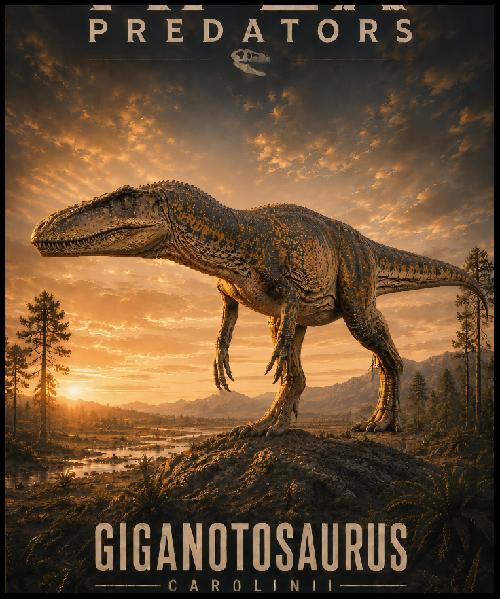
Giganotosaurus carolinii was described in 1995 from Patagonian Argentina and was briefly reported as the largest carnivorous dinosaur ever found. The size comparison with T. rex is now understood to be more nuanced. What the comparison actually reveals is two apex predators that independently reached similar dimensions through entirely separate evolutionary lineages, adapted to hunt different prey on opposite sides of the world.
Did They Ever Meet?
They did not. Giganotosaurus lived approximately 99–95 million years ago in what is now Patagonia. T. rex lived 68–66 million years ago in western North America. The temporal gap is approximately 30 million years — more time than separates humans from Oligocene apes.
The geographic separation was reinforced by ocean barriers. The South Atlantic, while narrower in the Cretaceous than today, effectively separated South American and North American faunas during this period. North America was dominated by tyrannosaurids; South America by abelisaurids and carcharodontosaurids. These were entirely separate evolutionary radiations that never shared territory.
Every comparison between T. rex and Giganotosaurus as combatants is therefore a thought experiment from the outset. This is worth stating clearly because popular framings of this matchup — particularly following the Jurassic World Dominion portrayal in 2022 — imply a natural encounter that never happened and could not have happened.
How Do They Compare as Animals?

Size
By overall length, Tyrannosaurus rex and Giganotosaurus carolinii were broadly comparable, both reaching approximately 12–13 metres (39–43 ft).
Mass is where the divergence becomes clear:
- T. rex: ~8,000–14,000 kg
- Giganotosaurus: ~6,000–8,000 kg (with higher estimates in some studies)
Despite similar lengths, T. rex was almost certainly substantially heavier, reflecting a more robust body plan.
Skull proportions reinforce this distinction:
- Giganotosaurus: longer skull (~1.8 m), relatively low and elongate
- T. rex: shorter (~1.5 m), but deeper, wider, and structurally reinforced
Crucially, skull length is not a proxy for performance—structural depth and reinforcement govern load-bearing capacity, and here T. rex is clearly specialized for higher mechanical stress.
Teeth and Bite Strategy
These two theropods represent fundamentally different predatory architectures:
- T. rex:
- Thick, conical (“banana-shaped”) teeth
- Deep roots, high resistance to bending
- Adapted for bone-crushing and puncture loading
- Giganotosaurus (a carcharodontosaurid):
- Long, laterally compressed, blade-like teeth
- Serrated edges optimized for slicing soft tissue
- Functionally analogous to shark dentition
Biomechanical modeling consistently indicates that T. rex produced far greater bite forces, enabled by its deep skull and reinforced cranial architecture.
The ecological implication is a strategy divergence:
- T. rex: high-force bites capable of crushing bone and accessing marrow
- Giganotosaurus: slashing bites, likely relying on repeated wounds and blood loss
These strategies align with prey differences—T. Rex targeted heavily built ceratopsians and hadrosaurs, while Giganotosaurus coexisted with enormous titanosaur sauropods.
Sensory Capabilities
T. rex shows strong evidence for a highly developed sensory system:
- Binocular vision: ~55° overlap, supporting depth perception
- Olfaction: exceptionally large olfactory bulbs, indicating advanced scent tracking
In contrast, available skull material for Giganotosaurus suggests:
- More laterally oriented eyes
- Wider field of view but reduced binocular overlap
This implies a potential trade-off:
- T. rex: precision targeting and depth-focused predation
- Giganotosaurus: broader environmental awareness
However, the comparison is constrained by incomplete cranial material for Giganotosaurus, limiting certainty.
What the Fossil Record Shows
The two taxa differ markedly in data quality and sample size:
- T. rex:
- 50+ known specimens
- Several near-complete individuals (e.g., “Sue,” “Scotty,” “Stan”)
- Extensive datasets: biomechanics, histology, pathology, soft tissue
- Giganotosaurus:
- Primarily known from a single holotype (MUCPv-Ch1, ~70% complete)
- Additional material is fragmentary and limited
This asymmetry matters. Estimates for T. rex are well-constrained and repeatedly tested, whereas those for Giganotosaurus carry greater uncertainty, particularly in mass and soft-tissue reconstruction.
Bottom Line
- Length: Comparable
- Mass: T. rex is significantly heavier
- Bite strategy: Crushing (T. rex) vs slicing (Giganotosaurus)
- Sensory systems: More advanced in T. rex (based on current evidence)
- Data reliability: Much stronger for T. rex
These are not near-identical apex predators—they represent distinct evolutionary solutions to large-prey predation, shaped by different anatomies, prey bases, and ecological contexts.
Speculative Encounter
If — purely as a thought experiment — these two animals had been placed in the same environment, T. rex’s superior bite force, greater mass, and more sophisticated sensory capabilities suggest a potential advantage in a confrontation. Giganotosaurus’s longer reach and possibly higher speed (some biomechanical estimates place it faster, though this is model-dependent and uncertain) could be countervailing factors.
No meaningful conclusion can be drawn, and any confident claim about the winner of such an encounter goes beyond what the fossil evidence supports.
Related and Contemporary Species
- Carcharodontosaurus saharicus — an African relative of Giganotosaurus of comparable size; together they represent the peak of carcharodontosaurid evolution, the lineage that T. rex’s tyrannosaur family never encountered.
- Mapusaurus roseae — a slightly smaller carcharodontosaurid from Patagonia found in a multi-individual bonebed, sometimes interpreted as evidence of group behaviour.
- Allosaurus fragilis — Giganotosaurus’s skull design is closer to Allosaurus than to T. rex, illustrating the deep evolutionary divergence between carcharodontosaurids and tyrannosaurids.
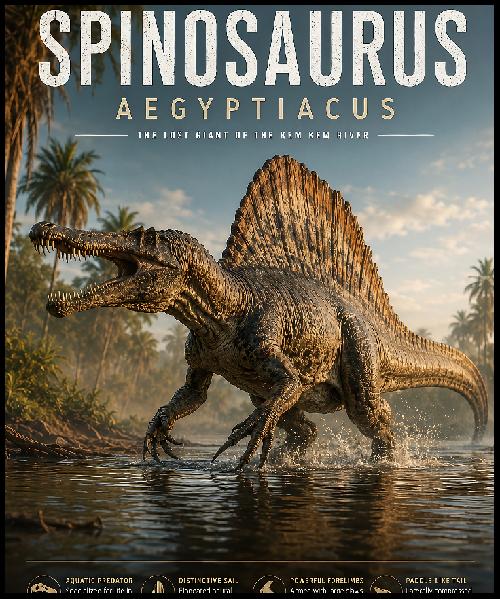
- Spinosaurus aegyptiacus — another giant theropod often included in large predator comparisons; semi-aquatic fish specialist rather than terrestrial large prey hunter.
Frequently Asked Questions
Was Giganotosaurus bigger than T. rex?
By length, they were comparable — both approximately 12–13 metres. By mass, T. rex was almost certainly heavier. Giganotosaurus had a longer skull, but T. rex’s was deeper and more powerfully built. No single metric gives a clear winner across all size dimensions.
Did T. rex and Giganotosaurus live at the same time?
No. Giganotosaurus lived approximately 99–95 million years ago; T. rex lived 68–66 million years ago. They were separated by roughly 30 million years and an ocean.
Which had the stronger bite?
T. rex almost certainly did. Its deep, reinforced skull and robust bone-crushing teeth were specifically adapted for extreme bite forces. Giganotosaurus had a flatter skull with slicing teeth — a different predatory tool, not a weaker version of the same one.
References
Coria RA, Salgado L. 1995. A new giant carnivorous dinosaur from the Cretaceous of Patagonia. Nature. 377(6546):224–226.
Coria RA, Currie PJ. 2006. A new carcharodontosaurid (Dinosauria, Theropoda) from the Upper Cretaceous of Argentina. Geodiversitas. 28(1):71–118.
Brusatte SL, Benson RBJ, Chure DJ, Xu X, Sullivan C, Hone DWE. 2010. The first definitive carcharodontosaurid (Dinosauria: Theropoda) from the Jurassic of North America. PLoS ONE. 5(2):e9430.
Brochu CA. 2003. Osteology of Tyrannosaurus rex: insights from a nearly complete skeleton and high-resolution computed tomographic analysis of the skull. Society of Vertebrate Paleontology Memoir. 7:1–138.
Bates KT, Falkingham PL. 2012. Estimating mass properties of dinosaurs using laser imaging and 3D volumetric reconstructions. PLoS ONE. 7(2):e32645.
Hutchinson JR, Garcia M. 2002. Tyrannosaurus was not a fast runner. Nature. 415(6875):1018–1021.
Carr TD. 2020. A high-resolution growth series of Tyrannosaurus rex was obtained from multiple lines of evidence. PeerJ. 8:e9192.
Canale JI, Novas FE, Pol D, et al. 2022. New giant carnivorous dinosaur reveals convergent evolutionary trends in carcharodontosaurian theropods. Current Biology. 32(14):3195–3204.
Featured Museum Collections
Museum-quality paleoart and educational poster
collections based on evidence-informed prehistoric
Life reconstructions.