
At a Glance
| Field | Information |
|---|---|
| Species | Tyrannosaurus rex |
| Period | Late Cretaceous (68–66 Ma) |
| Geographic range | Western North America (Laramidia) |
| Key formation | Hell Creek Formation (MT, ND, SD, WY) |
| Environment | Subtropical floodplains, dense forests, river systems |
| Climate | Warm and humid; no polar ice caps |
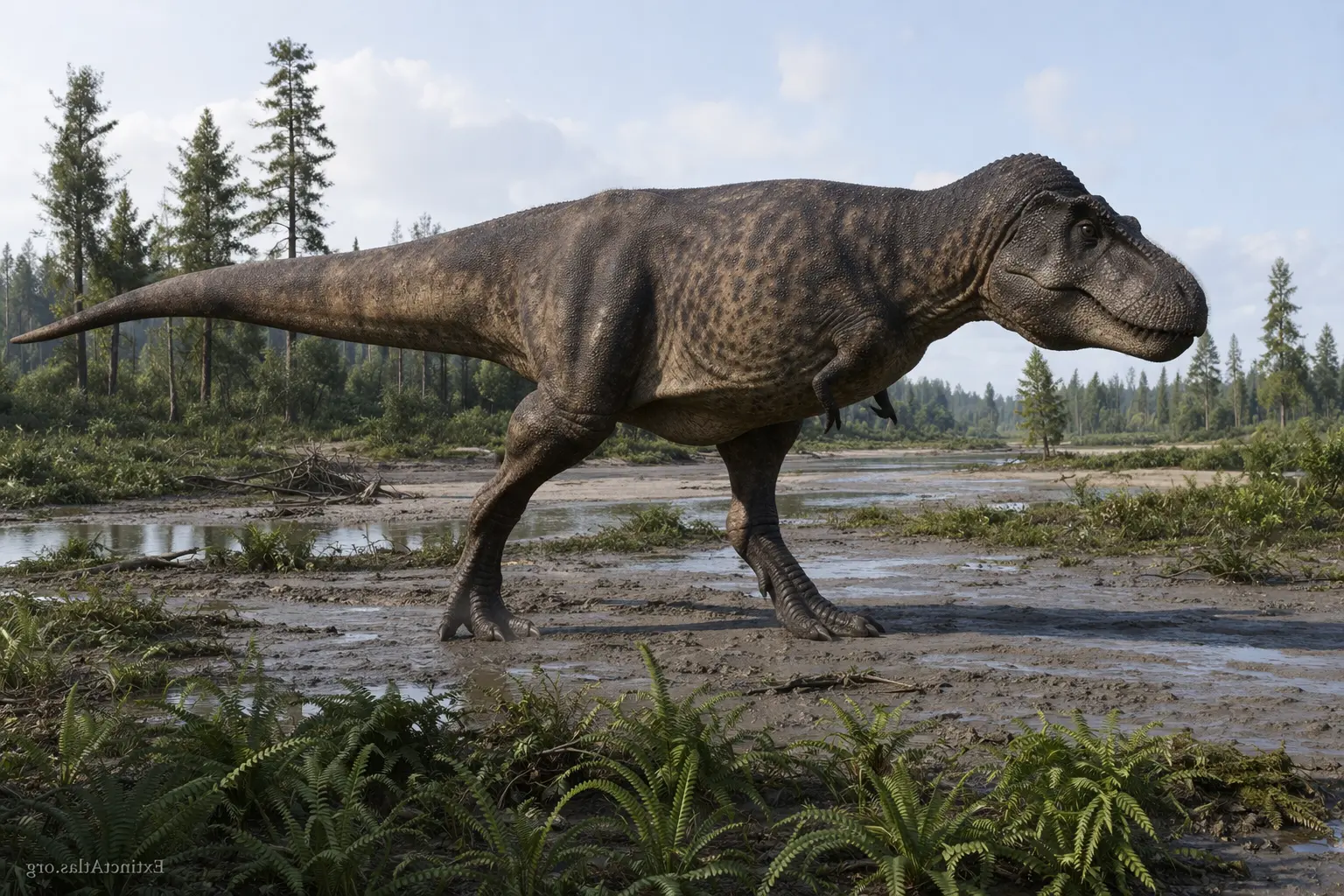
T. rex lived in the warm, humid floodplains and forests of western North America approximately 68–66 million years ago. Its fossils are concentrated in the Hell Creek Formation — ancient river and floodplain sediments in Montana, North Dakota, South Dakota, and Wyoming — which preserves the richest record of the latest Cretaceous ecosystem in the world.

Stand in the badlands of eastern Montana today, and you are standing where T. rex hunted. The landscape has been stripped back to the Late Cretaceous — literally. The pale grey mudstones and sandstones of the Hell Creek Formation are ancient floodplain sediments, laid down by rivers draining the young Rocky Mountains into the shallow inland sea that once split North America in two. T. rex fossils weather out of these same sediments after 66 million years underground.
Where Did T. Rex Live?
T. rex lived on Laramidia — the western landmass of North America during the Late Cretaceous, when a shallow seaway called the Western Interior Seaway divided the continent from north to south. Laramidia stretched from Alaska to Mexico, and T. rex fossils have been found across a substantial portion of this range.
The majority of confirmed T. rex material comes from the Hell Creek Formation and its lateral equivalents — the Lance Formation in Wyoming and the Frenchman Formation in Saskatchewan, Canada. These formations represent the same depositional environment across a wide geographic area, preserved in sediments dating to the final two million years of the Cretaceous.
Geographic range
Fossils of Tyrannosaurus rex are distributed across western North America, with confirmed material recovered from formations such as the Hell Creek (Montana and the Dakotas), Lance (Wyoming), Frenchman (Saskatchewan), and Scollard (Alberta). This distribution spans from southern Canada into the western United States, representing the northern portion of the Late Cretaceous landmass of Laramidia.
The densest and most extensively studied fossil record comes from the northern Hell Creek region, where stratigraphic sampling has provided the most detailed insights into the final populations of T. rex leading up to the K–Pg boundary.
What Was the Hell Creek Environment Like?
The Hell Creek ecosystem was warm, humid, and heavily vegetated — a landscape of river floodplains, oxbow lakes, coastal swamps, and dense forests quite unlike the semi-arid badlands that preserve its fossils today.
Climate
During the Late Cretaceous, North America lacked permanent polar ice caps and maintained a generally warm greenhouse climate. In the Hell Creek Formation region, environmental conditions are interpreted as subtropical to warm temperate, with high precipitation and pronounced seasonal variation.
Paleoclimate reconstructions based on isotopic data, fossil plants, and sedimentology indicate mean annual temperatures likely ranged from approximately 10–20 °C, supporting diverse floodplain ecosystems. While exact temperature estimates vary across methods, the overall climate was significantly warmer and more humid than at comparable latitudes today.
Vegetation
The Hell Creek flora was dominated by flowering plants — angiosperms that had diversified explosively during the Cretaceous. Dense riverside forests included early relatives of magnolias, plane trees, and other broad-leaved species. Conifers remained present, particularly on higher ground, alongside ferns, cycads, and horsetails in wetter lowland areas. This vegetation structure — dense riverine forest giving way to more open floodplain — provided both cover for ambush and open ground for movement.
Rivers and Waterways
The Hell Creek Formation environment was dominated by extensive fluvial systems, including meandering rivers, floodplains, and associated wetlands linked to the retreating Western Interior Seaway. These river systems produced dynamic landscapes shaped by channel migration, overbank flooding, and the formation of oxbow lakes and crevasse splays.
Seasonal flooding and sediment deposition created a mosaic of habitats that supported abundant herbivorous dinosaur populations. The relatively high occurrence of Tyrannosaurus rex fossils in these deposits is consistent with a productive floodplain ecosystem, although this pattern is also influenced by preservation and depositional biases inherent to fluvial environments.
What Other Species Shared T. Rex’s Habitat?
The Hell Creek ecosystem was a diverse, fully functioning Late Cretaceous community. T. rex was the apex predator within a food web that included large and small herbivores, smaller predators, early mammals, lizards, crocodilians, birds, and a wide range of invertebrates.
Large Herbivores
Triceratops horridus — the most common large herbivore in Hell Creek sediments and the most frequently documented T. rex prey species; constituted approximately 40% of large dinosaur specimens in some census counts. Edmontosaurus annectens — a large hadrosaur and the second principal prey species; gregarious behaviour has been inferred for some hadrosaur populations. Ankylosaurus magniventris — a heavily armoured ankylosaur; rare (approximately 1% of large dinosaur specimens) and well-defended. Pachycephalosaurus wyomingensis — a dome-headed herbivore of medium size; more plausibly regular prey for T. rex than the heavily armoured species.
Smaller Predators
- Dromaeosaurids (medium-sized theropods). Fossil evidence from the Hell Creek Formation indicates the presence of medium-sized dromaeosaurid theropods. These predators likely occupied ecological niches between small prey specialists and apex predators, and may have overlapped with juvenile Tyrannosaurus rex in prey selection.
- Acheroraptor temertyorum. A small dromaeosaurid known from Hell Creek deposits, representing one of the smaller predatory dinosaurs in the ecosystem.
- Small maniraptoran theropods. Additional small-bodied theropods, including troodontid-grade animals, were present and likely filled generalist predatory niches, feeding on small vertebrates and invertebrates.
Other Fauna
- Mammals. Early multituberculates and eutherians formed a diverse assemblage of small-bodied, primarily nocturnal animals occupying lower trophic levels.
- Aquatic and semi-aquatic fauna. Freshwater turtles, crocodilians, champsosaurs, lizards, and amphibians were abundant in riverine and wetland habitats, reflecting the fluvial nature of the ecosystem.
- Quetzalcoatlus northropi. A giant azhdarchid pterosaur with an estimated wingspan of around 10–11 metres inhabited the region. Functional interpretations suggest a predominantly terrestrial foraging lifestyle, although its precise feeding strategy remains uncertain.
Did T. Rex Have a Defined Territory?
Whether T. rex maintained defined territories is unknown — territorial behaviour does not fossilise. Inferences from body size and prey density suggest individual T. rex required large home ranges. Modern large solitary predators — tigers, large crocodilians — maintain home ranges of hundreds to thousands of square kilometres depending on prey availability. Extrapolating these patterns to T. rex is reasonable as a rough guide, but remains an inference rather than evidence.
Multiple T. rex individuals found in the same formation do not indicate gregarious behaviour — Hell Creek sediments represent approximately two million years of deposition. Co-occurrence in the same rock unit does not imply the animals lived simultaneously in proximity.
Related and Contemporary Species
- Nanuqsaurus hoglundi. A tyrannosaurid from the Late Cretaceous of northern Alaska, representing one of the highest-latitude occurrences of the group in Laramidia. Its presence indicates that tyrannosaurs occupied polar environments characterized by strong seasonal light variation and cooler climatic conditions compared to more southern regions. Differences in body size and ecology relative to Tyrannosaurus rex remain an area of ongoing study, but the taxon clearly demonstrates the geographic breadth of tyrannosaur distribution.
- Daspletosaurus torosus — an earlier North American tyrannosaur; occupied a comparable apex predator role in an older ecosystem, providing evolutionary context.
- Edmontosaurus regalis — the northern relative of E. annectens; found in slightly older and more northerly formations.
- Quetzalcoatlus northropi — the largest known flying animal; shared the Hell Creek sky with T. rex’s world.
Frequently Asked Questions
Where did T. rex live?
T. rex lived in western North America on the landmass known as Laramidia, separated from eastern North America by the Western Interior Seaway. Most confirmed fossils come from the Hell Creek Formation and equivalent formations in Montana, North Dakota, South Dakota, Wyoming, and Saskatchewan, in sediments dated to approximately 68–66 million years ago.
What was the climate like where T. rex lived?
The Hell Creek region had a warm, humid, subtropical climate significantly warmer than today, with no polar ice caps. The landscape was dominated by dense riverside forests and river floodplains. Mean annual temperatures are estimated to have been considerably higher than modern equivalents at the same latitude, though precise figures are model-dependent.
What other dinosaurs lived with T. rex?
T. rex shared the Hell Creek ecosystem with Triceratops, Edmontosaurus, Ankylosaurus, Pachycephalosaurus, and Torosaurus among the large herbivores, and with smaller predators including Dakotaraptor and Acheroraptor. The ecosystem also included early mammals, crocodilians, turtles, lizards, birds, and the giant pterosaur Quetzalcoatlus.
References
Horner JR, Goodwin MB, Myhrvold N. 2011. Dinosaur census reveals abundant Tyrannosaurus and rare predators in the Late Cretaceous of North America. PLoS ONE. 6(2):e16574.
Fastovsky DE, Bercovici A. 2016. The Hell Creek Formation and its contribution to the Cretaceous–Paleogene extinction: a short primer. Cretaceous Research. 57:368–390.
Johnson KR, Nichols DJ, Hartman JH. 2002. Hell Creek Formation: a 2002 synthesis. Geological Society of America Special Paper. 361:503–510.
Lyson TR, Longrich NR. 2011. Spatial niche partitioning in dinosaurs from the latest Cretaceous of North America. Proceedings of the Royal Society B: Biological Sciences. 278(1723):1158–1164.
Carr TD. 2020. A high-resolution growth series of Tyrannosaurus rex was obtained from multiple lines of evidence. PeerJ. 8:e9192.
Fiorillo AR, Tykoski RS. 2014. A diminutive Tyrannosaurus rex from the Hell Creek Formation and implications for ontogeny and ecology. Cretaceous Research. 50:167–176.
Murphy EC, Hoganson JW, Johnson KR. 2002. Lithostratigraphy of the Hell Creek Formation in North Dakota. In: Hartman JH, Johnson KR, Nichols DJ, editors. The Hell Creek Formation and the Cretaceous–Tertiary Boundary in the Northern Great Plains. Geological Society of America Special Paper 361. p. 9–34.
Recommended Paleontology & Natural History Books
As an Amazon Associate, Extinct Atlas may earn from qualifying purchases.
The Rise and Fall of the Dinosaurs
A compelling history of dinosaurs, tracing their origins, diversification, 200-million-year reign, extinction, and enduring legacy.
Dinosaurs and Prehistoric Life
A richly illustrated visual reference exploring dinosaurs, fossils, evolution, and prehistoric life across geological time.

Encyclopedia Prehistorica: Dinosaurs
An interactive dinosaur book featuring spectacular three-dimensional pop-ups, particularly suited to young readers and families.
The Rise and Reign of the Mammals
A sweeping history of mammalian evolution, from their origins alongside dinosaurs through the Cenozoic and the emergence of humans.