At a Glance
| Feature | Archaeopteryx | Deinonychus |
|---|---|---|
| Period | Late Jurassic (150–148 Ma) | Early Cretaceous (115–108 Ma) |
| Body length | ~50 cm | ~3.4 m |
| Body mass | ~0.8–1 kg | ~70–80 kg (estimated) |
| Feathers | Fully feathered — flight and body feathers evidenced | Feathers inferred from related taxa; not directly evidenced in all specimens |
| Flight capability | Contested — powered flight possible | None — terrestrial predator |
| Sickle claw | Absent | Present — hyperextensible second toe claw |
| Teeth | Present — small, conical, socketed | Present — serrated, blade-like |
| Geographic range | Southern Germany (Solnhofen) | Western North America |
Quick Answer:Archaeopteryx and Deinonychus were both feathered paravians, but they were very different animals. Archaeopteryx was crow-sized with flight feathers and lived 40 million years before Deinonychus, which was a large, powerful terrestrial predator. They never shared the same time or place, but they share the anatomical evidence that linked dinosaurs to birds.
The dinosaur-bird connection was not obvious until Deinonychus forced the issue. When John Ostrom described it in 1969, the similarities he found — in the wrist, the hip, the overall body plan — were close enough to Archaeopteryx to reopen a debate that had been dormant for nearly a century. These two animals, separated by 40 million years and an ocean, ended up changing how science understood the origin of birds.
Archaeopteryx vs Deinonychus: How Do These Two Paravians Compare?
Archaeopteryx and Deinonychus are both members of Paravia — the broader clade that includes dromaeosaurids, troodontids, and birds. Fossil evidence confirms they shared a suite of anatomical features inherited from a common ancestor: a furcula, semi-lunate wrist bone, three-fingered hand, and bipedal posture. Beyond this shared heritage, however, they diverged sharply in size, ecology, and evolutionary trajectory.
Size and Build
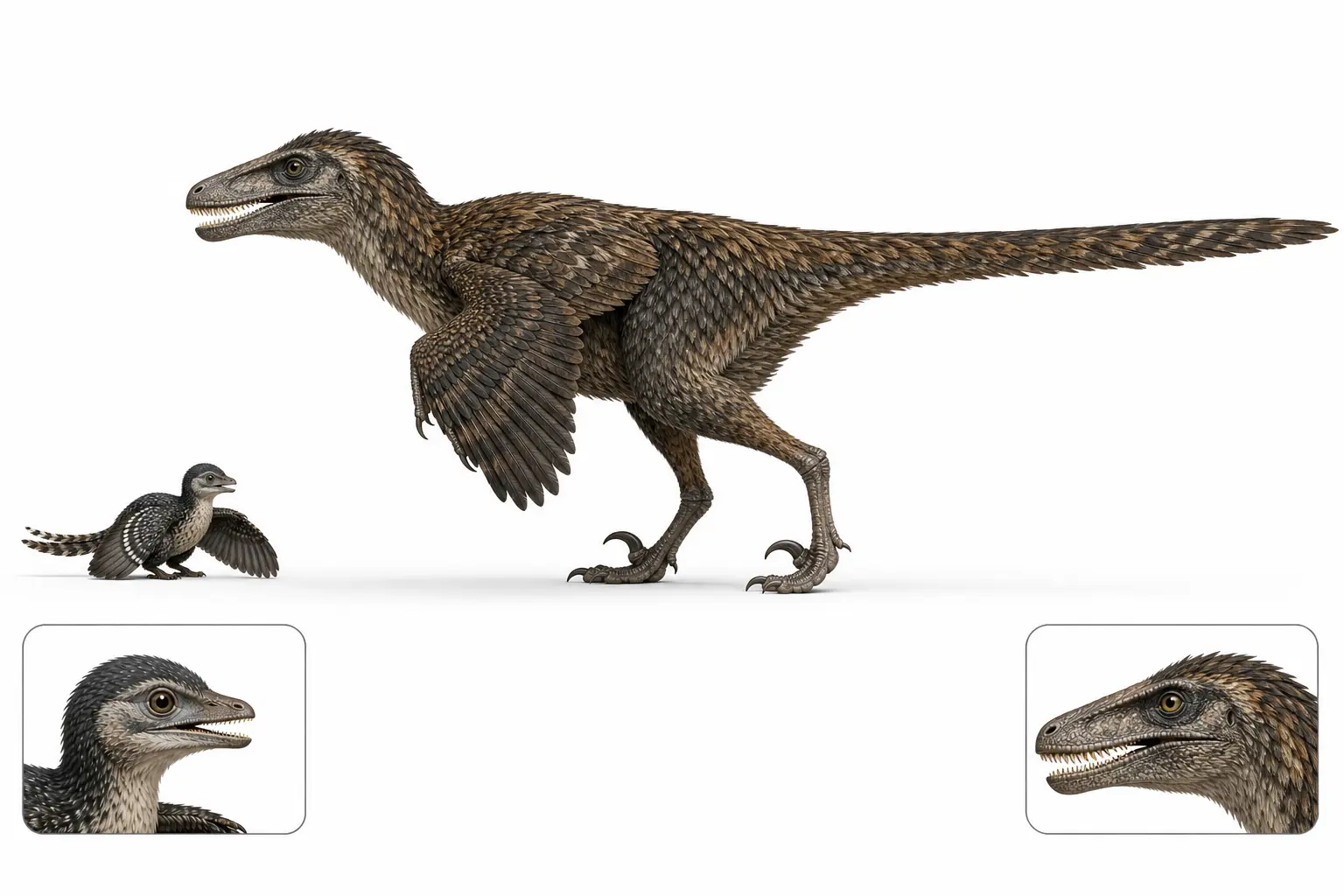
Deinonychus was approximately 3.4 metres long and estimated at 70–80 kg — making it roughly 70 to 100 times heavier than Archaeopteryx. Where Archaeopteryx was lightly built with hollow bones and a feathered wing surface, Deinonychus was a robust terrestrial predator with powerful hindlimbs and a stiffened tail used as a dynamic stabiliser during high-speed pursuit.
Dentition
Both animals were toothed. The teeth of Archaeopteryx were small, conical, and socketed — consistent with gripping small, slippery prey. The teeth of Deinonychus were serrated and blade-like, consistent with cutting through the flesh of much larger prey. The contrast in tooth morphology reflects a fundamental difference in ecological role.
The Sickle Claw: A Key Distinction
Deinonychus is defined in part by its hyperextensible second-toe sickle claw — a large, curved talon held off the ground during locomotion and deployed during prey restraint. Fossil evidence confirms this claw’s unusual range of motion from preserved joint anatomy.
Archaeopteryx had no equivalent structure. Its foot claws were curved but not hyperextensible, and none was enlarged to sickle proportions. For a full discussion of Archaeopteryx claw anatomy and function, see the Archaeopteryx claws post.
Feathers: What Each Animal Actually Had
Fossil evidence confirms Archaeopteryx was fully feathered — flight feathers, tail feathers, and body contour feathers are all directly evidenced from specimen impressions. For Deinonychus, direct feather evidence is limited; feathers are inferred from the exceptional preservation of closely related dromaeosaurids (particularly Microraptor and Zhenyuanlong) rather than from Deinonychus specimens themselves. Research suggests feathers were almost certainly present, but this remains inferred rather than directly evidenced for the genus.
Did They Ever Meet? Time and Geography
Archaeopteryx and Deinonychus did not overlap in time or space. Archaeopteryx is known exclusively from the Solnhofen Lagerstätte of Bavaria, dating to approximately 150–148 Ma. Deinonychus is known from the Cloverly and Antlers Formations of western North America, dating to approximately 115–108 Ma — roughly 35–40 million years later.
Any encounter between the two is impossible under the fossil record as currently understood, and any scenario depicting them together is speculative fiction.
Why the Comparison Matters
The Archaeopteryx–Deinonychus comparison is scientifically significant beyond simple size and anatomy. John Ostrom’s 1969 description of Deinonychus drew direct comparisons to Archaeopteryx in wrist anatomy, hip configuration, and overall paravian body plan. This work was foundational to the dinosaur renaissance of the 1970s and directly supported the hypothesis — now the scientific consensus — that birds are living theropod dinosaurs. The two species, studied together, helped establish one of the most important transitions in vertebrate evolutionary history.
Related and Contemporary Species
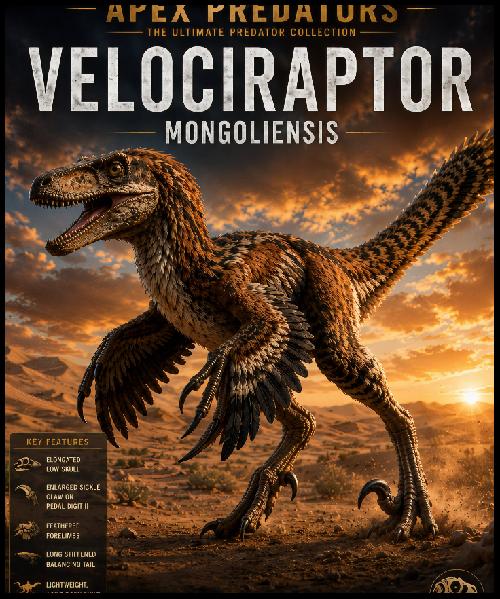
- Velociraptor mongoliensis — A smaller dromaeosaurid closely related to Deinonychus; frequently confused with it in popular culture. Shares the sickle claw and serrated dentition.
- Microraptor gui — A small four-winged dromaeosaurid with direct feather evidence; bridges the anatomical gap between Archaeopteryx and larger dromaeosaurids.
- Utahraptor ostrommaysorum — The largest known dromaeosaurid; provides scale context for the Deinonychus body plan at its extreme.
- Anchiornis huxleyi — A small feathered paravian from the Late Jurassic; closer in size and ecology to Archaeopteryx and relevant to the ancestral paravian body plan both animals share.
- Troodon formosus — A troodontid paravian; represents the third major lineage within Paravia alongside dromaeosaurids and birds.
Frequently Asked Questions
Were Archaeopteryx and Deinonychus related?
Yes — both belong to Paravia, the broader clade that includes dromaeosaurids and birds. They shared a common ancestor and retain several anatomical features in common, including a furcula and semi-lunate wrist bone. However, they were not closely related within Paravia: Archaeopteryx is an avialan and Deinonychus a dromaeosaurid, lineages that diverged well before either animal existed.
Who would win in a fight — Archaeopteryx vs Deinonychus?
This is a speculative scenario with no basis in the fossil record — the two animals were separated by approximately 35–40 million years and an ocean. If the question is purely hypothetical, Deinonychus was roughly 70–100 times heavier, armed with a sickle claw and serrated teeth, and was a pack-hunting predator. The outcome would not be in doubt. This scenario is entirely speculative.
Why is Deinonychus important to understanding Archaeopteryx?
John Ostrom’s 1969 description of Deinonychus identified anatomical features shared with Archaeopteryx — particularly in the wrist and hip — that became central evidence for the dinosaurian origin of birds. The comparison between the two species helped establish that Archaeopteryx was not an evolutionary outlier but part of a coherent theropod lineage leading to modern birds.
Conclusion
Archaeopteryx and Deinonychus never shared a sky, a continent, or an era — but they share a place in the history of palaeontology. Together, their anatomy built the evidential case for one of biology’s most consequential conclusions: that the birds outside your window are, by any rigorous classification, living dinosaurs.
Featured Museum Collections
Museum-quality paleoart and educational poster
collections based on evidence-informed prehistoric
Life reconstructions.