

At a Glance
| Field | Information |
|---|---|
| Species | Stegosaurus stenops — Ornithischia, Stegosauridae |
| Period | Late Jurassic, approximately 155–150 Ma |
| Brain size | Approximately 70–80 cm³ (estimated) — very small relative to body size compared to most dinosaurs |
| Sacral ganglion | Enlarged nerve cluster in the hip region — not a second brain |
| Myth status | Debunked — no vertebrate animal has two brains |
Quick Answer: Stegosaurus did not have two brains. The myth originated from the discovery of an enlarged cavity in the hip region of the spine, which early researchers speculated might house a secondary brain. Modern analysis shows this cavity most likely contained a glycogen body — a structure found in living birds — or simply an enlarged nerve ganglion. It was never a brain in any functional sense.
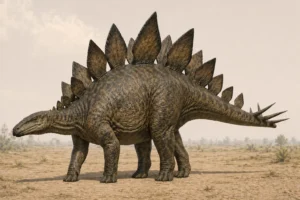
Few dinosaur misconceptions have proven as persistent as the idea that Stegosaurus had a second brain in its hips. It appears in textbooks, science classrooms, and popular media decades after palaeontologists identified it as a misreading of the fossil evidence. The real story of what that cavity contained — and what it tells us about Stegosaurus’s nervous system — is more interesting than the myth it replaced.
Did Stegosaurus Have Two Brains?
No. No vertebrate animal has two brains, and Stegosaurus was no exception. The two-brain claim originated in the late nineteenth century following the description of an unusually large neural canal cavity in the sacral region of the Stegosaurus spine — the area above the hips.
Early researchers, struck by the fact that this cavity was significantly larger than the cranial braincase, proposed that it might house a supplementary nerve centre capable of coordinating the animal’s hindquarters and tail independently of the primary brain. This interpretation was speculative from the outset and was never supported by direct fossil evidence of neural tissue.
What the Fossil Evidence Actually Shows
Fossil evidence documents the enlarged sacral cavity clearly — it is a real anatomical feature of Stegosaurus and not a preparation artefact or misidentification. What is contested is its contents and function. The cavity itself preserves no soft tissue, as neural and glandular material does not fossilise under normal conditions. Its function must therefore be inferred rather than directly observed.
The Glycogen Body Hypothesis
A commonly cited interpretation is that the enlarged sacral cavity in Stegosaurus may have housed a glycogen body — a structure present in the sacral spinal cord of living birds. In modern avians, the glycogen body is associated with the spinal cord and may play roles in energy storage and possibly aspects of balance or neural support, though its precise function remains incompletely understood.
Based on this living analogue, palaeontologists have proposed that a similar structure in Stegosaurus would be consistent with both the size and anatomical position of the sacral cavity. However, this interpretation remains an inference based on comparative anatomy rather than direct fossil evidence.
The Sacral Ganglion
An alternative and not mutually exclusive interpretation is that the cavity simply housed an enlarged sacral nerve ganglion — a concentration of nerve cell bodies that coordinated signals between the spinal cord and the hindlimbs and tail.
Enlarged sacral ganglia are documented in other large vertebrates and would represent a straightforward anatomical explanation for the cavity without requiring any novel structure. Under this interpretation, the cavity is unremarkable in functional terms, representing ordinary spinal anatomy scaled to a large animal rather than anything analogous to a brain.
How Big Was Stegosaurus’s Brain?
This is an active area of research. Details here reflect current scientific consensus but may be revised as new fossil evidence or analysis emerges.
Stegosaurus stenops had a genuinely small brain relative to its body size. Endocast analysis — the study of the internal shape of the braincase to reconstruct brain volume — suggests a brain volume of approximately 70–80 cm³, though published estimates vary and should be treated as indicative.
For an animal with a body mass exceeding 3,000 kg (6,600 lb), this represents a very low encephalisation quotient relative to body size compared to most dinosaurs. By comparison, a modern cat has a brain volume of approximately 25 cm³ in a body weighing around 4 kg — illustrating the extreme disparity between body size and brain volume in Stegosaurus.
What Brain Size Tells Us
Encephalisation quotient — the ratio of actual brain size to the brain size expected for an animal of a given body mass — is an imperfect but widely used proxy for cognitive complexity. Stegosaurus scores very low on this measure, consistent with limited behavioural flexibility and relatively simple neural processing compared to theropod dinosaurs of similar or smaller body size.
This does not mean Stegosaurus was behaviourally inert — it successfully navigated a complex predator-rich environment for roughly 5 million years — but it does suggest that complex learned behaviour or social cognition of the kind inferred for some theropods was unlikely.
Comparing Brain Sizes Across Dinosaurs
Among non-avian dinosaurs, brain size relative to body mass varied considerably. Large theropods, including Allosaurus, show higher encephalisation quotients than large herbivores of comparable body mass, consistent with the sensory and coordination demands of active predation.
Sauropods show similarly low encephalisation quotients to stegosaurids, reflecting the general pattern that large-bodied herbivores across the Mesozoic tended toward small relative brain sizes. Encephalisation increased markedly in the lineage leading to birds, with small maniraptorans showing brain-to-body ratios approaching those of modern avians.
How Did the Myth Originate?
The two-brains idea is traceable to late nineteenth-century palaeontology, a period when many foundational dinosaur descriptions were being produced rapidly and under significant competitive pressure — the era of the Bone Wars between Othniel Charles Marsh and Edward Drinker Cope.
Early descriptions of Stegosaurus anatomy were produced in this context, and some interpretations that would not survive modern scrutiny were published and subsequently entered popular science literature before they could be revised. The discovery history of Stegosaurus and the Bone Wars context are covered in full on the discovery page.
Once embedded in popular culture — particularly in educational materials aimed at children — the two-brains idea proved remarkably resistant to correction. It continued to appear in published children’s books and classroom resources decades after the palaeontological community had moved away from it. Its persistence in PAA boxes and AI-generated summaries today reflects the lag between scientific revision and the popular record rather than any current scientific support.
Related and Contemporary Species
- Diplodocus carnegii — large sauropod of the Morrison Formation; similarly low encephalisation quotient, illustrating that relatively small brain size was common among large Jurassic herbivores rather than unique to Stegosaurus
- Allosaurus fragilis — contemporaneous large theropod; higher encephalisation quotient than Stegosaurus, consistent with the greater sensory integration and coordination demands of active predation
- Kentrosaurus aethiopicus — African stegosaurid; closely related to Stegosaurus and likely shared broadly similar neuroanatomy based on phylogenetic relationship, though direct endocast data remains limited
- Archaeopteryx lithographica — Late Jurassic avialan; broadly contemporaneous with Stegosaurus and represents the opposite end of the encephalisation spectrum, with a brain-to-body ratio approaching early avian levels
Frequently Asked Questions
Did Stegosaurus have two brains?
No. Stegosaurus had one brain, located in its skull. The two-brains myth originated from the discovery of an enlarged cavity in the sacral region of the spine, which early researchers speculated might function as a secondary nerve centre. Modern analysis suggests the cavity most likely housed a glycogen body or enlarged nerve ganglion — neither of which is a brain in any functional sense.
How big was Stegosaurus’s brain compared to its body?
Stegosaurus had one of the lowest brain-to-body ratios of any known dinosaur. Endocast estimates suggest a brain volume of approximately 70–80 cm³ in an animal potentially exceeding 3,000 kg (6,600 lb) in body mass. This places it among the least encephalised non-avian dinosaurs, consistent with limited behavioural complexity relative to theropods of comparable or smaller size.
Was Stegosaurus intelligent?
By any reasonable measure, Stegosaurus had a limited cognitive capacity relative to its body size. Its encephalisation quotient is among the lowest documented for non-avian dinosaurs, suggesting simple neural processing rather than complex learned behaviour. That said, it successfully survived in a predator-rich environment for roughly 5 million years, which required sufficient sensory and motor function to detect threats, deploy tail defences, and locate food — none of which required high intelligence.
Stegosaurus had one brain, a small one, and a sacral cavity that has been misread for over a century. The myth endures not because the evidence supports it but because it entered popular culture before science caught up — a reminder that even well-debunked ideas can outlast the corrections meant to replace them.
Recommended Paleontology & Natural History Books
As an Amazon Associate, Extinct Atlas may earn from qualifying purchases.
The Rise and Fall of the Dinosaurs
A compelling history of dinosaurs, tracing their origins, diversification, 200-million-year reign, extinction, and enduring legacy.
Dinosaurs and Prehistoric Life
A richly illustrated visual reference exploring dinosaurs, fossils, evolution, and prehistoric life across geological time.
Encyclopedia Prehistorica: Dinosaurs
An interactive dinosaur book featuring spectacular three-dimensional pop-ups, particularly suited to young readers and families.
The Rise and Reign of the Mammals
A sweeping history of mammalian evolution, from their origins alongside dinosaurs through the Cenozoic and the emergence of humans.