

At a Glance
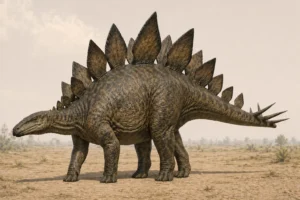
| Field | Information |
|---|---|
| Species | Stegosaurus stenops — Ornithischia, Stegosauridae |
| Period | Late Jurassic, approximately 155–150 Ma |
| Epoch | Kimmeridgian to Tithonian |
| Continental configuration | Laurasia and Gondwana partially separated; North America and Europe still connected |
| Followed by | Early Cretaceous faunal turnover; stegosaurids replaced by ankylosaurs and ceratopsians |
Quick Answer: Stegosaurus lived during the Late Jurassic period, approximately 155 to 150 million years ago. This places it in the Kimmeridgian to Tithonian epochs of the Jurassic, a world of warm climates, shallow seas, and continental landmasses still in the process of separating. It disappeared around 150 Ma — roughly 84 million years before the mass extinction that ended the non-avian dinosaurs.
One of the most disorienting facts about Stegosaurus is not how long ago it lived, but how long before other famous dinosaurs it disappeared. Stegosaurus and Tyrannosaurus rex are separated by more time than T. rex is from the present day — a detail that reframes the entire scale of the Mesozoic and the place Stegosaurus occupies within it.
When Did Stegosaurus Live?
This is an active area of research. Details here reflect current scientific consensus but may be revised as new fossil evidence or analysis emerges.
Stegosaurus lived approximately 155 to 150 million years ago, during the Late Jurassic period. More precisely, fossil evidence places the genus within the Kimmeridgian and Tithonian epochs — the final two stages of the Jurassic period before the transition into the Cretaceous at approximately 145 Ma.
The documented fossil range of Stegosaurus within the Morrison Formation spans roughly 5 million years, though species-level temporal ranges within the genus are less precisely constrained and subject to revision as new material is described. The genus is not known from Early Cretaceous deposits, and its disappearance predates the Jurassic–Cretaceous boundary by a small but meaningful margin.
The Jurassic Period in Context
The Jurassic period ran from approximately 201 Ma to 145 Ma — a span of roughly 56 million years. Stegosaurus occupied the final portion of this interval. The Jurassic period followed the Triassic period, during which dinosaurs first diversified following the end-Triassic mass extinction, and preceded the Cretaceous, which ended with the Chicxulub impact at 66 Ma. Within this framework, Stegosaurus sits closer to the middle of the Mesozoic Era than to either its beginning or its end.
What Was the World Like When Stegosaurus Lived?
Continental Configuration
During the Late Jurassic, the supercontinent Pangaea had been breaking apart for tens of millions of years, but the resulting landmasses were still in significantly different positions than today. North America and Europe remained connected via a land bridge, which helps explain the close taxonomic relationship between Morrison Formation fauna and dinosaur assemblages from contemporaneous European deposits.
The Atlantic Ocean was narrower and younger than it is today. Gondwana — the southern supercontinent comprising what would become South America, Africa, Antarctica, Australia, and India — was itself beginning to fragment. These continental connections and separations directly influenced which dinosaur lineages shared geographic ranges and which evolved in isolation.
Climate
The Late Jurassic climate was substantially warmer than today, with no polar ice caps and higher global sea levels that created extensive shallow inland seas. Based on isotopic and sedimentological evidence, mean global temperatures are estimated to have been significantly elevated relative to the present.
The Morrison Formation environment specifically was warm and seasonally semi-arid, as covered in detail on the habitat page. Atmospheric carbon dioxide concentrations were higher than modern levels, contributing to the greenhouse conditions that characterised much of the Mesozoic.
Flora
Flowering plants had not yet evolved during Stegosaurus’s lifetime. The vegetation Stegosaurus moved through was dominated by ferns, cycads, horsetails, and conifers — a plant community with no modern equivalent in terms of species composition, though broadly comparable in structure to some modern subtropical woodland and fern-dominated ecosystems. The first flowering plants would not appear until the Early Cretaceous, tens of millions of years after Stegosaurus had gone extinct.
Species-Level Temporal Differentiation
This is an active area of research. Details here reflect current scientific consensus but may be revised as new fossil evidence or analysis emerges.
The genus Stegosaurus currently contains two widely accepted species — S. stenops and S. armatus — with the validity and temporal range of additional proposed species remaining debated in the published literature.
S. stenops is the better-known species and provides the basis for most morphological and temporal reconstructions of the genus. S. armatus, described by Marsh in 1877, is known from less complete material, and its precise temporal range within the Morrison Formation is less well constrained.
Species-level temporal differentiation within Stegosaurus is an area where the fossil record remains insufficiently resolved to draw firm conclusions, and published species counts may be revised as additional material is described and existing specimens are reanalysed.
What Came Before and After Stegosaurus?
Predecessors
Stegosauridae as a family first appeared in the Middle Jurassic, with early stegosaurids documented from Chinese deposits dating to approximately 165 Ma. Huayangosaurus taibaii, from the Middle Jurassic of China, is among the earliest and most completely known stegosaurids and provides important context for understanding the group’s origins and early evolution.
By the time Stegosaurus appeared in the Late Jurassic Morrison Formation, stegosaurids had already diversified across multiple continents over a period of roughly 10 million years.
Successors
No direct descendants of Stegosaurus are known. The stegosaurid lineage effectively ended with the Late Jurassic faunal turnover, leaving no Cretaceous representatives in Laurasia. The ecological roles previously occupied by stegosaurids were taken over by ankylosaurs and, later, ceratopsians — both of which diversified extensively through the Cretaceous.
Ankylosauria, which had already been present in the Late Jurassic alongside Stegosaurus, became the dominant armoured herbivore group of the Cretaceous and persisted until the K-Pg extinction at 66 Ma.
The T. rex Comparison
The temporal separation between Stegosaurus and Tyrannosaurus rex is one of the most striking illustrations of deep time in palaeontology. Stegosaurus went extinct approximately 150 Ma. Tyrannosaurus rex first appeared approximately 68 Ma. The gap between them is therefore roughly 82 million years.
By comparison, T. rex is separated from the present day by only 66 million years — meaning Stegosaurus is, in a precise sense, a more ancient relative to T. rex than T. rex is relative to us. The two species never coexisted, never shared a habitat, and never interacted in any form.
Related and Contemporary Species
- Allosaurus fragilis — apex predator of the Morrison Formation; directly contemporaneous with Stegosaurus and documented in the same geological deposits.
- Diplodocus carnegii — a large sauropod of the Morrison Formation; shared Stegosaurus’s time range and habitat across the Late Jurassic of North America.
- Huayangosaurus taibaii — early stegosaurid from the Middle Jurassic of China, approximately 165 Ma; among the best-documented predecessors of Stegosaurus and key to understanding stegosaurid origins.
- Kentrosaurus aethiopicus — African stegosaurid from the broadly contemporaneous Tendaguru Formation; the closest temporal and ecological parallel to Stegosaurus outside North America.
- Ankylosaurus magniventris — while not contemporaneous with Stegosaurus, represents the armoured herbivore lineage that succeeded stegosaurids ecologically through the Cretaceous.
Frequently Asked Questions
What period did Stegosaurus live in?
Stegosaurus lived during the Late Jurassic period, specifically the Kimmeridgian to Tithonian epochs, approximately 155 to 150 million years ago. The Jurassic period ran from roughly 201 Ma to 145 Ma, placing Stegosaurus in the final portion of this interval, shortly before the transition into the Cretaceous.
Did Stegosaurus live at the same time as T. rex?
No. Stegosaurus and Tyrannosaurus rex are separated by approximately 82 million years. Stegosaurus went extinct around 150 Ma; T. rex did not appear until approximately 68 Ma. The two species never coexisted. The time gap between them is greater than the time separating T. rex from the present day.
How long did Stegosaurus exist as a species?
Fossil evidence places the genus Stegosaurus in the Morrison Formation from approximately 155 Ma to 150 Ma, giving it a documented range of roughly 5 million years. Species-level ranges within the genus are less precisely constrained and may be revised as new specimens are described and existing material is reanalysed.
Stegosaurus occupied a narrow but well-documented window of the Late Jurassic — a warm, flowerless world of giant sauropods and seasonal floodplains that no longer exists in any form. Its place in deep time is further from T. rex than T. rex is from us, a fact that reframes the entire scale of the Mesozoic.
Recommended Paleontology & Natural History Books
As an Amazon Associate, Extinct Atlas may earn from qualifying purchases.
The Rise and Fall of the Dinosaurs
A compelling history of dinosaurs, tracing their origins, diversification, 200-million-year reign, extinction, and enduring legacy.
Dinosaurs and Prehistoric Life
A richly illustrated visual reference exploring dinosaurs, fossils, evolution, and prehistoric life across geological time.
Encyclopedia Prehistorica: Dinosaurs
An interactive dinosaur book featuring spectacular three-dimensional pop-ups, particularly suited to young readers and families.
The Rise and Reign of the Mammals
A sweeping history of mammalian evolution, from their origins alongside dinosaurs through the Cenozoic and the emergence of humans.