
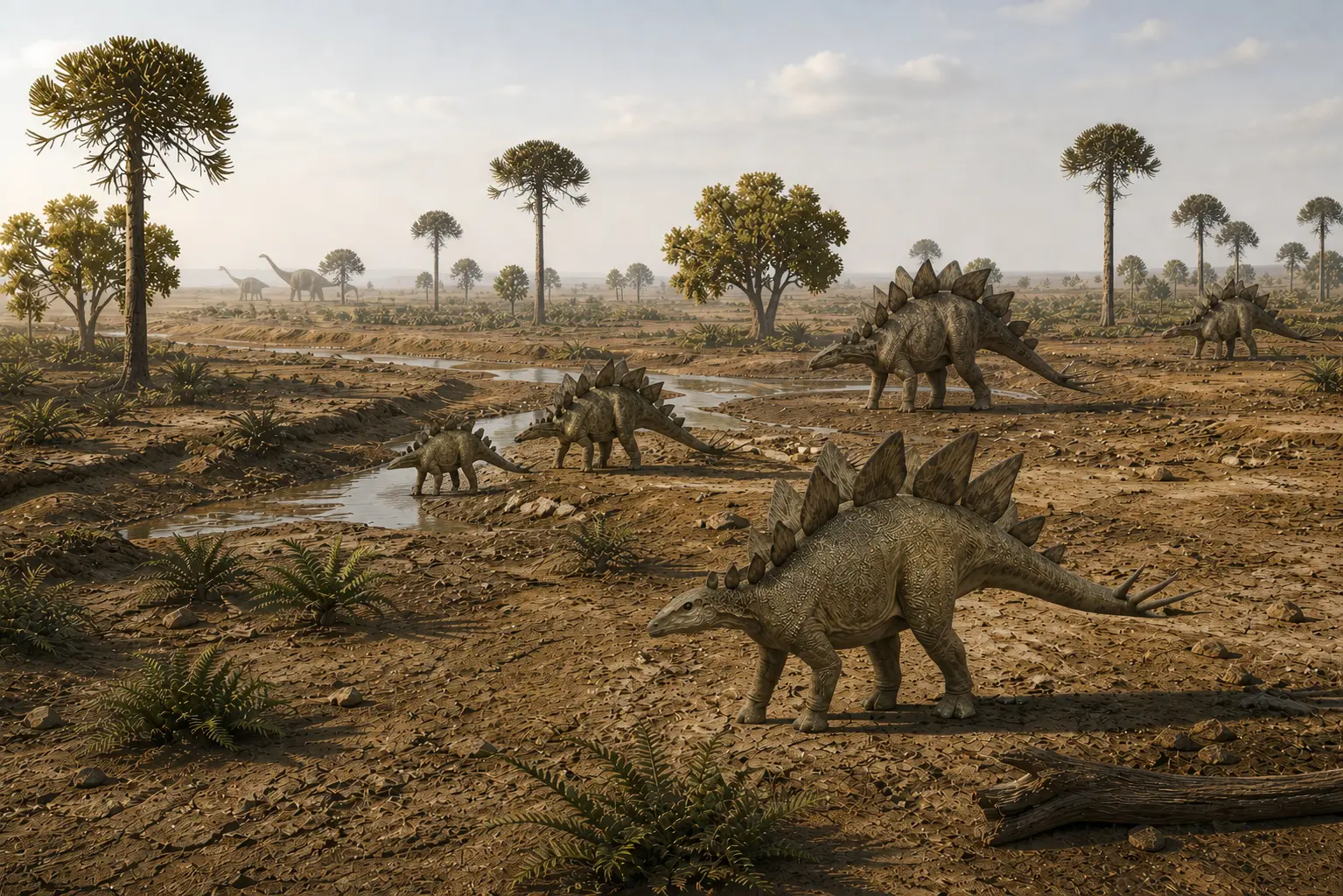
At a Glance
| Field | Information |
|---|---|
| Species | Stegosaurus stenops — Ornithischia, Stegosauridae |
| Period | Late Jurassic, approximately 155–150 Ma |
| Formation | Morrison Formation, western North America |
| Climate | Seasonal, semi-arid with wet and dry cycles |
| Vegetation | Ferns, cycads, conifers, horsetails — no grasses or flowering plants |
Quick Answer: Stegosaurus lived in the floodplains and river valleys of what is now western North America, in an environment geologists call the Morrison Formation. The Late Jurassic world it inhabited was warmer and drier than today, dominated by seasonal rivers, open fern prairies, and conifer woodlands — with no grasses, no flowers, and some of the largest animals ever to walk the Earth.
Picture a landscape with no grass underfoot and no flowers on any plant — just the low sweep of ferns, the sharp outline of cycads, and the distant canopy of conifers above a seasonal river. That was the world Stegosaurus moved through, roughly 150 million years ago, in a habitat that no longer exists in any recognisable form on Earth today.
Stegosaurus Habitat: The Morrison Formation
This is an active area of research. Details here reflect current scientific consensus but may be revised as new fossil evidence or analysis emerges.
Stegosaurus lived within the Morrison Formation, a sequence of sedimentary rock deposits spanning much of the western interior of modern North America — covering parts of present-day Colorado, Utah, Wyoming, Montana, South Dakota, Oklahoma, and New Mexico. Fossil evidence places Stegosaurus consistently within the floodplain and river channel deposits of this formation, suggesting it favoured low-lying, vegetated terrain near seasonal water sources.
The Morrison Formation is one of the most intensively studied dinosaur-bearing geological units in the world, and its environmental reconstruction is well supported by sedimentological, palaeobotanical, and geochemical evidence.
Climate and Seasonality
The Late Jurassic climate of the Morrison Formation was markedly different from the temperate conditions of western North America today. Based on isotopic analysis of fossil soils and plant material, palaeoclimatologists reconstruct the Morrison environment as warm and seasonally semi-arid — characterised by distinct wet and dry seasons rather than the consistent annual rainfall of modern temperate zones.
Mean annual temperatures are estimated to have been significantly higher than present. Prolonged dry seasons likely shaped the distribution and movement patterns of large herbivores, including Stegosaurus, concentrating animals near reliable water sources during drought periods.
Vegetation
Flowering plants had not yet evolved during the Late Jurassic, and grasses would not appear for tens of millions of years. The plant communities Stegosaurus moved through were dominated by ferns at ground level, with cycads, seed ferns, and horsetails forming the mid-storey, and tall conifers providing the upper canopy.
Palaeobotanical evidence from Morrison Formation deposits documents this plant assemblage directly. The absence of grasses and the dominance of ferns and cycads have direct implications for Stegosaurus’s feeding posture and diet — addressed in full on the diet page.
River Systems and Landscape
The Morrison landscape was shaped by large, seasonally active river systems draining eastward from a highland region to the west. During wet seasons, these rivers flooded extensively, depositing the sediments that would eventually preserve the Morrison fauna.
During dry seasons, the landscape contracted around permanent waterholes and river channels. Fossil evidence of Stegosaurus is concentrated in the finer-grained floodplain deposits rather than the coarser channel fills, consistent with an animal that favoured open, vegetated floodplain terrain over dense riparian zones.
Co-occurring Fauna
The Morrison Formation supported one of the most diverse large-animal communities documented in the Mesozoic fossil record. Stegosaurus shared this environment with a range of herbivores and predators whose remains are preserved in the same deposits.
Large sauropods, including Brachiosaurus, Diplodocus, and Camarasaurus, occupied the same formation, browsing at heights far beyond Stegosaurus’s reach and likely drawing on different plant resources. The dominant large predator was Allosaurus fragilis, fossil evidence for whose predatory interactions with Stegosaurus is discussed in full on the comparison page.
Smaller theropods, including Ceratosaurus and Torvosaurus, were also present. The ornithopod Camptosaurus shared the low-browsing niche with Stegosaurus, and the small theropod Ornitholestes is among the smaller carnivores documented from the same deposits.
Geographic Range Beyond North America
This is an active area of research. Details here reflect current scientific consensus but may be revised as new fossil evidence or analysis emerges.
While the Morrison Formation of North America provides the most complete and well-documented fossil record for Stegosaurus, stegosaurid dinosaurs are known from other Late Jurassic deposits across multiple continents. Kentrosaurus aethiopicus is documented from the Tendaguru Formation of Tanzania, and stegosaurid material has also been recovered from Portugal.
Fragmentary remains from North Africa, including Morocco, have been reported but are not securely assignable to Stegosaurus and remain taxonomically uncertain.
The geographic distribution of stegosaurids suggests the group was widespread across both Laurasia and Gondwana during the Late Jurassic, consistent with paleogeographic reconstructions showing broader continental connectivity than exists today.
Related and Contemporary Species
- Allosaurus fragilis — apex predator of the Morrison Formation; fossil evidence documents direct interaction with Stegosaurus and is the primary large theropod in its ecosystem.
- Diplodocus carnegii — large sauropod of the Morrison Formation; shared Stegosaurus’s habitat but browsed at far greater heights, reducing direct dietary competition.
- Camarasaurus supremus — the most common sauropod in the Morrison Formation by specimen count; occupied the same floodplain environment as Stegosaurus.
- Camptosaurus dispar — ornithopod herbivore of the Morrison Formation; shared the low-browsing niche with Stegosaurus and likely competed for similar plant resources.
- Kentrosaurus aethiopicus — African stegosaurid from the broadly contemporaneous Tendaguru Formation; the closest ecological parallel to Stegosaurus outside North America.
Frequently Asked Questions
Where did Stegosaurus live?
Stegosaurus lived in the floodplains and river valleys of the Morrison Formation, a geological unit covering much of western North America. Fossil evidence places it across present-day Colorado, Utah, Wyoming, and neighbouring states. The environment was warm, seasonally dry, and dominated by ferns, cycads, and conifers rather than the grasses and flowering plants familiar today.
What was the climate like when Stegosaurus lived?
Biomechanical estimates and geochemical analysis of Morrison Formation soils suggest the Late Jurassic climate of western North America was significantly warmer than today, with pronounced wet and dry seasons. There was no polar ice, sea levels were higher, and the continental interior experienced extended dry periods that would have concentrated large animals near seasonal water sources.
Did Stegosaurus live in the same place as T. rex?
No. Tyrannosaurus rex lived approximately 80 million years after Stegosaurus had already gone extinct, in a different geological period and a substantially different environment. The two species never shared a habitat. The time separating Stegosaurus from T. rex is greater than the time separating T. rex from the present day.
The Morrison Formation preserves a snapshot of one of the most extraordinary ecosystems in Earth’s history — a warm, semi-arid world of giant sauropods, active predators, and fern-covered floodplains that Stegosaurus navigated for roughly five million years. No equivalent environment exists today.
Recommended Paleontology & Natural History Books
As an Amazon Associate, Extinct Atlas may earn from qualifying purchases.
The Rise and Fall of the Dinosaurs
A compelling history of dinosaurs, tracing their origins, diversification, 200-million-year reign, extinction, and enduring legacy.
Dinosaurs and Prehistoric Life
A richly illustrated visual reference exploring dinosaurs, fossils, evolution, and prehistoric life across geological time.
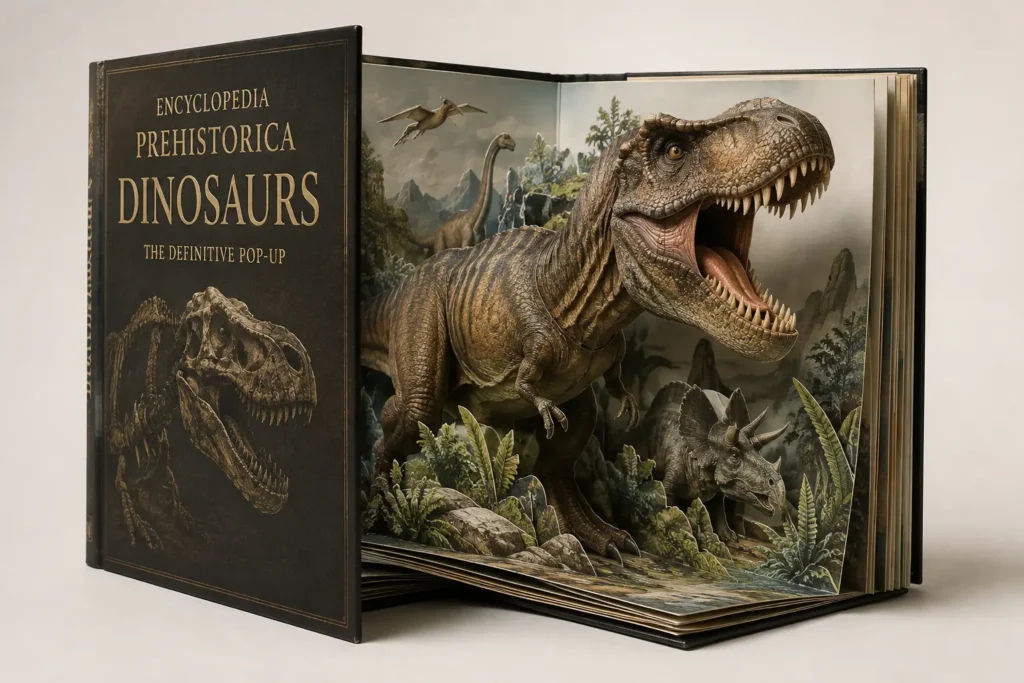
Encyclopedia Prehistorica: Dinosaurs
An interactive dinosaur book featuring spectacular three-dimensional pop-ups, particularly suited to young readers and families.
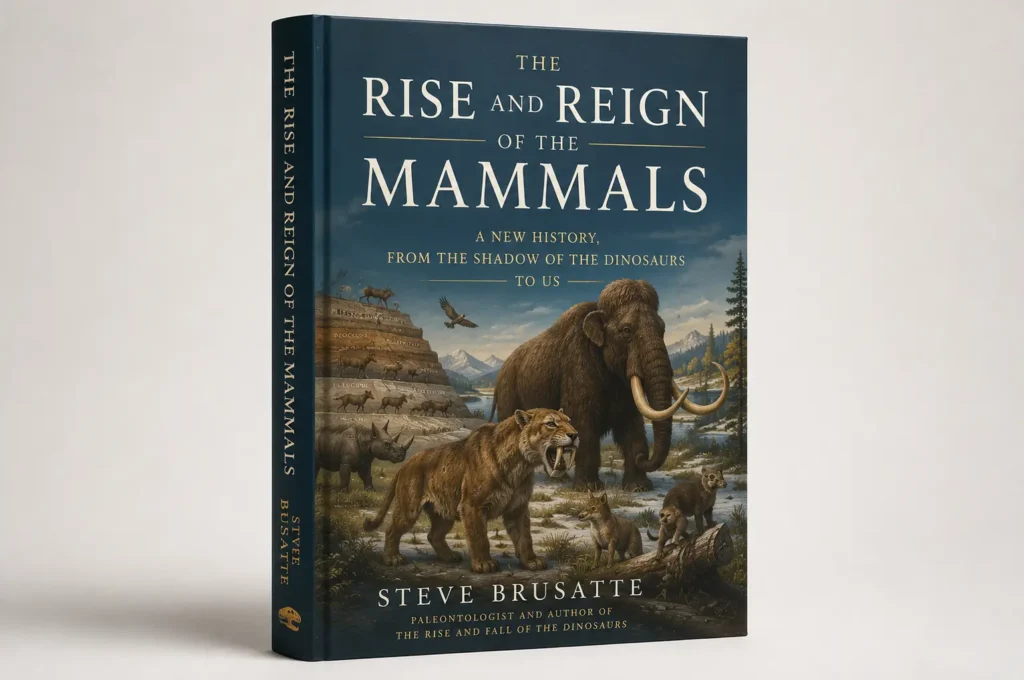
The Rise and Reign of the Mammals
A sweeping history of mammalian evolution, from their origins alongside dinosaurs through the Cenozoic and the emergence of humans.