
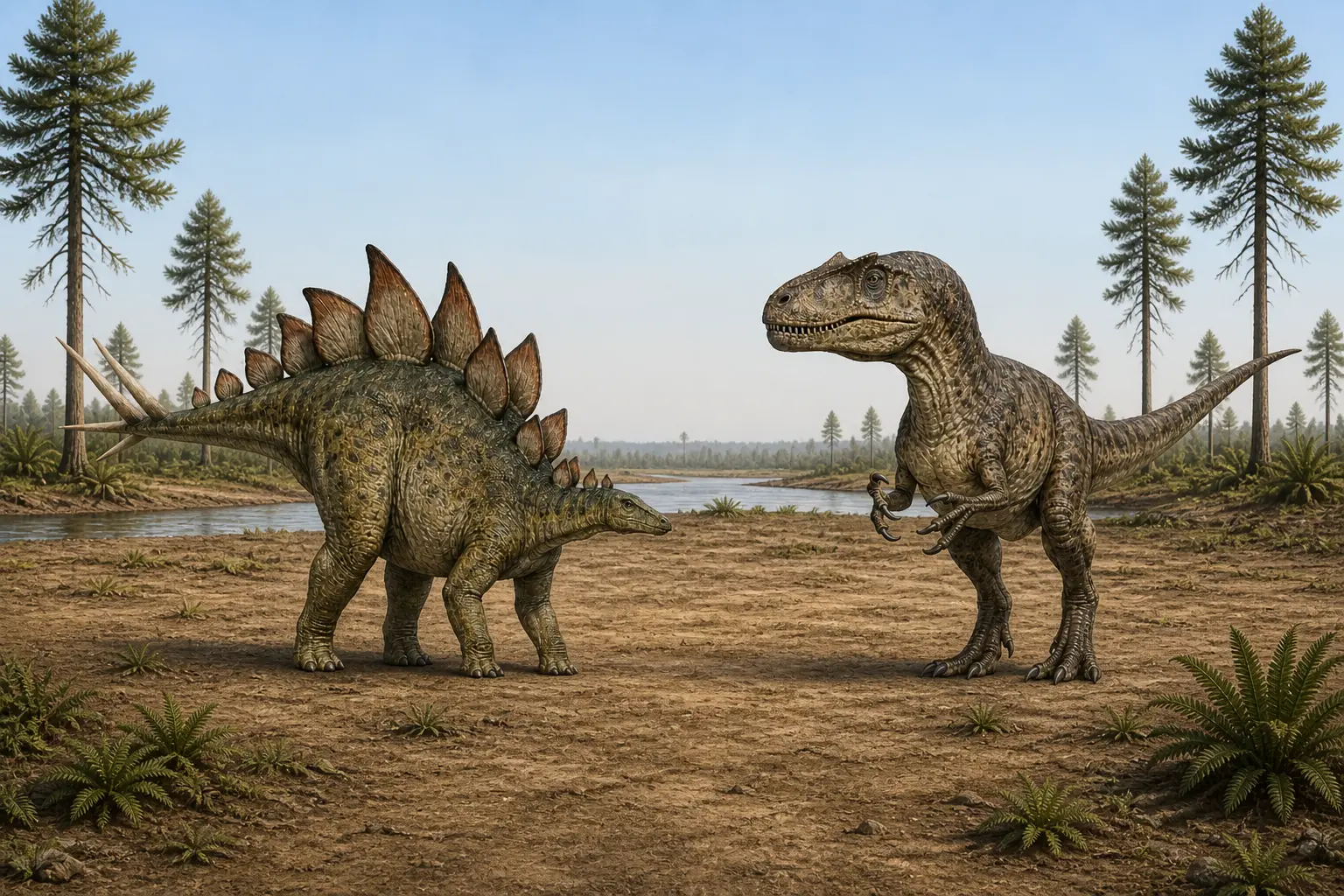
Stegosaurus vs Allosaurus
At a Glance
| Feature | Stegosaurus | Allosaurus |
|---|---|---|
| Classification | Ornithischia, Stegosauridae | Saurischia, Allosauridae |
| Period | Late Jurassic (155–150 Ma) | Late Jurassic (155–145 Ma) |
| Length | ~9 m (30 ft) | ~8.5–12 m (28–39 ft) |
| Weight | Estimated 2,700–4,000 kg (5,950–8,820 lb) | ~1,500–2,200 kg (3,300–4,900 lb) |
| Primary weapon | Thagomizer — 4 spikes, 60–90 cm each | Serrated teeth, three-clawed forelimbs |
| Fossil interaction evidence | UMNH 10781 — healed puncture wound in Allosaurus vertebra matching Stegosaurus spike | Same specimen |
Quick Answer Stegosaurus and Allosaurus were genuine contemporaries — both lived in the Late Jurassic of North America, approximately 155–150 million years ago, sharing the same ecosystem. We have direct fossil evidence of at least one real encounter: an Allosaurus vertebra bearing a healed puncture wound that precisely matches a Stegosaurus tail spike. Stegosaurus was heavier but slower; Allosaurus was faster and armed with powerful jaws and claws. Neither had a straightforward advantage.
Stegosaurus and Allosaurus are among the most recognisable dinosaurs ever discovered — and unlike many famous pairings, they actually shared the same time and place. The Morrison Formation of western North America preserves both species in the same rock, the same quarries, and in at least one case, the same bones. What we know about their interactions comes not from speculation but from physical evidence, and that evidence tells a more nuanced story than most popular accounts suggest.
Stegosaurus vs Allosaurus: Size, Weapons, and Ecological Overlap
Stegosaurus and Allosaurus coexisted in the Late Jurassic Morrison Formation of western North America, roughly 155–150 million years ago. Both are recovered from the same fossil sites — including the Cleveland-Lloyd Dinosaur Quarry in Utah and Dinosaur National Monument — confirming genuine geographic and temporal overlap, not just approximate proximity.
| Feature | Stegosaurus | Allosaurus |
|---|---|---|
| Body length | ~9 m (30 ft) | ~8.5–12 m (28–39 ft) |
| Body mass | 2,700–4,000 kg | ~1,500–2,200 kg |
| Stance | Quadrupedal, low-slung | Bipedal, upright |
| Primary offensive weapon | Thagomizer — 4 horizontal tail spikes | Serrated teeth; three large forelimb claws |
| Primary defensive asset | Thagomizer; dermal plates; body mass | Speed; binocular-capable vision |
| Locomotion | Slow quadruped | Active cursorial predator |
Stegosaurus was substantially heavier than Allosaurus despite being similar in length, owing to its broad, deep body. Allosaurus compensated with speed, agility, and a skull built for powerful, hatchet-like biting. The two animals were not mismatched in the way popular media often frames them — each carried serious risks for the other.
The Fossil Evidence of Real Encounters
Allosaurus Vertebra UMNH 10781
The most important piece of direct evidence for Stegosaurus–Allosaurus interaction is a single caudal vertebra from an Allosaurus, catalogued as UMNH 10781, recovered from the Cleveland-Lloyd Dinosaur Quarry in Utah. The transverse process of this vertebra — a lateral projection of bone — contains a puncture wound whose shape and cross-sectional dimensions precisely match a Stegosaurus tail spike.
The wound shows clear signs of bone remodelling around its margins, indicating partial healing. The Allosaurus survived the encounter. It lived long enough for new bone tissue to begin forming around the wound site, then died later — from an unrelated cause — preserving the injury permanently.
This specimen is one of a very small number of fossils anywhere in the record that documents direct physical contact between two specific species. It is not an inference drawn from size or geography. It is a preserved outcome of a real event.
Stegosaurus Spike Pathologies
Complementary evidence comes from the Stegosaurus side of the equation. A 2001 study by McWhinney and colleagues examined 51 Stegosaurus tail spikes and found that approximately 10% had broken tips with remodelled bone — meaning the animal had fractured its spike against a hard resisting surface and survived. Spike tips do not break from passive use. The damage pattern is consistent with high-force impacts of the kind produced when a spike is driven into bone or dense muscle tissue.
Neither line of evidence proves that every Allosaurus hunted Stegosaurus, nor that every Stegosaurus used its thagomizer in combat. What they establish is that this interaction happened — physically, measurably, at least once — and that it left marks on both animals.
Weapons and Tactics: What the Anatomy Tells Us
Allosaurus Attack Capability
Allosaurus was a large theropod with a skull adapted for delivering powerful downward bites rather than sustained crushing force. Its jaw mechanics have been compared to an axe — a fast, forceful strike followed by withdrawal, rather than the bone-crushing bite of a later predator like Tyrannosaurus. It also possessed three large, recurved claws on each forelimb, capable of gripping or raking prey.
As a biped, Allosaurus was faster and more manoeuvrable than Stegosaurus on open ground. It’s likely attack strategy — inferred from anatomy and from evidence of Allosaurus feeding traces on large sauropod bones at the same sites — was to target vulnerable areas: flanks, neck, hindquarters.
Stegosaurus Defence Capability
Stegosaurus was not built for speed or pursuit. Its defence was positional. The thagomizer was most effective when Stegosaurus could keep its rear end oriented toward a threat — and its anatomy supported this. The tail lacked ossified tendons, giving it unusual lateral flexibility. With large hindlimbs anchored and short forelimbs available to push off the ground, Stegosaurus could pivot its rear arc toward an attacker relatively quickly for an animal of its mass.
The dorsal plates offered limited direct armour — they were not solid bone structures positioned optimally to deflect bites — but their visual prominence may have made accurate targeting of the spine difficult, and the sheer bulk of Stegosaurus made it a costly target even for a predator of Allosaurus’s capability.
Stegosaurus vs T. rex: Why This Fight Never Happened
This section addresses one of the most common questions in popular dinosaur content directly: Stegosaurus and Tyrannosaurus rex never met.
The temporal separation between them is not a narrow margin. Stegosaurus lived approximately 155–150 million years ago, during the Late Jurassic. Tyrannosaurus rex lived approximately 68–66 million years ago, during the Late Cretaceous. The gap between them — roughly 80 million years — is longer than the entire span of time separating T. rex from the present day.
To put that in perspective: Stegosaurus is a more ancient relative to T. rex than T. rex is relative to us.
The two species did not share a continent, a climate, a food web, or a geological period. No encounter between them was possible. Any comparison between Stegosaurus and T. rex is a hypothetical constructed entirely outside the fossil record, and should be understood as such. The genuine predator of Stegosaurus was Allosaurus — and as UMNH 10781 demonstrates, that interaction was real.
Related and Contemporary Species
Ceratosaurus nasicornis — A smaller theropod predator from the same Morrison Formation, Ceratosaurus coexisted with Stegosaurus and may have preyed on juveniles or smaller individuals, though it lacked the size and power of Allosaurus.
Kentrosaurus aethiopicus — The East African relative of Stegosaurus, Kentrosaurus faced its own predators in the Tendaguru Formation of Tanzania and is the subject of the most detailed biomechanical study of stegosaur tail-strike mechanics, providing the closest available model for Stegosaurus thagomizer performance.
Torvosaurus tanneri — One of the largest theropods in the Morrison Formation, Torvosaurus was a contemporary of both Stegosaurus and Allosaurus and represents another potential predatory pressure on adult Stegosaurus, though direct interaction evidence has not been documented.
Camptosaurus dispar — A herbivorous ornithopod from the Morrison Formation, Camptosaurus shared the same ecosystem as Stegosaurus and Allosaurus, providing useful ecological context for the community structure within which their interactions took place.
Frequently Asked Questions
Did Stegosaurus and Allosaurus actually live at the same time?
Yes. Both species are recovered from the Late Jurassic Morrison Formation of western North America, dated to approximately 155–150 million years ago. They have been found at the same fossil quarries, including the Cleveland-Lloyd Dinosaur Quarry in Utah, confirming genuine temporal and geographic overlap — not just approximate coexistence.
Is there real fossil evidence of Stegosaurus and Allosaurus fighting?
Yes. An Allosaurus caudal vertebra catalogued as UMNH 10781 bears a puncture wound whose shape and dimensions precisely match a Stegosaurus tail spike. The wound shows signs of partial healing, meaning the Allosaurus survived the encounter. Separately, roughly 10% of examined Stegosaurus tail spikes show broken and remodelled tips consistent with high-impact contact.
Could Stegosaurus have fought off Allosaurus?
The fossil record suggests it could cause serious injury to one. Allosaurus UMNH 10781 survived a Stegosaurus spike through its vertebra, but the wound confirms it took a direct hit. Stegosaurus’s thagomizer, body mass, and pivoting defence capability made it a genuinely dangerous target — not a passive victim. Whether any individual encounter ended in predator or prey death cannot be determined from current evidence.
Conclusion
Stegosaurus and Allosaurus were real contemporaries in the same ecosystem, and the fossil record preserves direct physical evidence of at least one encounter between them. The comparison is not speculation — it is geology. The Stegosaurus vs T. rex framing, by contrast, has no basis in the fossil record: 80 million years of deep time separates the two animals. The genuine story is better.
Recommended Paleontology & Natural History Books
As an Amazon Associate, Extinct Atlas may earn from qualifying purchases.
The Rise and Fall of the Dinosaurs
A compelling history of dinosaurs, tracing their origins, diversification, 200-million-year reign, extinction, and enduring legacy.
Dinosaurs and Prehistoric Life
A richly illustrated visual reference exploring dinosaurs, fossils, evolution, and prehistoric life across geological time.
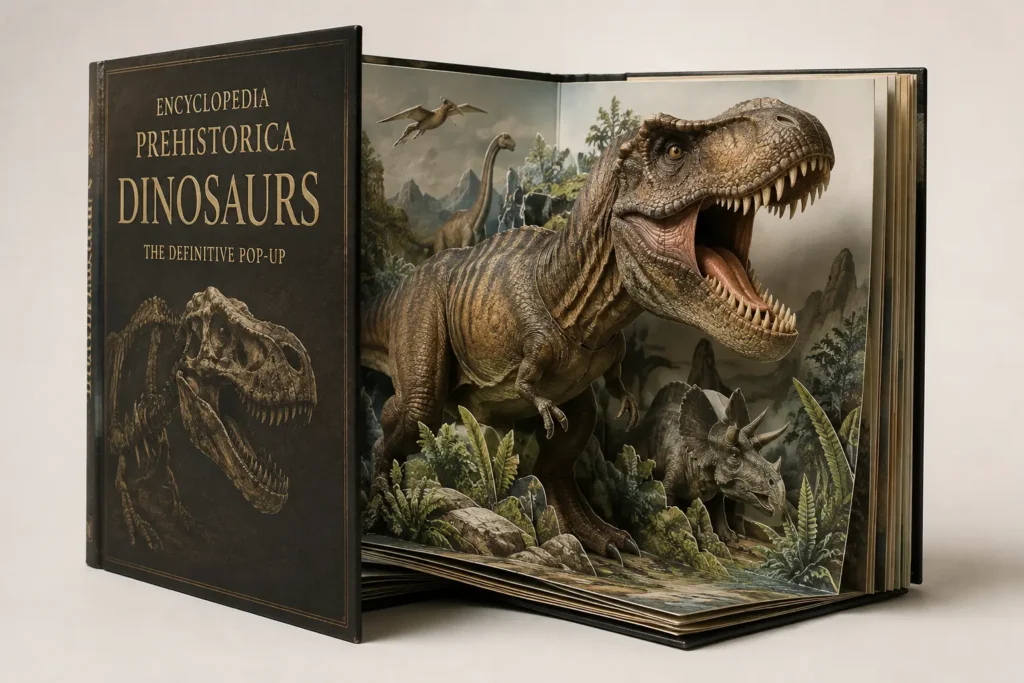
Encyclopedia Prehistorica: Dinosaurs
An interactive dinosaur book featuring spectacular three-dimensional pop-ups, particularly suited to young readers and families.
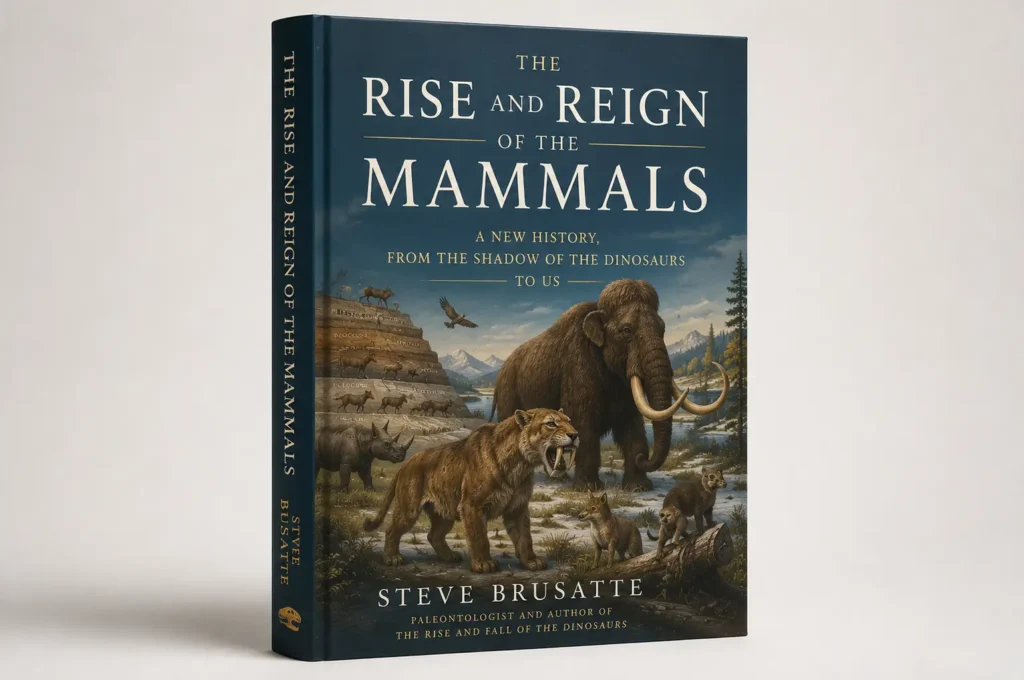
The Rise and Reign of the Mammals
A sweeping history of mammalian evolution, from their origins alongside dinosaurs through the Cenozoic and the emergence of humans.