

At a Glance
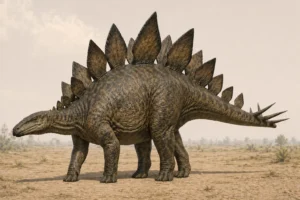
| Field | Information |
|---|---|
| Species | Stegosaurus spp. — Ornithischia, Stegosauridae |
| Period | Late Jurassic, approximately 155–150 Ma |
| Number of plates | 17 in well-documented S. stenops specimens |
| Plate arrangement | Two alternating rows running from neck to tail base |
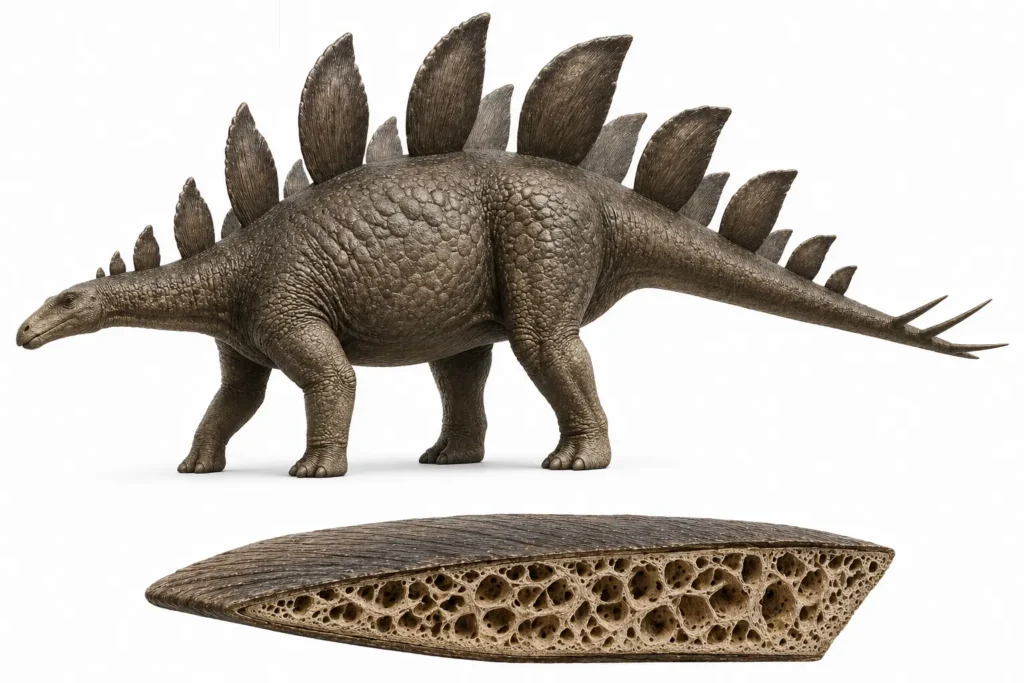
| Plate composition | Osteoderms — bony skin structures, not attached to the spine |
| Current consensus | No settled consensus; multiple hypotheses remain active |
Quick Answer: Why Stegosaurus had plates is not definitively resolved. Current scientific hypotheses include thermoregulation, species recognition and sexual display, and passive defence. Evidence has been cited in favour of each, but no single hypothesis commands full consensus. The plates were almost certainly multifunctional, and their role likely varied across contexts.
This is an active area of research. Details here reflect current scientific discussion but may be revised as new fossil evidence or analysis emerges.
The plates of Stegosaurus are among the most studied and most debated structures in dinosaur palaeontology. Decades of analysis have not resolved what they were primarily for, which is itself a significant scientific fact worth understanding.
Why Did Stegosaurus Have Plates?
The leading hypotheses for why Stegosaurus had plates on its back are:
- Thermoregulation — the plates may have functioned as heat exchangers, absorbing solar radiation or dissipating excess body heat through blood-vessel-rich tissue
- Species recognition and sexual display — plate shape, size, and possibly colour may have been used to identify conspecifics or signal reproductive fitness.
- Passive defence — the plates may have made the animal appear larger to predators or physically protected the flanks and spine to some degree
- Multifunction — the plates may have served more than one role simultaneously or differently across life stages.
No single hypothesis has been confirmed by the fossil evidence as the exclusive function of the plates.
Thermoregulation Hypothesis
The thermoregulation hypothesis was prominent in the late 20th century following evidence of vascular channels within the plates. Studies noted that the plates appear to have been richly supplied with blood vessels — grooves on plate surfaces suggest vascular tissue. If blood flow through the plates was variable, they could theoretically have functioned as a heat exchange mechanism: absorbing warmth when oriented toward the sun, or dissipating heat in warm conditions.
Experimental modelling has found that the plates would be relatively effective radiators under certain conditions. However, subsequent work has questioned whether the vascularity observed is sufficient to make thermoregulation the primary function, and the alternating arrangement of plates is not obviously optimal for a purely thermal mechanism. The vascular evidence is real; the interpretation of its function remains debated.
Display Hypothesis
The display hypothesis has gained traction in more recent literature. Evidence cited includes:
- Plate shape in Stegosaurus stenops — wide, tall, and laterally prominent — is consistent with a role in visual signalling, though not exclusive of other functions
- The alternating arrangement of plates increases lateral visibility, enhancing the animal’s visual profile when viewed from the side.
- Sexual dimorphism in plate shape has been proposed based on limited specimen comparisons, though the sample size is small, and the interpretation remains debated.
- Colour cannot be directly evidenced from fossils, but if the plates were visually enhanced in life — for example, through pigmentation or vascular flushing, as seen in some modern vertebrates — a display function becomes more plausible.
The display hypothesis does not exclude thermoregulation; the two functions could have coexisted.
Defence Hypothesis
The defence hypothesis is the most intuitive but the least well-supported by current evidence. The plates are positioned along the spine and upper flanks, and their osteodermal composition makes them robust structures. However, they do not cover the lateral body effectively, and their alternating arrangement leaves significant gaps. Most current researchers treat pure defence as a secondary function at best, with the tail spikes (thagomizer) — not the plates — representing the primary defensive weaponry. Full coverage of the tail spike function is in the dedicated thagomizer spoke.
Plate Arrangement: Alternating or Paired?
Early reconstructions of Stegosaurus showed the plates in two parallel, paired rows. Analysis of articulated specimens, most notably the well-preserved S. stenops holotype material, established that the plates were arranged in two alternating rows — each plate on one side offset from the corresponding plate on the other. This arrangement is now the accepted reconstruction for S. stenops, though it has been discussed in the context of other Stegosaurus species as well.
Species-Level Plate Variation
Plate morphology varies between Stegosaurus species. S. stenops has wide, tall, roughly oval plates over the back. S. ungulatus material shows somewhat different proportions. Kentrosaurus aethiopicus, the African stegosaurid relative, has smaller plates over the back transitioning to paired spikes over the hips and tail — a pattern that illustrates the variation in plate and spike arrangement within Stegosauridae and complicates any single-function explanation that must apply to the whole family.
Related and Contemporary Species
- Kentrosaurus aethiopicus — African stegosaurid; smaller plates combined with more extensive tail spikes, offering direct within-family comparison of plate and spike balance
- Huayangosaurus taibaii — early Chinese stegosaurid; more primitive plate arrangement, useful for tracing plate evolution within the family
- Allosaurus fragilis — the primary predator of the Morrison Formation; relevant to the defensive function debate, as Allosaurus represents the selection pressure that any defensive function must be evaluated against
- Tuojiangosaurus multispinus — Chinese stegosaurid; plate morphology distinct from S. stenops, contributing to the within-family variation picture
Frequently Asked Questions
Why did Stegosaurus have plates on its back?
The exact function of Stegosaurus plates has not been definitively established. The leading scientific hypotheses are thermoregulation, species recognition or sexual display, and passive defence. Evidence supports elements of each, and most researchers currently favour a multifunctional explanation. The plates were almost certainly not for a single purpose.
Were Stegosaurus plates solid bone?
Stegosaurus plates were osteoderms — bony structures that developed within the skin rather than being attached to the spine. Evidence of vascular channels within the plates shows they were penetrated by blood vessels during life, meaning they were covered in living tissue rather than being bare exposed bone. This vascularity is central to both the thermoregulation and display hypotheses.
Did all Stegosaurus have the same plates?
Plate shape and size varied between Stegosaurus species and along the spine of individual animals. The largest, most prominent plates sat over the hips and mid-back in S. stenops. Smaller plates appeared at the neck and near the tail base. Related stegosaurids such as Kentrosaurus had a different plate-to-spike ratio, showing that plate configuration varied across the family.
The plates of Stegosaurus remain one of palaeontology’s genuinely open questions. The evidence points toward multiple functions — thermal, visual, possibly defensive — but no single answer has closed the debate. That uncertainty is the scientifically honest position, and it makes the plates no less remarkable.
Recommended Paleontology & Natural History Books
As an Amazon Associate, Extinct Atlas may earn from qualifying purchases.
The Rise and Fall of the Dinosaurs
A compelling history of dinosaurs, tracing their origins, diversification, 200-million-year reign, extinction, and enduring legacy.
Dinosaurs and Prehistoric Life
A richly illustrated visual reference exploring dinosaurs, fossils, evolution, and prehistoric life across geological time.
Encyclopedia Prehistorica: Dinosaurs
An interactive dinosaur book featuring spectacular three-dimensional pop-ups, particularly suited to young readers and families.
The Rise and Reign of the Mammals
A sweeping history of mammalian evolution, from their origins alongside dinosaurs through the Cenozoic and the emergence of humans.