

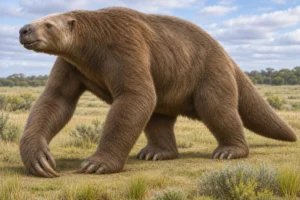
Megatherium was a giant terrestrial ground sloth whose behaviour is reconstructed primarily from its skeleton and associated fossil evidence. It probably moved mainly on four limbs but could adopt an upright or semi-upright posture, potentially using its muscular tail as a third support. This posture may have helped it reach higher vegetation. However, the exact frequency, duration, and purpose of such behaviour remain uncertain.
What Was Megatherium’s Typical Posture?
Megatherium was a massive terrestrial mammal with powerful limbs, a robust pelvis and a substantial tail. Its skeletal structure indicates that it was capable of supporting its considerable body mass on land.
The most conservative reconstruction places it primarily in a quadrupedal posture during ordinary movement. However, biomechanical studies and fossil trackway interpretations indicate that it could also adopt a bipedal or semi-upright position.
The distinction between locomotion and posture is important. An animal capable of rising onto its hind limbs does not necessarily walk bipedally as its habitual mode of movement. Standing upright temporarily and travelling on two legs are different behaviours, requiring separate interpretations of the evidence.
| Behavioural interpretation | Evidence and qualification |
|---|---|
| Quadrupedal stance | Consistent with skeletal anatomy and interpretations of its ordinary terrestrial movement |
| Bipedal or semi-upright posture | Supported as a possible posture by biomechanical and trackway interpretations |
| Habitual bipedal walking | Not conclusively established |
| Tail-supported standing | Plausible reconstruction based on the robust tail and skeletal support system |
| High-level browsing | A proposed behaviour supported indirectly by anatomical and pathological evidence |
Could Megatherium Stand on Its Hind Legs?
The anatomy of Megatherium has long attracted attention because its powerful hind limbs, pelvis, vertebral column and tail could have supported an upright posture.
Biomechanical research by Casinos (1996) examined the mechanical demands of both bipedal and quadrupedal locomotion. The study found that some limb-related results were inconclusive, but calculations involving vertebral resistance and femoral bending suggested adaptations compatible with bipedalism.
This supports the possibility that Megatherium could raise its anterior body and assume a bipedal stance. It does not demonstrate that the animal spent most of its time upright or routinely travelled on two legs.
A distinction should therefore be maintained between anatomical capacity and habitual behaviour. The skeleton provides evidence about what the animal could physically do; it does not preserve a direct record of how frequently it performed a particular action.
Did Megatherium Use Its Tail as a Third Support?
A widely used reconstruction depicts Megatherium rising onto its hind limbs while placing its heavy tail on the ground. The hind feet and tail would form a three-point support system, often described as a tripodal posture.
This arrangement could have helped stabilise the animal while its forelimbs were raised away from the ground. The tail was substantial, and its vertebral structure and associated musculature are consistent with a strong supporting function.
The proposed posture has a straightforward mechanical explanation:
- The hind limbs support much of the animal’s body weight.
- The tail contacts the ground behind the pelvis.
- The three support points provide a broad base.
- The forelimbs become available for reaching or interacting with objects in front of the animal.
This is a biomechanical reconstruction, not a directly observed behaviour. Fossils can preserve the anatomical structures required for support, but they cannot independently establish exactly how often Megatherium adopted this position.
Did Megatherium Reach High Vegetation?
One proposed function of an upright posture was reaching vegetation above the animal’s normal head height. Its large body, powerful limbs, and potential ability to raise its forequarters could have allowed access to higher plant material.
Evidence from the clavicles provides an additional line of investigation.
A 2022 study by Chichkoyan and colleagues examined 11 clavicles of Megatherium americanum from Pleistocene deposits of the Pampean region of Argentina. Seven specimens showed pathological changes, including subchondral sclerosis, exostoses, cysts, and draining sinuses. The authors identified evidence of arthritis, infection, and trauma.
They proposed that repeated shoulder movements, including adduction, abduction and upward movement while standing beside trees, might have contributed to some of these changes. Compressive forces associated with quadrupedal locomotion may also have affected the clavicular joints.
The researchers interpreted these findings as indirect evidence that Megatherium may have attempted to reach vegetation at higher levels of trees. The interpretation is significant, but the pathologies do not uniquely identify one behaviour. They cannot establish that every affected individual repeatedly reared upright or that high browsing was the principal cause of the observed changes.
What Do the Clavicle Pathologies Reveal About Behaviour?
The clavicle connects the shoulder region to the front of the chest and contributes to the mechanics of forelimb movement. Its condition can therefore provide information about stresses experienced during an animal’s lifetime.
The 2022 investigation is particularly useful because it examined multiple specimens rather than relying solely on a theoretical reconstruction.
| Evidence | Observation | Possible behavioural implication |
|---|---|---|
| Specimens examined | 11 clavicles of M. americanum | Multiple individuals or specimens provide a broader sample of skeletal pathology |
| Specimens with pathological changes | 7 | Joint stress, trauma or disease affected several specimens |
| Subchondral sclerosis | Identified in the sample | May reflect altered loading or joint stress |
| Exostoses and cysts | Identified in the sample | Evidence of abnormal bone and joint conditions |
| Draining sinuses | Identified in the sample | Consistent with pathological processes, including infection |
| Authors’ interpretation | Shoulder movement and quadrupedal loading may have contributed | Possible reaching movements near trees, alongside ordinary locomotor stresses |
These findings do not establish a single behavioural explanation. Instead, they show that the shoulder joints experienced substantial mechanical and pathological stresses during the animals’ lives.
How Should Megatherium’s Behaviour Be Reconstructed?
Behavioural reconstructions of extinct mammals rely on indirect evidence. For Megatherium, researchers combine skeletal anatomy, biomechanical modelling, trackway interpretations and pathological changes in fossil bones.
The strength of each inference depends on the type of evidence.
| Evidence category | What it can help establish | Main limitation |
|---|---|---|
| Skeletal anatomy | Physical capacity for particular postures and movements | Capacity does not establish frequency of behaviour |
| Biomechanical modelling | Mechanical feasibility of standing or moving in different positions | Results depend on model assumptions |
| Fossil trackways | Particular episodes of movement and limb placement | Preserve limited events, not an animal’s full behavioural repertoire |
| Clavicle pathologies | Past joint stress, trauma and possible movement patterns | Several activities can produce similar pathological changes |
| Tail and vertebral anatomy | Potential support and weight-bearing functions | Does not directly preserve the animal’s posture in life |
The most defensible reconstruction is therefore a large terrestrial animal that normally supported itself on four limbs but was capable of adopting an upright or semi-upright posture. Tail-supported rearing and reaching higher vegetation are plausible interpretations, although their frequency and precise purpose cannot be determined with certainty.
References
A. Peer-Reviewed Literature
1. Casinos, A. (1996). Bipedalism and quadrupedalism in Megatherium: An attempt at biomechanical reconstruction. Lethaia, 29(1), 87–96. https://doi.org/10.1111/j.1502-3931.1996.tb01842.x.
2. Chichkoyan, K. V., Villa, C., Winkler, V., Manuelli, L., & Acuña Suarez, G. E. (2022). Paleopathologies of the clavicles of the giant ground sloth Megatherium americanum (Mammalia, Xenarthra) from the Pleistocene of the Pampean Region (Argentina). Ameghiniana, 59(6), 390–406. https://doi.org/10.5710/AMGH.15.10.2022.3509.
3. Deak, M. D., Porter, W. P., Mathewson, P. D., Lovelace, D. M., Flores, R. J., Tripati, A. K., Eagle, R. A., Schwartz, D. M., & Butcher, M. T. (2025). Metabolic skinflint or spendthrift? Insights into ground sloth integument and thermophysiology revealed by biophysical modeling and clumped isotope paleothermometry. Journal of Mammalian Evolution, 32, Article 1. https://doi.org/10.1007/s10914-024-09743-2.
4. Fariña, R. A., & Blanco, R. E. (1996). Megatherium, the stabber. Proceedings of the Royal Society B: Biological Sciences, 263(1377), 1725–1729. https://doi.org/10.1098/rspb.1996.0252.