
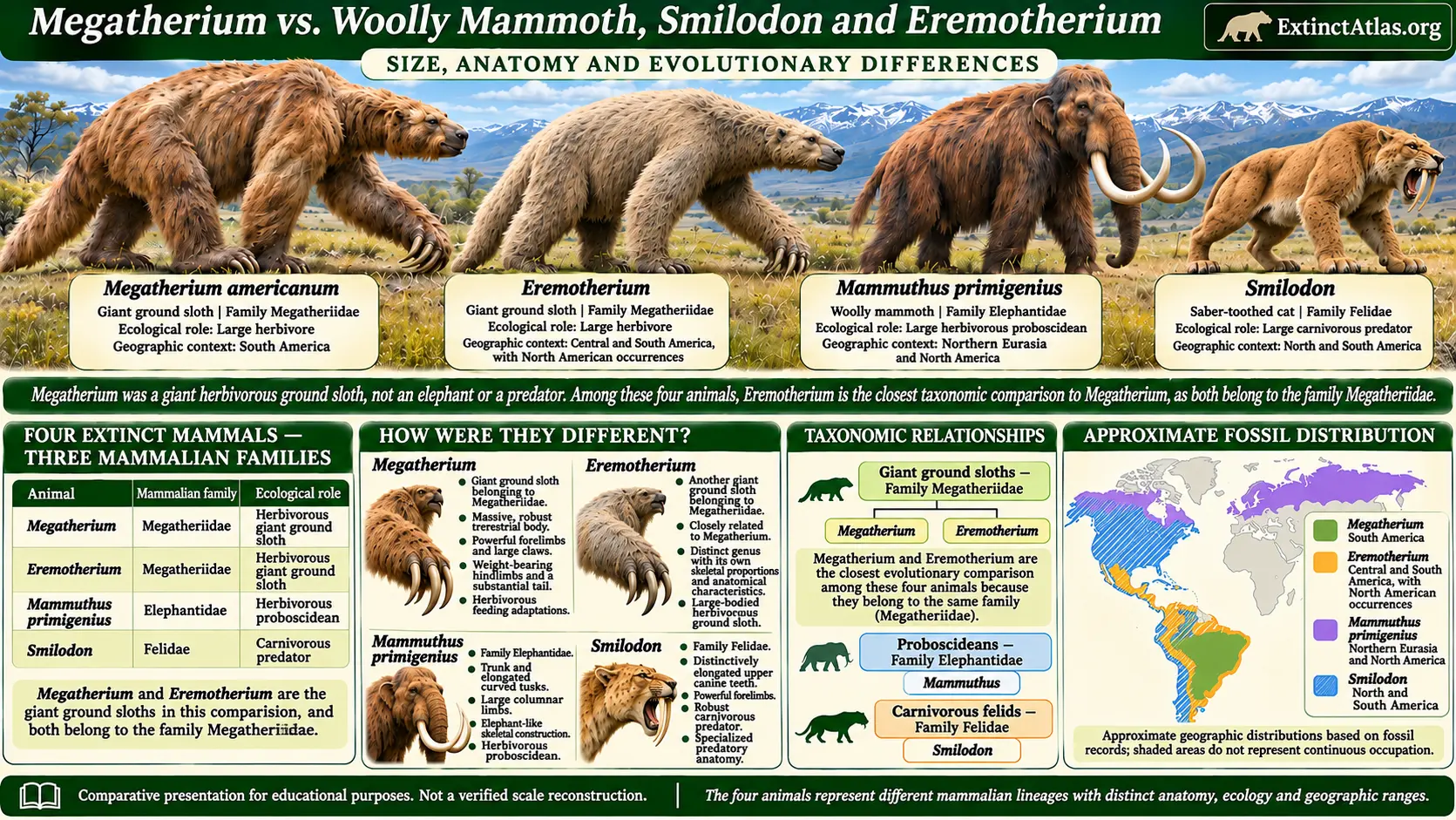
Megatherium was a giant ground sloth, not an elephant or a predatory mammal. It differed from the woolly mammoth (Mammuthus primigenius) in evolutionary ancestry, anatomy and feeding adaptations, and from the saber-toothed cat Smilodon in both body structure and ecological role. Its closest comparison in this group is Eremotherium, another giant ground sloth, although the two genera had important anatomical and geographical differences.
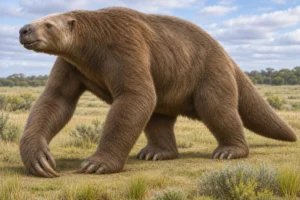
This comparison examines four extinct mammals using comparable evidence where available. Body-mass estimates are approximate and should not be interpreted as directly measured weights.
Megatherium Compared with Other Prehistoric Animals: Quick Facts
| Animal | Mammalian group | Principal ecological role | Geographic context |
|---|---|---|---|
| Megatherium | Megatheriidae | Giant herbivorous ground sloth | South America |
| Eremotherium | Megatheriidae | Giant herbivorous ground sloth | Central and South America, with North American occurrences |
| Woolly mammoth (Mammuthus primigenius) | Elephantidae | Large herbivorous proboscidean | Northern Eurasia and North America |
| Smilodon | Felidae | Large carnivorous predator | North and South America |
Megatherium vs Woolly Mammoth
Megatherium and the woolly mammoth were among the most recognisable large mammals of the Pleistocene, but they belonged to very different evolutionary groups.
Megatherium americanum was a giant ground sloth adapted to terrestrial herbivory. The woolly mammoth was an elephant relative with a trunk, elongated tusks, and specialised adaptations for feeding in cold environments.
| Characteristic | Megatherium americanum | Woolly mammoth |
|---|---|---|
| Family | Megatheriidae | Elephantidae |
| Order | Pilosa | Proboscidea |
| Approximate body mass | 3,700–4,000 kg | Commonly around 4,000–6,000 kg for large adults; estimates vary |
| Body structure | Massive body, powerful limbs and long tail | Large body, trunk and curved tusks |
| Feeding apparatus | Specialised cheek teeth and powerful jaws | Trunk, tusks and grinding cheek teeth |
| Diet | Herbivorous | Herbivorous |
| Geographic range | South America | Northern Eurasia and North America |
| Distinctive adaptations | Enlarged claws and weight-bearing hindquarters | Thick insulating coat and large tusks |
The comparison illustrates that similar body masses can occur in mammals with very different anatomical adaptations. The mammoth’s trunk and tusks were central features of its feeding and interaction with the environment, whereas Megatherium relied on its jaws, forelimbs and specialised teeth.
Megatherium vs Smilodon
Smilodon was a large carnivorous predator, whereas Megatherium was a giant herbivorous ground sloth. Despite their coexistence in Pleistocene South America, they occupied fundamentally different ecological roles.
The largest species of Smilodon, S. populator, had estimated body masses of approximately 220–360 kg, with particularly large individuals potentially exceeding 400 kg. This was substantially below the commonly reconstructed mass of M. americanum.
PubMed+1
| Characteristic | Megatherium americanum | Smilodon populator |
|---|---|---|
| Family | Megatheriidae | Felidae |
| Order | Pilosa | Carnivora |
| Estimated body mass | Approximately 3,700 kg in one volumetric model | Approximately 220–360 kg |
| Dietary category | Herbivore | Carnivore |
| Feeding adaptations | Powerful jaws and specialised cheek teeth | Enlarged upper canine teeth and specialised predatory anatomy |
| Forelimbs | Powerful, with enlarged claws | Muscular, adapted for prey restraint |
| Ecological role | Large terrestrial herbivore | Large mammalian predator |
| Geographic context | South America | South America and North America, depending on species |
The mass comparison is particularly striking: in the cited reconstructions, M. americanum was several times heavier than S. populator. Their differences were not simply a matter of size; their skeletal structures reflected different feeding and ecological adaptations.
Megatherium vs Eremotherium
Eremotherium is the closest evolutionary comparison among the animals discussed here because both genera belong to the family Megatheriidae.
They were giant ground sloths with broadly similar body plans, but they were not the same genus. Comparative anatomical research identifies differences in their skulls, teeth-bearing jaw structures, and forefoot bones.
| Characteristic | Megatherium | Eremotherium |
|---|---|---|
| Family | Megatheriidae | Megatheriidae |
| Group | Megatheriinae | Megatheriinae |
| Geographic distribution | South America | Central and South America, extending into North America |
| Skull morphology | Characteristic premaxillary and palatal features | Different premaxillary and palatal configurations |
| Tooth-row arrangement | Generally subparallel | More curved |
| Forefoot anatomy | Functional digits II–V in the described genus-level diagnosis | Different digit configurations between species |
| Ecological role | Giant herbivorous ground sloth | Giant herbivorous ground sloth |
The differences in the manus (forefoot) are especially useful for distinguishing these genera. De Iuliis and Cartelle’s comparative work documents differences in the arrangement and fusion of wrist and metacarpal elements.
Importantly, the anatomical distinctions are not merely differences in body size. They are morphological characteristics used in systematic identification.
Comparative Body Size and Mass
One of the most useful quantitative comparisons comes from Brassey and Gardiner (2015), who applied the same volumetric estimation method to a reconstructed woolly mammoth and Megatherium americanum.
Body-mass estimates from published research
| Animal | Estimated body mass | Estimation context |
|---|---|---|
| Megatherium americanum | 3,706 kg | Volumetric α-shape model |
| Woolly mammoth | 3,635 kg | Same volumetric α-shape model |
| Eremotherium laurillardi | 3,900–5,000 kg | Published reconstruction estimates |
| Smilodon populator | 220–360 kg | Skeletal allometric estimates |
These estimates come from different studies and methods. Only the Megatherium–mammoth pair represents a direct comparison using the same volumetric model.
The 2015 study estimated the two animals at remarkably similar masses, with M. americanum slightly heavier in that particular reconstruction. This is a useful example of why popular descriptions of one animal as universally larger than another should be treated cautiously.
Differences in Anatomy and Feeding Adaptations
Although Megatherium and Eremotherium shared a broadly similar giant ground-sloth body plan, their skeletal differences are important for distinguishing the genera.
The woolly mammoth had a fundamentally different feeding apparatus, including a trunk and specialised grinding teeth. Smilodon, by contrast, possessed enlarged upper canine teeth and a predatory skeletal configuration.
| Anatomical feature | Megatherium | Eremotherium | Woolly mammoth | Smilodon |
|---|---|---|---|---|
| Skull | Elongated ground-sloth skull | Distinct megatheriine skull | Large proboscidean skull | Short, powerful felid skull |
| Teeth | Molariform cheek teeth | Molariform cheek teeth | Grinding cheek teeth | Carnivorous dentition |
| Forelimbs | Powerful, claw-bearing | Powerful, claw-bearing | Weight-bearing limbs | Muscular prey-restraint adaptations |
| Specialised structure | Enlarged claws and muscular tail | Distinctive manus and wrist anatomy | Trunk and tusks | Enlarged upper canines |
| Feeding strategy | Herbivorous browsing | Herbivorous browsing | Herbivory | Predation |
Differences in Geographic Distribution and Ecology
The geographical distributions of these mammals reflect different evolutionary histories and environmental adaptations.
Megatherium was primarily South American, whereas Eremotherium laurillardi achieved a much broader Pan-American distribution. Fossil occurrences of E. laurillardi extend from southern Brazil through Central America and Mexico into parts of North America.
Eremotherium therefore provides an especially useful comparison for understanding the geographical expansion of giant ground sloths.
The woolly mammoth occupied northern Eurasian and North American environments, while Smilodon had a distribution across the Americas. Their ecological roles were also fundamentally different: the mammoth was a large herbivore, whereas Smilodon was a predator.
Why Is Eremotherium an Important Comparison?
Eremotherium deserves particular attention because its similarities to Megatherium can lead to confusion in fossil identification and popular reconstructions.
De Iuliis and Cartelle’s research on Eremotherium eomigrans (1999) demonstrated that forefoot anatomy provides important diagnostic information. The species possessed a five-digit manus, distinguishing it from the described configurations of other giant megatheriines.
Comparative research also identifies differences in the scaphoid, metacarpal-carpal articulation, skull, and dentary structure.
These distinctions are important because the two genera should not be treated as alternative names for the same animal.
Current Scientific Understanding
The comparison of Megatherium, Eremotherium, woolly mammoths and Smilodon illustrates the diversity of large Pleistocene mammals.
Three conclusions are particularly important:
- Megatherium and Eremotherium were closely related giant ground sloths, but their anatomical and geographical characteristics differed.
- Megatherium americanum and the woolly mammoth could reach remarkably similar body masses according to comparable volumetric estimates.
- Smilodon was substantially smaller in body mass than these giant herbivores, despite being a formidable predator.
Body mass alone cannot establish ecological dominance, evolutionary superiority, or the outcome of encounters between extinct animals. Their anatomy, feeding adaptations, and ecological roles provide a more meaningful basis for comparison.
References
A. Peer-Reviewed Research
1. Brassey, C. A., & Gardiner, J. D. (2015). An advanced shape-fitting algorithm applied to quadrupedal mammals: improving volumetric mass estimates. Royal Society Open Science, 2, 150302. https://doi.org/10.1098/rsos.150302
2. Christiansen, P., & Harris, J. M. (2005). Body size of Smilodon (Mammalia: Felidae). Journal of Morphology, 266(3), 369–384. https://doi.org/10.1002/jmor.10384
3. De Iuliis, G., & Cartelle, C. (1999). A new giant megatheriine ground sloth (Mammalia: Xenarthra: Megatheriidae) from the late Blancan to early Irvingtonian of Florida. Zoological Journal of the Linnean Society, 127(4), 495–515. https://doi.org/10.1111/j.1096-3642.1999.tb01383.x
4. Cartelle, C., & De Iuliis, G. (1995). Eremotherium laurillardi: the Pan-American late Pleistocene megatheriid sloth. Journal of Vertebrate Paleontology, 15(4), 830–841. https://doi.org/10.1080/02724634.1995.10011265
5. McDonald, H. G. (2005). Paleoecology of extinct xenarthrans and their environments. Bulletin of the Florida Museum of Natural History, 45(4).
6. Carbot-Chanona, G., et al. (2022). Research on the paleobiogeography and distribution of Eremotherium in Mexico. Boletín de la Sociedad Geológica Mexicana, 74(2). https://doi.org/10.18268/BSGM2022v74n2a070322
7. Tejada, J. V., et al. (2025). Metabolic skinflint or spendthrift? Insights into ground sloth integument and thermophysiology revealed by biophysical modeling and clumped isotope paleothermometry. https://pmc.ncbi.nlm.nih.gov/articles/PMC11732909/