
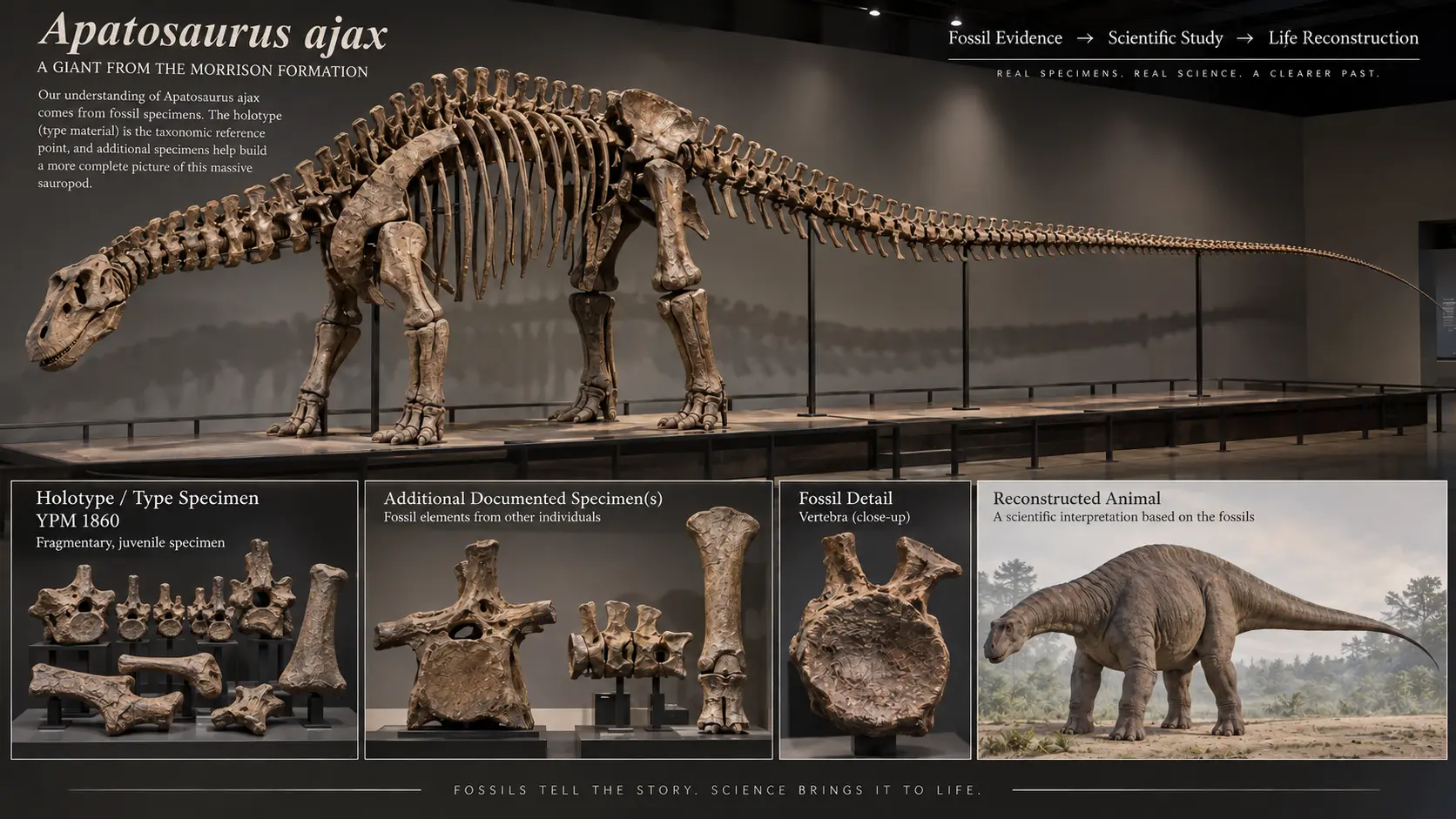
| Quick fact | Information |
|---|---|
| Holotype | YPM 1860 |
| Nomenclatural role | Holotype of Apatosaurus ajax; genoholotype of Apatosaurus |
| Type locality | Lakes Quarry 10, Morrison Formation, Colorado, USA |
| Key specimen-history issue | Material from YPM 1860 became intermingled with YPM 1840 |
| Important attribution uncertainty | The braincase labelled YPM 1860 cannot be confidently assigned to YPM 1860 or YPM 1840 |
| Important referred specimens | AMNH 460; NSMT-PV 20375 |
| Main evidence caution | Specimen identity, preservation, referral, and reconstruction must be kept distinct |
The fossil record of Apatosaurus ajax is anchored by YPM 1860, the holotype of the species and the genoholotype of Apatosaurus. The specimen is incomplete, and its history includes the intermingling of material with YPM 1840. Additional specimens referred to A. ajax provide important anatomical information, but they do not all have identical preservation or attribution histories. Understanding the species therefore requires keeping specimen identity, preservation, referral, and reconstruction distinct. [1]
What is the Apatosaurus ajax type specimen?
The type specimen of Apatosaurus ajax is YPM 1860, housed in the Yale Peabody Museum collections.
YPM 1860 is the holotype of Apatosaurus ajax. It also has special nomenclatural importance because A. ajax is the type species of Apatosaurus, making YPM 1860 the genoholotype of the genus. Tschopp, Mateus, and Benson explicitly identify YPM 1860 in both roles. [1]
The type locality is Lakes Quarry 10, Morrison, Gunnison County, Colorado, USA, in the Morrison Formation. Tschopp and colleagues assign the locality to the Kimmeridgian–Tithonian, Upper Brushy Basin Member of the Morrison Formation. [1]
YPM 1860 therefore provides the name-bearing specimen for both Apatosaurus ajax and the genus Apatosaurus.
What material does the type specimen preserve?
YPM 1860 is an incomplete fossil specimen, not a completely preserved skeleton.
It provides important postcranial anatomical information. Cranial-region material has also historically been associated with the specimen, but its attribution requires qualification because of the specimen-history problem discussed below. [1]
Tschopp and colleagues emphasize that diplodocid holotypes can be fragmentary and that Apatosaurus ajax YPM 1860 is among the specimens for which historically associated material became mixed.
For their specimen-level analysis, Tschopp and colleagues followed earlier work by Berman & McIntosh and McIntosh in determining which elements should constitute the A. ajax holotype individual. They treated the material conservatively rather than automatically assigning every historically associated element to YPM 1860. [1]
One important exception is a braincase currently labelled YPM 1860. The authors state that this braincase could not be confidently assigned to either YPM 1860 or YPM 1840. They therefore tested both possible attributions in supplementary phylogenetic analyses. [1]
The analysis in which the braincase was assigned to YPM 1860 was more parsimonious, supporting the possibility that the museum label is correct. That analytical result does not eliminate the underlying attribution uncertainty. [1]
Why is YPM 1860 scientifically complicated?
The central problem is that YPM 1860 became intermingled with YPM 1840 during collection and shipping. [1]
YPM 1840 is the specimen historically identified as the holotype of Atlantosaurus immanis. The two specimens came from different quarries, but material from them became mixed during subsequent handling. As a result, distinguishing which bones belong to which individual can be difficult. [1]
This is not merely a historical curation issue. It directly affects the anatomical definition of the name-bearing specimen of Apatosaurus ajax.
Tschopp and colleagues followed the earlier assessments of Berman & McIntosh and McIntosh when deciding which elements belonged to YPM 1860. The braincase currently labelled YPM 1860 remains the principal material whose attribution could not be confidently resolved. [1]
The authors tested two possibilities:
- assigning the braincase to YPM 1840;
- assigning the braincase to YPM 1860.
Assigning the braincase to YPM 1860 produced the more parsimonious result, so its existing identification remained plausible. The result should nevertheless be understood as an analytical preference rather than as complete proof of attribution. [1]
A modern reconstruction must therefore not automatically treat every element historically associated with YPM 1860 as unquestionably belonging to that individual.
Other important specimens
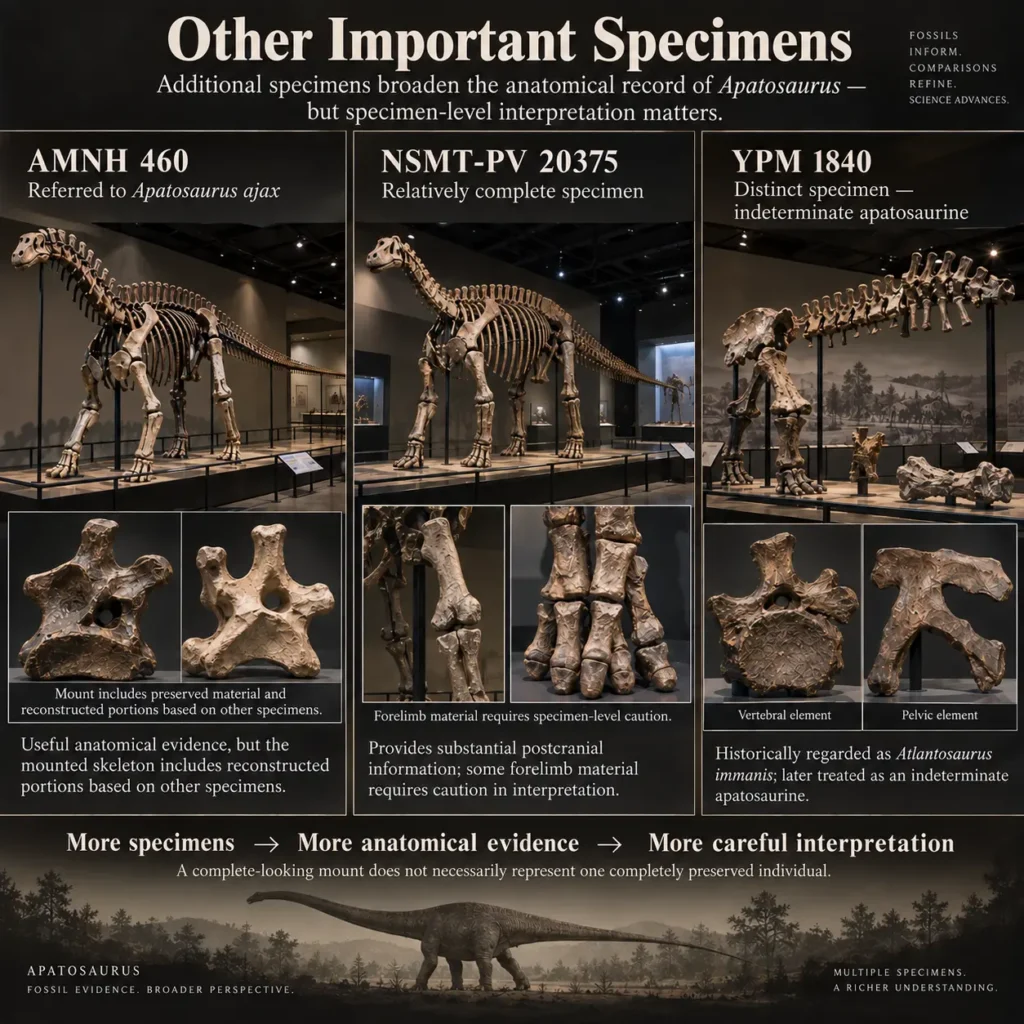
Additional specimens attributed to Apatosaurus ajax provide anatomical information beyond the incomplete holotype.
AMNH 460
AMNH 460 was referred to Apatosaurus ajax in the specimen-level literature and was included as an A. ajax specimen by Tschopp and colleagues. [1]
The specimen requires an additional qualification: it is mounted with reconstructed portions based on other specimens. Tschopp and colleagues therefore took care not to score anatomical characters using material belonging to other individuals. [1]
AMNH 460 is consequently useful evidence for understanding A. ajax, but the complete appearance of its mounted skeleton should not be interpreted as though every visible element was preserved in that individual.
NSMT-PV 20375
NSMT-PV 20375 is another specimen identified with Apatosaurus ajax. It is relatively complete and provides substantial postcranial anatomical information. [2]
Its anatomy nevertheless requires specimen-level caution. Tschopp and colleagues noted unusual proportions among some forelimb elements and considered the possibility that some material might represent more than one individual. They consequently excluded those forelimb elements from their phylogenetic scoring. [1]
NSMT-PV 20375 is therefore valuable evidence while also illustrating why a relatively complete specimen does not necessarily mean that every preserved element is unquestionably from one individual.
YPM 1840
YPM 1840 is important primarily because of its relationship to the history of YPM 1860.
It was historically regarded as the holotype of Atlantosaurus immanis and became intermingled with YPM 1860. Tschopp and colleagues treated YPM 1840 as an indeterminate apatosaurine and Atlantosaurus immanis as a nomen dubium in their 2015 treatment. [1]
YPM 1840 should nevertheless remain a distinct specimen in the fossil record rather than being silently absorbed into YPM 1860.
Composite and reconstructed skeletons
A mounted skeleton can look complete even when the fossil evidence behind it is incomplete.
For Apatosaurus ajax, several factors contribute to this distinction:
- YPM 1860 is incomplete.
- Historically associated material can have complicated specimen attribution.
- Referred specimens can provide anatomical information absent from the holotype.
- Some mounted specimens contain reconstructed portions based on other individuals. [1]
AMNH 460 provides a direct example. Tschopp and colleagues state that it is mounted with reconstructed portions based on other specimens and therefore excluded characters based on material belonging to other individuals from their specimen scoring. [1]
Material categories
| Material category | What it means |
|---|---|
| Holotype material | Fossil material attributed to YPM 1860 under the adopted interpretation of the A. ajax holotype |
| Referred A. ajax material | Fossil material from another individual assigned to the species |
| Reconstructed material | Restoration of missing anatomy based on available fossil evidence, potentially including other specimens |
| Composite or attribution-uncertain material | Material for which individual or specimen attribution requires qualification |
A visible bone in a museum mount therefore cannot automatically be described as a bone preserved in YPM 1860.
That distinction is particularly important when anatomical measurements are subsequently used for body-size reconstruction.
What can specimens tell us?
Specimens provide the physical evidence from which Apatosaurus ajax anatomy, taxonomy, and aspects of body size are reconstructed.
Anatomy
YPM 1860 provides name-bearing anatomical evidence for A. ajax, while additional referred specimens increase the amount of anatomical overlap available for comparison.
The specimen-based approach used by Tschopp and colleagues is particularly important because many diplodocid holotypes are incomplete. Comparing specimens makes it possible to evaluate anatomical characters that would otherwise be absent from a fragmentary type specimen. [1]
Detailed skeletal interpretation belongs to Anatomy.
Size
Specimens provide measurable skeletal dimensions that can contribute to body-size reconstruction.
A measurement from one individual does not automatically establish a species-wide value. This is particularly important when large referred specimens contribute measurements used in length or mass reconstruction.
A specimen-based measurement should therefore retain its specimen identity and reconstruction context when it is used to support a length or mass estimate.
Detailed numerical estimates and reconstruction methodology belong to Size & Body Mass.
Taxonomy
Specimens are the basis for determining whether named dinosaurs represent distinct taxa.
YPM 1860 has exceptional importance because it is simultaneously the holotype of A. ajax and the genoholotype of Apatosaurus. Its position therefore anchors the genus in specimen-based phylogenetic analyses. Tschopp and colleagues explicitly used specimen-level evidence when evaluating the taxonomic relationships of Apatosaurus and related apatosaurines. [1]
The analysis also demonstrates why specimen-level taxonomy matters: individual specimens can occupy different positions in a phylogenetic analysis, and uncertain or reconstructed material can affect which anatomical characters are available for analysis. [1]
Fossil history
The history of YPM 1860 and YPM 1840 shows why fossil interpretation depends not only on the bones themselves but also on their specimen identity and documented history.
For Apatosaurus ajax, understanding the specimen history is therefore part of understanding the scientific evidence.
Evidence and specimen-attribution summary
| Specimen or material | Role | Attribution relevant to this resource |
|---|---|---|
| YPM 1860 | Holotype of A. ajax; genoholotype of Apatosaurus | Name-bearing specimen; incomplete; historically mingled material |
| YPM 1840 | Historically identified as holotype of Atlantosaurus immanis | Became mingled with YPM 1860; treated by Tschopp et al. as an indeterminate apatosaurine |
| AMNH 460 | Referred A. ajax specimen | Mounted with reconstructed portions based on other specimens |
| NSMT-PV 20375 | Referred A. ajax specimen | Relatively complete; some forelimb attribution considered problematic |
| Braincase labelled YPM 1860 | Cranial material associated with the holotype label | Attribution to YPM 1860 versus YPM 1840 cannot be demonstrated with complete confidence |
The central scientific point is that specimen identity and specimen completeness must remain attached to anatomical claims.
YPM 1860 anchors the name Apatosaurus ajax, but understanding the species’ anatomy necessarily incorporates additional specimens whose attribution and preservation histories must be evaluated individually.
References
[1] Tschopp, E., Mateus, O., & Benson, R. B. J. (2015). A specimen-level phylogenetic analysis and taxonomic revision of Diplodocidae (Dinosauria, Sauropoda). PeerJ, 3, e857. DOI: 10.7717/peerj.857.
[2] Upchurch, P., Tomida, Y., & Barrett, P. M. (2004). A New Specimen of Apatosaurus Ajax (Sauropoda, Diplodocidae) from the Morrison Formation (Upper Jurassic) of Wyoming, USA. National Science Museum Monographs, 26.
Recommended Paleontology & Natural History Books
As an Amazon Associate, Extinct Atlas may earn from qualifying purchases.
The Rise and Fall of the Dinosaurs
A compelling history of dinosaurs, tracing their origins, diversification, 200-million-year reign, extinction, and enduring legacy.
Dinosaurs and Prehistoric Life
A richly illustrated visual reference exploring dinosaurs, fossils, evolution, and prehistoric life across geological time.
Encyclopedia Prehistorica: Dinosaurs
An interactive dinosaur book featuring spectacular three-dimensional pop-ups, particularly suited to young readers and families.
The Rise and Reign of the Mammals
A sweeping history of mammalian evolution, from their origins alongside dinosaurs through the Cenozoic and the emergence of humans.