Quick Info
| Field | Current understanding | Evidence status |
|---|---|---|
| Diet | Carnivorous | Established |
| Best-supported dietary component | Fish | Direct fossil evidence |
| Fish evidence | Fish remains and scales associated with the holotype | Direct evidence |
| Other dietary evidence | Material attributed to an ornithopod associated with the holotype | Direct fossil evidence |
| Exclusively fish-eating? | No; the available evidence indicates a broader carnivorous diet | Strongly supported |
| Skull and jaw evidence | Long, narrow jaws with relatively conical teeth | Strong anatomical evidence |
| Feeding adaptation | Cranial anatomy is consistent with capturing and retaining prey | Strong inference |
| Aquatic-associated feeding | Exploitation of aquatic prey is strongly supported; feeding around shallow-water margins is plausible | Mixed direct + inferential evidence |
| Terrestrial prey | Associated ornithopod material provides evidence for non-fish prey | Strong |
| Exact prey diversity | Cannot be reconstructed comprehensively | Limited |
| Exact feeding technique | Not directly preserved | Limited |
| Scavenging | Cannot be securely established or excluded from the available dietary evidence | Uncertain |
| Fully aquatic feeding | Not established | Contested |
| Primary evidence source | Holotype NHMUK PV R9951 | Strong |
| Overall dietary confidence | High for carnivory and fish consumption; lower for detailed feeding behaviour | High / Moderate |
Quick Answer
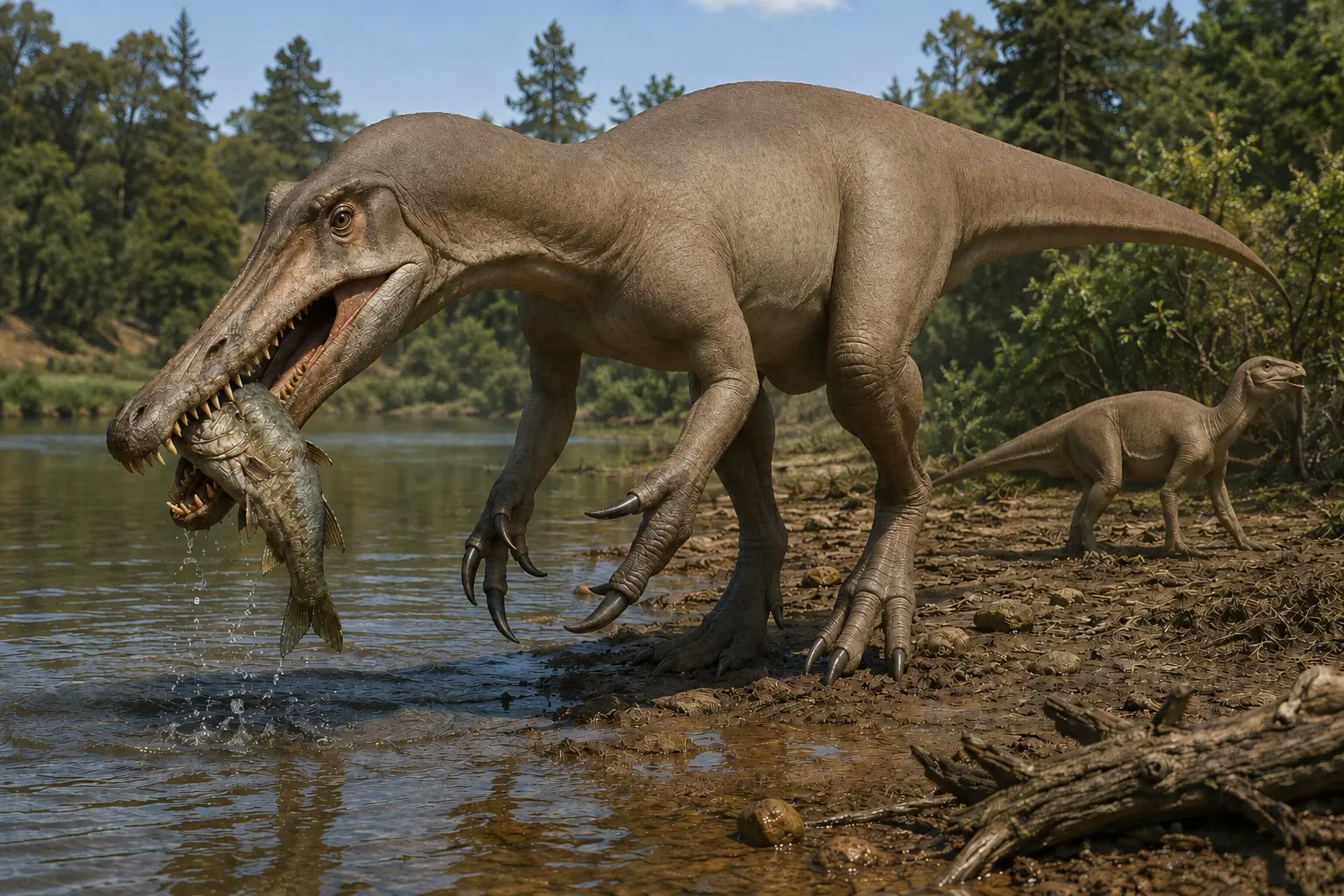
Baryonyx was a carnivorous spinosaurid with unusually strong direct evidence for fish consumption. The holotype, NHMUK PV R9951, preserves fish remains and scales associated with the abdominal region, while associated material attributed to an ornithopod provides evidence that its documented diet was not restricted to fish.
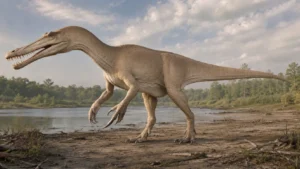
The most defensible conclusion is therefore not simply that Baryonyx was a “fish-eating dinosaur”, but that it was a carnivorous spinosaurid for which fish consumption is directly documented and non-fish prey is also represented in the fossil record.
Its elongated, narrow jaws and relatively conical teeth provide anatomical evidence consistent with prey capture and retention. These features support interpretations of a specialized feeding system, but they do not by themselves establish a particular hunting technique.
Detailed claims about exactly how Baryonyx hunted, how frequently it entered water, whether it pursued prey underwater, or what proportion of its diet consisted of fish require additional inference and should not be treated as direct dietary evidence.
Introduction
Diet is one of the better-supported aspects of Baryonyx biology because the type specimen provides more than anatomical clues. The holotype preserves material interpreted as food remains, allowing researchers to distinguish at least some aspects of its actual feeding record from interpretations based solely on teeth, jaws, anatomy, or habitat.
This distinction is important. In many extinct animals, diet must be reconstructed primarily from anatomical and ecological evidence. In Baryonyx, the fossil record provides unusually direct evidence because identifiable food remains are associated with the holotype.
The dietary evidence nevertheless has limits. Fish remains demonstrate that fish were consumed; they do not establish the proportion of fish in the overall diet, the frequency of fish consumption, the complete range of prey, or the precise circumstances in which individual prey were obtained.
The evidence is therefore best considered in layers: direct food remains provide the strongest evidence for what was consumed; anatomy provides functional evidence about how prey could have been captured; and ecological and behavioural interpretations require progressively greater inference.
What the Fossil Evidence Shows
| Evidence | What it tells us | Confidence |
|---|---|---|
| Fish remains | Provides direct evidence that Baryonyx consumed fish | High |
| Fish scales | Provides additional direct evidence of fish consumption | High |
| Associated ornithopod material | Provides evidence for consumption or ingestion of non-fish prey | High |
| Elongated jaws | Indicates a distinctive cranial configuration relevant to prey capture | High |
| Relatively conical teeth | Consistent with gripping prey rather than relying primarily on blade-like slicing | High |
| Aquatic-associated geological setting | Provides ecological context for access to fish and other aquatic resources | Moderate |
| Complete dietary composition | Cannot be recovered directly from the available evidence | Low |
| Hunting sequence | Not directly preserved | Low |
| Frequency of piscivory | Cannot be measured from the known fossil evidence | Low |
The most important evidence comes from the holotype itself. Fish remains and scales associated with the abdominal region provide direct evidence that fish had been consumed. This is considerably stronger than inferring piscivory solely from the animal’s elongated snout or tooth morphology.
The associated ornithopod material is important when interpreting the breadth of the documented diet. The evidence therefore supports a broader interpretation of Baryonyx as a carnivore capable of exploiting more than one prey category.
The fossil record does not, however, provide a complete inventory of the animal’s prey. A preserved feeding event represents only a limited sample of an individual’s dietary history. It cannot establish the proportions of different prey types consumed by the species as a whole.
Evidence Hierarchy
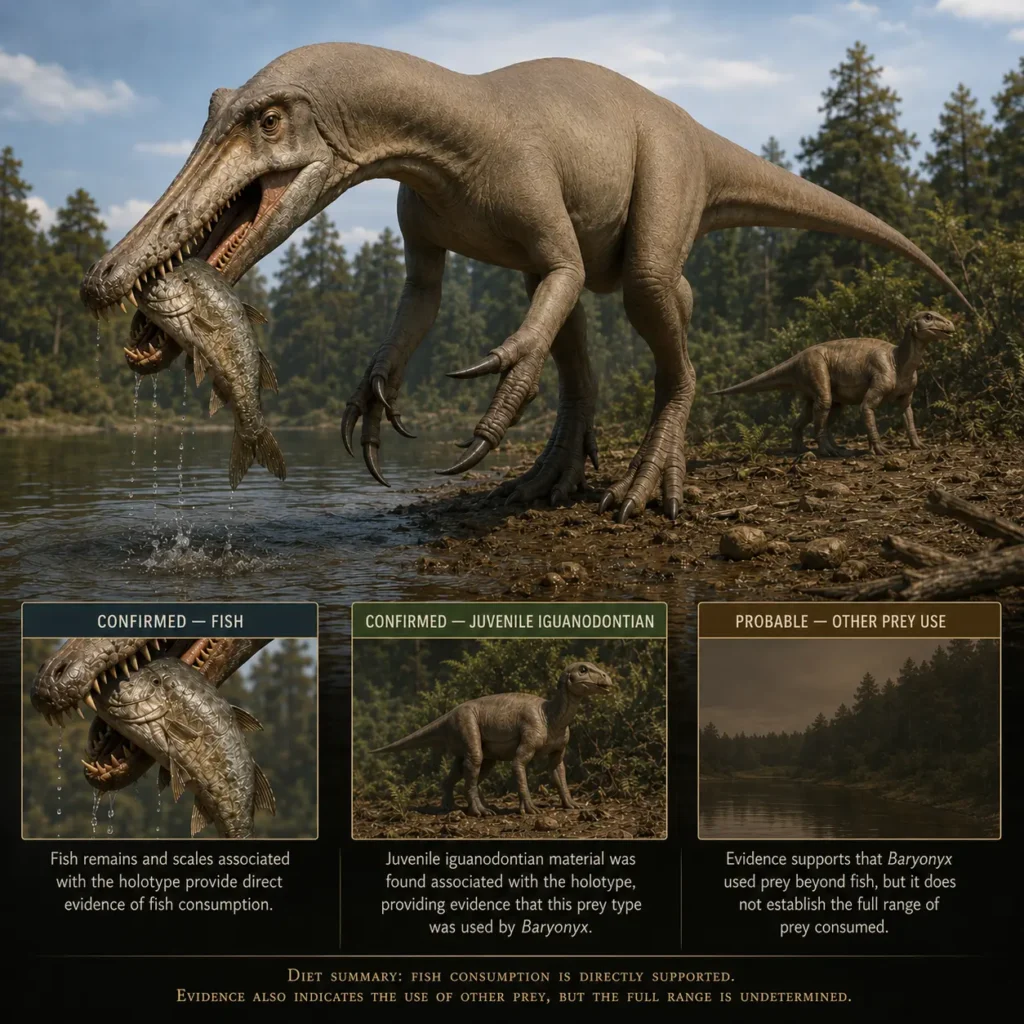
The dietary evidence can be arranged into four broad levels:
1. Direct dietary evidence
- Fish remains
- Fish scales
- Associated non-fish prey material
These provide the strongest evidence for what Baryonyx actually consumed.
2. Anatomical evidence
- Elongated rostrum
- Narrow jaws
- Relatively conical teeth
- Specialized anterior jaw morphology
These features provide independent evidence about the animal’s potential feeding mechanics.
3. Ecological inference
- Association with environments containing aquatic resources
- Plausible access to shallow water and water margins
- Compatibility with exploitation of fish and other aquatic prey
These observations provide ecological context but do not directly document feeding behaviour.
4. Behavioural reconstruction
- Exact prey-capture technique
- Underwater pursuit
- Diving
- Frequency of wading
- Scavenging frequency
- Complete hunting sequence
These remain more difficult to establish because they are not directly preserved in the fossil record.
This hierarchy is important because the presence of evidence at one level should not automatically be used to establish a conclusion belonging to another. For example, direct evidence of fish consumption establishes piscivory, but it does not by itself establish underwater pursuit.
Fish in the Diet
Fish consumption is the clearest dietary conclusion available for Baryonyx.
The association of fish remains and scales with the abdominal region of the holotype provides direct evidence that fish had been consumed. This evidence was particularly significant in the history of spinosaurid research because it connected the unusual cranial anatomy of Baryonyx with an identifiable food resource.
The evidence does not, however, establish that fish constituted a fixed percentage of the animal’s diet. A preserved feeding record represents a limited snapshot of an individual animal’s feeding history and cannot by itself reveal the complete diet of the species.
A scientifically calibrated description is therefore:
Fish were a directly documented component of Baryonyx‘s diet.
It is reasonable to regard fish as an important part of its feeding ecology, but the available evidence does not permit a precise estimate of how much of its total diet consisted of fish.
Nor does the fish evidence establish that Baryonyx was an obligate piscivore. The associated non-fish prey material indicates that its documented feeding record was broader than fish alone.
Evidence for Other Prey
The dietary record is broader than fish.
Material attributed to an ornithopod was associated with the holotype, providing evidence for non-fish prey in the feeding record. This is important because it prevents the animal from being characterized solely as a specialized fish predator on the basis of its skull.
The evidence should nevertheless be interpreted cautiously. It does not establish the complete identity of every prey animal consumed by Baryonyx, nor does it demonstrate that ornithopods represented a particular proportion of its diet.
The strongest conclusion is narrower:
The available fossil evidence documents fish consumption and also provides evidence for non-fish prey.
This supports the interpretation of Baryonyx as a carnivorous animal with a broader documented diet rather than an obligate fish specialist.
Skull and Teeth as Feeding Evidence
The skull provides an independent line of evidence that complements the direct dietary record.
| Anatomical feature | Dietary relevance | Evidence level |
|---|---|---|
| Elongated snout | Provides a distinctive longirostrine feeding configuration | Direct anatomy + functional inference |
| Relatively narrow jaws | Consistent with the specialized cranial morphology of spinosaurids | Direct anatomy |
| Conical teeth | Consistent with gripping and retaining prey | Direct anatomy + functional inference |
| Anterior jaw configuration | Provides a specialized surface for prey capture | Direct anatomy + functional inference |
| Longirostrine skull overall | Compatible with capturing relatively small prey, including fish | Strong inference |
The elongated jaws and relatively conical teeth are consistent with a feeding system capable of capturing and retaining prey. Such morphology differs from the strongly blade-like dentition associated with slicing-dominated feeding in some other theropods.
The anatomy therefore provides functional support for the dietary evidence preserved in the holotype. It is particularly compatible with the capture of relatively small, potentially slippery prey such as fish.
However, this remains an anatomical and functional inference, not a direct observation of feeding behaviour. The fossils establish the morphology; biomechanical and ecological interpretation is used to reconstruct what that morphology may have permitted.
This distinction prevents the common error of moving directly from:
“The animal had this anatomy.”
to:
“Therefore it definitely hunted in this exact way.”
The first is directly observable in the fossil record. The second requires reconstruction.
Was Baryonyx a Fish Specialist?
The available evidence supports substantial fish consumption, but it does not establish Baryonyx as an obligate or exclusive fish specialist.
The distinction matters because the animal’s long, narrow skull and conical teeth are strongly associated with piscivorous feeding in spinosaurids, while the holotype provides direct evidence that fish were actually consumed. However, associated non-fish material demonstrates that the documented feeding record was broader than fish alone.
The original description of Baryonyx already interpreted fish as an important dietary component while proposing that fishing was not its only source of food. Later studies have likewise treated the available evidence as compatible with opportunistic feeding on fish and other vertebrate prey.
| Statement | Assessment |
|---|---|
| Baryonyx consumed fish | Directly supported |
| Fish were an important part of its feeding ecology | Strongly supported |
| Baryonyx consumed non-fish prey | Supported by associated fossil material |
| Fish were its only prey | Not supported |
| Fish constituted a specific percentage of its diet | Not established |
| Baryonyx was an obligate piscivore | Not established |
| Baryonyx exploited aquatic resources | Strongly supported |
| Baryonyx was dependent on aquatic prey | Not established |
| Baryonyx was fully aquatic | Not established |
Calling Baryonyx a “fish-eating dinosaur” is therefore reasonable as a broad description, provided the phrase is not interpreted to mean that fish were its exclusive food.
Calling it an obligate piscivore would go beyond the available evidence.
How Did Baryonyx Catch Its Food?
The fossil record provides stronger evidence for what Baryonyx ate than for the complete mechanics of how it obtained its food.
Its elongated skull, relatively narrow jaws, and conical teeth form a cranial configuration consistent with capturing and retaining prey. Functional studies of spinosaurid rostra have also found that the long, narrow snout of Baryonyx represents a specialized biomechanical configuration associated with prey capture.
These anatomical features are particularly compatible with the capture of relatively small prey, including fish. However, the morphology does not preserve a complete hunting sequence.
The Large Manual Claw
The very large first manual claw is another feature frequently incorporated into reconstructions of Baryonyx feeding behaviour.
Its size and morphology make a functional role in feeding plausible, and the original interpretation proposed that the forelimbs and large claw could have contributed to handling larger fish. However, the precise function of the claw cannot be observed directly in the fossil record.
It is therefore preferable to distinguish:
- Large manual claw: directly preserved anatomy
- Potential role in prey handling: functional inference
- Specific “gaffing” or hooking behaviour: behavioural reconstruction
- Demonstrated use of the claw during feeding: not directly established
The claw should therefore not be presented as proof of a particular hunting technique.
Possible Feeding Modes
Several feeding behaviours are compatible with the known anatomy and dietary evidence.
Capturing Fish at the Water’s Edge
This is one of the most conservative interpretations.
An animal with an elongated, narrow snout and conical teeth could have captured fish from shallow water or along the margins of rivers, lakes, or other aquatic environments. This interpretation is broadly consistent with the original ecological reconstruction of Baryonyx, which envisioned the animal feeding around shallow water rather than requiring full immersion.
Wading and Shallow-Water Foraging
Wading is also compatible with the available evidence, but it remains an ecological reconstruction rather than a directly preserved behaviour.
Importantly, the ability to obtain aquatic prey while standing in shallow water does not require an animal to be an efficient swimmer or an underwater pursuit predator.
Surface or Partial Submersion
Partial immersion or surface swimming cannot be ruled out solely from the dietary evidence. Fish consumption is compatible with several degrees of aquatic interaction.
However, the available evidence does not establish how frequently Baryonyx entered water or whether swimming formed a routine part of its feeding behaviour.
Underwater Pursuit
Active underwater pursuit of fish is a substantially stronger behavioural claim.
The presence of fish in the digestive region does not demonstrate that the fish were caught underwater. Likewise, a longirostrine skull does not establish whether prey were captured from the bank, in shallow water, during surface swimming, or during deeper submersion.
Consequently:
Fish consumption is directly supported; underwater pursuit is not directly demonstrated.
What Does the Aquatic Evidence Actually Show?
Diet and aquatic lifestyle are related questions, but they are not the same question.
An animal can consume fish without being fully aquatic. Modern animals demonstrate a wide range of strategies for exploiting aquatic prey, including shoreline feeding, wading, shallow-water foraging, surface swimming, and underwater pursuit.
For Baryonyx, the direct evidence establishes access to and consumption of fish. It does not independently determine the amount of time the animal spent in water.
This distinction is particularly important because interpretations of spinosaurid aquatic ecology have changed over time.
The original Baryonyx interpretation proposed a mainly fish-eating animal that could have crouched on the banks of water bodies or waded in shallow water. The authors also noted that the animal’s anatomy did not provide clear evidence of specialized adaptations for an aquatic mode of life.
Later research proposed a wider range of aquatic behaviours across Spinosauridae, including semiaquatic and, for some taxa, fully submerged foraging. These hypotheses have relied on several different lines of evidence, including skeletal morphology and quantitative analyses of bone structure.
The evidence should therefore be treated as a spectrum rather than a simple terrestrial-versus-aquatic binary.
A Useful Ecological Spectrum
Terrestrial feeding
→ Shoreline feeding
→ Wading in shallow water
→ Partial submersion/surface swimming
→ Underwater foraging
The fossil evidence for Baryonyx strongly supports the first-order conclusion that it consumed aquatic prey. It does not currently establish which position beyond shoreline or shallow-water exploitation best describes its routine feeding behaviour.
The 2024 Reassessment of Fully Submerged Foraging
A particularly important development is the 2024 reassessment by Myhrvold and colleagues of the quantitative evidence used to infer aquatic lifestyles in spinosaurids.
Fabbri and colleagues had used femoral and rib dimensions together with global bone compactness and phylogenetic flexible discriminant analysis to classify Baryonyx and Spinosaurus as fully submerged “subaqueous foragers.” Myhrvold and colleagues re-examined the datasets and analytical methods underlying that conclusion.
They concluded that the data and methods used by Fabbri and colleagues did not support the conclusion that Baryonyx and Spinosaurus were fully submerged subaqueous foragers. They identified problems involving the construction of the datasets, statistical assumptions, classification methodology, and uncertainty in the underlying measurements.
Importantly, the 2024 study did not claim to have demonstrated that Baryonyx was entirely terrestrial. The authors explicitly stated that their study was not intended to determine the ecology and lifestyle of Baryonyx or its relatives and that their results did not settle the broader debate.
The appropriate interpretation is therefore:
The 2024 reassessment weakens the specific quantitative case for classifying Baryonyx as a fully submerged “subaqueous forager”; it does not eliminate the possibility of semiaquatic or shallow-water behaviour.
This distinction is important for maintaining an evidence-calibrated account.
What Can Be Said About Its Feeding Behaviour?
The current evidence supports a hierarchy of increasingly uncertain conclusions.
| Feeding question | Current assessment |
|---|---|
| Did Baryonyx consume fish? | Yes — directly supported |
| Could its jaws capture fish? | Strongly supported by anatomy and direct dietary evidence |
| Did it exploit aquatic environments? | Strongly supported in the broad sense |
| Could it have fed at water margins? | Plausible and consistent with the evidence |
| Could it have waded in shallow water? | Plausible; not directly demonstrated |
| Could it have partially submerged while feeding? | Possible; not directly demonstrated |
| Did it routinely swim while feeding? | Not established |
| Did it pursue fish underwater? | Not established |
| Did it routinely dive? | Not established |
| Did it always feed in water? | Not established |
| Did it use its large claw to hook fish? | Possible functional interpretation; not directly demonstrated |
| Did it scavenge? | Possible, but not directly demonstrated |
| What was its exact hunting sequence? | Unresolved |
This hierarchy is preferable to presenting a single reconstructed hunting behaviour as fact.
Diet and the Aquatic Question
Fish consumption has played an important role in interpretations of Baryonyx ecology, but dietary evidence alone cannot determine aquatic lifestyle.
The presence of fish remains in the abdominal region establishes consumption. It does not establish whether the fish were captured in deep water, shallow water, at a shoreline, or through some other feeding strategy.
Likewise, anatomical features associated with fish capture can indicate functional capability without demonstrating a specific behavioural sequence.
The distinction can therefore be expressed simply:
Fish consumption → directly supported
Aquatic-resource exploitation → strongly supported
Shallow-water or shoreline feeding → plausible and historically proposed
Routine swimming during feeding → unresolved
Underwater pursuit → not established
Fully submerged foraging → not established
The 2024 reassessment is particularly relevant to the last point. It found that the statistical and anatomical dataset used to classify Baryonyx as a fully submerged forager did not provide sufficient support for that conclusion. At the same time, the authors did not regard their study as resolving the broader question of spinosaurid ecology.
The scientifically responsible position is therefore neither to describe Baryonyx as definitively fully aquatic nor to claim that the animal was definitively restricted to terrestrial feeding.
What We Cannot Determine From the Fossils
The unusually informative dietary evidence should not be mistaken for a complete record of feeding ecology.
The available fossils do not currently establish:
- the exact percentage of fish in the diet;
- the full range of prey species consumed;
- the frequency of terrestrial versus aquatic prey;
- the preferred prey size;
- whether particular prey were actively hunted or scavenged;
- how frequently Baryonyx entered water;
- whether it routinely swam while feeding;
- whether it pursued fish underwater;
- the precise location in which each preserved food item was captured;
- the complete sequence of prey capture, handling and swallowing;
- the proportion of feeding activity involving the large manual claw.
These limitations do not make the dietary interpretation weak. They define the boundary between what the fossil record directly demonstrates and what must be reconstructed from anatomy, biomechanics and ecological comparison.
For Baryonyx, that boundary is unusually valuable because the direct dietary evidence is strong enough to support several conclusions without requiring a complete behavioural reconstruction.
Current Scientific Understanding
The strongest current interpretation is that Baryonyx was a carnivorous spinosaurid with directly documented fish consumption and evidence for a broader diet.
Its elongated, narrow jaws and relatively conical teeth provide anatomical evidence consistent with prey capture, particularly the capture and retention of relatively small prey. The fossil record also demonstrates that its feeding was not restricted to fish.
The available evidence is compatible with exploitation of aquatic resources and with feeding around shallow-water environments. However, the evidence does not establish a precise hunting technique, routine swimming, underwater pursuit, or full aquatic dependence.
The 2024 reassessment of quantitative aquatic-lifestyle evidence is especially important here. It found that the analysis used to classify Baryonyx as a fully submerged “subaqueous forager” was not sufficiently supported by the underlying data and methodology. The study did not, however, resolve the broader question of Baryonyx‘s ecological lifestyle.
The most defensible synthesis is therefore:
** Baryonyx was a carnivorous spinosaurid that demonstrably consumed fish and also had evidence for non-fish prey. Its cranial anatomy was well suited to prey capture, and exploitation of aquatic resources is strongly supported. The precise extent of its aquatic behaviour and the mechanics of its feeding remain unresolved.**
This distinction between direct dietary evidence, anatomical inference and behavioural reconstruction should remain central to any scientific account of Baryonyx’s diet.
Frequently Asked Questions
What did Baryonyx eat?
Baryonyx was a carnivorous spinosaurid. The strongest direct dietary evidence comes from the holotype, which preserves fish remains and scales associated with the abdominal region. Material attributed to an ornithopod was also associated with the specimen, providing evidence for non-fish prey.
The available evidence therefore supports a broader carnivorous diet rather than an exclusively fish-based diet.
Did Baryonyx eat fish?
Yes. Fish consumption is directly supported by remains associated with the holotype, including fish scales and other fish material. The detailed description of the specimen published by Charig and Milner in 1997 is the principal source for this evidence.
Was Baryonyx a fish specialist?
Baryonyx appears to have been strongly adapted for exploiting fish, and fish consumption is directly documented. However, the available evidence does not establish that it was an obligate or exclusive fish specialist.
The associated non-fish material demonstrates that its documented feeding record extended beyond fish.
Did Baryonyx eat other dinosaurs?
There is evidence for non-fish prey in the form of material attributed to an ornithopod associated with the holotype. This supports the conclusion that Baryonyx consumed at least some terrestrial vertebrate prey.
The evidence should not be expanded into a complete list of dinosaur prey or used to determine how frequently such prey were consumed.
Did Baryonyx eat Iguanodon?
Material attributed to an iguanodontid has been reported from the abdominal region of the holotype. The detailed 1997 description provides the principal documentation for this association.
It is therefore reasonable to state that the holotype preserves evidence of an iguanodontid-type prey item, while avoiding the stronger claim that Iguanodon constituted a regular or major part of the species’ diet.
How important were fish in the diet?
Fish were clearly a documented component of the diet and may have been an important part of the animal’s feeding ecology.
However, the fossil record does not allow a reliable percentage of fish in the total diet to be calculated. A single preserved feeding record cannot represent the complete dietary composition of an entire species.
Did Baryonyx hunt fish?
Its skull and teeth were well suited to capturing and retaining prey, and the direct evidence of fish consumption makes fish capture a reasonable interpretation.
The fossils do not, however, preserve the complete hunting behaviour. It is therefore safer to say that Baryonyx was capable of capturing fish and demonstrably consumed them than to present one specific hunting technique as fact.
Did Baryonyx catch fish with its large claw?
The large first manual claw is an important anatomical feature and has been incorporated into several reconstructions of Baryonyx feeding behaviour.
A role in prey handling is plausible, but the fossil record does not directly demonstrate that the claw was used to hook fish. The specific “fishing with the claw” scenario should therefore be treated as a behavioural hypothesis rather than a fact.
Did Baryonyx fish like a crocodile?
Its elongated snout, narrow jaws and relatively conical teeth have been compared functionally with the feeding apparatus of long-snouted crocodilians. These similarities support the possibility of a grasping-based feeding strategy.
They do not establish that Baryonyx used the same feeding mechanics as a crocodilian.
Did Baryonyx live in water?
The available evidence supports access to aquatic resources, particularly because fish consumption is directly documented. However, diet alone cannot determine how much time the animal spent in water.
Possible behaviours range from feeding at shorelines and wading in shallow water to more extensive interaction with aquatic environments. The available evidence does not establish one precise level of aquatic dependence.
Did Baryonyx hunt underwater?
This has not been established.
The direct evidence demonstrates that Baryonyx consumed fish, but it does not demonstrate where those fish were captured. They could have been obtained from shallow water or the margins of an aquatic environment without requiring underwater pursuit.
Did Baryonyx dive?
There is currently no direct fossil evidence demonstrating routine diving behaviour.
Quantitative studies have proposed different interpretations of spinosaurid aquatic ecology, but a 2024 reassessment found that the statistical evidence used to classify Baryonyx and Spinosaurus as fully submerged “subaqueous foragers” did not support that conclusion. The study did not, however, resolve the broader question of their ecological lifestyle.
Was Baryonyx fully aquatic?
A fully aquatic lifestyle has not been established.
The evidence for fish consumption is strong, but consuming aquatic prey does not require full aquatic adaptation. The current evidence is compatible with a range of behaviours, including exploitation of aquatic resources from shorelines or shallow water.
The specific quantitative case for fully submerged foraging has also been challenged by methodological reassessment. This does not prove that Baryonyx was entirely terrestrial; it means that the evidence is insufficient to treat fully submerged foraging as established.
Did Baryonyx wade in shallow water?
Shallow-water feeding and wading are plausible interpretations and were included in earlier reconstructions of its ecology. The Natural History Museum currently describes Baryonyx as potentially feeding from riverbanks or shallow water.
However, wading behaviour itself is not directly preserved in the fossil record and should therefore remain an interpretation rather than a confirmed behaviour.
Did Baryonyx scavenge?
Scavenging cannot be securely established or excluded from the available dietary evidence.
The presence of prey remains demonstrates consumption but does not necessarily reveal whether the prey was captured alive or obtained as carrion. Scavenging is therefore possible, but its frequency and importance cannot currently be determined.
What did Baryonyx use its large claw for?
The large first manual claw was clearly an important anatomical feature, but its precise behavioural function remains uncertain.
Potential functions have included prey handling and interaction with larger food items. A specific function should not be treated as established unless supported by independent functional evidence.
How confident are scientists about the diet of Baryonyx?
Confidence is high for several broad conclusions:
- Baryonyx was carnivorous.
- It consumed fish.
- Its skull and teeth were consistent with a prey-capture system suited to gripping prey.
- Its documented feeding record included non-fish prey.
Confidence is lower for:
- the exact proportions of different prey;
- the frequency of fish consumption;
- the preferred prey size;
- the role of the large manual claw;
- the frequency of scavenging;
- the precise hunting technique;
- the degree of aquatic behaviour.
The distinction between these levels of confidence is essential when reconstructing the feeding ecology of an extinct animal.
Conclusion
The dietary evidence for Baryonyx is unusually informative for a non-avian dinosaur.
The holotype provides direct evidence that fish were consumed, while associated non-fish material demonstrates that the documented diet was broader than fish alone. Its elongated, narrow jaws and relatively conical teeth provide independent anatomical evidence consistent with prey capture and retention.
These findings support the interpretation of Baryonyx as a carnivorous spinosaurid that exploited aquatic prey, but they do not by themselves establish a specific hunting technique or fully aquatic lifestyle.
The strongest scientific conclusion is therefore:
** Baryonyx was a carnivorous spinosaurid with directly documented fish consumption and evidence for a broader diet. Its cranial anatomy was consistent with specialized prey capture, while the precise mechanics of feeding and the extent of aquatic behaviour remain uncertain.**
This distinction between direct dietary evidence, anatomical inference, and behavioural reconstruction provides the most defensible framework for interpreting the feeding ecology of Baryonyx.
References
- Charig, A. J., & Milner, A. C. (1986). Baryonyx, a remarkable new theropod dinosaur. Nature, 324, 359–361. https://doi.org/10.1038/324359a0.
- Charig, A. J., & Milner, A. C. (1997). Baryonyx walkeri, a fish-eating dinosaur from the Wealden of Surrey. Bulletin of the Natural History Museum, Geology Series, 53(1), 11–70.
- Rayfield, E. J., Milner, A. C., Xu, V. B., & others. (2013). Feeding mechanics in spinosaurid theropods and extant crocodilians. PLOS ONE, 8(1), e65295. https://doi.org/10.1371/journal.pone.0065295.
- Myhrvold, N. P., Baumgart, S. L., Vidal, D., Fish, F. E., Henderson, D. M., Saitta, E. T., & Sereno, P. C. (2024). Diving dinosaurs? Caveats on the use of bone compactness and pFDA for inferring lifestyle. PLOS ONE, 19(3), e0298957. https://doi.org/10.1371/journal.pone.0298957.
- Natural History Museum. Baryonyx. Natural History Museum, London.
- Natural History Museum. Baryonyx specimen record, NHMUK PV R9951. Natural History Museum Data Portal.
Reference-use note
The Charig & Milner (1997) paper should be treated as the principal reference for the holotype’s detailed anatomy and direct dietary evidence. The 1986 Nature paper is the original naming and preliminary description. The Rayfield et al. study provides functional context for spinosaurid feeding mechanics, while Myhrvold et al. (2024) is the key source for the methodological reassessment of the fully submerged-foraging hypothesis. The NHM sources are useful authoritative institutional references for specimen and public-facing contextual information.
Featured Museum Collections
Museum-quality paleoart and educational poster
collections based on evidence-informed prehistoric
Life reconstructions.