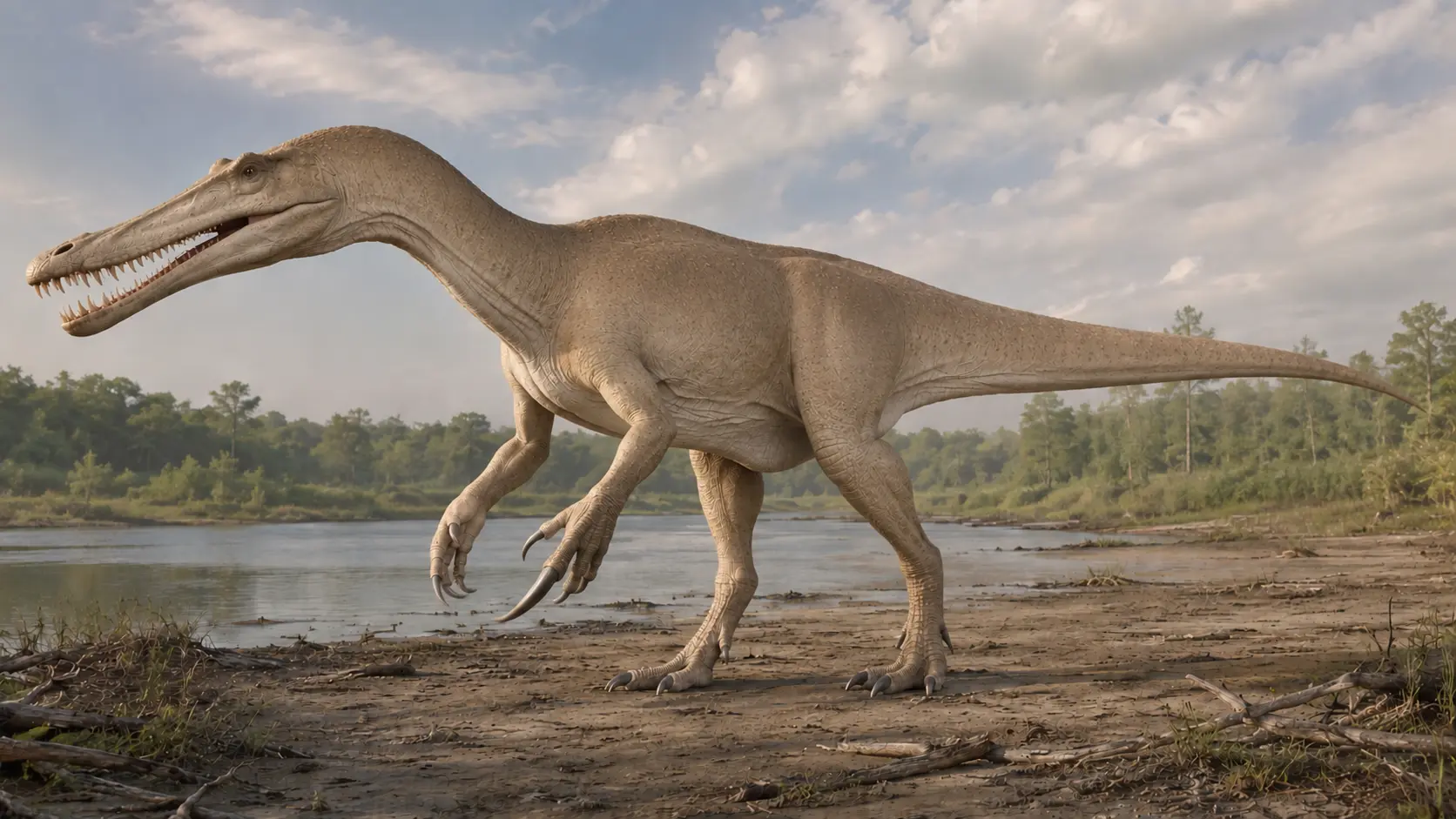
Baryonyx is an Early Cretaceous spinosaurid theropod best known from the type species Baryonyx walkeri, named in 1986 from a substantial partial skeleton discovered near Ockley, Surrey, England. Its unusually long, narrow skull, conical teeth, robust forelimbs and very large manual claw distinguish it from many other theropods. The type specimen also preserves direct evidence of feeding, including fish remains and material attributed to an ornithopod, making Baryonyx one of the better-supported examples of a dinosaur with evidence for substantial fish consumption.
The animal lived in what is now southern England during the Early Cretaceous. Its association with aquatic-margin environments and fish has made its ecology a major subject of discussion, but the fossil record does not establish that Baryonyx was a fully aquatic pursuit predator. That interpretation remains contested.
Core Facts
| Field | Current understanding | Evidence status |
|---|---|---|
| Scientific name | Baryonyx | Established |
| Type species | Baryonyx walkeri | Established |
| Named | 1986 | Established |
| Named by | Alan J. Charig and Angela C. Milner | Established |
| Family | Spinosauridae | Established |
| Dinosaur group | Theropoda | Established |
| Geological interval | Early Cretaceous | Established |
| Type-specimen age | Generally associated with the Barremian | Strongly supported, with stratigraphic detail requiring care |
| Type formation | Upper Weald Clay Formation | Established |
| Type locality | Ockley, Surrey, England | Established |
| Secure geographic record | England | Established |
| Holotype | NHMUK PV R9951 | Established |
| Estimated length | Approximately 10 m (approximately 33 ft) | Estimated |
| Estimated mass | Approximately 2,000 kg (approximately 4,400 lb) | Estimated |
| Diet | Carnivorous; direct evidence supports substantial fish consumption and other prey | Strong |
| Skull | Long, narrow snout with conical teeth | Strong |
| Forelimbs | Robust, with a very large manual claw | Strong |
| Aquatic adaptation | Degree remains unresolved | Contested |
| Coloration | Not known | No species-specific evidence established |
The Natural History Museum gives approximately 10 m (33 ft) in length and 2,000 kg (4,400 lb) in mass as estimates. These values are reconstructions, not direct measurements of a living animal.
Classification and Scientific Identity
Quick Summary
| Field | Current understanding |
|---|---|
| Accepted scientific name | Baryonyx |
| Type species | Baryonyx walkeri |
| Taxonomic rank | Genus |
| Family | Spinosauridae |
| Clade | Theropoda |
| Dinosaur group | Theropod dinosaur |
| Authority | Charig & Milner, 1986 |
| Year named | 1986 |
| Type specimen | NHMUK PV R9951 |
| Type locality | Ockley, Surrey, England |
| Type formation | Upper Weald Clay Formation |
| Current nomenclatural status | Baryonyx is the accepted genus name for the type taxon |
| Secure geographic record | England |
| Historical attribution requiring qualification | Iberian material historically referred to Baryonyx |
| Type species status | Baryonyx walkeri is the canonical species associated with the genus |
Taxonomic Context
Baryonyx was established by Alan J. Charig and Angela C. Milner in 1986 from the substantial partial skeleton now designated NHMUK PV R9951. The type species, Baryonyx walkeri, remains the canonical species for the genus. The principal taxonomic complication concerns referred material, rather than the basic identity of the British type taxon. Several Iberian specimens were historically assigned to Baryonyx, but subsequent research has revised the Early Cretaceous Iberian spinosaurid record. Those historical assignments should therefore be distinguished from the secure British type record rather than presented as current confirmed distribution.
Baryonyx is a member of Spinosauridae, the theropod family that also includes better-known genera such as Spinosaurus and Suchomimus. Its type species is Baryonyx walkeri, described by Alan Charig and Angela Milner in 1986.
The genus was established from the unusual combination of anatomical features preserved in the Surrey specimen. The long, narrow snout and relatively straight conical teeth differ from the deeper, more conventionally robust jaws seen in many large predatory theropods. The enormous first manual claw was another immediately distinctive feature.
The name Baryonyx is derived from Greek roots referring to a heavy or powerful claw, reflecting the conspicuous manual claw that first brought the specimen to scientific attention. The species name walkeri commemorates William J. Walker, who discovered the original claw and subsequently associated skeletal material.
The canonical taxonomic identity is considerably more secure than the historical geographic extent of the genus. Several specimens from the Iberian Peninsula were historically assigned to Baryonyx, but subsequent research has changed the interpretation of Iberian spinosaurid diversity. Those historical referrals should therefore not be presented as equivalent to the secure British record.
This distinction matters because a fossil can resemble the type of a known genus without necessarily belonging to that genus. As additional spinosaurid fossils have been discovered and studied, some older assignments have been reassessed.
When and Where Baryonyx Lived
Quick Summary
| Field | Current understanding | Evidence status |
|---|---|---|
| Geological era | Mesozoic | Established |
| Geological period | Cretaceous | Established |
| Geological interval | Early Cretaceous | Established |
| Geological stage | Barremian is the preferred placement for the type material | Strongly supported, with stratigraphic qualification |
| Approximate age | Early Cretaceous, Barremian | Approximate |
| Type formation | Upper Weald Clay Formation | Established |
| Type locality | Ockley, Surrey, England | Established |
| Country | United Kingdom | Established |
| Secure geographic record | England | Established |
| Paleoenvironmental setting | Terrestrial and freshwater-associated Wealden environments | Geological/paleoenvironmental interpretation |
| Historical wider record | Iberian specimens were historically referred to Baryonyx | Historical attribution |
| Current Iberian status | Historical Iberian assignments should not be treated as confirmed current Baryonyx distribution | Revised interpretation |
The type specimen was recovered from the Upper Weald Clay Formation near Ockley in Surrey, southern England. The Natural History Museum collection record identifies NHMUK PV R9951 as the holotype of Baryonyx walkeri and records its geological setting within the Early Cretaceous Wealden succession.
The Wealden deposits preserve terrestrial and freshwater-associated environments from southern Britain during the Early Cretaceous. This setting provides important environmental context for Baryonyx, particularly when considering its fish-eating adaptations.
However, environmental association should not be confused with proof of a particular lifestyle. Finding a predator in deposits formed in a landscape containing substantial water does not by itself demonstrate that the animal routinely swam, dived, or pursued prey underwater.
The secure modern distribution should therefore be described conservatively. England provides the principal confirmed geographic record represented by the type material. Historical Iberian occurrences require explicit qualification because subsequent taxonomic work has reassessed those specimens.
Fossil Record and Discovery
Quick Summary
| Field | Current understanding | Evidence status |
|---|---|---|
| Discovery year | 1983 | Established |
| Discoverer | William J. Walker | Established |
| Discovery location | Clay workings near Ockley, Surrey, England | Established |
| Initial discovery | A large manual claw | Established |
| Subsequent discovery | Associated partial skeleton | Established |
| Holotype | NHMUK PV R9951 | Established |
| Type species | Baryonyx walkeri | Established |
| Genus named | Baryonyx | Established |
| Species named | Baryonyx walkeri | Established |
| Naming year | 1986 | Established |
| Describing authors | Alan J. Charig and Angela C. Milner | Established |
| Geological unit | Upper Weald Clay Formation | Established |
| Principal preserved material | Substantial partial skull and postcranial skeleton | Direct fossil evidence |
| Importance of specimen | Principal anatomical basis for recognizing the genus | Strong |
| Dietary evidence | ornithopod material associated with the specimen indicates that its diet was not necessarily restricted to fish. | Direct fossil evidence |
| Historical referred material | Additional specimens were historically assigned to Baryonyx | Historical taxonomic interpretation |
| Current treatment of historical Iberian material | Not treated as secure current Baryonyx distribution | Revised interpretation |
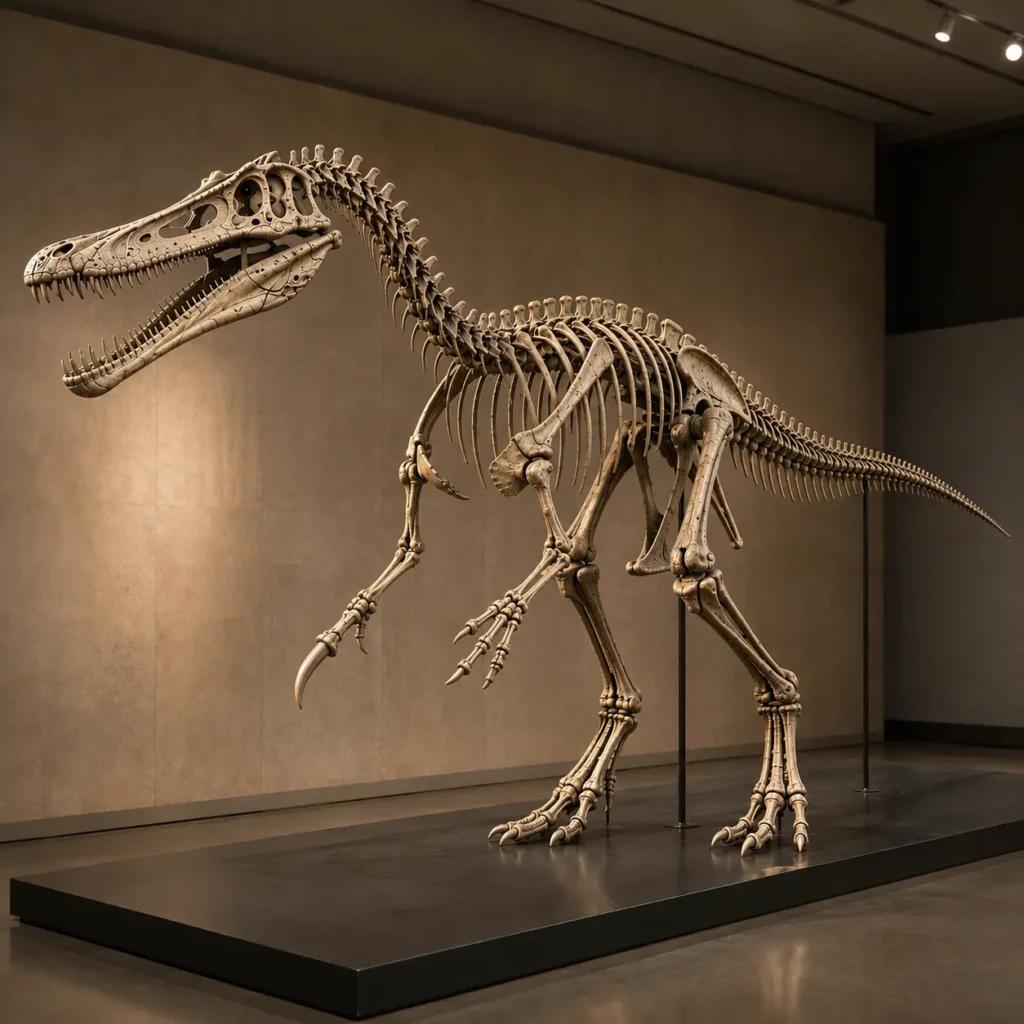
The discovery of Baryonyx began in 1983, when William J. Walker found a very large claw at a claypit near Ockley, Surrey. Further excavation revealed that the claw belonged to a much larger associated skeleton.
The resulting specimen, now catalogued as NHMUK PV R9951, became the holotype of Baryonyx walkeri. It preserves substantial parts of the skull and postcranial skeleton and remains the principal basis for understanding the genus.
The importance of the specimen extends beyond its completeness relative to many theropod fossils. Its anatomy combines several unusual features, while its preservation also provides evidence relevant to feeding ecology. This combination made Baryonyx particularly influential in the early development of scientific understanding of spinosaurids.
The original description by Charig and Milner established Baryonyx as a new theropod genus and species and highlighted its unusual skull, teeth, and enlarged manual claw. The specimen subsequently became central to broader interpretations of spinosaurid anatomy and feeding.
The Holotype
The holotype is particularly important because it establishes the anatomical foundation against which other proposed Baryonyx material can be compared.
Its preserved elements include substantial cranial and postcranial material. The skull and jaws provide the strongest evidence for its distinctive feeding anatomy, while the forelimbs and enormous claw contribute to its characteristic anatomical profile.
The existence of substantial type material does not mean every biological characteristic of the animal is known. Fossils preserve some structures much better than others, and features such as coloration, detailed soft-tissue anatomy, and many aspects of behavior remain outside what the canonical specimen can directly establish.
Anatomy
Skull and Jaws
Quick Summary
| Feature | Current understanding | Evidence status |
|---|---|---|
| Skull shape | Elongated, relatively narrow skull with an extended snout | Strong direct anatomical evidence |
| Snout | Long rostrum characteristic of spinosaurid anatomy | Strong direct anatomical evidence |
| Jaws | Elongated jaws adapted to a distinctive longirostrine feeding apparatus | Strong anatomical evidence |
| Teeth | Numerous relatively conical teeth suited to gripping rather than the blade-like dentition of some other large theropods | Strong direct anatomical evidence |
| Tooth arrangement | Teeth occur along the elongated jaws and contribute to the characteristic spinosaurid feeding apparatus | Strong |
| Jaw profile | Relatively slender, elongated jaws compared with the deep jaws of many large predatory theropods | Strong |
| Cranial specialization | Skull morphology differs substantially from that of many other large theropods | Strong |
| Feeding relevance | Skull and dentition are consistent with capturing prey including fish | Strong, with behavioral interpretation remaining inferential |
| Direct dietary evidence | Fish remains and scales associated with the holotype provide direct evidence for fish consumption | Very strong |
| Non-fish dietary evidence | Ornithopod material associated with the specimen indicates that fish were not necessarily its only prey | Strong |
| Functional interpretation | Cranial morphology supports a specialized feeding system, but exact feeding behavior cannot be observed directly from the fossil | Moderate–High |
| Soft-tissue reconstruction | Jaw musculature and other soft tissues are incompletely known | Limited |
| Aquatic implication | Cranial and dietary features are compatible with exploitation of aquatic-associated prey, but do not independently establish a fully aquatic lifestyle | Contested / restricted |
The skull of Baryonyx is elongated and relatively narrow compared with that of many other large theropods. Its jaws carried numerous relatively slender, conical teeth.
This morphology is important because tooth shape and jaw construction provide anatomical evidence about feeding mechanics. The combination is consistent with capturing and retaining prey rather than the highly specialized slicing dentition seen in some other predatory theropods.
The rostrum also contributes to the distinctive appearance of spinosaurids. However, anatomy should not be translated directly into a complete behavioral reconstruction. A particular skull shape can constrain plausible feeding behavior without revealing every detail of how an individual animal actually fed.
The Large Manual Claw
The most famous anatomical feature of Baryonyx is its exceptionally large first manual claw. The original description reported a claw bone roughly 30 cm (approximately 12 in) long.
The claw is securely documented anatomically. Its precise behavioral function is less certain.
It has often been discussed in connection with prey capture and feeding, particularly because it occurs alongside the animal’s distinctive skull and teeth. Nevertheless, the fossil itself does not provide a direct observation of the claw in use. Interpretations of its function therefore need to remain separate from the securely established morphology.
Forelimbs and Postcranial Skeleton
The forelimbs were robust and form part of the unusual anatomical combination that distinguishes Baryonyx. The postcranial skeleton also provides evidence about its overall body plan and relationship to other spinosaurids.
The available skeleton is substantial but incomplete. Consequently, some aspects of body proportions and locomotor performance remain reconstruction-dependent.
This is particularly important for numerical estimates. A published estimate of approximately 10 m (33 ft) in length should be treated as an approximate reconstruction rather than a directly measured body length. The same applies to the approximately 2,000 kg (4,400 lb) mass estimate.
Diet and Ecology
Quick Summary
| Aspect | Current understanding | Evidence status |
|---|---|---|
| Dietary category | Carnivorous theropod | Established |
| Fish consumption | Fish formed an important component of its diet | Direct fossil evidence |
| Other prey | Material attributed to an ornithopod was associated with the holotype | Direct fossil evidence |
| Exclusively piscivorous? | No; the available evidence does not support restricting its diet to fish | Strongly supported |
| Feeding anatomy | Long, narrow jaws and conical teeth were well suited to gripping prey | Strong anatomical evidence |
| Aquatic-associated food resources | Cranial anatomy and direct fish evidence support exploitation of aquatic-associated prey | Strong, with ecological interpretation |
| Terrestrial prey | Associated ornithopod material provides evidence relevant to non-fish prey consumption. | Strong |
| Habitat association | The type specimen comes from the Upper Weald Clay Formation, deposited in environments containing terrestrial and freshwater-associated settings | Geological/paleoenvironmental evidence |
| Aquatic-margin association | Compatible with foraging around aquatic environments | Plausible |
| Fully aquatic lifestyle | Not established | Contested |
| Underwater pursuit | Not established by the dietary evidence alone | Unknown |
| Detailed feeding behavior | Cannot be directly observed from the fossil record | Inferential |
| Detailed paleoecology | Requires reconstruction beyond the directly preserved evidence | Moderate / inferential |
The dietary evidence of Baryonyx is unusually informative.
Fish remains and scales were found associated with the abdominal region of the holotype. This provides direct fossil evidence that fish formed an important component of its diet. The specimen also preserves material attributed to an ornithopod, providing evidence that its diet was not limited exclusively to fish.
This distinction is important. Baryonyx is frequently described simply as a “fish-eating dinosaur,” but the available evidence supports a more nuanced interpretation: it was a carnivorous spinosaurid with direct evidence for substantial fish consumption and evidence for other prey as well.
Its skull and teeth provide anatomical support for this interpretation. The elongated snout and conical teeth are compatible with capturing relatively small prey, including aquatic prey, while the broader anatomy does not require an exclusively aquatic feeding strategy.
The detailed evidence for diet belongs to the dedicated Baryonyx diet resource. The hub therefore provides the central finding without reproducing the full dietary analysis.
Ecology and Aquatic Adaptation
Quick Summary
| Question | Current scientific understanding | Evidence status | Confidence |
|---|---|---|---|
| Aquatic association | Baryonyx was associated with environments containing freshwater and aquatic-margin habitats | Geological and paleoenvironmental evidence | Moderate |
| Fish consumption | Fish formed an important component of its diet | Direct fossil evidence from the holotype | High |
| Aquatic-margin foraging | Foraging around shallow water or aquatic margins is a plausible interpretation of its anatomy, diet and environment | Combined direct and inferential evidence | Moderate |
| Wading | A wading or shallow-water feeding lifestyle is plausible, but not directly demonstrated | Inferential | Moderate |
| Semiaquatic lifestyle | A semiaquatic interpretation has been proposed and remains scientifically plausible | Inferential / comparative | Moderate |
| Fully aquatic lifestyle | Not established | Contested | Low |
| Underwater pursuit | No secure evidence demonstrates sustained underwater pursuit of prey | Limited | Low |
| Swimming ability | The fossil record does not establish detailed swimming performance | Limited | Low |
| Diving behavior | No secure evidence establishes routine diving or a specific diving depth | Limited | Low |
| Bone compactness / pFDA evidence | Quantitative evidence previously used to support aquatic adaptation has methodological limitations | Analytical / contested | Low |
| Terrestrial capability | Nothing in the available evidence establishes that Baryonyx was incapable of terrestrial locomotion | Anatomical / comparative | Moderate |
| Aquatic adaptation as a whole | The degree of aquatic specialization remains unresolved | Mixed evidence | Low–Moderate |
| Coloration or integument related to aquatic life | Not established | No direct evidence | Unknown |
The ecology of Baryonyx is more difficult to establish than its anatomy.
Its fish-eating evidence, long narrow jaws, and occurrence in Early Cretaceous deposits associated with aquatic environments have all contributed to interpretations of a close relationship with water. Researchers have consequently considered possibilities ranging from shoreline or shallow-water foraging to more substantial aquatic adaptation.
Those possibilities should not be collapsed into a single established lifestyle.
In particular, the claim that Baryonyx was a fully aquatic pursuit predator requires more evidence than simply demonstrating that it ate fish or lived near water. Aquatic behavior can involve several distinct questions: whether an animal entered water, how frequently it did so, whether it could swim effectively, whether it foraged while submerged, and whether it was behaviorally or anatomically specialized for sustained underwater pursuit.
Current evidence does not establish all of those propositions.
A 2024 reassessment of quantitative evidence used to infer aquatic lifestyles in spinosaurids identified methodological problems with the bone-compactness and pFDA approach and concluded that such evidence could not straightforwardly establish a fully aquatic lifestyle for these animals. This reinforces the need to distinguish evidence for aquatic association from evidence for a specific underwater lifestyle.
Geographic Record and Historical Reassignments
The history of Baryonyx illustrates why fossil distribution must be separated from historical specimen labels.
Early interpretations assigned some spinosaurid material from Portugal and Spain to Baryonyx. As the Iberian fossil record became better understood, however, researchers recognized a more diverse spinosaurid fauna. Recent revisionary work does not support treating Baryonyx as a confirmed component of the Iberian fauna.
Accordingly, a current Baryonyx profile should not simply reproduce older distribution maps that show the genus extending across Iberia. The secure British record and historically referred material are different evidentiary categories.
This does not mean that every historical identification was unreasonable when made. It means that taxonomic interpretations can change as new fossils, comparisons, and phylogenetic information become available.
Size and Body Proportions
Quick Summary
| Measurement / Feature | Current understanding | Evidence status |
|---|---|---|
| Total body length | Approximately 10 m (33 ft) | Estimated |
| Body mass | Approximately 2,000 kg (2 tonnes; 4,400 lb) | Estimated |
| Length precision | The available evidence supports an approximate value rather than an exact measurement | Moderate confidence |
| Mass precision | Less certain than length because mass requires reconstruction of soft tissues and body volume | Moderate-to-Low confidence |
| Specimen basis | Primarily the substantial type specimen, NHMUK PV R9951 | Strong |
| Skeleton completeness | Substantial partial skeleton, but incomplete | Direct fossil evidence |
| Body proportions | Reconstructed from preserved skeletal anatomy and comparative anatomy | Reconstructed |
| Methodological basis for length | Skeletal reconstruction and comparative scaling | Estimated / reconstructed |
| Methodological basis for mass | Reconstruction-dependent; requires assumptions about body volume, soft tissues and density | Modelled / estimated |
| Exact maximum size | Not securely established | Unknown |
| Population-level size variation | Poorly constrained because the secure specimen record is limited | Limited evidence |
| Growth-related size variation | Insufficient evidence for a detailed growth series | Limited |
| Confidence in length | Greater than confidence in mass | Moderate |
| Confidence in mass | Lower than confidence in skeletal dimensions | Moderate-to-Low |
Published estimates place Baryonyx at approximately 10 m (33 ft) long and around 2,000 kg (4,400 lb) in mass.
These figures are useful for communicating the approximate scale of the animal, but neither represents a direct measurement. Fossil skeletons must be reconstructed, and body mass in particular depends on assumptions about body volume, proportions, and density.
| Measurement | Published estimate | How it should be interpreted |
|---|---|---|
| Length | Approximately 10 m (33 ft) | Reconstructed estimate |
| Mass | Approximately 2,000 kg (4,400 lb) | Reconstructed estimate |
| Exact adult length | Not documented as a direct measurement | Fossils do not provide a tape-measured living body |
| Exact adult mass | Not documented as a direct measurement | Mass must be reconstructed |
The hub therefore uses approximate values rather than presenting a single highly precise figure as though it were directly established.
What the Fossils Tell Us — and What They Do Not
The evidence for Baryonyx is uneven across different biological questions.
| Question | Current evidence | Confidence |
|---|---|---|
| Was Baryonyx a spinosaurid theropod? | Strong anatomical and taxonomic evidence | High |
| What did its skull look like? | Substantial preserved cranial material | High |
| Did it have a very large manual claw? | Direct skeletal evidence | High |
| Did it eat fish? | Fish remains and scales associated with the holotype | High |
| Did it eat only fish? | No; other prey evidence is also present | High |
| Was it about 10 m (33 ft) long? | Published reconstruction estimate | Moderate |
| Did it live in southern England? | Secure type locality and stratigraphic record | High |
| Was it associated with aquatic environments? | Geological and ecological evidence supports an aquatic-margin association | Moderate |
| Was it fully aquatic? | Not established | Low |
| What exact coloration did it have? | No secure species-specific evidence | Unknown |
| What was its precise swimming speed? | No sufficiently secure species-specific estimate | Unknown |
| What was its exact body mass? | Reconstruction-dependent | Moderate at best |
This uneven evidence profile is important. A scientifically useful Baryonyx page should not treat every question as equally answerable merely because the animal itself is well known.
Current Scientific Understanding
The strongest current understanding of Baryonyx comes from the combination of its substantial type specimen, distinctive anatomy, geological context, and direct dietary evidence.
Its identity as a spinosaurid theropod is well established. Its elongated skull, conical teeth, and enlarged manual claw are directly documented anatomical features. Its type specimen also preserves unusually informative dietary evidence, demonstrating substantial fish consumption while showing that its diet was not restricted to fish.
Its environmental and behavioral interpretation is less certain.
The evidence is compatible with an animal that exploited aquatic-margin resources, but it does not by itself establish a fully aquatic lifestyle. Claims about underwater pursuit, detailed swimming performance, or other specialized aquatic behaviors require additional evidence and should remain qualified.
The same principle applies to historical geographic records. The British type material provides the secure foundation for the genus, whereas historical Iberian assignments have been affected by subsequent taxonomic revision.
Taken together, the evidence supports a distinctive Early Cretaceous spinosaurid with strong anatomical and dietary evidence but a more constrained record for detailed ecology and behavior. That distinction between what the fossils directly show and what researchers infer from them is central to the current scientific picture.
Recommended final bibliography
Charig, A. J., & Milner, A. C. (1986). Baryonyx, a remarkable new theropod dinosaur. Nature, 324, 359–361. https://doi.org/10.1038/324359a0.
Charig, A. J., & Milner, A. C. (1997). Baryonyx walkeri, a fish-eating dinosaur from the Wealden of Surrey. Bulletin of the Natural History Museum: Geology Series, 53, 11–70.
Isasmendi, E., Cuesta, E., Díaz-Martínez, I., Company, J., Sáez-Benito, P., Viera, L. I., Torices, A., & Pereda-Suberbiola, X. (2024). Increasing the theropod record of Europe: A new basal spinosaurid from the Enciso Group of the Cameros Basin (La Rioja, Spain). Evolutionary implications and palaeobiodiversity. Zoological Journal of the Linnean Society, 202(3), zlad193. https://doi.org/10.1093/zoolinnean/zlad193.
Myhrvold, N. P., Baumgart, S. L., Vidal, D., Fish, F. E., Henderson, D. M., Saitta, E. T., & Sereno, P. C. (2024). Diving dinosaurs? Caveats on the use of bone compactness and pFDA for inferring lifestyle. PLOS ONE, 19(3), e0298957. https://doi.org/10.1371/journal.pone.0298957.
Natural History Museum. (n.d.). Baryonyx. The Natural History Museum, London.
Natural History Museum. (n.d.). How did Baryonyx change what we knew about spinosaurs? The Natural History Museum, London.
Natural History Museum. (n.d.). NHMUK PV R9951: Baryonyx walkeri [Collection specimen record]. Natural History Museum Data Portal.
Featured Museum Collections
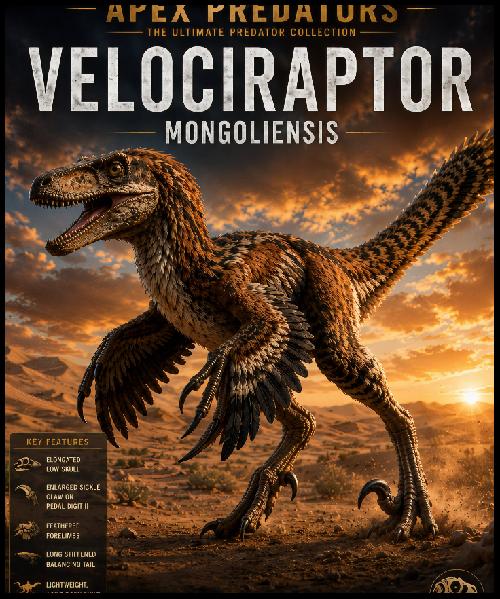
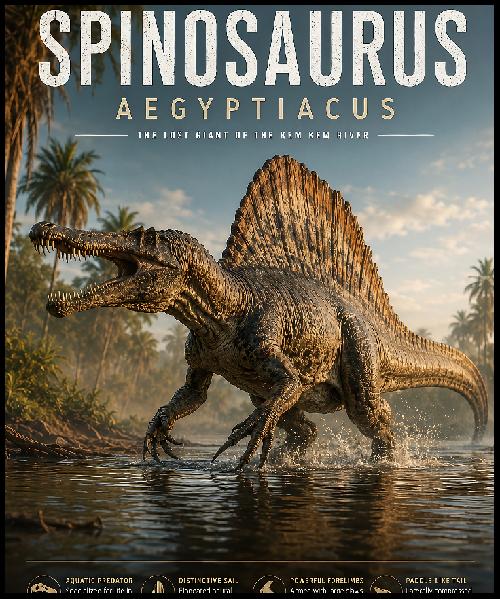
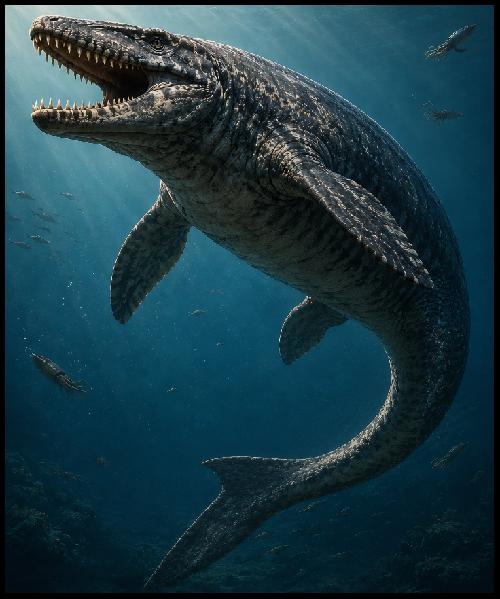
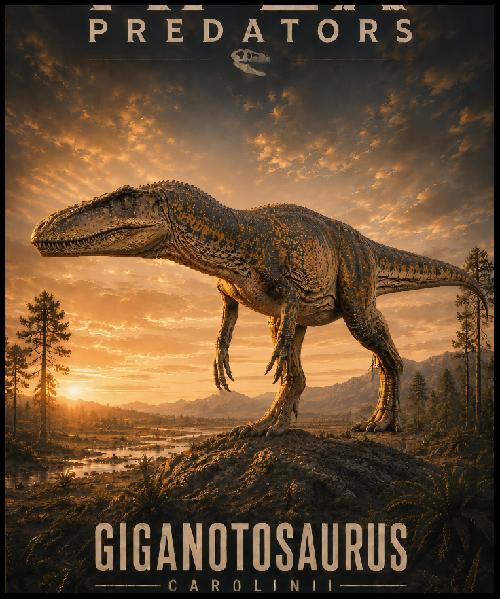
Museum-quality paleoart and educational poster
collections based on evidence-informed prehistoric
Life reconstructions.