
At a Glance
| Attribute | Detail |
|---|---|
| Name meaning | “Ancient wing” (Greek) |
| Lived | Late Jurassic, approximately 150–148 Ma |
| Location | Solnhofen Lagerstätte, Bavaria, southern Germany |
| Length | Approximately 50 cm (20 in) snout to tail tip |
| Wingspan | Approximately 60–70 cm (24–28 in) |
| Body mass | Estimated 0.8–1 kg (1.8–2.2 lb) |
| Diet | Carnivorous — insects, small vertebrates, possibly fish |
| Classification | Avialae; exact position within the bird lineage contested |
| Known specimens | Approximately 12 specimens generally recognised as Archaeopteryx |
| Discovered | First feather described 1861, Bavaria |
Quick Answer:Archaeopteryx was a small, feathered creature that lived approximately 150 million years ago in what is now Germany. It possessed a unique combination of dinosaurian features — toothed jaws, a long bony tail, and clawed wings — alongside fully formed flight feathers, making it one of the most important transitional fossils ever found. Whether it could sustain powered flight remains actively debated.
About the size of a raven and covered in fully formed feathers, Archaeopteryx looks, at first glance, like a bird. Look closer at those jaws — lined with small, sharp teeth — and the three clawed fingers extending from each wing, and something older and stranger comes into focus. It sits at one of the most consequential boundaries in vertebrate evolution: the point where the dinosaur lineage became the bird lineage, or very nearly did.
What Was Archaeopteryx?
Archaeopteryx is classically described as the earliest known bird, and for much of the past 160 years, that framing has held. The picture is more complicated now.
This is an active area of research. Details here reflect current scientific consensus but may be revised as new fossil evidence or analysis emerges.
Fossil evidence places it firmly within Avialae — the group that includes modern birds and their closest relatives. Some phylogenetic analyses have repositioned it just outside that group, as a non-avian paravian more closely related to dinosaurs like Deinonychus than to modern birds. The current working consensus retains it within Avialae, but its exact position — direct ancestor to later birds or a side branch — remains unresolved.
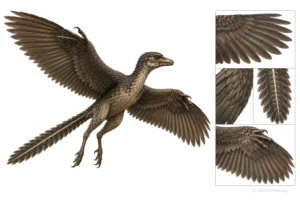
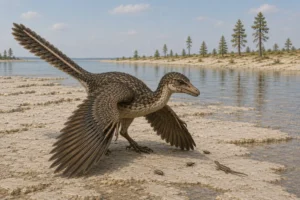
What is not in doubt is its significance. Archaeopteryx carries both sets of credentials simultaneously. On the dinosaurian side: socketed teeth, a long tail of approximately 20 vertebrae, clawed forelimbs, and gastralia (belly ribs absent in all modern birds). On the avian side: a well-developed furcula (wishbone), asymmetric flight feathers on the wings, and feathers on the tail forming a fan. No other known species from this period combines these traits in the same way.
Size and Appearance
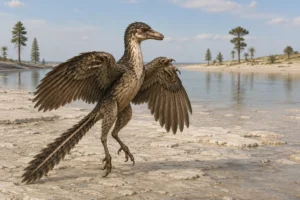
Archaeopteryx was a small animal. Fossil evidence from the 12 known specimens supports an overall length of approximately 50 cm (20 in) and a wingspan of approximately 60–70 cm (24–28 in) — broadly comparable to a modern raven or large crow. Body mass is estimated at 0.8–1 kg (1.8–2.2 lb), though estimates vary depending on the specimen and the modelling assumptions used.
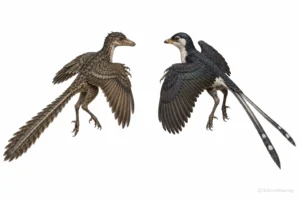
Its jaws were elongated and lined with small, conical teeth — no beak was present. The forelimbs bore three functional clawed fingers on the leading edge of each wing. The hindlimbs were long and ended in curved, raptorial claws. A 2011 study of melanosomes in feather specimens suggested that at least some plumage was black or very dark, though whether this is representative of the full body colouration is contested.
One feature that often surprises: the tail. Where modern birds have a fused pygostyle to anchor tail feathers, Archaeopteryx had a long, unfused tail of approximately 20 separate vertebrae with feathers attached along its length, producing a frond-like silhouette quite unlike any living bird.
Could Archaeopteryx Fly?
The short answer is: probably yes, in a limited capacity — but the nature and efficiency of that flight remain debated.
Fossil evidence shows that Archaeopteryx possessed asymmetric flight feathers, a feature strongly associated with aerodynamic function in modern birds. It also had a well-developed furcula (wishbone) and wing proportions that fall within the lower range of modern flying birds. Together, these features indicate some degree of aerial capability.
Bone microstructure analyses published in 2018 found that Archaeopteryx had bone density comparable to modern volant (flying) birds, rather than to non-avian theropods. This supports the interpretation that it was capable of active flapping, at least over short distances. However, this evidence does not demonstrate sustained or efficient flight comparable to modern birds.
Several anatomical limitations complicate the picture. Archaeopteryx lacked a keeled sternum, the structure that anchors the powerful flight muscles in modern birds, and retained a long, bony tail, which would have increased drag and reduced manoeuvrability. These features suggest that if powered flight was present, it was likely short-range and energetically inefficient.
Two broader evolutionary models frame the debate. The ground-up hypothesis proposes that flight evolved from running theropods using their forelimbs to generate lift. In contrast, the trees-down hypothesis suggests that early paravians first glided from elevated positions before developing powered flight. Analyses of claw curvature in Archaeopteryx have produced conflicting results, with some studies supporting climbing ability and others indicating a primarily terrestrial lifestyle.
Current evidence is best interpreted as placing Archaeopteryx near the threshold of powered flight — capable of some active aerial movement, but not yet adapted for sustained, high-efficiency flight seen in later birds.
For the full treatment of flight anatomy, feather asymmetry evidence, and the origin-of-flight debate, see: Did Archaeopteryx Fly?
What Did Archaeopteryx Eat?
Archaeopteryx was carnivorous. Its dentition — small, sharp, conical teeth set in sockets — is consistent with a diet of animal prey. Inferred prey items include insects, small lizards, small vertebrates, and possibly fish, given the lagoon environment of the Solnhofen formation. No direct stomach contents have been confirmed in any Archaeopteryx specimen, so prey identification rests on comparative inference from jaw anatomy and ecological context rather than direct fossil evidence.
For a full examination of its jaw mechanics, tooth morphology, and feeding ecology within the Solnhofen environment, see our dedicated post: What Did Archaeopteryx Eat?
Claws and Locomotion
Archaeopteryx had claws on both its feet and its wings — and what those claws were actually used for is one of the more contested questions in its biology.
The hand claws on the leading edge of the wings are one of its most distinctively non-avian features. The foot claws are long and curved, with a hallux (first toe) whose exact orientation — whether fully reversed as in perching birds — remains debated in the literature. Claw curvature studies have been used to argue for arboreal climbing capacity, ground-dwelling, or both, depending on the analysis.
For the full treatment of claw anatomy, hallux position, and the arboreal versus terrestrial locomotion debate, see our dedicated post: Archaeopteryx Claws and Locomotion.
Discovery and Fossil Record
Archaeopteryx entered the scientific record at a historically charged moment. The first known specimen — a single feather — was described in 1861 from the Solnhofen limestone of Bavaria, the same year Charles Darwin’s On the Origin of Species was two years in print and already reshaping how scientists understood the relationship between species. The first skeletal specimen, the London Specimen, was described the same year by Richard Owen, and the species was formally named Archaeopteryx lithographica.
Twelve specimens are now confirmed, all recovered from the Solnhofen Lagerstätte in Bavaria — a formation famous for the exceptional preservation quality produced by its fine-grained limestone. The Solnhofen environment is reconstructed as a shallow tropical archipelago: warm lagoons, semi-arid low-lying islands, and a fauna that included small dinosaurs, pterosaurs, and marine invertebrates. Some specimens are now interpreted as juveniles based on bone fusion studies, indicating that growth stages are represented in the fossil record, though detailed trait-level data for younger individuals are limited.
The specimens are distributed across several institutions: the Natural History Museum in London, the Humboldt Museum in Berlin, and several German regional collections hold the most significant examples.
Related and Contemporary Species
Archaeopteryx did not exist in isolation. Its Solnhofen environment was shared with pterosaurs and small dinosaurs, and the broader Late Jurassic period saw the first diversification of paravian theropods — the group that includes both Archaeopteryx and the dromaeosaurids.
Two comparisons are particularly instructive for understanding where Archaeopteryx sits in evolutionary terms:
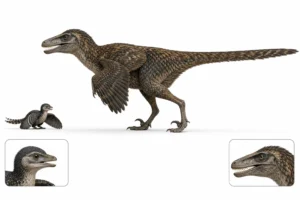
Archaeopteryx vs. Deinonychus — Deinonychus was a dromaeosaurid from the Early Cretaceous of North America, roughly 40 million years younger and considerably larger. Comparing the two illuminates the shared paravian anatomy — the clawed feet, the theropod body plan — and highlights how different the bird and dromaeosaurid lineages became over time. As covered in our comparative post, the two animals would never have encountered each other. See: Archaeopteryx vs. Deinonychus.
Archaeopteryx vs. Confuciusornis — Confuciusornis is an Early Cretaceous bird from China, approximately 125 Ma, and represents a significantly more derived stage of avian evolution. Comparing the two shows how much the bird lineage changed in roughly 25 million years: Confuciusornis had a true beak, a pygostyle, and no teeth. The comparison is one of the clearest illustrations of the direction the bird lineage was heading. See: Archaeopteryx vs. Confuciusornis.
Common Questions About Archaeopteryx
Was Archaeopteryx a dinosaur or a bird?
It was both, depending on how you define the terms. Under modern cladistic classification, birds are dinosaurs — a lineage of theropod dinosaurs that survived the end-Cretaceous extinction. Archaeopteryx sits at or very near the base of the avian lineage and possesses traits from both sides of that boundary. Calling it a bird is defensible; calling it a feathered dinosaur is equally accurate.
How many Archaeopteryx fossils have been found?
Twelve specimens are confirmed as of current knowledge, all from the Solnhofen limestone of Bavaria, southern Germany.
When did Archaeopteryx go extinct?
Archaeopteryx is not known from any formation younger than the Late Jurassic, approximately 148 Ma. Its disappearance coincides broadly with faunal turnover at the Jurassic–Cretaceous boundary, though the direct cause is not established. More derived birds appear in the Cretaceous fossil record and likely replaced contemporaneous avialans, though exactly how and when this transition occurred is inferred rather than directly evidenced.
Why is Archaeopteryx so important?
It is one of the most complete and best-evidenced transitional fossils in the vertebrate record, preserving both the dinosaurian ancestry of birds and the early stages of avian anatomy in a single animal. It arrived in the scientific literature at a moment when transitional forms were theoretically predicted but rarely demonstrated — and it has remained central to debates about the origin of birds and flight for over 160 years.
⚖️ Comparison
🦷 Anatomy
Featured Museum Collections
Museum-quality paleoart and educational poster
collections based on evidence-informed prehistoric
Life reconstructions.