At a Glance
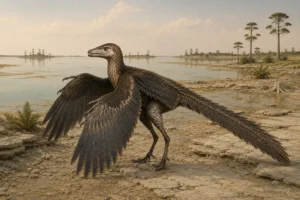
| Field | Information |
|---|---|
| Species | Archaeopteryx lithographica |
| Period | Late Jurassic (approx. 150–148 Ma) |
| Wingspan | Approx. 60–70 cm |
| Flight feathers | Asymmetric; consistent with flight capability in modern birds |
| Flight status | Contested — powered flight possible; gliding not ruled out |
| Furcula | Present and well-developed |
Quick Answer: Whether Archaeopteryx could fly is one of palaeontology’s most debated questions. Fossil evidence confirms it had fully formed, asymmetric flight feathers and a furcula, both consistent with some aerial ability. Current research suggests consistent with limited powered flapping, but whether it was sustained or efficient remains unresolved.
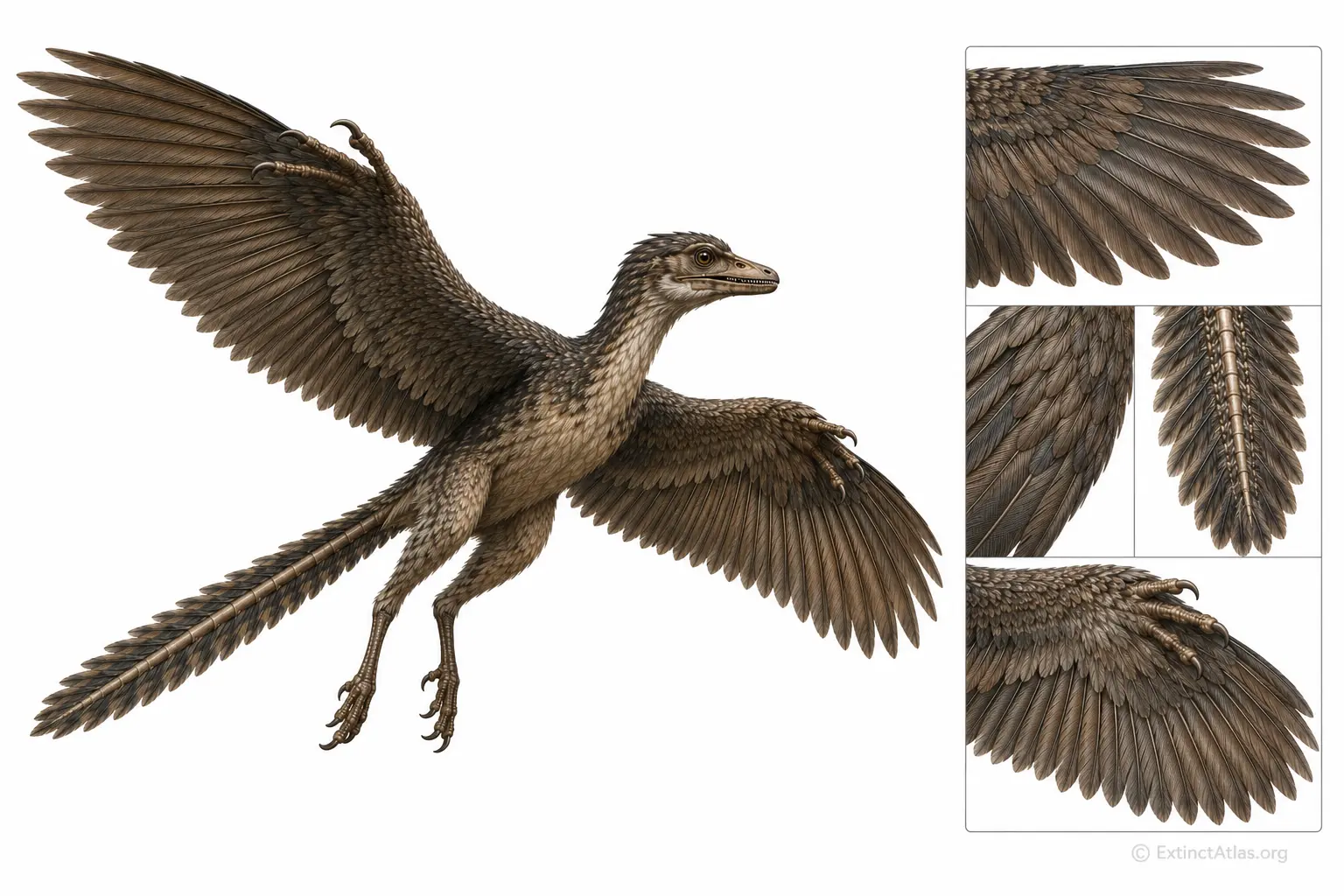
Forty-seven asymmetric flight feathers — preserved in exquisite detail in the Solnhofen limestone — made Archaeopteryx the first fossil to show that dinosaurs and birds shared more than a passing resemblance. The feathers were not decorative. They were structurally identical to the flight feathers of modern flying birds, and that fact has driven more than 160 years of scientific argument about what Archaeopteryx actually did with them.
Could Archaeopteryx Fly? What the Fossil Evidence Shows
Fossil evidence confirms Archaeopteryx possessed the two structural prerequisites most associated with flight in modern birds: asymmetric flight feathers and a well-developed furcula (wishbone). Asymmetric feathers — where the leading vane is narrower than the trailing vane — are found in every strong-flying bird alive today and are absent in flightless species. Their presence in Archaeopteryx is evidenced directly from fossil impressions and is not in dispute.
The Furcula and Wing Bones
The furcula acts as a spring in modern birds, storing and releasing energy during the flight stroke. Archaeopteryx possessed a fully formed furcula, which researchers interpret as consistent with some form of flapping motion. Wing bone proportions fall within a range that overlaps with modern flying birds, though the humerus is proportionally shorter than in strong fliers.
Bone Density Evidence
A 2018 study examining bone microstructure found that Archaeopteryx bone density was comparable to modern flying birds rather than non-flying dinosaurs. Research suggests this supports active flapping flight rather than pure gliding, though scientists note the data does not resolve whether flight was sustained or limited to short bursts.
Powered Flight or Gliding? The Central Debate
The flight capability of Archaeopteryx is contested, with researchers divided into broadly two camps.
The Case for Powered Flight
Proponents point to asymmetric feathers, furcula morphology, bone density data, and wing bone proportions as a convergent package consistent with active flapping. Some researchers argue that the full suite of features would be redundant in a purely gliding animal.
The Case for Gliding or Limited Flight
Sceptics note that Archaeopteryx retained several features that would have limited flight efficiency: a heavy bony tail, clawed forelimbs, and no keeled sternum — the anchor point for the large flight muscles seen in modern birds. Current evidence indicates Archaeopteryx may have been capable of short, powered bursts rather than the sustained, efficient flight of modern birds.
Ground-Up vs Trees-Down
Some researchers argue that flight in Archaeopteryx evolved from the ground up, driven by leaping predatory behaviour. Others favour a trees-down model, in which gliding from elevated perches preceded true flapping flight. The arboreal question connects directly to claw function — covered fully in the Claws and Locomotion post.
The Feathers in Detail
Fossil impressions from the best-preserved specimens show flight feathers on both wings and a fan of tail feathers fringing the bony tail. A 2011 analysis of melanosomes — microscopic pigment structures — in one isolated feather suggested dark, possibly black colouration. Whether this is representative of Archaeopteryx plumage overall is contested; the sample comes from a single feather whose attribution to Archaeopteryx has itself been debated.
Body Feathers
Evidence from high-resolution specimen scans confirms contour feathers were present on the body, not just the wings. This makes Archaeopteryx more fully feathered than older reconstructions suggested.
Related and Contemporary Species
- Anchiornis huxleyi — A small feathered paravian from the Late Jurassic of China, sometimes compared to Archaeopteryx for its four-winged configuration and relevance to flight origin debates.
- Xiaotingia zhengi — A Jurassic paravian whose description in 2011 briefly displaced Archaeopteryx from its position as the earliest bird in some phylogenetic analyses; relevant to the flight-evolution placement of Archaeopteryx.
- Confuciusornis sanctus — An Early Cretaceous bird with a true pygostyle and toothless beak, representing a more flight-adapted stage of avian evolution; compared directly to Archaeopteryx in the vs. Confuciusornis post.
- Microraptor gui — A four-winged dromaeosaurid whose gliding capability informs the trees-down hypothesis and provides a comparative model for early aerial locomotion.
- Deinonychus antirrhopus — A dromaeosaurid sharing key paravian features with Archaeopteryx; compared directly with vs. Deinonychus post.
Frequently Asked Questions
Could Archaeopteryx fly like a modern bird?
Research suggests Archaeopteryx was capable of some form of powered flight, but probably not with the efficiency of modern birds. It lacked a keeled sternum for large flight muscles and retained a heavy bony tail, which would have limited both speed and manoeuvrability. Current evidence points to short, active bursts rather than sustained soaring.
What makes Archaeopteryx’s feathers significant?
The flight feathers of Archaeopteryx are asymmetric — the same structural design seen in every strong-flying bird today. Fossil evidence confirms this directly from preserved impressions, making them the earliest unambiguous evidence of flight-ready feathers in the fossil record.
Why is the flight debate still unresolved?
Some researchers argue that the absence of a keeled sternum and the retention of a bony tail are decisive limitations; others contend that the end of the feather and bone evidence is sufficient for powered flight. Biomechanical models vary depending on the assumptions used, and no single line of evidence has settled the question.
Conclusion
Archaeopteryx had the feathers, the furcula, and the bone structure consistent with powered flight — but retained enough dinosaurian anatomy to keep the debate alive. Whether it flapped efficiently or glided opportunistically, it occupies a unique position as the earliest fossil to unite dinosaurian and avian traits in a single, flight-capable body.
Featured Museum Collections
Museum-quality paleoart and educational poster
collections based on evidence-informed prehistoric
Life reconstructions.