What Did Archaeopteryx Eat?
At a Glance
| Field | Information |
|---|---|
| Species | Archaeopteryx lithographica |
| Period | Late Jurassic (approx. 150–148 Ma) |
| Diet type | Carnivorous |
| Primary prey (inferred) | Insects, small lizards, small vertebrates |
| Jaw type | Toothed; no beak |
| Stomach contents confirmed | None |
Quick Answer:Archaeopteryx was a carnivore. Its small, sharp teeth, grasping claws, and the prey available in its Solnhofen island environment suggest it fed on insects, small lizards, and other small vertebrates. No direct stomach contents have been confirmed, so the full prey range remains inferred from anatomy and ecology.
Teeth tell stories. Every Archaeopteryx skull recovered from the Solnhofen limestone preserves the same feature that immediately separates it from any living bird: a jaw lined with small, sharp, socketed teeth. No living bird has teeth. Their presence in Archaeopteryx is one of the clearest anatomical signals that this animal ate meat — and that it was still, in fundamental ways, a dinosaur.
What Did Archaeopteryx Eat? Evidence from Anatomy and Environment
Archaeopteryx was carnivorous. Fossil evidence confirms socketed, conical teeth in both upper and lower jaws — a design suited to gripping and puncturing small, slippery prey rather than grinding plant material. The teeth are not serrated, which distinguishes the feeding apparatus from the blade-like dentition of larger theropod predators.
Jaw Mechanics
The jaws of Archaeopteryx were relatively long and lightly built. Research suggests this configuration was better suited to snapping at fast-moving small prey — insects, small lizards — than to processing larger vertebrates. Bite force estimates for Archaeopteryx have not been robustly modelled, but the slender jaw structure is consistent with a diet of small, manageable prey items.
No Confirmed Stomach Contents
Unlike some exceptionally preserved theropods from Chinese Lagerstätten, no Archaeopteryx specimen has yielded confirmed stomach contents. The diet reconstructed here is inferred entirely from jaw and claw anatomy combined with the ecological context of the Solnhofen environment.
The Solnhofen Environment and Prey Availability
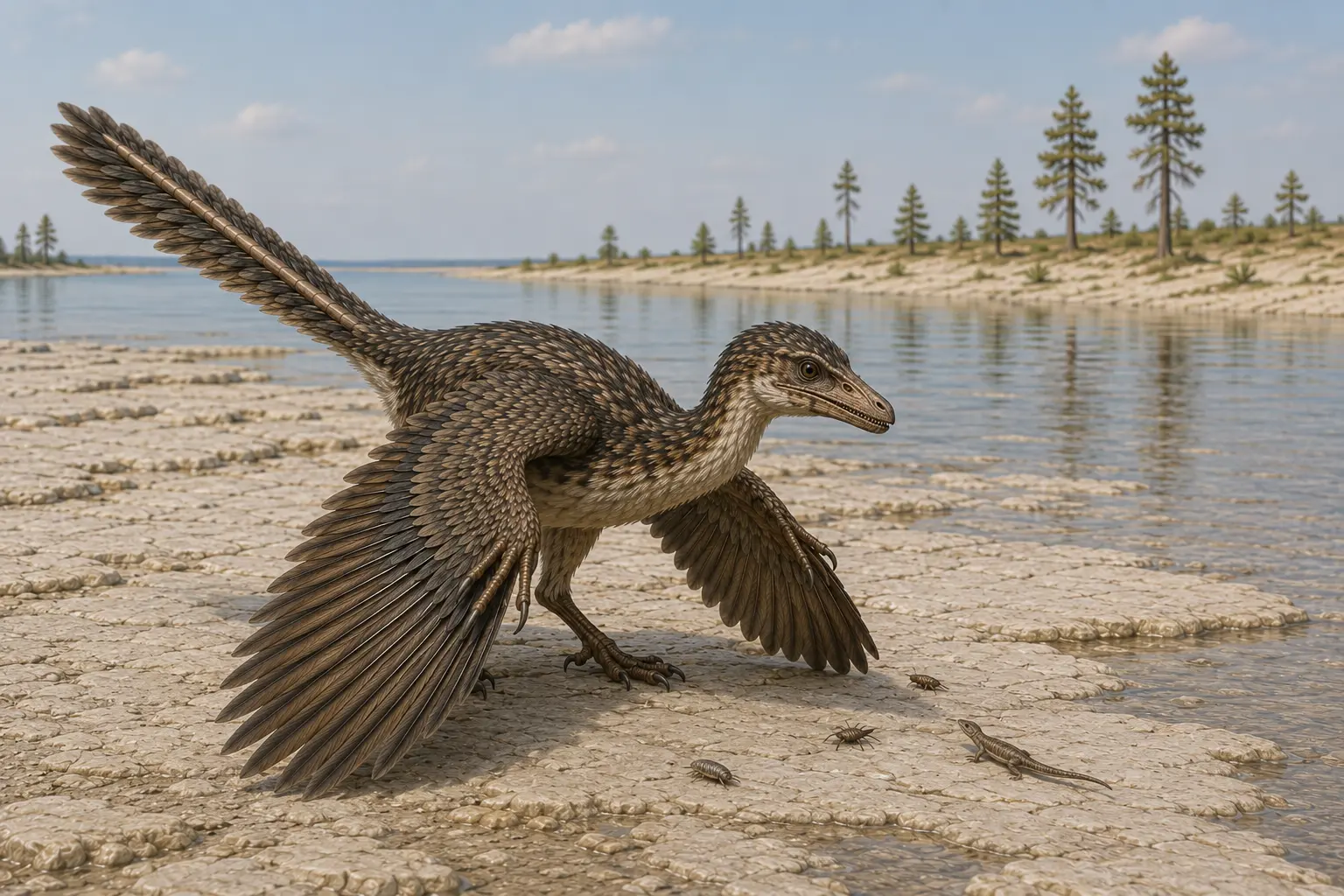
Archaeopteryx lived on or around the low-lying islands of a shallow tropical archipelago in what is now Bavaria, Germany. The Solnhofen Lagerstätte preserves a snapshot of this ecosystem: dragonflies, beetles, small fish, lizards, and pterosaurs all appear in the same deposits.
Likely Prey Items
Research suggests the most plausible prey for Archaeopteryx included:
- Insects — abundant in the Solnhofen deposits and well within the handling capacity of the jaw and claw apparatus
- Small lizards and reptiles — present in the Solnhofen fauna; teeth and claw morphology consistent with this prey type
- Small vertebrates — possible but less certain; jaw robustness may have limited prey size
- Fish — possible given the lagoonal setting; some researchers suggest opportunistic fish-snatching, but this is speculative and not directly evidenced.
Ecological Position
Current evidence indicates Archaeopteryx occupied a small predator niche — closer to an ecological generalist hunting small, diverse prey than to a specialised pursuit predator. It was not an apex predator within its ecosystem; larger theropods and marine predators occupied higher trophic positions.
Claws and Prey Handling
Archaeopteryx possessed curved, raptorial claws on both its hands and feet. How these claws function in prey capture and restraint is covered fully in the Claws and Locomotion section. In the context of diet, the claw morphology is consistent with pinning or gripping small prey items before dispatch by the jaws.
Related and Contemporary Species
- Compsognathus longipes — A small theropod from the same Solnhofen deposits, occupying a similar small-predator niche; useful ecological comparison for Archaeopteryx diet reconstruction.
- Juravenator starki — Another small Solnhofen theropod; provides context for the prey community Archaeopteryx shared and competed within.
- Scipionyx samniticus — An Italian theropod with confirmed stomach contents including lizards and fish; it illustrates the prey types plausibly available to similar-sized Jurassic predators.
- Microraptor gui — A small feathered paravian with confirmed fish and bird remains in gut contents; provides a comparative model for small paravian diet reconstruction.
- Anchiornis huxleyi — A feathered paravian of comparable size; ecological context informs diet inference for Archaeopteryx.
Frequently Asked Questions
Did Archaeopteryx have teeth?
Yes. Fossil evidence confirms Archaeopteryx had small, sharp, socketed teeth in both upper and lower jaws — a feature absent in all living birds. The teeth are conical rather than serrated, consistent with gripping small prey rather than cutting through larger animals.
Could Archaeopteryx catch fish?
Possibly, given its lagoonal habitat, but this is not directly evidenced. Some researchers suggest opportunistic fish-snatching was within its behavioural range; others note the jaw structure is better suited to insects and small lizards. No stomach contents have been confirmed for any Archaeopteryx specimen.
Was Archaeopteryx a hunter or a scavenger?
Current evidence indicates Archaeopteryx was an active predator of small prey rather than a scavenger. Its toothed jaws, grasping claws, and probable mobility — including some aerial capability — are more consistent with active hunting than with scavenging behaviour, though no direct behavioural evidence exists.
Conclusion
Archaeopteryx was a small, toothed carnivore hunting insects, lizards, and other small prey in the island lagoons of Late Jurassic Europe. Its jaw anatomy points clearly to meat-eating, but the full picture of its diet is built from inference rather than direct fossil evidence — a reminder that for all its famous preservation, Archaeopteryx still holds some of its secrets.
Featured Museum Collections
Museum-quality paleoart and educational poster
collections based on evidence-informed prehistoric
Life reconstructions.