At a Glance
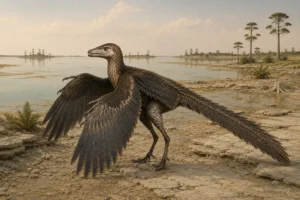
| Feature | Archaeopteryx | Confuciusornis |
|---|---|---|
| Period | Late Jurassic (150–148 Ma) | Early Cretaceous (125–120 Ma) |
| Body length | ~50 cm | ~50–60 cm |
| Teeth | Present — small, conical | Absent — toothless beak |
| Tail | Long, bony (approx. 20 vertebrae) | Short — true pygostyle present |
| Wing claws | Three functional clawed fingers | Reduced or absent |
| Sternum | No keeled sternum evidenced | Keeled sternum present |
| Flight status | Contested — powered flight possible | Flight evidenced — more advanced than Archaeopteryx |
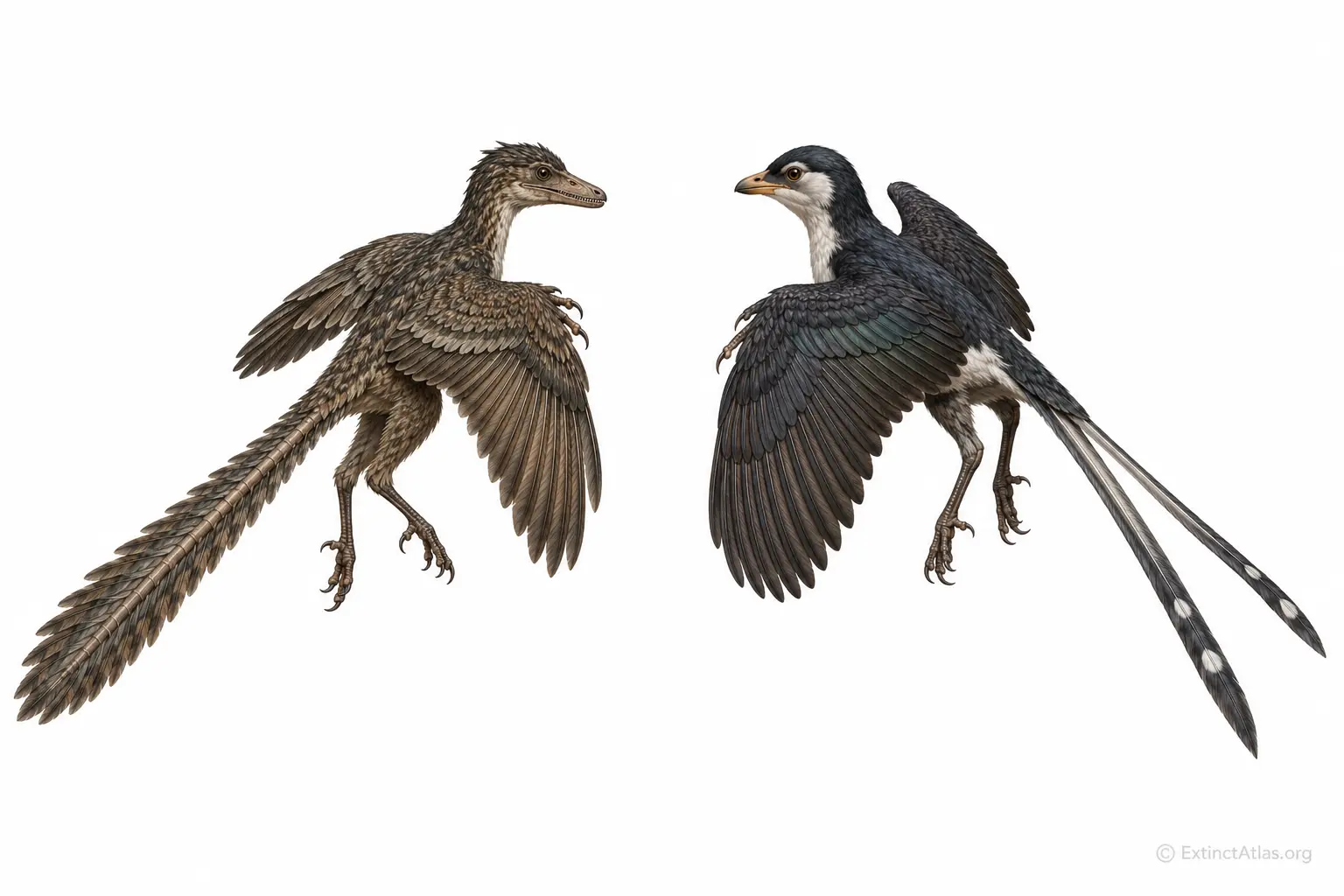
Quick Answer:Archaeopteryx and Confuciusornis were both early birds, but Confuciusornis was more flight-adapted. Living roughly 25 million years later, it had a toothless beak, a pygostyle replacing the long bony tail, and a keeled sternum to anchor larger flight muscles — features Archaeopteryx entirely lacked.
Twenty-five million years is a long time to get better at flying. Confuciusornis is what happens when you take the basic Archaeopteryx body plan and run it through the filter of Early Cretaceous selection pressures: the teeth are gone, the bony tail is replaced by a compact pygostyle, and the sternum finally has a keel. What remains is still recognisably a bird in transition — but a much more committed one.
Archaeopteryx vs Confuciusornis: How Far Did Flight Evolve?
Confuciusornis sanctus is one of the most abundant early birds in the fossil record, known from hundreds of specimens from the Yixian and Jiufotang Formations of Liaoning, China. Fossil evidence confirms it was contemporaneous with the earliest feathered dromaeosaurids from the same deposits, making it a critical data point for understanding how rapidly avian flight anatomy evolved after Archaeopteryx.
The Pygostyle vs the Bony Tail
The most immediately visible distinction between the two animals is the tail. Archaeopteryx retained approximately 20 free caudal vertebrae forming a long, bony tail fringed with feathers — a fully dinosaurian feature. Confuciusornis had replaced this with a pygostyle: a fused, abbreviated tail structure that serves as the anchor point for the tail fan in modern birds. The pygostyle represents a significant aerodynamic and weight reduction. Fossil evidence confirms its presence in Confuciusornis; its absence in Archaeopteryx is equally well-evidenced.
Teeth vs Beak
Archaeopteryx was toothed. Confuciusornis was not — it is among the earliest known birds with a fully toothless beak. The loss of teeth is generally interpreted as part of a broader trend toward weight reduction and dietary specialisation in avian evolution, though the specific dietary implications for Confuciusornis are inferred rather than directly confirmed.
The Keeled Sternum: A Critical Flight Adaptation
Archaeopteryx shows no evidence of a keeled sternum — the ridge of bone that anchors the large pectoralis muscles responsible for the powered downstroke in modern flying birds. Its absence is one of the primary anatomical arguments against efficient powered flight in Archaeopteryx.
Fossil evidence confirms Confuciusornis possessed a keeled sternum. Research suggests this gave it a significantly greater flight muscle attachment area than Archaeopteryx, supporting more powerful and sustained flapping. The keeled sternum of Confuciusornis is one of the clearest structural markers separating the two animals in terms of flight capacity.
Feather Rachis Width and the Flight Debate
A 2013 study published in Science compared the primary feather rachis — the central shaft — of Archaeopteryx and Confuciusornis and found both to be narrower than in comparably sized modern strong fliers. Some researchers interpreted this as evidence that neither animal was capable of sustained powered flight. Others contested this interpretation, arguing that rachis width alone is not a reliable proxy for flight performance and that the full suite of anatomical evidence must be considered. This debate is contested and unresolved; the study represents one line of evidence among several.
For the full treatment of Archaeopteryx’s flight capability, see the Did Archaeopteryx Fly?.
Did They Overlap in Time or Space?
Archaeopteryx and Confuciusornis did not overlap. Archaeopteryx is known from Bavaria, Germany, at approximately 150–148 Ma. Confuciusornis is known from Liaoning Province, China, at approximately 125–120 Ma — roughly 25–30 million years later and on a different continental landmass.
They represent sequential rather than contemporary stages of early bird evolution. No encounter between them is possible under the fossil record as currently understood.
What the Comparison Reveals About Bird Evolution
Placed side by side, Archaeopteryx and Confuciusornis illustrate a broad directional pattern in early avian evolution: the progressive reduction of dinosaurian features — including teeth, a long bony tail, and manual wing claws — alongside the development of key avian flight adaptations such as a pygostyle, a keeled sternum, and a toothless beak.
This pattern, however, should not be interpreted as a simple linear progression. The fossil record is inherently incomplete and biased toward environments that favour preservation, which can create the impression of a stepwise evolutionary sequence. Current phylogenetic evidence indicates that early bird evolution was instead a diversifying radiation, with multiple lineages experimenting in parallel with different combinations of anatomical traits.
Within this broader evolutionary landscape, Confuciusornis represents a more derived avialan condition than Archaeopteryx, particularly in features related to powered flight. However, it is not a direct descendant. Both taxa are best understood as separate branches within early Avialae, reflecting different evolutionary solutions during a period of rapid anatomical innovation.
Related and Contemporary Species
- Sapeornis chaoyangensis — An Early Cretaceous bird from the same Liaoning deposits as Confuciusornis; provides ecological and phylogenetic context for the radiation Confuciusornis belongs to.
- Anchiornis huxleyi — A Late Jurassic feathered paravian predating or contemporaneous with Archaeopteryx; relevant to the ancestral condition from which both Archaeopteryx and Confuciusornis ultimately derive.
- Microraptor gui — An Early Cretaceous four-winged dromaeosaurid from Liaoning; contemporary with Confuciusornis and illustrates the diversity of feathered paravians in the same ecosystem.
- Jeholornis prima — Another Early Cretaceous avialan from Liaoning with a long bony tail; demonstrates that the transition from bony tail to pygostyle was not universal or simultaneous across early bird lineages.
- Ichthyornis dispar — A Late Cretaceous toothed bird; shows that tooth loss in Confuciusornis was not a universal or irreversible trend across all early bird lineages.
Frequently Asked Questions
Which was the better flyer — Archaeopteryx or Confuciusornis?
Current evidence indicates that Confuciusornis was more flight-capable than Archaeopteryx. It possessed a keeled sternum for larger flight muscles, a pygostyle replacing the heavy bony tail, and no manual wing claws to add drag and weight. A contested 2013 study suggested both had narrow feather rachises inconsistent with strong flight, but most researchers regard Confuciusornis as the more aerodynamically advanced of the two.
Is Confuciusornis descended from Archaeopteryx?
Research suggests Confuciusornis was not a direct descendant of Archaeopteryx but rather an independent branch of the early avialan radiation. Current phylogenetic analyses place them in separate lineages within Avialae, both ultimately deriving from a common paravian ancestor but not from each other.
Why does Confuciusornis matter to the study of bird evolution?
Confuciusornis is one of the most completely known early birds, with hundreds of specimens preserving feathers, soft tissue outlines, and occasionally gut contents. Fossil evidence from this abundance has informed understanding of sexual dimorphism in early birds, feather function, and the pace of flight-anatomy evolution in the 25 million years separating it from Archaeopteryx.
Conclusion
Archaeopteryx and Confuciusornis are not competitors — they are checkpoints. Placed 25 million years apart on the same evolutionary trajectory, they show what was gained and what was shed as the avian body plan moved toward the flight-optimised architecture of modern birds. The distance between them, measured in lost teeth, fused tail vertebrae, and a single keeled ridge of bone, turns out to be considerable.
Featured Museum Collections
Museum-quality paleoart and educational poster
collections based on evidence-informed prehistoric
Life reconstructions.