

At a Glance
| Topic | Current evidence | Interpretation |
|---|---|---|
| Primary locomotor mode | Substantial postcranial anatomy and apatosaurine body plan | Quadrupedal locomotion |
| Limb use | Forelimbs and hind limbs formed the principal weight-bearing locomotor system | Strong anatomical support |
| Foot–ground interaction | Sauropod manus and pes anatomy together with trackway evidence | Supported at sauropod level; species-level attribution is limited |
| Gait | Anatomical constraints and biomechanical modelling | Model-dependent |
| Trackways | Morrison Formation preserves sauropod trackways, including quadrupedal manus–pes sets | Direct trace evidence for sauropod locomotion; usually not securely attributable to B. excelsus |
| Speed | Estimates depend on body size, limb proportions, stride and biomechanical assumptions | Estimated, not directly observed |
| Running | Giant-sauropod biomechanics place substantial constraints on high-speed locomotion | No secure species-specific evidence for conventional running |
| Exact gait or stride | Not directly preserved in the skeleton | Uncertain |
How Did Brontosaurus excelsus Move?
Brontosaurus excelsus was a large, long-necked sauropod whose postcranial anatomy supports a quadrupedal locomotor configuration, with both the forelimbs and hind limbs contributing to body support and movement.
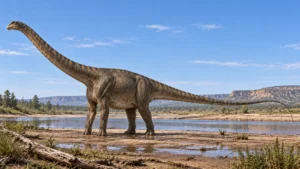
YPM 1980, the holotype of B. excelsus, preserves substantial postcranial material and provides the principal specimen-specific anatomical basis for reconstructing the species’ locomotor system. Tschopp, Mateus, and Benson identified YPM 1980 as the genoholotype of Brontosaurus excelsus and included it in their specimen-level analysis of Diplodocidae.
The more difficult question is how those limbs were coordinated during movement.
A fossil skeleton does not preserve an ordinary walking sequence. Locomotor reconstruction therefore combines preserved anatomy with functional interpretation, biomechanical modelling and, where appropriate, trace-fossil evidence. These evidence classes provide different kinds of information and should not be treated as equivalent.
Quadrupedal Locomotion
The four-limbed locomotor configuration of B. excelsus is consistent with the established sauropod body plan. The skeletal evidence provides the basis for interpreting the forelimbs and hind limbs as the principal weight-bearing limbs.
This conclusion is considerably stronger than more specific claims about gait or speed.
Biomechanical studies of dinosaurs have shown that locomotor performance can be investigated from limb proportions, body dimensions, dynamic similarity, and mechanical constraints. Earlier analyses of dinosaur locomotion generally concluded that most quadrupedal dinosaurs were restricted to walking gaits, while later biomechanical approaches have explored a broader range of mechanically possible movements.
For very large sauropods, body mass and limb mechanics impose substantial constraints on locomotion. These constraints make conventional mammal-like running with a prolonged aerial phase particularly problematic for giant sauropods.
This does not establish one precise gait for B. excelsus. Quadrupedal locomotion identifies the broad locomotor mode; it does not specify one universal footfall sequence or movement pattern.
Limb Anatomy and Weight Support
The limbs of B. excelsus formed the principal skeletal system for supporting and moving the body.
The preserved anatomy can be used to investigate:
- limb proportions;
- joint arrangement;
- forelimb and hind-limb contribution;
- mechanical leverage;
- potential joint motion;
- force transmission through the limbs.
Some of these are direct observations of fossil anatomy. Others are functional interpretations or biomechanical reconstructions.
A preserved joint surface, for example, demonstrates the morphology of the joint but does not directly record the precise position in which that joint was held during ordinary walking.
Biomechanical studies can test possible limb configurations and loading conditions, but their conclusions depend on assumptions about body mass, joint range, muscle properties, soft tissues, and other variables.
Foot Anatomy and Foot–Ground Interaction
Sauropod feet consisted of distinct forefeet, or manus, and hind feet, or pes. Their morphology and the relationship between manus and pes are important for reconstructing how sauropods interacted with the substrate.
Fossil trackways provide an additional source of information because they record actual foot–substrate interactions. Track morphology can preserve information about foot placement, stride, trackway geometry, and the relationship between manus and pes.
However, the connection between a particular trackway and a particular sauropod species is often uncertain.
A detailed study of articulated Camarasaurus feet demonstrated why this problem is difficult. Complete articulated fore- and hind feet are rare in sauropod skeletons, and the authors concluded that assigning footprints to genus- or species-level taxa is generally problematic. This is comparative sauropod evidence, not direct evidence that the tracks discussed were made by B. excelsus.
Consequently, Morrison Formation footprints should not automatically be labelled Brontosaurus excelsus footprints.
Gait Reconstruction
Gait describes the temporal sequence and coordination of limb movements during locomotion.
That sequence is not normally preserved in a dinosaur skeleton. Researchers therefore use anatomical constraints, biomechanical models and trackway geometry to investigate possible gaits.
Computer-based gait reconstruction can test large numbers of possible limb movements and identify mechanically plausible solutions. Such models are useful because they allow researchers to investigate locomotor hypotheses that cannot be tested directly on fossils.
However, a mechanically plausible gait is not necessarily the gait that the living animal routinely used.
The distinction can be expressed as:
preserved anatomy → functional interpretation → biomechanical model → mechanically plausible gait
Each step introduces additional assumptions.
For B. excelsus, the evidence therefore supports the broad quadrupedal locomotor configuration much more securely than it supports one specific named gait.
Trackways and Trace-Fossil Evidence
The Morrison Formation preserves numerous dinosaur track sites, including sauropod trackways. At Dinosaur Ridge, for example, documented Morrison Formation track assemblages include sauropod tracks and manus–pes sets from quadrupedal trackmakers.
Trackways can provide information about:
- stride length;
- pace length;
- track orientation;
- manus–pes relationships;
- trackway gauge;
- changes in stride;
- turning;
- substrate interaction.
Modern ichnological terminology distinguishes measurements such as pace and stride and provides standardized terminology for describing trackways and individual tracks.
Trackways are particularly valuable because they record activity rather than merely anatomy. They can therefore provide information that is difficult or impossible to obtain from isolated bones.
Trackmaker attribution
The principal limitation is identifying the animal that produced a particular trackway.
A Morrison Formation sauropod trackway demonstrates sauropod locomotion, but it does not automatically demonstrate locomotion by Brontosaurus excelsus. The Morrison Formation contained multiple sauropod taxa, and the morphological overlap among large sauropod feet and tracks can complicate taxonomic attribution.
Historical references to tracks as Apatosaurus or “Brontosaurus” therefore should not automatically be treated as secure species-level identifications.
For ExtinctAtlas purposes, a Morrison sauropod trackway is best used as comparative sauropod locomotor evidence unless a specific species attribution is independently supported.
Speed Estimates
Speed cannot be directly measured for an extinct dinosaur.
One established approach uses relationships among stride length, limb length, and dynamic similarity to estimate speed from fossil trackways. Alexander’s work on dinosaur speeds used relationships derived from living animals to estimate dinosaur locomotor performance. Such calculations necessarily carry uncertainty because the underlying relationships are not direct measurements of extinct animals.
Biomechanical models provide another approach. They can estimate mechanically possible speeds from body dimensions, limb proportions, gait assumptions, and other parameters.
Published biomechanical discussions have also considered Apatosaurus. Alexander (2006), for example, reported a calculated value of approximately 9 m/s, or about 32 km/h, for a hypothetical Apatosaurus under a specified dynamic-similarity comparison with an elephant.
This figure should not be presented as a measured speed or species-specific maximum speed for Brontosaurus excelsus.
The distinction is essential:
A model-derived value for Apatosaurus under specified assumptions is not a demonstrated maximum speed for B. excelsus.
Likewise, a calculated maximum should not be interpreted as the animal’s normal travelling speed.
What the Fossils Establish
Directly Supported
The fossil record provides strong support for:
- a large sauropod postcranial body plan;
- substantial forelimb and hind-limb skeletal systems;
- a quadrupedal weight-bearing configuration;
- specialized sauropod manus and pes anatomy;
- skeletal proportions that can be incorporated into locomotor models.
YPM 1980 provides the principal specimen-specific anatomical basis for B. excelsus locomotion.
Supported at Broader Sauropod Level
Morrison Formation trackways provide direct trace-fossil evidence that sauropods walked across the landscapes represented by those sediments.
They can preserve information about:
- foot placement;
- stride;
- pace;
- gauge;
- turning;
- manus–pes relationships;
- substrate interaction.
However, these traces should generally be treated as broader sauropod evidence, rather than automatically as species-specific evidence for B. excelsus.
What Scientists Infer
Combining skeletal anatomy, comparative sauropod evidence and biomechanical modelling allows scientists to investigate:
- how the limbs could have supported the body;
- how the limbs may have moved through available joint ranges;
- how forces may have been transmitted through the limbs;
- which gait patterns were mechanically feasible;
- how stride length relates to possible speed;
- how sauropod feet interacted with different substrates.
These are inferences rather than direct observations of a living Brontosaurus.
Biomechanical models are particularly useful for testing competing locomotor hypotheses. At the same time, their results depend on assumptions concerning factors such as body mass, joint mobility, muscle properties, soft tissues, and neuromuscular control.
Different assumptions can therefore produce different mechanically plausible solutions.
What Remains Uncertain
Exact Gait
The available evidence does not establish one universally accepted gait sequence for ordinary walking by B. excelsus.
Exact Walking Speed
There is no directly measured species-specific walking speed. Published estimates depend on assumptions concerning body size, limb length, stride, and dynamic similarity.
Maximum Speed
A theoretical biomechanical maximum is not equivalent to demonstrated behaviour. A secure species-specific maximum speed has not been established.
Running
There is no secure species-specific evidence demonstrating conventional running by B. excelsus. Biomechanical work on giant sauropods places substantial constraints on running and high-speed locomotion.
This should not be converted into the stronger claim that running was physically impossible under every conceivable condition.
Trackway Identity
Morrison Formation sauropod tracks provide valuable evidence for sauropod locomotion, but individual trackways generally cannot be assigned confidently to B. excelsus solely because they occur in the Morrison Formation.
Exact Foot Mechanics
Footprints record interactions between feet and substrates, but their final morphology can also be affected by sediment properties, foot kinematics, and post-formational alteration. Consequently, a footprint should not be treated as a simple cast of the anatomical foot.
Evidence Assessment
The evidence provides strong support for the basic quadrupedal locomotor configuration of Brontosaurus excelsus. The postcranial skeleton, particularly the limb system, provides the principal specimen-specific anatomical foundation for this interpretation.
Evidence becomes progressively less direct when reconstructing the mechanics of movement. Limb function involves anatomical interpretation; gait requires biomechanical reconstruction; and speed estimates introduce additional assumptions concerning stride, body dimensions, and dynamic similarity.
Morrison Formation trackways provide direct trace-fossil evidence for sauropod foot–ground interaction. They can inform stride, gauge, foot placement and other aspects of locomotion, but their species-level attribution is generally much less secure.
The overall evidence therefore supports a hierarchy of confidence:
highest confidence: broad quadrupedal locomotor configuration;
intermediate confidence: general limb and foot function and broader sauropod locomotor mechanics;
lower confidence: exact gait, stride, locomotor speed and detailed foot mechanics;
unresolved in many cases: species-specific trackway attribution and an exact maximum speed for B. excelsus.
Evidence Strength
| Claim / topic | Evidence basis | Evidence strength | Principal limitation |
|---|---|---|---|
| Quadrupedal locomotion | Postcranial anatomy and sauropod body plan | Strong | Exact gait sequence is not preserved |
| Limb weight support | Preserved limb anatomy plus functional interpretation | Strong to moderate | Detailed loading is reconstructed |
| General foot–ground interaction | Sauropod foot anatomy and trackways | Moderate | Trackmaker identity is often uncertain |
| Limb function | Anatomy plus biomechanical analysis | Moderate | Model assumptions affect functional reconstruction |
| General gait mechanics | Anatomy and biomechanical modelling | Moderate | Multiple mechanically plausible solutions may exist |
| Exact gait pattern | Biomechanical modelling | Limited | No directly preserved limb sequence |
| Locomotor speed | Trackway and biomechanical methods | Limited | Depends on measurements and model assumptions |
| Maximum speed | Biomechanical modelling | Limited to uncertain | No direct species-specific observation |
| B. excelsus trackway attribution | Morrison Formation sauropod tracks | Unresolved in general | Trackways cannot usually be securely assigned to species |
| Conventional running | Comparative giant-sauropod biomechanics | Uncertain | No secure species-specific evidence |
Evidence Hierarchy for Locomotion
| Evidence type | What it can establish | Evidence class |
|---|---|---|
| Preserved limb anatomy | Limb structure and proportions | Direct observation |
| Functional anatomy | Likely mechanical role of anatomical structures | Anatomical inference |
| Biomechanical modelling | Mechanically feasible movement patterns | Model-dependent inference |
| Sauropod trackways | Actual foot–substrate interaction and trackway geometry | Direct trace evidence |
| Trackway-based speed | Approximate locomotor speed under stated assumptions | Model-dependent inference |
| Species-specific trackway attribution | Whether a particular trackway was made by B. excelsus | Generally unresolved |
| Exact routine gait | The precise gait normally used by B. excelsus | Uncertain |
| Exact maximum speed | Species-specific top speed | Uncertain |
Scientific Interpretation & Uncertainty
The locomotion of Brontosaurus excelsus is best reconstructed as a large-bodied quadrupedal sauropod locomotor system, rather than as a precisely known sequence of movements.
The skeletal anatomy provides the strongest foundation. YPM 1980 preserves the postcranial anatomy necessary to establish the broad locomotor configuration, while biomechanical analysis can test how such a limb system may have functioned under the constraints imposed by a very large body.
Trackways provide an independent line of evidence for sauropod foot placement and interaction with the substrate, but their value must be separated from the question of species identity.
The evidence becomes progressively more inferential along the sequence:
anatomy → functional interpretation → biomechanical modelling → gait → speed
Consequently, the statement that Brontosaurus was a quadrupedal sauropod is much better supported than a statement specifying its exact gait, stride, routine speed or maximum speed.
Morrison Formation sauropod trackways should likewise not be treated as automatically belonging to B. excelsus. They are valuable evidence for sauropod locomotion, but species-level attribution requires additional evidence.
Frequently Asked Questions
Did Brontosaurus walk on four legs?
Yes. Its postcranial anatomy supports a quadrupedal locomotor configuration in which both forelimbs and hind limbs contributed to weight support and movement. The precise mechanics of that locomotion are less certain.
How did Brontosaurus walk?
It moved using all four weight-bearing limbs. The exact coordination of those limbs during ordinary walking is reconstructed from anatomy and biomechanical modelling rather than directly preserved.
How fast could Brontosaurus move?
There is no directly measured species-specific speed. Dinosaur-speed estimates can be derived from trackway measurements, body proportions and biomechanical models, but these estimates depend on assumptions and should not be presented as measured speeds.
Could Brontosaurus run?
There is no secure species-specific evidence demonstrating conventional running by B. excelsus. Biomechanical studies of giant sauropods place substantial constraints on high-speed locomotion, but this should not be interpreted as proof that every form of faster-than-walking movement was impossible.
Did Brontosaurus leave Morrison Formation trackways?
Sauropod trackways are well documented from the Morrison Formation, including quadrupedal manus–pes trackways. However, a Morrison Formation sauropod trackway cannot automatically be identified as B. excelsus. Species-level trackmaker attribution is generally difficult.
How were Brontosaurus feet used during walking?
The manus and pes functioned as weight-bearing structures during quadrupedal locomotion. Their detailed loading patterns and foot mechanics are reconstructed from anatomy, comparative sauropod evidence, and trackways rather than directly observed.
References
- Tschopp, E., Mateus, O. & Benson, R. B. J. (2015). A specimen-level phylogenetic analysis and taxonomic revision of Diplodocidae (Dinosauria, Sauropoda). PeerJ, 3, e857.
- Alexander, R. McN. (1982). Speeds and gaits of dinosaurs. Palaeogeography, Palaeoclimatology, Palaeoecology, 38(3–4), 227–256. DOI: 10.1016/0031-0182(82)90005-0.
- Alexander, R. McN. (2006). Dinosaur biomechanics. Proceedings of the Royal Society B: Biological Sciences, 273(1596), 1849–1855. DOI: 10.1098/rspb.2006.3532.
- Sellers, W. I., Manning, P. L., Lyson, T., Stevens, K. & Margetts, L. (2009). Virtual palaeontology: Gait reconstruction of extinct vertebrates using high-performance computing. Palaeontologia Electronica, 12(3), 11A.
- Tschopp, E., Wings, O., Frauenfelder, T. & Brinkmann, W. (2015). Articulated bone sets of manus and pedes of Camarasaurus (Sauropoda, Dinosauria). Palaeontologia Electronica, 18(2), 44A, 1–65. DOI: 10.26879/559.
- Lockley, M. G., McCrea, R. T. & Buckley, L. G. (2015). A review of dinosaur track occurrences from the Morrison Formation in the type area around Dinosaur Ridge. Palaeogeography, Palaeoclimatology, Palaeoecology, 433, 10–19. DOI: 10.1016/j.palaeo.2015.05.018.
- Lallensack, J. N., Leonardi, G. & Falkingham, P. L. (2025). Glossary of fossil tetrapod tracks. Palaeontologia Electronica, 28(1), a8. DOI: 10.26879/1389.
Recommended Paleontology & Natural History Books
As an Amazon Associate, Extinct Atlas may earn from qualifying purchases.
The Rise and Fall of the Dinosaurs
A compelling history of dinosaurs, tracing their origins, diversification, 200-million-year reign, extinction, and enduring legacy.
Dinosaurs and Prehistoric Life
A richly illustrated visual reference exploring dinosaurs, fossils, evolution, and prehistoric life across geological time.
Encyclopedia Prehistorica: Dinosaurs
An interactive dinosaur book featuring spectacular three-dimensional pop-ups, particularly suited to young readers and families.
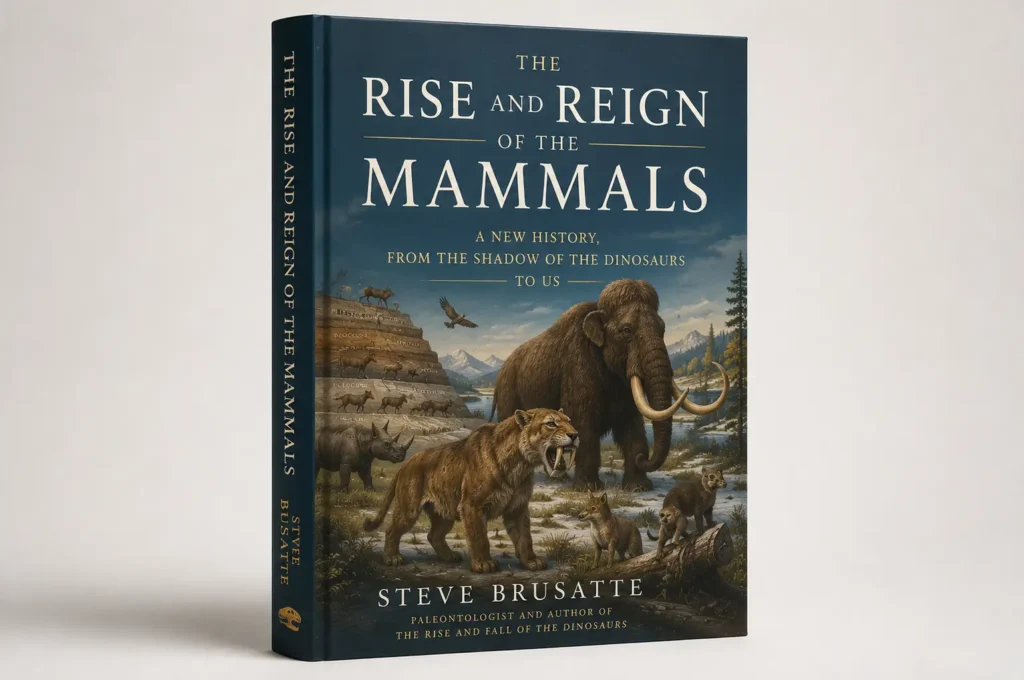
The Rise and Reign of the Mammals
A sweeping history of mammalian evolution, from their origins alongside dinosaurs through the Cenozoic and the emergence of humans.