

Quick Answer
Brontosaurus excelsus was a long-necked, four-legged diplodocoid sauropod that lived during the Late Jurassic and is known from the Morrison Formation of western North America. Its substantial skeletal record supports strong anatomical treatment. The species was historically classified as Apatosaurus excelsus, but specimen-level phylogenetic work published in 2015 supported recognizing Brontosaurus as a separate genus, a treatment continued by recent specialist syntheses.
Scientific Quick Facts
| Field | Current assessment | Evidence / qualification |
|---|---|---|
| Scientific name | Brontosaurus excelsus | Currently treated as a valid species of Brontosaurus in recent specialist syntheses |
| Historical name | Apatosaurus excelsus | Important historical treatment; older sources may still use it |
| Geological age | Late Jurassic | Based on its geological occurrence |
| Fossil setting | Morrison Formation, western North America | Formation-level context; exact local habitat requires caution |
| Holotype | YPM 1980 | Substantial skeletal material |
| Anatomical evidence | High confidence | Direct skeletal evidence, with reconstruction required for incomplete elements |
| Body length | Reconstructed estimate | Moderate confidence; avoid false precision |
| Body mass | Model-dependent estimate | Low–moderate confidence; no single authoritative value |
| Locomotion | Quadrupedal | Anatomical/functional inference |
| Maximum speed | Not definitively established | Biomechanical estimates are assumption-dependent |
| Diet | Herbivorous | More precise dietary composition is less certain |
| Behavior | Poorly constrained | Direct behavioral evidence is lacking |
| Coloration | Unknown | No established species-specific direct evidence |
| Species-specific extinction cause | Not established | Evidence is insufficient for a definitive causal account |
What was Brontosaurus?
Brontosaurus excelsus belonged to the diplodocoid sauropods, a group of long-necked, long-tailed dinosaurs. Its anatomy is known well enough to support detailed skeletal study, although its fossil record is not complete in every respect.
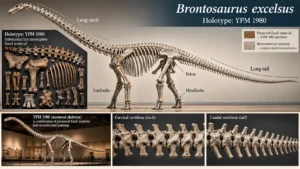
The holotype, YPM 1980, is particularly important. It provides substantial skeletal evidence, but its mounted reconstruction should not be interpreted as a completely preserved skeleton. The specimen was extensively reconstructed before mounting, meaning that some elements represented in the reconstruction are reconstructed rather than directly preserved.
That distinction is fundamental to interpreting what is known about the animal.
When and where did Brontosaurus live?
Brontosaurus excelsus is associated with the Morrison Formation of western North America and lived during the Late Jurassic.
The Morrison Formation should not be treated as a single uniform environment. It represents environments that varied geographically and through time. Formation-level evidence therefore provides useful context for understanding the world in which B. excelsus lived, but it does not automatically establish the precise habitat of every individual specimen.
Fossils and discovery
The holotype YPM 1980 provides substantial evidence for the species’ skeletal anatomy and is central to its scientific history.
The specimen also illustrates why fossil reconstruction requires care. A substantial fossil can still contain missing or incomplete elements, and a mounted skeleton can combine directly preserved material with reconstruction.
Consequently, visual representations of Brontosaurus should not automatically be interpreted as photographs of the animal’s complete original skeleton.
Anatomy
The skeleton shows the characteristic sauropod combination of a large body, elongated neck, long tail, and four weight-bearing limbs.
Direct skeletal evidence provides the strongest basis for anatomical statements. Reconstructed elements require a different evidentiary treatment, particularly when missing structures are supplied through comparative evidence.
The skull requires particular caution because direct species-level evidence is insufficient for some aspects of its reconstruction.
For detailed treatment of the preserved skeleton, reconstructed elements, and anatomical interpretation, see Brontosaurus Anatomy and Skeleton.
What did Brontosaurus eat?
The evidence supports interpreting Brontosaurus excelsus as a herbivorous sauropod.
More detailed claims about exactly what plants it consumed or precisely how it fed are less secure. Broader evidence from other Morrison sauropods can provide context, but it should not silently be transferred to B. excelsus as direct species-specific evidence.
How did Brontosaurus move?
Its anatomy supports a quadrupedal locomotor interpretation.
Skeletal morphology and biomechanical modelling can be used to investigate locomotion, but they do not provide direct observations of performance. In particular, a definitive maximum speed cannot be established from the available evidence.
Speed estimates therefore need to be presented as model-dependent or inferential rather than as a measured species-specific maximum.
How big was Brontosaurus?

The overall dimensions of Brontosaurus are reconstructed rather than measured from a completely preserved whole skeleton.
YPM 1980 is an important specimen for reconstruction, but its extensive reconstruction history means that whole-body dimensions should not be presented as direct fossil measurements.
Body length can appropriately be discussed using a qualified estimate or range. Body mass is more uncertain, because estimates depend on reconstructed body volume and modelling assumptions such as density. Different methods can consequently produce different results.
For the detailed evidence behind size and mass estimates, see How Big Was Brontosaurus? Size, Mass, and Reconstruction.
Why is it called Brontosaurus?
The species has a long nomenclatural history.
It was historically treated as Apatosaurus excelsus, which explains why older scientific literature and public-facing sources may use that name.
In 2015, a specimen-level phylogenetic analysis supported recognizing Brontosaurus as a separate genus. Subsequent specialist synthesis has continued to list B. excelsus as a valid species.
The historical Apatosaurus treatment remains important context, however, and institutional or secondary usage is not completely uniform. Current treatment and historical nomenclature should therefore be distinguished rather than presented as though there had never been a taxonomic dispute.
For the full history, see Brontosaurus and Apatosaurus: Taxonomy and Naming.
What remains uncertain?
The scientific record for Brontosaurus excelsus is strong but uneven across different biological questions.
Relatively well supported
- Taxonomic identity
- Substantial skeletal anatomy
- Geological occurrence
- Herbivorous feeding mode
More reconstruction- or inference-dependent
- Whole-body dimensions
- Body mass
- Locomotor performance
- Detailed feeding strategy
- Fine-scale paleoecology
Poorly constrained
- Detailed behavior and sociality
- Reproduction
- Physiology
- Soft-tissue anatomy
Not established
- Species-specific coloration
- A definitive species-specific cause of extinction
These distinctions are important because a well-known fossil skeleton can create an impression that every aspect of the animal’s biology is equally well understood. It is not.
Why is Brontosaurus scientifically important?
Brontosaurus excelsus is significant both as a sauropod and as a case study in changing dinosaur taxonomy.
Its substantial skeletal record permits detailed anatomical investigation, while its taxonomic history demonstrates how new specimen-level analyses can change interpretations of long-established names. Its reconstruction history also illustrates a broader scientific principle: the presence of a substantial fossil record does not eliminate uncertainty when researchers reconstruct missing anatomy or estimate whole-body properties.
The species therefore provides a useful combination of relatively strong anatomical evidence and clearly identifiable scientific uncertainty.
Frequently Asked Questions
Is Brontosaurus the same as Apatosaurus?
Brontosaurus excelsus was historically treated as Apatosaurus excelsus. Current specialist treatments generally recognize B. excelsus as a valid species of Brontosaurus, while the historical Apatosaurus treatment remains important when interpreting older literature.
What did Brontosaurus eat?
It was a herbivorous sauropod. More specific claims about dietary composition or feeding strategy are less certain.
How did Brontosaurus move?
Its anatomy supports quadrupedal locomotion. More specific claims about locomotor performance, particularly maximum speed, remain inferential.
How big was Brontosaurus?
Its whole-body dimensions are reconstructed estimates rather than direct measurements of a completely preserved skeleton. Body mass is especially model-dependent, so estimates should retain their methodological qualifications.
Where did Brontosaurus live?
It is known from the Morrison Formation of western North America. The formation represents environmentally heterogeneous settings, so it should not be treated as one uniform habitat.
What color was Brontosaurus?
Its species-specific coloration is unknown. An artistic reconstruction may choose a color scheme, but that choice should not be presented as scientifically established coloration.
Evidence and Sources
The taxonomic treatment of Brontosaurus excelsus is based on specimen-level phylogenetic analysis and subsequent specialist synthesis. The principal anatomical evidence comes from the substantial holotype material, YPM 1980, while recognizing that portions of the mounted skeleton were reconstructed.
The discussion of body size and mass distinguishes direct fossil evidence from reconstructed dimensions and model-dependent estimates. Morrison Formation evidence is used as formation-level ecological context rather than as evidence for a single uniform habitat or a fully resolved species-specific environment.
Evidence Note
The strongest evidence concerns the taxonomic identity and skeletal anatomy of Brontosaurus excelsus. Confidence is lower for reconstructed whole-body dimensions, body mass, locomotor performance, behavior, and fine-scale ecology because these require increasing levels of reconstruction, modelling, or inference.
Species-specific coloration and a definitive species-specific cause of extinction are not established by the available evidence.
References
Tschopp, E., Mateus, O., & Benson, R. B. J. (2015).
“A specimen-level phylogenetic analysis and taxonomic revision of Diplodocidae (Dinosauria, Sauropoda).” PeerJ, 3, e857. DOI: 10.7717/peerj.857.
Principal source for the specimen-level taxonomic assessment of Brontosaurus excelsus and the anatomical and reconstruction context of YPM 1980.
Upchurch, P., Mannion, P. D., & Taylor, M. P. (2013).
“Caudal pneumaticity in sauropod dinosaurs.” PLoS ONE, 8(10), e78213. DOI: 10.1371/journal.pone.0078213.
Provides additional anatomical evidence concerning pneumatic features in sauropod caudal vertebrae, including observations relevant to YPM 1980.
Sellers, W. I., Margetts, L., Coria, R. A., & Manning, P. L. (2013).
“March of the Titans: The Locomotor Capabilities of Sauropod Dinosaurs.” PLoS ONE, 8(10), e78733. DOI: 10.1371/journal.pone.0078733.
🦷 Anatomy


Recommended Paleontology & Natural History Books
As an Amazon Associate, Extinct Atlas may earn from qualifying purchases.
The Rise and Fall of the Dinosaurs
A compelling history of dinosaurs, tracing their origins, diversification, 200-million-year reign, extinction, and enduring legacy.
Dinosaurs and Prehistoric Life
A richly illustrated visual reference exploring dinosaurs, fossils, evolution, and prehistoric life across geological time.
Encyclopedia Prehistorica: Dinosaurs
An interactive dinosaur book featuring spectacular three-dimensional pop-ups, particularly suited to young readers and families.
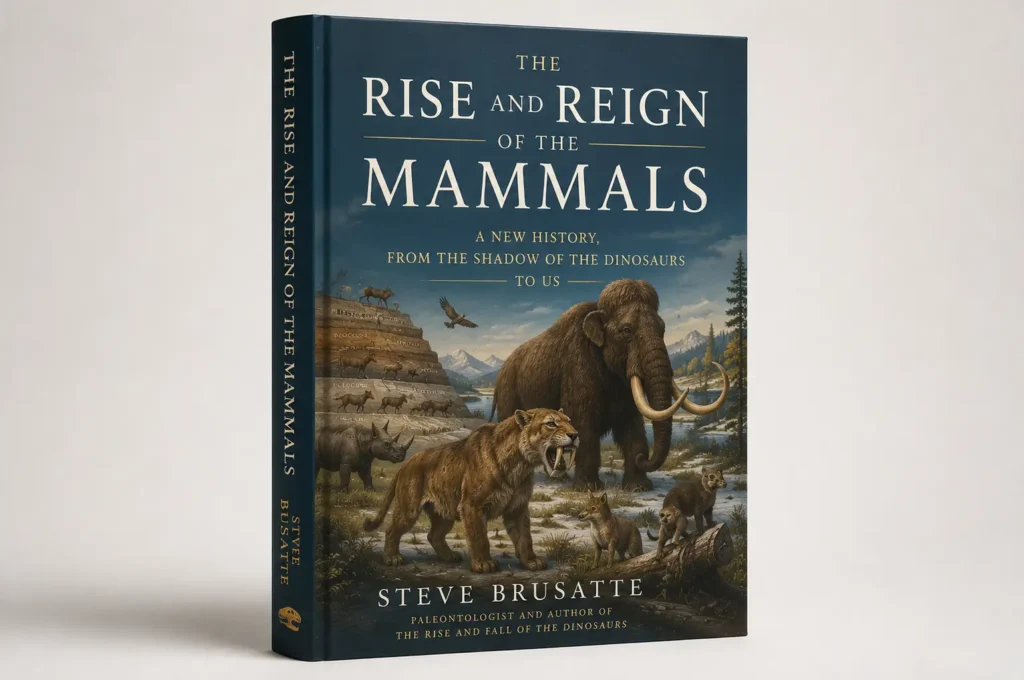
The Rise and Reign of the Mammals
A sweeping history of mammalian evolution, from their origins alongside dinosaurs through the Cenozoic and the emergence of humans.