

Quick Answer
Brontosaurus excelsus was a very large sauropod, but its exact whole-body dimensions and mass were not directly measured from a complete fossil skeleton. The holotype, YPM 1980, provides substantial skeletal evidence, but the specimen was incomplete and extensively reconstructed before mounting.
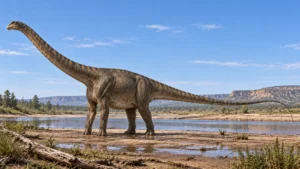
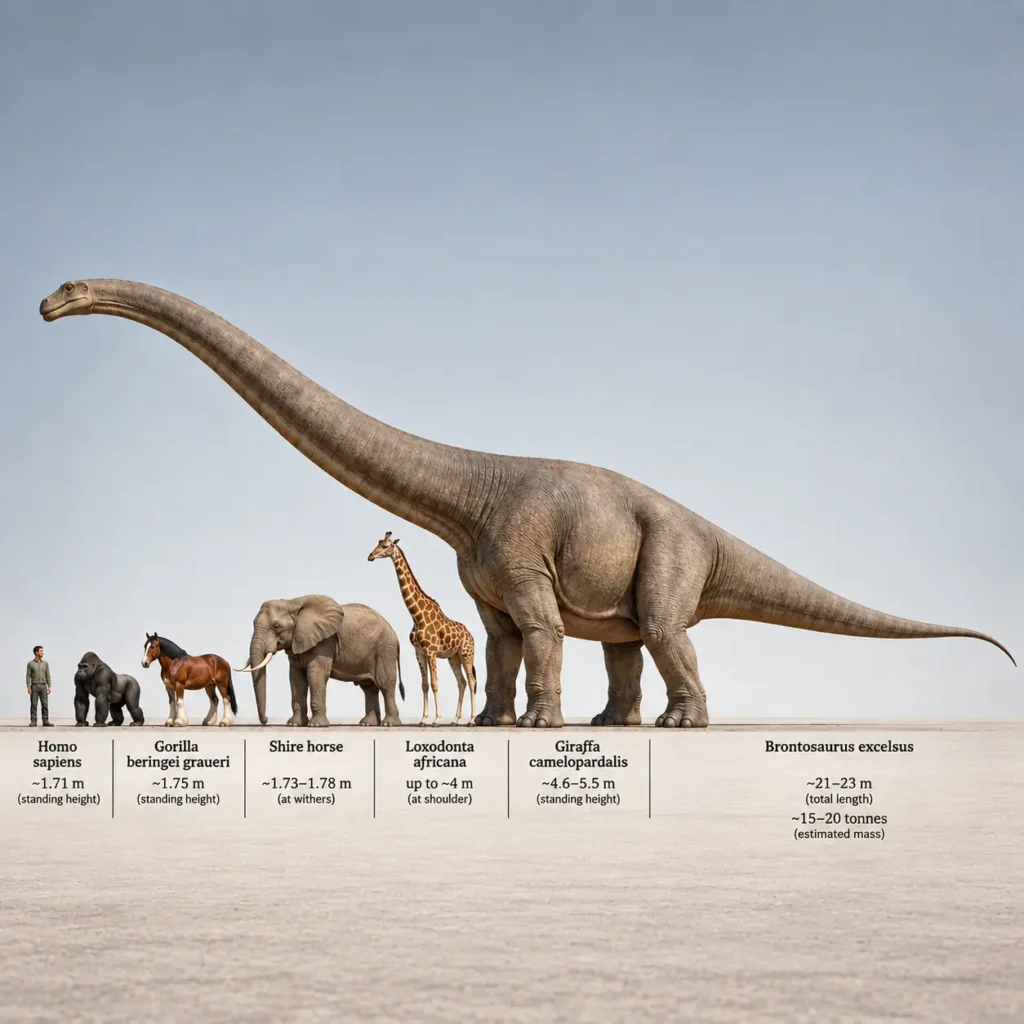
Published estimates commonly place B. excelsus at roughly 21–22 metres in length, while published mass estimates vary substantially depending on reconstruction and modelling method. A commonly cited reconstruction-based mass range is approximately 15–31 tonnes, but the upper end should not be treated as a species-wide measured value or as a uniquely authoritative estimate.
The safest scientific summary is therefore: about 21–22 m in reconstructed length, with mass considerably more model-dependent and uncertain.
Scientific Evidence and Estimate Table
| Quantity | Evidence basis | Estimate type | Confidence | Principal uncertainty |
|---|---|---|---|---|
| Body length | YPM 1980 and reconstructed skeletal proportions | Approximately 21–22 m | Moderate | Incomplete skeleton and reconstruction choices |
| Body mass | Reconstructed body dimensions plus mass-estimation methods | Approximately 15–31 t in cited estimates | Low–moderate | Body volume, density, reconstruction and modelling assumptions |
| Skeletal evidence | Holotype YPM 1980 | Substantial preserved material | High | The mounted skeleton includes extensive reconstruction |
| Whole-body measurement | Reconstructed animal rather than complete fossil | Model/reconstruction dependent | Moderate | Missing or reconstructed elements |
| Exact mass | No direct fossil measurement | Not established | Low | Living body volume and density are not directly preserved |
| Maximum speed | Biomechanical inference | Not established here | Low | Morphology does not directly record maximum performance |
The length estimate of approximately 21–22 m is consistent with commonly cited reconstructions of YPM 1980. The wider 15–31 tonne mass range reflects the fact that body-mass estimates can differ according to modelling approach; it should not be read as a measured biological range.
What do we actually know about Brontosaurus size?
The fossil record provides a substantial skeletal basis for reconstructing the size of Brontosaurus excelsus, but it does not provide a direct measurement of a completely preserved living animal.
Individual preserved bones can be measured directly. A whole-body length requires researchers to reconstruct incomplete portions, establish the relationships among skeletal elements, and restore missing anatomy.
YPM 1980 is particularly important because it is the holotype and preserves substantial skeletal material. However, Tschopp and colleagues noted that it was extensively reconstructed before being mounted. Later examination has likewise documented substantial plaster restoration in the mount.
Consequently, a value such as 21–22 m should be understood as a reconstruction-based estimate, not as a tape-measure measurement of a complete fossil.
Why is length an estimate?
A complete animal cannot be measured directly when its skeleton is incomplete.
Researchers must reconstruct missing portions, establish anatomical proportions, and determine how the skeletal elements relate to one another. Different reconstruction choices can consequently produce somewhat different whole-body dimensions.
The approximately 21–22 m figure is therefore best treated as a qualified estimate associated with a particular reconstruction, rather than an immutable species measurement.
This distinction matters because apparent numerical precision can obscure the interpretive steps between fossil and whole-body measurement.
Why is body mass harder?
Mass requires another major step beyond skeletal dimensions.
A reconstructed skeleton does not directly preserve the volume of the living animal. Researchers must estimate body volume and then apply assumptions about body density and composition.
Mass-estimation studies use quantitative methods to infer dinosaur body mass from anatomical measurements and models. Benson and colleagues, for example, incorporated dinosaur mass estimates into a large comparative analysis of dinosaur body-mass evolution, illustrating that such values are model-derived estimates rather than direct fossil measurements.
For B. excelsus, cited estimates include values around 15 tonnes and broader published estimates extending to approximately 31 tonnes, depending on the source and method. The difference should be preserved rather than collapsed into one apparently definitive number.
Why can published mass estimates differ?
Different estimates can result from differences in:
- reconstructed skeletal proportions;
- body shape and soft-tissue outlines;
- estimated body volume;
- density assumptions;
- treatment of pneumatic or air-filled spaces;
- and the particular mass-estimation method used.
This is why a mass estimate is not simply “read off” the fossil.
The correct scientific question is not merely “How much did Brontosaurus weigh?” but “What reconstruction and modelling assumptions produced this mass estimate?”
What does YPM 1980 tell us?
YPM 1980 is the holotype of Brontosaurus excelsus and provides substantial skeletal evidence.
Tschopp et al. described it as the specimen from which the first published reconstruction of an entire sauropod skeleton was produced, while also noting that the skeleton had been extensively reconstructed before mounting.
That reconstruction history is directly relevant to quantitative interpretation.
The mounted skeleton should therefore not be treated as though every visible element were an original fossil. Later examination has also documented plaster restoration obscuring or supplementing genuine osteological features in parts of the mount.
Preserved versus reconstructed anatomy
| Evidence category | Meaning for size reconstruction |
|---|---|
| Directly preserved material | Provides primary skeletal measurements and anatomical constraints |
| Incomplete preserved material | Requires reconstruction to establish whole-body dimensions |
| Reconstructed skeletal elements | Contribute to a whole-body model but are not direct fossil measurements |
| Comparative reconstruction | Uses related taxa to interpret missing anatomy and must remain identified as comparative |
| Volumetric model | Converts reconstructed body geometry into an estimate of body volume |
| Mass model | Applies assumptions such as density to estimate body mass |
The progression is therefore:
fossil evidence → skeletal reconstruction → body-dimension estimate → volumetric reconstruction → mass estimate
Each step introduces additional assumptions.
What is the best-supported length estimate?
A practical reader-facing estimate is approximately 21–22 metres from head to tail.
That range is preferable to presenting 22 m as an exact measurement because it preserves the fact that the value comes from reconstruction. Published summaries specifically give B. excelsus at approximately 21–22 m, while other secondary compilations cite 22 m for the YPM 1980 reconstruction.
The estimate should therefore be written as:
about 21–22 metres, based on reconstruction of incomplete skeletal material.
rather than:
exactly 22 metres long.
What is the best-supported mass estimate?
Mass is less secure.
A commonly cited value is around 15 tonnes, while another compilation associated with YPM 1980 gives a broader 15–31 tonne range. These values should not be treated as equivalent measurements: they represent different levels of modelling and estimation uncertainty.
The scientifically safest wording is:
Published mass estimates are roughly in the 15-tonne range at the lower end, with some cited reconstructions extending to about 31 tonnes; the spread reflects modelling and reconstruction assumptions.
The 15–31 tonne figure is therefore a cited estimate range, not a directly observed biological range.
Why should the mass range not be averaged?
A numerical average can create false precision.
Suppose two estimates differ because one reconstruction assumes a different body volume or density from another. Averaging them does not necessarily create a scientifically superior estimate. It may simply produce a number that corresponds to neither model.
For that reason, the preferred approach is to preserve the methodological provenance of each estimate.
How should a size estimate be evaluated?
| Question | Why it matters |
|---|---|
| What specimen provides the basis? | Establishes the fossil evidence |
| How complete is the specimen? | Determines how much reconstruction is required |
| Which elements are reconstructed? | Reveals where interpretation enters the estimate |
| How was the body reconstructed? | Different geometries can produce different dimensions |
| How was mass calculated? | Volume and density assumptions affect the result |
| Is the result a range or single value? | A range can better represent uncertainty |
| Are competing estimates preserved? | Prevents methodological differences from disappearing |
| Does the source distinguish measurement from reconstruction? | Helps prevent false precision |
What remains uncertain?
The principal uncertainty is not whether Brontosaurus was a very large sauropod. Its substantial skeletal evidence makes that clear.
The uncertainty concerns the quantitative boundaries of its body size.
Length is comparatively better constrained because the skeleton supplies direct anatomical dimensions from which a whole-body reconstruction can be built. Mass is less secure because it requires estimating the volume and density of tissues that are not directly preserved.
Thus:
- length: approximately 21–22 m in commonly cited reconstructions;
- mass: roughly 15 t in some estimates, with cited reconstructions extending substantially higher;
- exact mass: not established;
- exact whole-body dimensions: not directly measured from a complete fossil.
Is Brontosaurus’s size known more confidently than its mass?
Yes.
The evidence assessment assigns moderate evidence and confidence to body length, compared with low–moderate evidence and confidence for body mass.
That difference follows directly from the number of modelling steps involved.
Skeletal dimensions constrain body size. Mass requires those dimensions to be converted into a model of the entire living body.
Does the skeleton tell us exactly how large the living animal was?
No.
Individual fossil bones can be measured directly, but a whole-body length is reconstructed from those measurements.
YPM 1980 is particularly important because its mounted skeleton includes extensive reconstruction.
The result is scientifically useful, but it should remain labelled as a reconstruction.
What about comparisons with other dinosaurs?
Comparative size claims require an explicit comparison basis.
It is not enough to place a reconstructed Brontosaurus length or mass beside a value for another dinosaur and declare one animal larger. The underlying specimens, reconstruction methods, definitions, and uncertainty ranges need to be sufficiently comparable.
This is especially important for mass, where methodological differences can be large.
Frequently Asked Questions
How long was Brontosaurus?
Commonly cited reconstructions put Brontosaurus excelsus at approximately 21–22 metres long. This is a reconstructed estimate, not a direct measurement of a completely preserved skeleton.
How much did Brontosaurus weigh?
Published estimates vary. A value around 15 tonnes is commonly cited, while another compilation associated with YPM 1980 gives a broader 15–31 tonne range. These figures are model-dependent and should not be treated as a single authoritative mass.
Why do Brontosaurus size estimates differ?
Because whole-body size must be reconstructed from incomplete skeletal evidence, and mass additionally requires assumptions about body volume and density.
Was YPM 1980 a complete Brontosaurus skeleton?
No. It preserves substantial skeletal material but was extensively reconstructed before mounting.
Is Brontosaurus size directly measured from its fossils?
Individual bones can be measured directly, but whole-body dimensions are reconstructed.
Was Brontosaurus the biggest dinosaur?
That requires a controlled comparison among taxa using comparable specimens and methods. A simple ranking based on isolated published numbers would be misleading.
Is its body mass known precisely?
No. Mass is considerably more model-dependent than skeletal dimensions.
Evidence and Sources
Primary taxonomic and specimen source
Tschopp, E., Mateus, O., & Benson, R. B. J. (2015). “A specimen-level phylogenetic analysis and taxonomic revision of Diplodocidae (Dinosauria, Sauropoda).” PeerJ, 3, e857.
This study provides the specimen-level framework for YPM 1980 and explicitly documents its reconstruction history.
Body-mass methodology and comparative estimates
Benson, R. B. J., Campione, N. E., Carrano, M. T., Mannion, P. D., Sullivan, C., Upchurch, P., & Evans, D. C. (2014). “Rates of Dinosaur Body Mass Evolution Indicate 170 Million Years of Sustained Ecological Innovation on the Avian Stem Lineage.” PLoS Biology, 12(5), e1001853.
This study provides a large comparative dataset of dinosaur body-mass estimates and illustrates the model-dependent nature of such estimates.
Specimen reconstruction and preservation
Published examination of YPM 1980 documents substantial plaster restoration in the mounted specimen, reinforcing the distinction between preserved fossil material and reconstructed anatomy.
Quantitative Evidence Note
The numerical values on this page should be interpreted in the following hierarchy:
preserved skeletal measurements → reconstructed skeletal proportions → whole-body length estimate → reconstructed body volume → mass estimate
The farther a claim moves along that chain, the more modelling assumptions it incorporates.
The 21–22 m length estimate is therefore a qualified reconstruction-based estimate. The 15–31 t mass range is a representation of cited estimates rather than a directly measured biological range. No single exact mass is presented as authoritative.
Source Integrity Note
Reader-facing numerical claims are tied to identifiable scientific or source literature. Internal provenance remains separate from the published article, consistent with the editorial framework’s distinction between audit provenance and reader-facing references.
References
- Tschopp, E., Mateus, O., & Benson, R. B. J. (2015). A specimen-level phylogenetic analysis and taxonomic revision of Diplodocidae (Dinosauria, Sauropoda). PeerJ, 3, e857.
This is the key primary source for Brontosaurus excelsus, YPM 1980, specimen-level anatomy, and the 2015 taxonomic treatment. (Encyklopedia Dinozaury) - Benson, R. B. J., Campione, N. E., Carrano, M. T., Mannion, P. D., Sullivan, C., Upchurch, P., & Evans, D. C. (2014). Rates of dinosaur body mass evolution indicate 170 million years of sustained ecological innovation on the avian stem lineage. PLoS Biology, 12(5), e1001853.
This is an appropriate scientific source for the methodological basis of dinosaur body-mass estimates, rather than using a general website to substantiate mass methodology. (Library and Archives Canada) - Gregory, W. K. (1905). The probable weight of the dinosaur Brontosaurus.
This is historically important because the original volumetric mass-estimation work used a reconstructed Brontosaurus excelsus model. Modern summaries document Gregory’s scale-model and displacement approach. (Palaeontology Online)
Recommended Paleontology & Natural History Books
As an Amazon Associate, Extinct Atlas may earn from qualifying purchases.
The Rise and Fall of the Dinosaurs
A compelling history of dinosaurs, tracing their origins, diversification, 200-million-year reign, extinction, and enduring legacy.
Dinosaurs and Prehistoric Life
A richly illustrated visual reference exploring dinosaurs, fossils, evolution, and prehistoric life across geological time.
Encyclopedia Prehistorica: Dinosaurs
An interactive dinosaur book featuring spectacular three-dimensional pop-ups, particularly suited to young readers and families.
The Rise and Reign of the Mammals
A sweeping history of mammalian evolution, from their origins alongside dinosaurs through the Cenozoic and the emergence of humans.