
Introduction
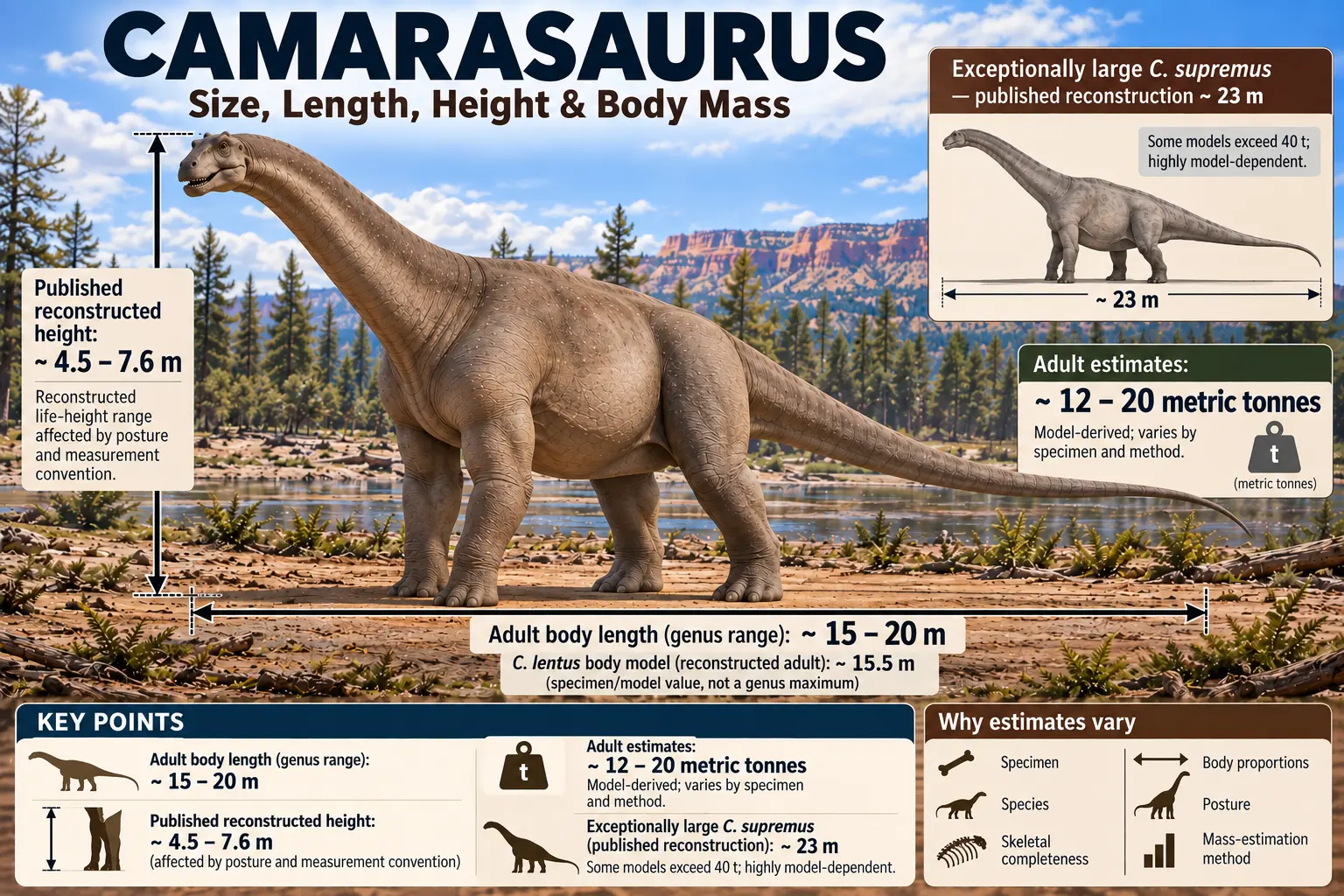
Camarasaurus was a large-bodied sauropod of the Late Jurassic Morrison Formation. Its size is reasonably well constrained compared with many extinct dinosaurs because the genus is represented by numerous skeletons and substantial limb-bone material. However, there is no single scientifically definitive value for its length, height, or body mass.
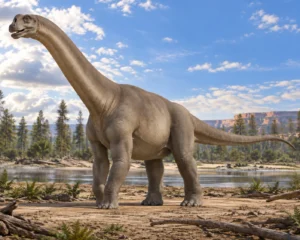
Published estimates differ because researchers have used different specimens, species, body proportions, reconstruction assumptions, and mass-estimation methods. Some estimates describe a particular specimen or species, while others are generalized reference estimates for the genus. These distinctions are important when comparing Camarasaurus with other sauropods.
Quick Facts — Camarasaurus Size
| Feature | Quick answer |
|---|---|
| Geological age | Late Jurassic |
| Typical adult length | Approximately 15–20 m, depending on specimen and species |
| Largest published length estimates | Approximately 23 m for exceptionally large C. supremus reconstructions |
| Estimated height | Approximately 4.5–7.6 m, depending on posture and measurement convention |
| Adult body mass | Published estimates commonly fall around 12–20 metric tonnes for several adult reconstructions |
| Largest published mass estimates | More than 40 metric tonnes in some large-C. supremus reconstructions |
| Evidence for general size | Strong |
| Evidence for exact height | Moderate |
| Evidence for body mass | Moderate |
| Evidence for maximum size | Moderate |
| Important caution | No single length, height, or mass represents every Camarasaurus individual |

At a Glance — Size Estimates
| Measurement | Evidence-based interpretation |
|---|---|
| Body length | Published adult reconstructions commonly fall around 15–20 m, while substantially larger estimates have been proposed for exceptionally large specimens |
| Maximum proposed length | About 23 m has been published for very large Camarasaurus, particularly C. supremus |
| Height | Published estimates commonly fall around 4.5–7.6 m, depending on specimen and definition of height |
| Body mass | Published estimates vary substantially; approximately 12–20 metric tonnes occurs among several adult reconstructions |
| Largest mass estimates | Some reconstructions of C. supremus exceed 40 metric tonnes, but these are model-dependent |
| Quantitative certainty | Length: strong evidence for specimen-scale reconstruction; height and mass: moderate because reconstruction and modelling assumptions affect the result |
Body Length
Body length is one of the most frequently quoted measurements for Camarasaurus, but values should be associated with a specimen, species, or reconstruction whenever possible.
A substantial adult Camarasaurus lentus body model used in biomechanical research has a reconstructed body length of about 15.5 m. This represents a model of a particular adult rather than a maximum for the entire genus.
Other published sources place adult Camarasaurus in a broader range around 15–20 m. General institutional references also commonly describe the genus within approximately this scale.
The upper end becomes more uncertain when Camarasaurus supremus is considered. Large bones attributed to this species indicate that some individuals were considerably larger than the more commonly represented C. lentus. Estimates approaching 23 m have been published for exceptionally large C. supremus, but such estimates require reconstruction of incomplete portions and assumptions about body proportions.
Approximately 23 m should therefore be treated as a published upper-end reconstruction, not as a universal length for Camarasaurus.
Why Length Estimates Differ
Several factors can change a reconstructed sauropod length:
- The specimen may be incomplete.
- Different species may have had different proportions.
- The position assigned to individual vertebrae affects total skeletal length.
- Neck and tail posture changes the measured end-to-end distance.
- Missing bones may require reconstruction.
- Mounted skeletons may use different restorations.
- A genus-level estimate can combine individuals that were not the same size.
For this reason, a statement such as “Camarasaurus was exactly 23 m long” gives a misleading impression of precision.
Height
Height is less straightforward than body length because a sauropod’s vertical dimensions depend strongly on posture.
Published institutional estimates place Camarasaurus at approximately 4.5–7.6 m tall. These values should be understood as reconstructed life-height estimates rather than measurements taken directly from a living animal.
The height of a reconstructed individual depends on:
- limb posture;
- neck posture;
- vertebral articulation;
- head position;
- whether height is measured to the shoulder, hips, or highest point of the head;
- and whether the reconstruction represents a particular specimen or a generalized body plan.
Camarasaurus had relatively robust limbs and a distinctive body profile compared with more lightly built sauropods. Its relatively short neck and tail also influenced its overall proportions.
A single “height” value therefore has less explanatory value than a stated range accompanied by the measurement convention.
Body Mass
Body mass is substantially more difficult to reconstruct than skeletal length.
A fossil skeleton does not preserve the animal’s living mass. Researchers must estimate mass using approaches such as:
- limb-bone scaling;
- volumetric reconstruction;
- three-dimensional body models;
- regression equations based on skeletal dimensions;
- and combinations of anatomical and comparative data.
Different methods can produce materially different results.
One published volumetric body model for an adult Camarasaurus lentus produced a mass estimate of approximately 12.3 metric tonnes alongside a reconstructed length of about 15.5 m. Other limb-bone-based analyses have produced values around 19 metric tonnes for individual Camarasaurus specimens.
These values are not necessarily contradictory. They can represent different individuals and different estimation methodologies.
Institutional reference sources have also published adult mass estimates in approximately the 18–20 metric-tonne range. Such values are useful for general scale but should not be interpreted as measured body mass.
How Sauropod Mass Is Estimated
Mass estimation generally begins with the skeleton and reconstructs the missing soft tissues around it.
Limb-Bone Scaling
One approach uses measurements such as the circumference of weight-bearing limb bones. These dimensions can be related statistically to body mass using relationships established from living animals and fossil taxa.
For Camarasaurus, limb-bone-based studies have produced adult mass estimates in the broad range of roughly 19 tonnes for some specimens.
This approach is useful because limb bones had to support the animal’s weight, but the resulting value remains an estimate rather than a direct measurement.
Volumetric Reconstruction
A different approach reconstructs the three-dimensional body volume and assigns densities to the reconstructed tissues.
This method can account for body shape more directly, but the result depends on assumptions about:
- the thickness of soft tissues;
- body volume;
- air-filled spaces;
- internal organs;
- muscle distribution;
- and tissue density.
Small changes in the reconstructed body envelope can therefore produce substantial changes in calculated mass.
Model-Dependent Values
The difference between methods becomes particularly important when reconstructing very large Camarasaurus supremus.
Published estimates for large C. supremus have included approximately 18 m and 23–24 tonnes in one reconstruction, while another reconstruction based on larger skeletal proportions produced approximately 23 m and more than 40 tonnes.
These figures illustrate the uncertainty surrounding maximum-size reconstruction rather than establishing a single maximum mass for the genus.
Why Estimates Differ
The variation in Camarasaurus size estimates reflects several separate sources of uncertainty.
| Source of variation | Effect on estimate |
|---|---|
| Specimen selection | Different individuals were different sizes |
| Species identity | Species assigned to the genus may not have had identical proportions |
| Skeletal completeness | Missing bones require reconstruction |
| Body proportions | Neck, trunk and tail proportions affect total length |
| Posture | Changes apparent length and height |
| Mass methodology | Limb scaling and volumetric methods can produce different results |
| Soft-tissue reconstruction | Body volume directly affects volumetric mass |
| Pneumaticity | Air-filled skeletal structures affect reconstructed body mass |
| Historical reconstructions | Older estimates may use different anatomical assumptions |
| Maximum-size extrapolation | Scaling a partial large specimen introduces additional uncertainty |
The largest reported value is therefore not automatically the most accurate value.
Size Variation and Specimen Context
Camarasaurus is represented by numerous individuals, including animals at different ontogenetic stages. This extensive fossil record provides unusually good evidence for variation within the genus.
Importantly, small individuals were not necessarily juveniles.
A specimen from Montana described by Woodruff and Foster was relatively small but showed histological evidence of skeletal maturity. This demonstrates that body size cannot simply be used as a proxy for age or developmental stage.
The same principle applies when comparing museum specimens. A smaller skeleton should not automatically be described as a juvenile, and a large skeleton should not automatically be assumed to represent the maximum adult size.
Ontogeny and the Problem of Size ≠ Maturity
Histological research provides evidence that growth in sauropods was complex and that maturity cannot be determined reliably from body size alone.
Growth models based on bone histology can estimate developmental trajectories, but the resulting ages and growth curves depend on the sampled bones, preserved growth record, mathematical model, and interpretation of maturity.
For Camarasaurus, this is particularly important because some comparatively small individuals show evidence of advanced skeletal maturity.
The appropriate interpretation is therefore:
Body size and maturity are related, but they are not interchangeable measurements.
Size comparisons between Camarasaurus specimens should therefore consider ontogenetic evidence whenever available.
What Can Be Stated With Confidence
The fossil record supports several broad conclusions.
Camarasaurus was a large, robust sauropod, but it was not uniformly represented by individuals of one size. Many adult reconstructions fall broadly within the mid-teen to around 20 m length range, depending on species and specimen.
Approximately 15.5 m is supported by a published adult C. lentus body model, while institutional references commonly describe the genus at approximately 15–20 m.
Larger estimates approaching 23 m have been proposed for exceptionally large C. supremus. These should be presented as upper-end reconstructions rather than as the standard size of the genus.
Body mass is less certain. Estimates around 12–20 metric tonnes occur in published specimen-based and model-based work, while substantially larger values have been proposed for exceptionally large C. supremus.
The most scientifically defensible presentation is therefore a range of published estimates with their methodological context, rather than a single maximum number presented as fact.
Evidence Assessment
| Claim area | Evidence strength | Assessment |
|---|---|---|
| Overall body size | Strong | Numerous specimens provide substantial evidence for the general size range of Camarasaurus |
| Body length | Strong | Skeletal material permits specimen-based reconstructions, although incomplete specimens and reconstructed proportions introduce variation |
| Height | Moderate | Height depends strongly on posture, articulation, and the measurement convention used |
| Body mass | Moderate | Mass is reconstructed rather than directly measured and varies with estimation methodology |
| Maximum size | Moderate | Large specimens support substantially greater size, but upper-end values require reconstruction and, in some cases, extrapolation |
| Size variation | Strong | Numerous specimens provide evidence for substantial variation among individuals |
| Maturity from size alone | Limited | Histological evidence demonstrates that small body size does not necessarily indicate immaturity |
Overall assessment: Evidence for the general size and proportions of Camarasaurus is strong. Evidence for exact height, body mass, and maximum size is less certain because these values depend more heavily on posture, reconstruction methodology, specimen selection, and modelling assumptions.
Quantitative Interpretation
Numerical values on this page represent reconstructed or estimated values unless explicitly identified otherwise.
Length and height are geometric reconstructions. Body mass is a model-derived estimate. Values from different studies should not be combined into an artificial range without considering their specimen, species, methodology, and underlying assumptions.
A published maximum estimate should therefore not automatically be treated as the most accurate estimate.
References
Primary and Specialist Sources
- Woodruff, D. C. & Foster, J. R. (2017). The first specimen of Camarasaurus (Dinosauria: Sauropoda) from Montana: The northernmost occurrence of the genus. PLOS ONE 12(5): e0177423.
- Sander, P. M., Christian, A., Clauss, M., Fechner, R., Gee, C. T. et al. (2011). Biology of the sauropod dinosaurs: the evolution of gigantism. Biological Reviews.
- Campione, N. E. & Evans, D. C. (2012). Research on limb-bone scaling and body-mass estimation in non-avian dinosaurs.
- Relevant volumetric and three-dimensional sauropod body-reconstruction studies.
- Relevant Camarasaurus histological and growth studies.
Institutional Sources
- Natural History Museum of Utah. Camarasaurus.
- National Park Service, Dinosaur National Monument. Camarasaurus lentus.
Recommended Paleontology & Natural History Books
As an Amazon Associate, Extinct Atlas may earn from qualifying purchases.
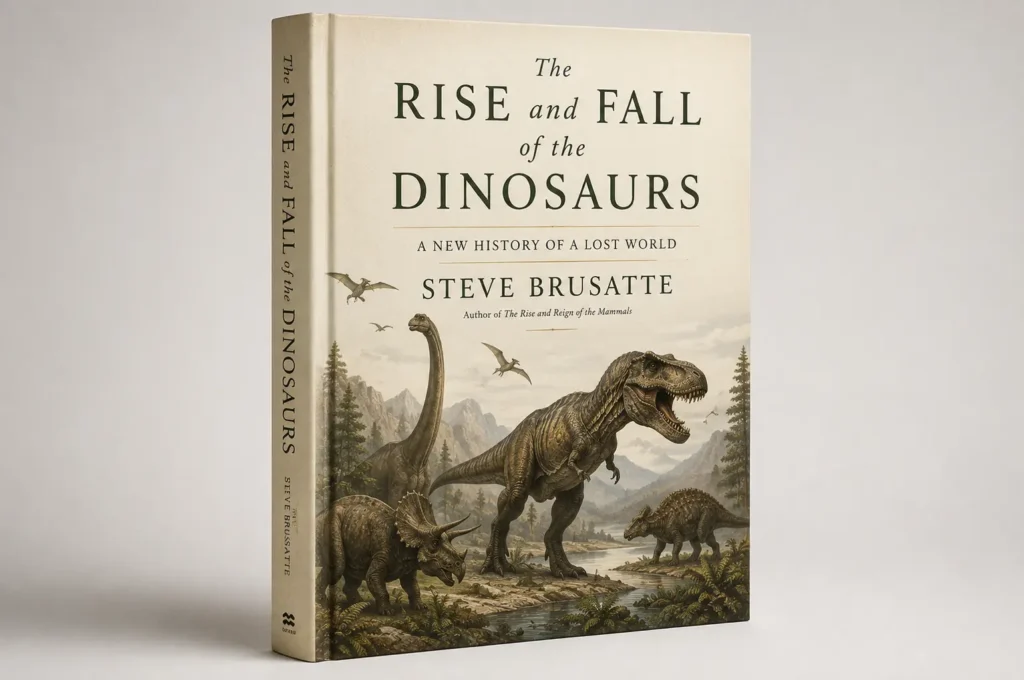
The Rise and Fall of the Dinosaurs
A compelling history of dinosaurs, tracing their origins, diversification, 200-million-year reign, extinction, and enduring legacy.
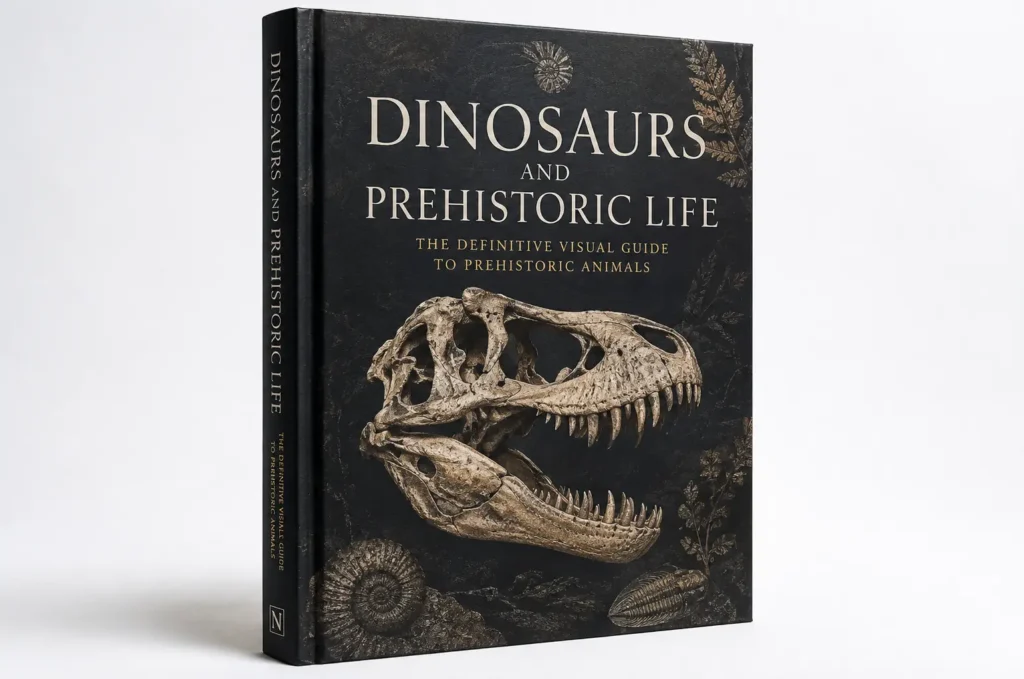
Dinosaurs and Prehistoric Life
A richly illustrated visual reference exploring dinosaurs, fossils, evolution, and prehistoric life across geological time.
Encyclopedia Prehistorica: Dinosaurs
An interactive dinosaur book featuring spectacular three-dimensional pop-ups, particularly suited to young readers and families.
The Rise and Reign of the Mammals
A sweeping history of mammalian evolution, from their origins alongside dinosaurs through the Cenozoic and the emergence of humans.