
Quick Answer
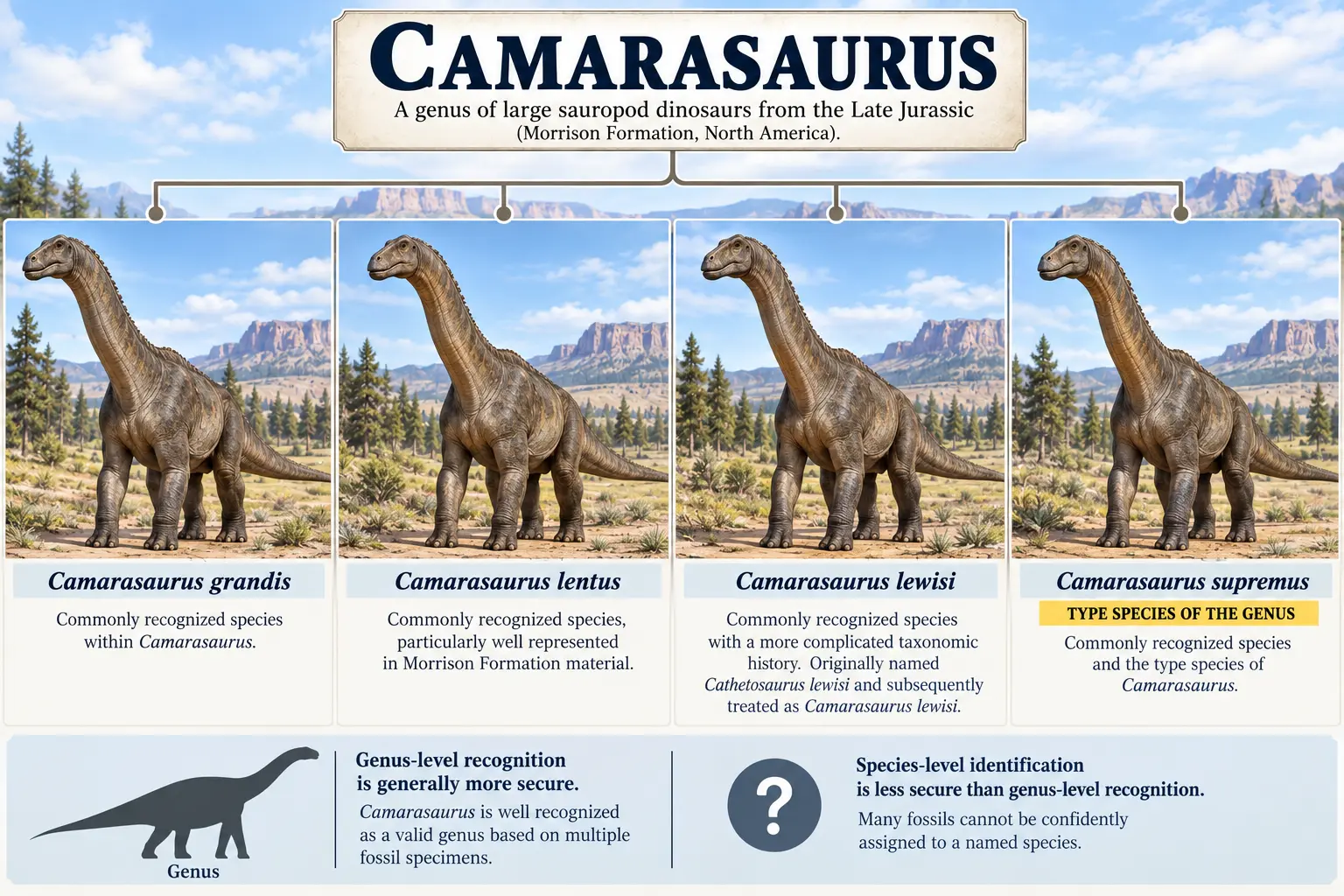
Four species are commonly treated as valid within Camarasaurus in the literature used here: Camarasaurus grandis, C. lentus, C. lewisi, and C. supremus. C. supremus is the type species of the genus.
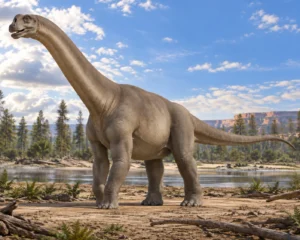
The genus itself is well established, but species-level identification is less secure. Many Camarasaurus fossils cannot be confidently assigned to a particular species because specimens are incomplete, diagnostic features can vary with growth, and some historically important type material has limitations.
The result is an important distinction: recognizing the genus Camarasaurus is generally more secure than assigning every fossil specimen to one of its named species.
Which Species of Camarasaurus Are Recognized?
| Species | Current treatment | Taxonomic note |
|---|---|---|
| Camarasaurus grandis | Commonly recognized | One of the species included in modern treatments of the genus |
| Camarasaurus lentus | Commonly recognized | Particularly well represented in Morrison Formation material |
| Camarasaurus lewisi | Commonly recognized, with a more complicated history | Originally named Cathetosaurus lewisi; subsequently treated as Camarasaurus lewisi |
| Camarasaurus supremus | Commonly recognized | Type species of Camarasaurus |
The four-species treatment follows the published Morrison Formation assessment used here. Species-level treatment remains more complicated than the simple list suggests because specimens differ in completeness and some proposed diagnostic characters may reflect growth or individual variation.
Current Taxonomic Picture
| Level | Current treatment |
|---|---|
| Genus | Camarasaurus |
| Family | Camarasauridae |
| Major clade | Macronaria |
| Commonly recognized species | C. grandis, C. lentus, C. lewisi, C. supremus |
| Type species | C. supremus |
| Genus-level confidence | High |
| Species-level confidence | Uneven |
| Proportion of fossils confidently assignable to a named species | Limited relative to the total genus-level sample |
The last row is intentionally qualitative. The published specimen dataset contains a large proportion of material identified only as Camarasaurus sp.; the individual published percentage figures for named species should not be treated as a mutually exclusive normalized distribution.
What Is the Type Species?
The type species of Camarasaurus is Camarasaurus supremus.
A type species anchors the formal name of a genus. It does not mean that every fossil identified as Camarasaurus belongs to C. supremus.
The type material and subsequent material assigned to the genus have played an important role in defining the anatomy and taxonomic boundaries of Camarasaurus. Because the original material is not equivalent to a complete, uniformly preserved modern reference specimen, taxonomic interpretation still depends on comparison across a much larger fossil sample.
How Secure Are the Species Boundaries?
Species-level identification is more difficult than recognizing the genus.
Several factors contribute to this uncertainty:
- many specimens are incomplete;
- potentially diagnostic bones are not preserved in every specimen;
- anatomical variation can occur within a species;
- growth can alter skeletal proportions and morphology;
- historically named species were not all established from equally informative material;
- Morrison Formation localities do not all provide equally precise stratigraphic information.
Consequently, a feature that appears distinctive in one specimen may not provide an absolute boundary between species when a larger sample is considered.
This is especially important for vertebral characters and other features that can change during growth.
How Are C. grandis and C. lentus Distinguished?
C. grandis and C. lentus have historically been separated using differences in skeletal morphology, including characters of the vertebrae.
These characters can be informative, but they should not be treated as perfectly discrete diagnostic switches. Variation within the fossil sample means that species identification can remain uncertain when the relevant anatomical elements are incomplete or when a specimen falls near the observed range of variation.
The appropriate interpretation is therefore comparative rather than absolute: researchers assess a suite of anatomical characters rather than relying on a single feature in isolation.
What Is the Taxonomic History of Camarasaurus lewisi?
Camarasaurus lewisi has a particularly complicated nomenclatural history.
The taxon was originally described as Cathetosaurus lewisi. Subsequent work treated it within Camarasaurus, producing the combination Camarasaurus lewisi.
The history illustrates why taxonomic names should not be treated as permanently fixed representations of biological boundaries. Generic placement can change when researchers reinterpret anatomical relationships or compare historically named material with larger samples.
The taxonomic history of C. lewisi should therefore be distinguished from the much simpler question of whether fossils attributed to this taxon possess recognizable anatomical characteristics.
How Much of the Fossil Record Can Be Assigned to Species?
The Camarasaurus fossil record is unusually large, but a substantial portion of the sample is identified only to the genus level.
A published assessment of Morrison Formation material reported more than 530 specimens from more than 100 localities. In that dataset, approximately 82% of specimens were recorded only as Camarasaurus sp., illustrating the difference between a very abundant genus-level record and a more limited species-level record.
The published assessment also reports smaller proportions associated with individual named species. Those figures are retained in the source literature but should not be presented here as a single normalized percentage distribution, because the reported values do not function as mutually exclusive categories that sum to 100%.
The important scientific conclusion is therefore the one supported robustly by the dataset: most of the assessed material was not confidently assigned to a named species.
Why Does Growth Matter for Species Identification?
Growth can change skeletal proportions and the expression of anatomical characters.
This creates a potential problem when researchers compare a small or juvenile specimen with an adult specimen and interpret every difference as taxonomic.
A reliable species-level diagnosis therefore requires characters that remain informative across ontogenetic stages or can otherwise be demonstrated to distinguish taxa rather than growth stages.
This is one reason the unusually large Camarasaurus fossil sample is valuable: researchers can examine variation across individuals and growth stages rather than relying on one or two isolated specimens.
Was There a Stratigraphic Sequence of Camarasaurus Species?
Some research has proposed a broad stratigraphic succession involving:
C. grandis → C. lentus → C. supremus
This pattern has been discussed as a possible temporal sequence within the Morrison Formation.
It should not, however, be presented as an established evolutionary succession.
Several limitations affect the interpretation:
- individual localities are not always precisely correlated;
- geographic sampling is uneven;
- species assignments are themselves uncertain for part of the material;
- morphological variation can complicate comparisons across stratigraphic levels.
The sequence is therefore best treated as a proposed stratigraphic pattern, not as a definitive chronological replacement of one species by another.
Why Are Some Camarasaurus Fossils Identified Only as Camarasaurus sp.?
A fossil can be confidently identified as belonging to Camarasaurus without preserving enough information to determine which named species it represents.
For example, an isolated bone may have anatomical characteristics that establish the genus but lack the combination of characters needed for species-level assignment.
This distinction is scientifically useful rather than a weakness in identification:
- Camarasaurus identifies the genus with relatively high confidence.
- Camarasaurus sp. indicates that the specimen belongs to the genus but has not been confidently assigned to a particular species.
The second designation avoids creating false precision.
What Does the Species-Level Evidence Actually Establish?
The current evidence supports several conclusions with different levels of confidence.
| Question | Evidence-supported conclusion |
|---|---|
| Is Camarasaurus a well-established genus? | Yes |
| Is C. supremus the type species? | Yes |
| Are four species commonly treated as valid in the literature used here? | Yes |
| Can every Camarasaurus specimen be assigned to one of those species? | No |
| Does anatomical variation occur within the fossil sample? | Yes |
| Can growth complicate species diagnosis? | Yes |
| Is the placement/history of C. lewisi straightforward? | No |
| Is the proposed grandis → lentus → supremus sequence established as a definitive evolutionary succession? | No |
What Remains Uncertain?
Exact species boundaries
The genus is secure, but some species boundaries remain difficult to resolve because of incomplete specimens, anatomical variation, and ontogenetic effects.
Diagnostic characters
Some historically proposed diagnostic characters may prove less distinctive when larger samples are examined.
Camarasaurus lewisi
Its nomenclatural history and generic placement require explicit treatment rather than being presented as an uncomplicated species assignment.
Stratigraphic succession
The proposed succession of species through the Morrison Formation is useful as a hypothesis for interpreting the record, but it should not be presented as a settled evolutionary sequence.
Specimen assignment
A large fossil sample does not automatically produce a large number of confidently identified species-level specimens. Many specimens remain appropriately identified only as Camarasaurus sp.
Bottom Line
Camarasaurus is a well-established genus with an unusually rich fossil record. Four species are commonly treated as valid in the literature used here: C. grandis, C. lentus, C. lewisi, and C. supremus, with C. supremus as the type species.
The principal taxonomic caution is that genus-level confidence is substantially stronger than species-level confidence. Many fossils cannot be assigned securely to a named species, and variation associated with growth, incomplete preservation, and historically complex type material complicates species boundaries.
For that reason, identifying a specimen as Camarasaurus sp. can be the scientifically appropriate conclusion rather than an incomplete identification.
References
Primary and Scientific Literature
Woodruff, D. C., & Foster, J. R. (2017). “The first specimen of Camarasaurus (Dinosauria: Sauropoda) from Montana: The northernmost occurrence of the genus.” PLOS ONE, 12(5), e0177423.
https://doi.org/10.1371/journal.pone.0177423
McIntosh, J. S., Miller, W. E., Stadtman, K. L., & Gillette, D. D. (1996). “The osteology of Camarasaurus lewisi (Jensen, 1988).” Brigham Young University Geology Studies, 41, 73–95.
Institutional Sources
Natural History Museum of Utah. “Camarasaurus.”
National Park Service. Dinosaur National Monument resources on Camarasaurus and the Morrison Formation.
Reference Note
The quantitative specimen figures discussed in the text are source-specific results from the published Morrison Formation assessment. The page intentionally does not convert the reported species-level figures into a normalized distribution because doing so would imply a precision and mutual exclusivity that the source data do not establish.
References
Primary and Scientific Literature
Woodruff, D. C., & Foster, J. R. (2017). “The first specimen of Camarasaurus (Dinosauria: Sauropoda) from Montana: The northernmost occurrence of the genus.” PLOS ONE, 12(5), e0177423. https://doi.org/10.1371/journal.pone.0177423
McIntosh, J. S., Miller, W. E., Stadtman, K. L., & Gillette, D. D. (1996). “The osteology of Camarasaurus lewisi (Jensen, 1988).” Brigham Young University Geology Studies, 41, 73–95.
Ikejiri, T. (2005). Distribution and biochronology of Camarasaurus (Dinosauromorpha, Sauropoda) from the Jurassic Morrison Formation of the Rocky Mountain Region. New Mexico Geological Society Guidebook, 56, 367–379.
Institutional Sources
Natural History Museum of Utah. “Camarasaurus.” Natural History Museum of Utah.
National Park Service, Dinosaur National Monument. “Camarasaurus lentus.”
National Park Service, Dinosaur National Monument. “Fantastic Camarasauruses (from Dinosaur National Monument) and Where to Find Them.”
National Park Service, Dinosaur National Monument. “Morrison Formation.”
Reference Note
Quantitative specimen-identification figures are retained as source-specific results from the published Morrison Formation assessment. The page does not convert the reported species-level figures into a normalized distribution because doing so would imply that the reported categories form mutually exclusive components of a 100% distribution. The approximately 82% genus-only figure is therefore presented as a reported dataset characteristic rather than combined mathematically with the individual species figures.
Recommended Paleontology & Natural History Books
As an Amazon Associate, Extinct Atlas may earn from qualifying purchases.
The Rise and Fall of the Dinosaurs
A compelling history of dinosaurs, tracing their origins, diversification, 200-million-year reign, extinction, and enduring legacy.
Dinosaurs and Prehistoric Life
A richly illustrated visual reference exploring dinosaurs, fossils, evolution, and prehistoric life across geological time.
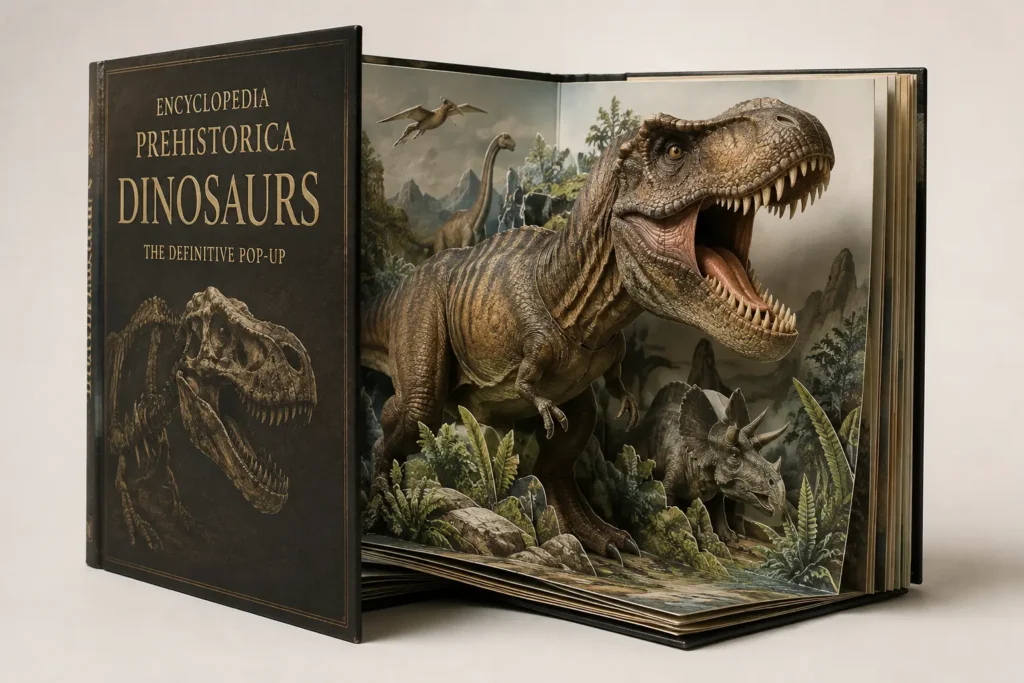
Encyclopedia Prehistorica: Dinosaurs
An interactive dinosaur book featuring spectacular three-dimensional pop-ups, particularly suited to young readers and families.
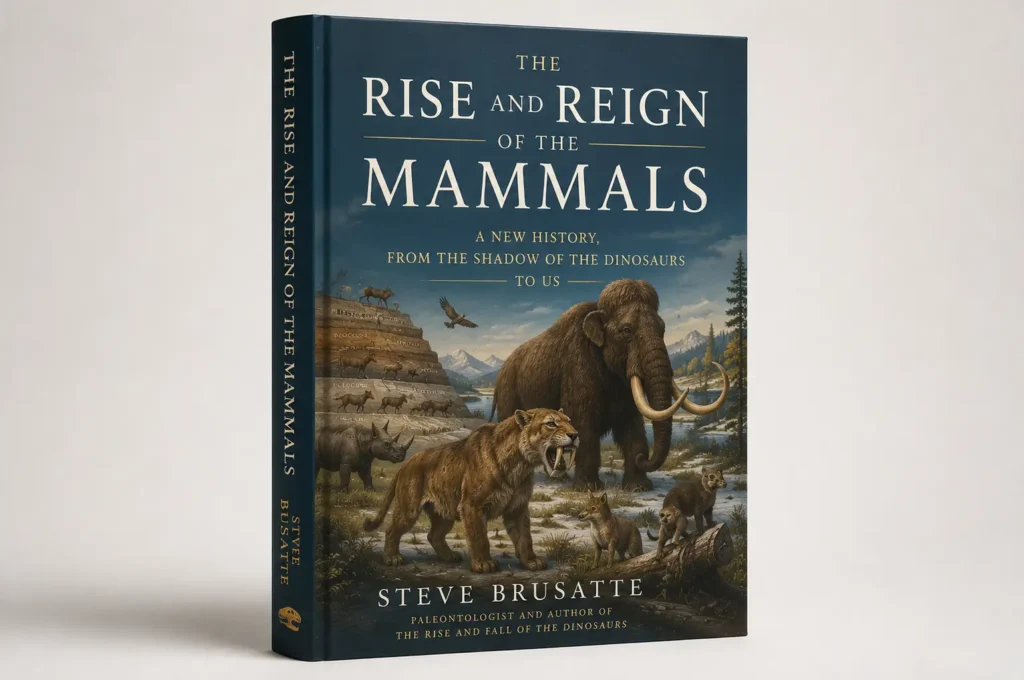
The Rise and Reign of the Mammals
A sweeping history of mammalian evolution, from their origins alongside dinosaurs through the Cenozoic and the emergence of humans.