
Quick Answer
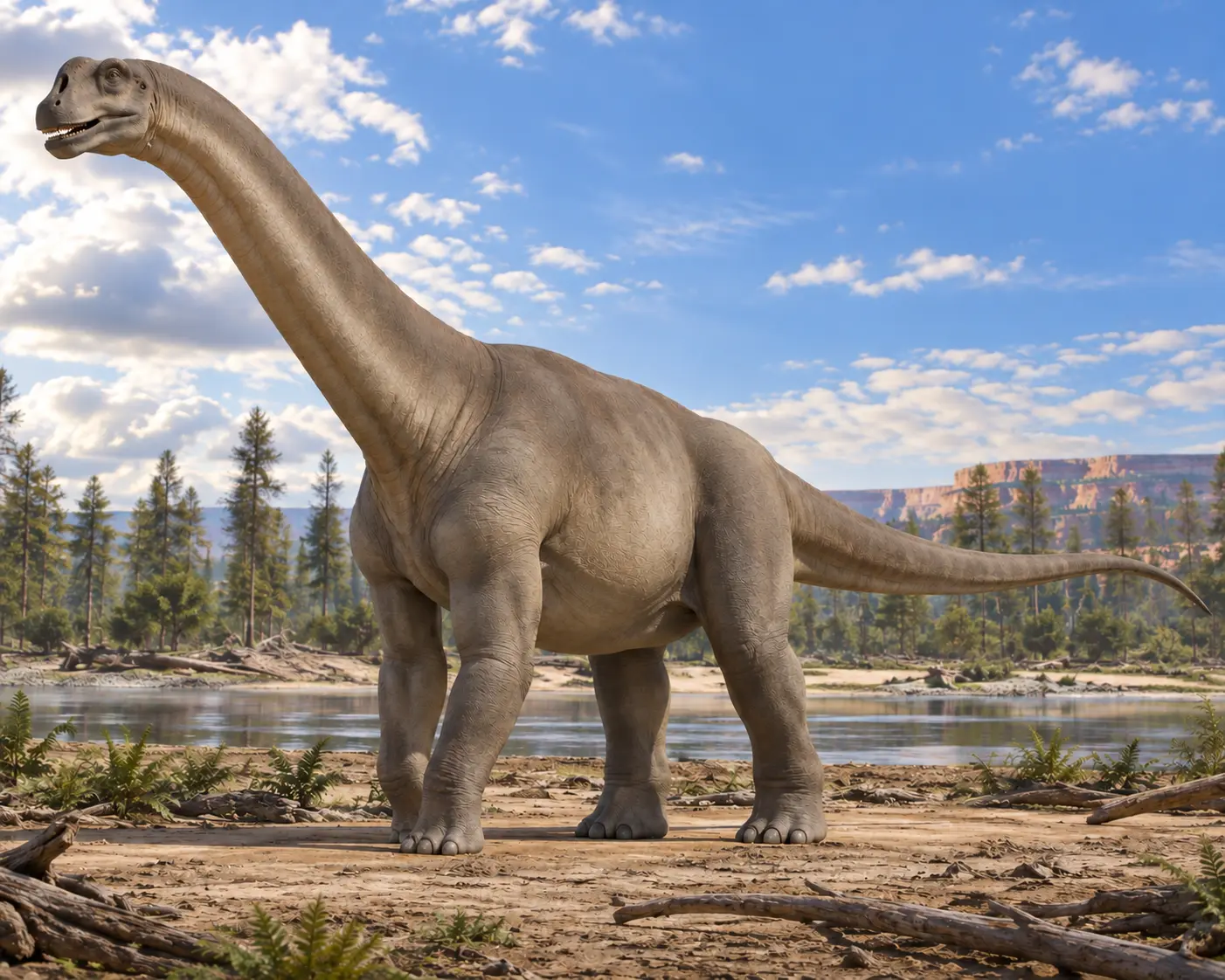
Camarasaurus was a large, robust, four-legged herbivorous sauropod dinosaur of the Late Jurassic. It is especially well represented in the Morrison Formation of western North America, where fossils occur at more than 100 localities and include isolated bones, partial skeletons, and exceptionally complete articulated specimens.
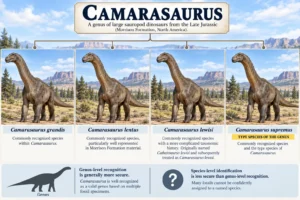
Its broad, relatively deep skull and large spoon- or chisel-shaped teeth distinguish it from the more slender-headed diplodocid sauropods that lived in the same ecosystems. Four species are commonly treated as valid in the literature used here: Camarasaurus grandis, C. lentus, C. lewisi, and C. supremus. C. supremus is the type species.
The fossil record provides strong evidence for its general anatomy, quadrupedal construction, dentition, and broad herbivorous ecology. More detailed questions about exact body size, feeding mechanics, species boundaries, and behavior require specimen-specific or interpretive qualification.
Camarasaurus at a Glance
| Feature | Summary |
|---|---|
| Scientific name | Camarasaurus Cope, 1877 |
| Taxonomic rank | Genus |
| Family | Camarasauridae |
| Major clade | Macronaria |
| Geological age | Late Jurassic |
| Principal fossil record | Morrison Formation, western North America |
| Diet | Herbivorous |
| Body plan | Large, robust quadrupedal sauropod |
| Skull | Broad and relatively deep, with a short, blunt snout |
| Teeth | Large, robust, spoon- or chisel-shaped teeth |
| Fossil record | More than 530 specimens reported in a published Morrison Formation assessment |
| Locality record | More than 100 localities reported in that assessment |
| Commonly treated species | C. grandis, C. lentus, C. lewisi, C. supremus |
| Main scientific limitation | Species-level assignment is less secure than genus-level identification |
What Was Camarasaurus?
Camarasaurus was a sauropod dinosaur: a member of the large-bodied, long-necked herbivorous dinosaurs that formed an important component of Late Jurassic ecosystems.
The genus name means “chambered lizard,” referring to the chambered structure of parts of its vertebrae. These spaces are part of the pneumatic architecture documented in the skeleton. Fossil evidence establishes these skeletal pneumatic features; interpretations of their relationship to an air-sac respiratory system extend beyond the directly preserved bone itself.
Camarasaurus differed noticeably in proportions from the extremely long-necked diplodocid sauropods that shared the Morrison Formation. Its body and limbs were relatively robust, while its neck and tail were proportionally shorter. Its substantial skull and robust teeth are also distinctive features of the genus.
When and Where Did Camarasaurus Live?
Camarasaurus is principally known from the Morrison Formation, a Late Jurassic terrestrial rock succession exposed across much of the western United States.
Geological and Geographic Context
| Context | Evidence-supported summary |
|---|---|
| Geological period | Late Jurassic |
| Approximate age represented in the Morrison Formation | Roughly 156–149 million years ago in the Dinosaur National Monument portion of the record |
| Principal formation | Morrison Formation |
| Principal region | Western North America |
| Important Utah localities | Dinosaur National Monument, Cleveland-Lloyd Dinosaur Quarry, and other Colorado Plateau localities |
| Additional geographic record | Fossils are documented from numerous Morrison Formation localities, including a confirmed occurrence in Montana |
| Environmental setting | The Morrison Formation records a range of terrestrial environments, including floodplain, river, and lake-associated settings |
| Geographic qualification | The broad genus-level range should not be interpreted as the range of every recognized species |
The Morrison Formation preserves a diverse terrestrial ecosystem, including several kinds of sauropod, theropod, and ornithischian dinosaurs, plants, and other organisms.
The geographic record is substantially stronger at the genus level than at the species level. Because many specimens cannot be confidently assigned to a particular species, the presence of Camarasaurus at a locality does not automatically establish that every recognized species occupied that locality.
What Did Camarasaurus Look Like?
Camarasaurus had the basic sauropod body plan: four weight-bearing limbs supporting a large trunk, a long neck, and a long tail. Its proportions were nevertheless comparatively robust.
General Anatomy
| Anatomical feature | General evidence-supported description |
|---|---|
| Overall build | Robust, large-bodied sauropod |
| Limbs | Column-like weight-bearing limbs positioned beneath the body |
| Forelimbs | Somewhat shorter than the hind limbs |
| Neck | Long but proportionally shorter than in some contemporary diplodocid sauropods |
| Tail | Long but proportionally shorter than in some diplodocids |
| Skull | Broad and relatively deep |
| Snout | Short and relatively broad |
| Teeth | Large, robust, spoon- or chisel-shaped teeth |
| Vertebrae | Contain chambered pneumatic structures in parts of the skeleton |
| Preserved articulation | Exceptionally complete articulated specimens provide direct evidence for skeletal relationships and proportions |
One particularly informative juvenile specimen from Dinosaur National Monument preserves much of the skeleton in articulation. Its forelimbs were preserved in a position beneath the body, providing important direct evidence for the upright limb posture of sauropods.
How Large Was Camarasaurus?
There is no single measurement that should be treated as the universal size of the genus.
Published and institutional estimates vary because reconstructed body size depends on the specimen, species attribution, reconstruction method, and estimation method.
Size Estimates
| Estimate | Interpretation |
|---|---|
| Approximately 15 m long | Estimate reported for large C. lentus material at Dinosaur National Monument |
| Approximately 15–20 m long | Broad institutional range reported for Camarasaurus |
| Approximately 18 tonnes | National Park Service estimate for an adult C. lentus in the Dinosaur National Monument context |
| Up to approximately 20 tonnes | Broad upper mass estimate reported by the Natural History Museum of Utah |
These values should not be combined into a single canonical “Camarasaurus size.” The 15 m and approximately 18-tonne figures are tied particularly to C. lentus material from Dinosaur National Monument, whereas the 15–20 m and approximately 20-tonne figures represent broader institutional estimates.
The scientifically useful conclusion is that Camarasaurus was a large sauropod, while exact length and mass remain reconstruction-dependent.
What Did Camarasaurus Eat?
Camarasaurus was herbivorous. Its large, robust teeth provide important anatomical evidence for its feeding biology.
The teeth were broader and more robust than the slender, peg-like teeth characteristic of some other sauropods. Their shape and construction are consistent with processing relatively tough vegetation.
The fossil record does not provide a definitive list of every plant consumed by Camarasaurus. Likewise, anatomical and biomechanical evidence can inform feeding performance without revealing every aspect of natural feeding behavior.
Detailed treatment of the skull, teeth, jaw mechanics, modeled bite force, and dietary interpretation belongs to the dedicated Camarasaurus Skull, Teeth, and Feeding page.
What Does the Fossil Record Tell Us?
The fossil record of Camarasaurus is unusually extensive for a sauropod.
A published assessment reported more than 530 Camarasaurus specimens from more than 100 Morrison Formation localities. The same assessment identified approximately 50 partial associated skeletons.
These figures are source-specific results from the published Morrison Formation dataset and should not be interpreted as a complete census of every Camarasaurus fossil ever discovered.
Fossil Record
| Fossil-record measure | Published assessment |
|---|---|
| Total specimens | More than 530 |
| Localities | More than 100 |
| Partial associated skeletons | Approximately 50 |
| Genus-level identification | A large majority of the assessed material was identified only as Camarasaurus sp.; the published assessment reports approximately 82% |
| Species-level identification | A substantially smaller portion of the assessed material was confidently assigned to named species |
| Geographic significance | Material occurs across much of the exposed Morrison Formation |
| Stratigraphic qualification | Correlation between Morrison localities is imperfect, limiting some species-level stratigraphic interpretations |
The approximately 82% figure is a reported characteristic of the cited dataset, not a normalized estimate of all Camarasaurus fossils. The individual species-level figures reported in the source are not reproduced here as a single percentage distribution because they should not be treated as mutually exclusive categories that sum to 100%.
The large sample makes it possible to study anatomy, growth, variation, distribution, and preservation in ways that are difficult for taxa represented by only a few fragmentary fossils.
Abundance does not mean that every scientific question is equally well resolved. In particular, species-level identification remains more difficult than recognizing the genus.
Which Species of Camarasaurus Are Recognized?
Four species are commonly treated as valid in the literature used here.
Recognized Species
| Species | Status | Taxonomic note |
|---|---|---|
| Camarasaurus supremus | Recognized species | Type species of the genus |
| Camarasaurus grandis | Recognized species | Included in commonly used species-level treatments |
| Camarasaurus lentus | Recognized species | Particularly well represented in Morrison Formation material |
| Camarasaurus lewisi | Recognized in many treatments | Originally named Cathetosaurus lewisi and subsequently treated within Camarasaurus; its history is more complicated than that of the other commonly recognized species |
Species-level treatment remains more complicated than this overview suggests because specimens differ in completeness and some proposed diagnostic characters may overlap with growth-related or individual variation.
For detailed nomenclature, diagnostic characters, and species-level uncertainty, see Camarasaurus Species and Taxonomy.
How Did Camarasaurus Move?
The skeleton shows Camarasaurus as a quadrupedal sauropod with its limbs positioned beneath the body.
The articulated juvenile specimen from Dinosaur National Monument was historically important because its preserved forelimbs provided unusually direct evidence for the upright sauropod stance.
The evidence is much less secure for questions such as maximum running speed. Exact speed estimates depend on biomechanical assumptions and reconstruction parameters that cannot be directly measured from fossils.
Camarasaurus can therefore be described confidently as a large quadrupedal sauropod, but an exact maximum speed should not be presented as an established fact.
What Remains Uncertain?
The fossil record of Camarasaurus is extensive, but the strength of evidence is not uniform across all biological questions.
Species boundaries
The genus is well established, but assigning individual specimens to particular species can be difficult. Some recognized species have problematic or limited type material, while anatomical differences can overlap with growth-related variation.
Detailed species diagnoses belong on the dedicated taxonomy page rather than this overview.
Exact body size
Length and mass estimates depend on particular specimens and reconstruction methods. A specimen-specific estimate should not automatically be converted into a universal genus-wide value.
Feeding behavior
The skull and teeth provide strong anatomical evidence for herbivory and inform interpretations of food processing. Biomechanical models can test aspects of feeding performance, but they do not establish every detail of natural feeding behavior or provide a definitive plant list.
Detailed bite-force modeling and dietary interpretation belong to the dedicated feeding page.
Behavior
The fossil record provides limited direct evidence for communication, temperament, intelligence, or detailed social behavior. These should not be presented as established characteristics of the genus.
Coloration
There is no sufficiently direct evidence establishing the body coloration of Camarasaurus. Artistic reconstructions may use plausible colors, but those colors should not be presented as known biological facts.
Respiratory interpretation
The skeleton preserves pneumatic structures in parts of the vertebrae. The fossil evidence therefore supports skeletal pneumaticity, but the complete soft-tissue respiratory system cannot be observed directly in the fossil record and should be described as an anatomical inference rather than as directly preserved anatomy.
Current Scientific Understanding
Camarasaurus is one of the better-represented sauropod dinosaurs of the Morrison Formation. Its abundant fossil material provides unusually strong evidence for its general anatomy, quadrupedal construction, skull, dentition, and broad herbivorous ecology.
The evidence becomes less direct when moving from general anatomy toward species-level identification, exact body size, detailed feeding behavior, and other biological traits.
The most defensible general picture is therefore of a robust, large-bodied Late Jurassic herbivorous sauropod with a broad skull, strong teeth, relatively shorter neck and tail than some contemporary diplodocids, and an unusually rich fossil record.
References
Primary and Scientific Literature
Woodruff, D. C., & Foster, J. R. (2017). “The first specimen of Camarasaurus (Dinosauria: Sauropoda) from Montana: The northernmost occurrence of the genus.” PLOS ONE, 12(5), e0177423. DOI: 10.1371/journal.pone.0177423.
McIntosh, J. S., Miller, W. E., Stadtman, K. L., & Gillette, D. D. (1996). “The osteology of Camarasaurus lewisi (Jensen, 1988).” Brigham Young University Geology Studies, 41, 73–95.
Institutional Sources
Natural History Museum of Utah. “Camarasaurus.” Natural History Museum of Utah.
National Park Service, Dinosaur National Monument. “Camarasaurus lentus.”
National Park Service, Dinosaur National Monument. “Fantastic Camarasauruses (from Dinosaur National Monument) and Where to Find Them.”
National Park Service, Dinosaur National Monument. “Morrison Formation.”
Reference Note
Quantitative specimen-identification figures are retained as source-specific results from the published Morrison Formation assessment. The approximately 82% genus-only figure is presented as a reported characteristic of that dataset. The page does not combine the individual species-level figures into a normalized distribution because doing so would imply that the reported categories form mutually exclusive components of a 100% distribution.
Size estimates are likewise retained with their specimen, species, or institutional context rather than being combined into a single universal genus-level value.
🦷 Anatomy

Recommended Paleontology & Natural History Books
As an Amazon Associate, Extinct Atlas may earn from qualifying purchases.
The Rise and Fall of the Dinosaurs
A compelling history of dinosaurs, tracing their origins, diversification, 200-million-year reign, extinction, and enduring legacy.
Dinosaurs and Prehistoric Life
A richly illustrated visual reference exploring dinosaurs, fossils, evolution, and prehistoric life across geological time.
Encyclopedia Prehistorica: Dinosaurs
An interactive dinosaur book featuring spectacular three-dimensional pop-ups, particularly suited to young readers and families.
The Rise and Reign of the Mammals
A sweeping history of mammalian evolution, from their origins alongside dinosaurs through the Cenozoic and the emergence of humans.