Quick Info
| Category | Information |
|---|---|
| Scientific Name | Deinonychus antirrhopus |
| Diet Classification | Carnivore |
| Geological Age | Early Cretaceous (115–108 Ma) |
| Primary Evidence | Teeth, jaws, claws, forelimbs, fossil associations |
| Known Prey Association | Tenontosaurus |
| Feeding Strategy | Active predation inferred |
| Direct Dietary Evidence | Moderate |
| Scientific Confidence | High |
| Major Debate | Solitary vs social feeding behavior |
Quick Answer
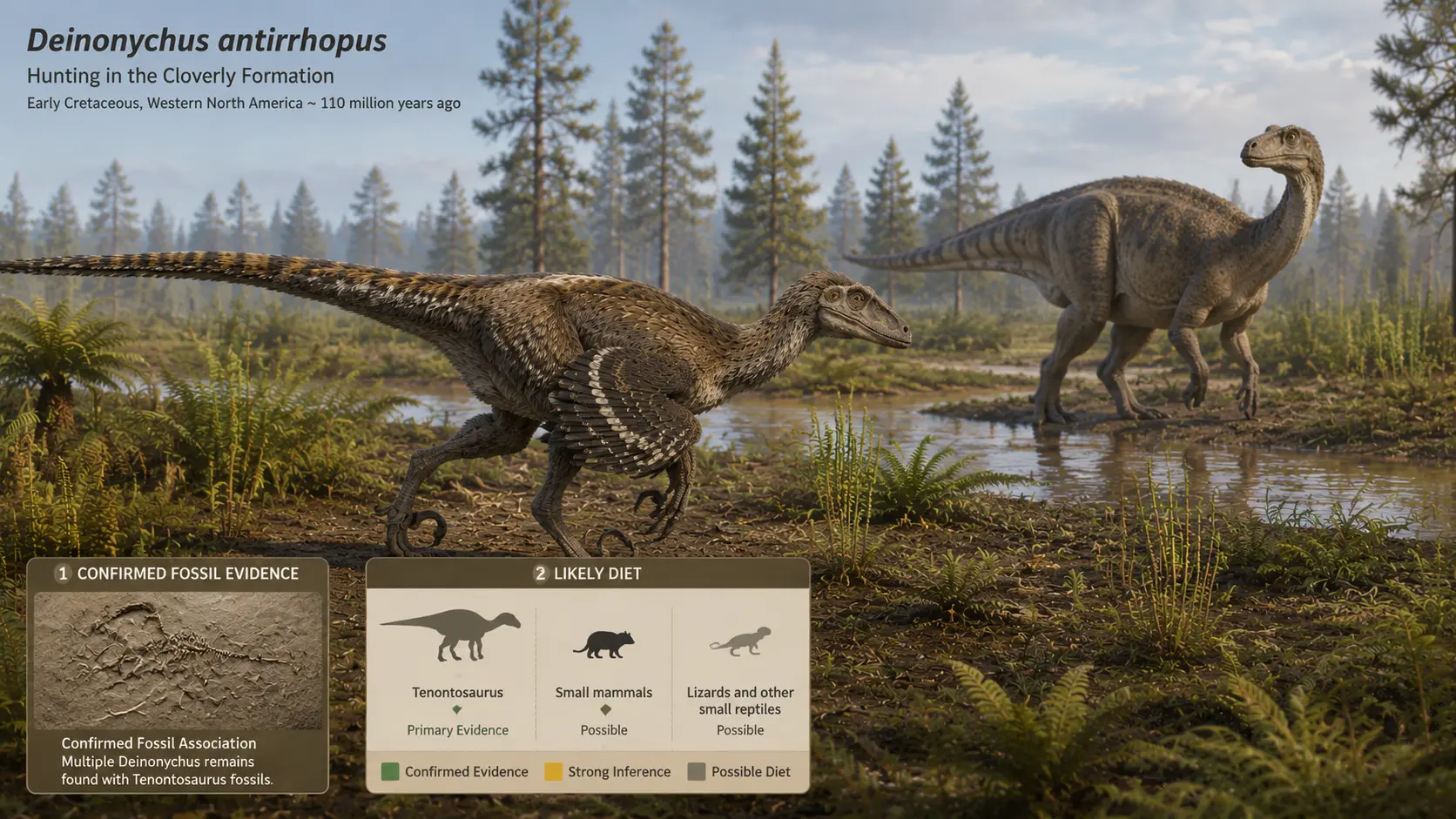
Deinonychus was a carnivorous theropod dinosaur that likely preyed on vertebrate animals living in Early Cretaceous ecosystems of western North America. Evidence from its teeth, jaws, forelimbs, hind limbs, and enlarged second-toe claw indicates adaptations for capturing and consuming animal prey. Fossil associations with the herbivorous dinosaur Tenontosaurus provide some of the strongest evidence for its feeding ecology, although the exact nature of these interactions remains debated.

Introduction
Diet is one of the best-supported aspects of Deinonychus biology. Unlike questions involving social behavior or precise locomotor performance, feeding ecology can be evaluated using multiple independent lines of evidence, including anatomy, biomechanics, and fossil associations.
The combination of serrated teeth, grasping forelimbs, powerful hind limbs, and an enlarged sickle-shaped claw suggests that Deinonychus occupied the role of a medium-sized terrestrial predator. While researchers continue to debate aspects of its hunting behavior and feeding ecology, there is broad agreement that Deinonychus occupied a carnivorous ecological role.
Current evidence is consistent with active predation, although opportunistic scavenging cannot be excluded and may have formed part of its overall feeding strategy, as occurs in many modern predators.
What Is Known From Evidence
Fossil Evidence
| Evidence Type | Interpretation | Confidence |
|---|---|---|
| Serrated Teeth | Meat consumption | High |
| Theropod Jaw Anatomy | Carnivorous feeding | High |
| Grasping Forelimbs | Prey capture and restraint | High |
| Enlarged Toe Claw | Predatory function likely | Moderate |
| Tenontosaurus Associations | Predator-prey interaction possible | Moderate |
Multiple lines of evidence indicate a carnivorous lifestyle. The teeth of Deinonychus are laterally compressed, recurved, and serrated—features commonly associated with flesh consumption in theropod dinosaurs.
Its forelimbs possessed large grasping hands equipped with curved claws capable of securing prey. Together with the hind limbs and enlarged second-toe claw, these adaptations support a predatory ecological role.
Anatomical Evidence
Teeth
| Feature | Description | Functional Interpretation |
|---|---|---|
| Shape | Recurved | Helps retain prey |
| Serrations | Present | Assists tissue cutting |
| Compression | Lateral | Efficient slicing action |
| Replacement | Continuous | Maintains feeding effectiveness |
The teeth of Deinonychus resemble those of other predatory theropods and show no adaptations associated with herbivory or omnivory.
Forelimbs and Hands
| Feature | Interpretation |
|---|---|
| Large Hands | Prey manipulation |
| Curved Manual Claws | Grasping capability |
| Mobile Forelimbs | Active prey handling |
| Strong Flexion | Holding struggling prey |
The forelimbs appear unusually important for a non-avian theropod. Researchers have long noted similarities between the grasping ability of Deinonychus and the prey-handling behavior of some modern predatory birds.
Prey Evidence
The most frequently discussed prey association involves the ornithopod dinosaur Tenontosaurus.
Numerous Deinonychus specimens have been found in association with Tenontosaurus remains. These occurrences suggest ecological interactions between the two animals, but the precise nature of those interactions remains uncertain.
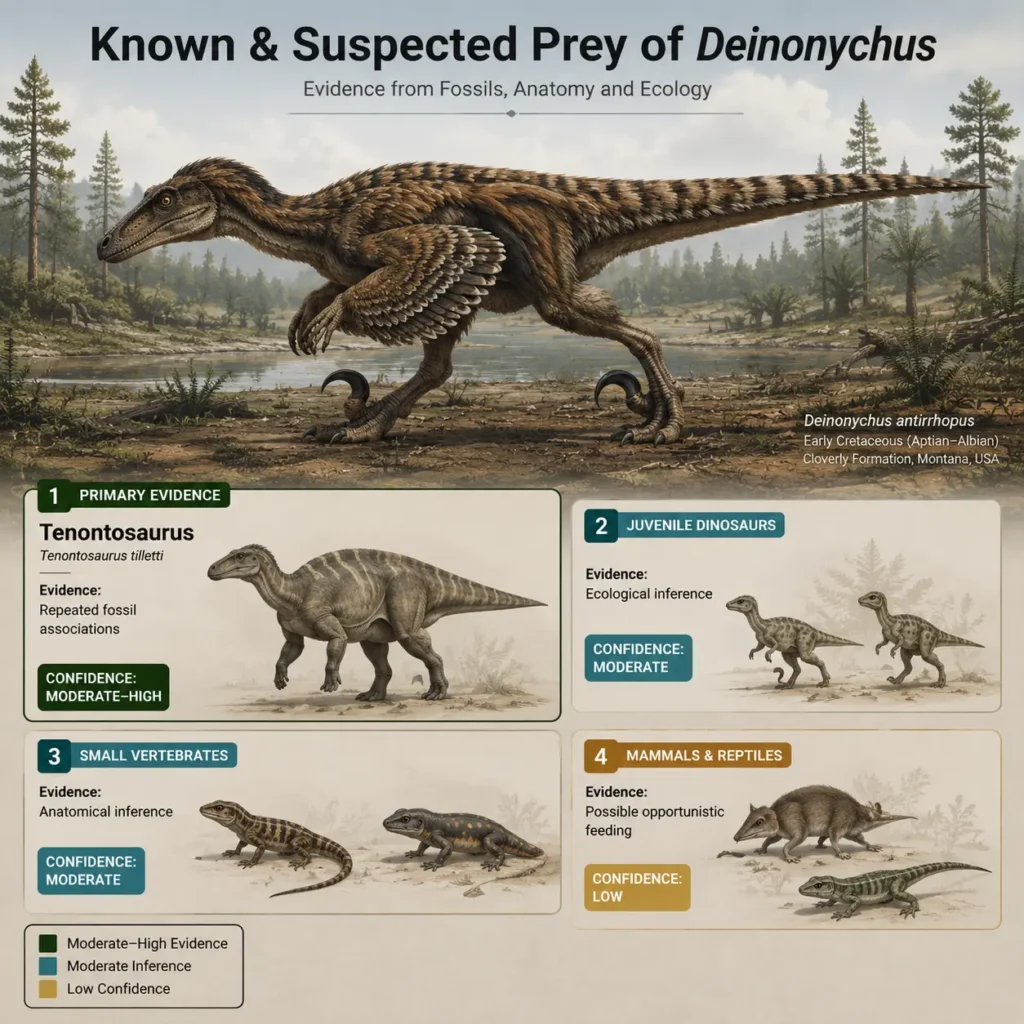
Known and Suspected Prey
| Potential Prey | Evidence Basis | Confidence |
|---|---|---|
| Tenontosaurus | Repeated fossil associations | Moderate to High |
| Juvenile Dinosaurs | Ecological inference | Moderate |
| Small Vertebrates | Anatomical inference | Moderate |
| Mammals and Reptiles | Possible opportunistic feeding | Low |
The strongest evidence concerns Tenontosaurus, although the size range of Deinonychus suggests it likely exploited a variety of prey types throughout its life.
Scientific Interpretation
How Did Deinonychus Hunt?
Current evidence supports active predation, but the exact mechanics remain uncertain.
Biomechanical studies suggest that the enlarged second-toe claw may have functioned primarily in prey restraint rather than slashing. Under the “Raptor Prey Restraint” model, Deinonychus may have used its feet and forelimbs to pin prey while delivering bites.
Predatory Adaptations
| Adaptation | Possible Function |
|---|---|
| Enlarged Toe Claw | Prey restraint |
| Grasping Hands | Holding prey |
| Serrated Teeth | Tissue processing |
| Long Hind Limbs | Pursuit and maneuverability |
| Stiffened Tail | Balance during movement |
These adaptations collectively suggest a predator specialized for controlling prey rather than relying solely on bite force.
Alternative Interpretations
Although Deinonychus is universally regarded as carnivorous, some aspects of its feeding ecology remain debated.
Researchers disagree about the extent to which it relied on:
- Active predation
- Opportunistic feeding
- Scavenging
- Group feeding behavior
These possibilities are not mutually exclusive. Many modern predators both hunt and scavenge when opportunities arise.
Scientific Debate
The Tenontosaurus Question
One of the most important debates concerns the repeated association of Deinonychus remains with Tenontosaurus fossils.
Two primary interpretations exist:
| Interpretation | Summary |
|---|---|
| Cooperative Hunting | Multiple individuals may have participated in attacks on large prey |
| Predator Aggregation | Multiple animals gathered independently around food resources |
Current evidence does not conclusively support either explanation.
Social Feeding Behavior
Evidence for coordinated hunting remains limited. Some researchers argue that the fossil record supports social behavior, whereas others note that many modern predators gather around carcasses without exhibiting cooperative hunting.
As a result, dietary interpretations involving group predation should be treated cautiously.
Did Deinonychus Scavenge?
Direct fossil evidence demonstrating scavenging by Deinonychus has not been discovered. However, the absence of such evidence does not mean scavenging never occurred. Among modern carnivores, including birds of prey, crocodilians, and mammalian predators, opportunistic scavenging is a common and energy-efficient feeding strategy. Paleontologists therefore consider it plausible that Deinonychus occasionally fed on carcasses when suitable opportunities arose. Distinguishing scavenging from active predation in the fossil record is exceptionally difficult because both behaviors can leave similar traces, such as bite marks, tooth wear, or associations between predator and prey fossils. Consequently, fossil evidence rarely allows researchers to determine how an individual animal obtained its food. Current scientific evidence supports Deinonychus as an active predator, but opportunistic scavenging likely complemented its hunting behavior, as it does in many living carnivorous vertebrates.
Current Scientific Understanding
Current scientific evidence strongly supports the interpretation of Deinonychus as an active carnivorous predator. Its anatomy, dentition, and ecological associations are all consistent with feeding on vertebrate prey.
The strongest evidence derives from skeletal adaptations and repeated associations with Tenontosaurus. While these data clearly establish a predatory lifestyle, important uncertainties remain regarding hunting strategies, prey selection, and the role of social behavior.
Most researchers agree that Deinonychus occupied the ecological role of a medium-sized predator within Early Cretaceous ecosystems, but debates continue regarding exactly how it captured and consumed its prey.
Evidence Assessment
| Evidence Category | Assessment |
|---|---|
| Carnivorous Diet | Strong Direct Evidence |
| Predatory Adaptations | Strong Direct Evidence |
| Tenontosaurus Associations | Moderate Evidence |
| Hunting Strategy | Limited Direct Evidence |
| Group Hunting Hypothesis | Low Confidence |
| Social Feeding Behavior | Low Confidence |
The evidence for carnivory is robust and supported by multiple independent lines of evidence. In contrast, specific claims regarding hunting behavior or social feeding remain substantially more uncertain and require careful interpretation.
Frequently Asked Questions
What did Deinonychus eat?
Deinonychus was a carnivore that likely fed on vertebrate prey, including dinosaurs such as Tenontosaurus and potentially smaller animals within its ecosystem.
Did Deinonychus hunt Tenontosaurus?
Fossil associations suggest interactions between Deinonychus and Tenontosaurus, but the exact nature of those interactions remains debated.
Was Deinonychus an apex predator?
Not necessarily. Within many Early Cretaceous ecosystems, it was a major medium-sized predator, but ecological roles likely varied across habitats and age classes.
Did Deinonychus hunt in packs?
Current evidence remains inconclusive. Some researchers have proposed cooperative hunting, while others favor non-social predator aggregations around food sources.
References
Primary Taxonomic Sources
Ostrom, J.H. (1969). Osteology of Deinonychus antirrhopus, an unusual theropod from the Lower Cretaceous of Montana. Bulletin of the Peabody Museum of Natural History, 30, 1–165.
Ostrom, J.H. (1976). Archaeopteryx and the origin of birds. Biological Journal of the Linnean Society, 8, 91–182.
Peer-Reviewed Scientific Literature
Maxwell, W.D., & Ostrom, J.H. (1995). Taphonomy and paleoecology of Deinonychus bonebeds from the Cloverly Formation (Lower Cretaceous) of Montana and Wyoming. Palaios, 10(3), 285–298.
Manning, P.L., Payne, D., Pennicott, J., Barrett, P.M., & Ennos, A.R. (2006). Dinosaur killer claws or climbing crampons? Biology Letters, 2(1), 110–112.
Fowler, D.W., Freedman, E.A., Scannella, J.B., & Kambic, R.E. (2011). The predatory ecology of Deinonychus and the origin of flapping in birds. PLoS ONE, 6(12), e28964.
Roach, B.T., & Brinkman, D.L. (2007). A reevaluation of cooperative pack hunting and gregariousness in Deinonychus antirrhopus and other nonavian theropod dinosaurs. Bulletin of the Peabody Museum of Natural History, 48(1), 103–138.
Turner, A.H., Makovicky, P.J., & Norell, M.A. (2012). A review of dromaeosaurid systematics and paravian phylogeny. Bulletin of the American Museum of Natural History, 371, 1–206.
Brusatte, S.L., O’Connor, J.K., & Jarvis, E.D. (2015). The origin and diversification of birds. Current Biology, 25(19), R888–R898.
Monographs and Academic Books
Paul, G.S. (2016). The Princeton Field Guide to Dinosaurs (2nd ed.). Princeton University Press.
Holtz, T.R. Jr. (2007). Dinosaurs: The Most Complete, Up-to-Date Encyclopedia for Dinosaur Lovers of All Ages. Random House.
Brusatte, S.L. (2018). The Rise and Fall of the Dinosaurs. William Morrow.
Museum and Institutional Sources
Yale Peabody Museum. Collections and historical information relating to Deinonychus antirrhopus and holotype YPM 5205.
Databases
Paleobiology Database. Taxonomic and occurrence records for Deinonychus antirrhopus.
The Theropod Database. Taxonomic, anatomical, and bibliographic information for Deinonychus and related dromaeosaurids.
Featured Museum Collections
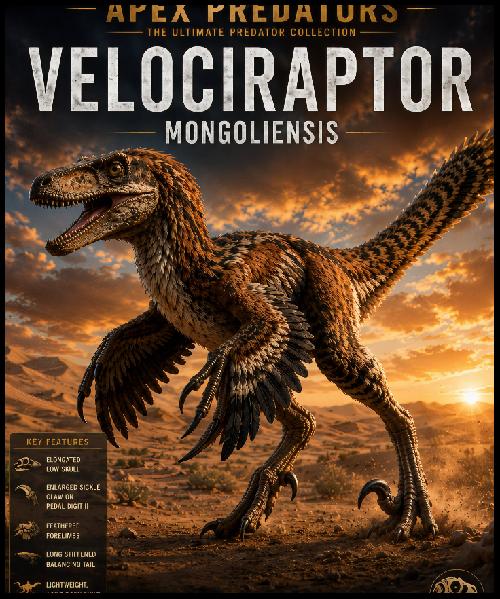
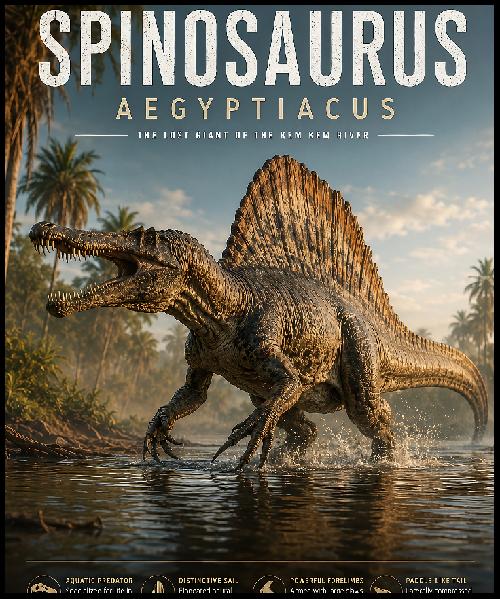
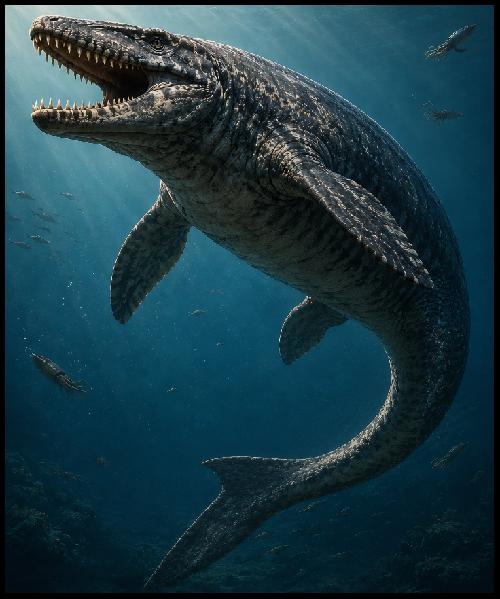
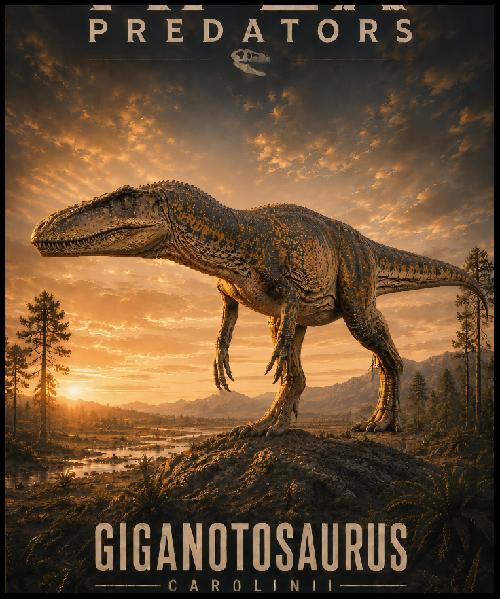
Museum-quality paleoart and educational poster
collections based on evidence-informed prehistoric
Life reconstructions.