Quick Info
| Category | Information |
|---|---|
| Scientific Name | Deinonychus antirrhopus |
| Geological Age | Early Cretaceous (115–108 Ma) |
| Primary Formations | Cloverly Formation, Antlers Formation |
| Geographic Range | Western North America |
| Paleocontinent | North America |
| Habitat Type | River systems, floodplains, forests, open woodlands |
| Ecosystem Role | Medium-sized terrestrial predator |
| Associated Herbivores | Tenontosaurus, Sauropelta |
| Fossil Evidence Quality | Moderate to High |
| Scientific Confidence | Moderate |
Quick Answer
Deinonychus lived in western North America during the Early Cretaceous, approximately 115–108 million years ago. Fossil evidence indicates it inhabited environments dominated by river channels, floodplains, forested regions, and seasonally wet lowlands. These ecosystems supported diverse communities of dinosaurs, crocodilians, turtles, fishes, mammals, and other vertebrates. As a medium-sized predator, Deinonychus occupied an important ecological role within these environments.

Introduction
Understanding where Deinonychus lived provides important context for interpreting its ecology, behavior, and evolution. Unlike anatomical characteristics that can be observed directly from fossils, habitat reconstructions rely on multiple lines of evidence, including sedimentology, associated fossils, paleoclimate indicators, and regional geology.
The environments inhabited by Deinonychus were very different from those of later Late Cretaceous dinosaurs such as Tyrannosaurus and Triceratops. During the Early Cretaceous, western North America supported extensive river systems and diverse terrestrial ecosystems that provided abundant resources for both herbivorous and predatory dinosaurs.
What Is Known From Evidence
Geographic Distribution
| Category | Evidence |
|---|---|
| Primary Region | Western North America |
| Confirmed Countries | United States |
| Major States | Montana, Wyoming, Oklahoma, Utah |
| Principal Formation | Cloverly Formation |
| Additional Formation | Antlers Formation |
| Confidence Level | High |
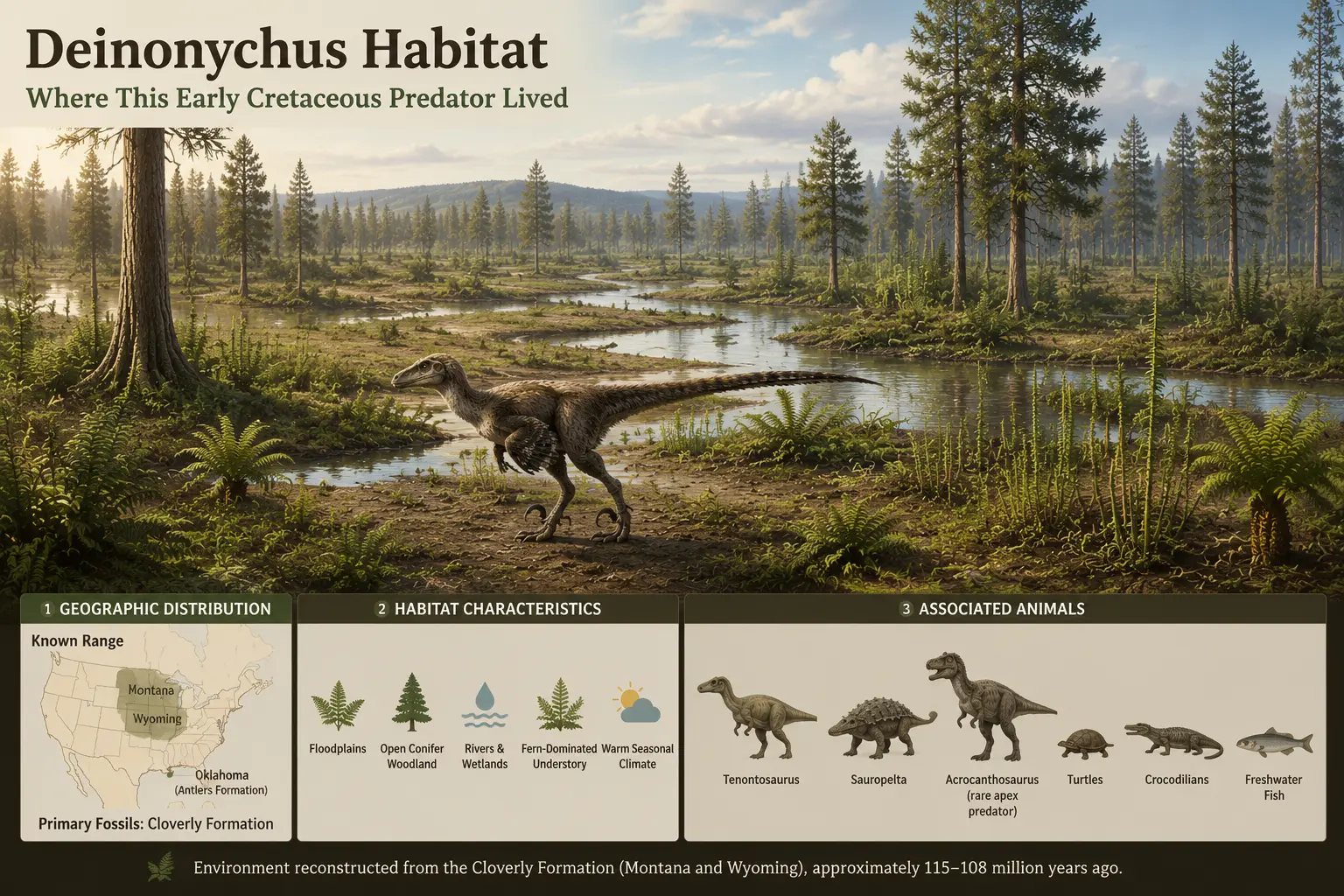
Most Deinonychus fossils have been recovered from the Cloverly Formation of Montana and Wyoming. Additional material has been reported from roughly equivalent Early Cretaceous deposits elsewhere in western North America, including the Antlers Formation of Oklahoma.
These discoveries indicate that Deinonychus occupied a substantial geographic range across portions of the western interior of North America.
Geological Context
| Category | Information |
|---|---|
| Era | Mesozoic |
| Period | Cretaceous |
| Epoch | Early Cretaceous |
| Age Range | 115–108 Ma |
| Major Stages | Aptian–Albian |
| Confidence Level | High |
The environments inhabited by Deinonychus existed during a period of significant ecological change in North America. Flowering plants were becoming increasingly important components of terrestrial ecosystems, while many dinosaur groups were undergoing diversification.
Sedimentary Evidence
| Evidence Type | Interpretation |
|---|---|
| River Deposits | Active fluvial systems |
| Floodplain Sediments | Broad lowland habitats |
| Paleosols | Vegetated terrestrial environments |
| Channel Deposits | Dynamic river networks |
| Fossil Assemblages | Diverse ecosystems |
The sedimentary rocks preserving Deinonychus fossils indicate landscapes dominated by rivers and floodplains. These environments were periodically influenced by flooding and supported a variety of plant and animal communities.
Paleoenvironment
Habitat Characteristics
| Environmental Feature | Likely Condition |
|---|---|
| River Systems | Extensive |
| Floodplains | Common |
| Forest Cover | Present |
| Open Woodlands | Likely |
| Wetlands | Localized |
| Seasonal Variation | Probable |
Current geological and fossil evidence suggests that Deinonychus inhabited river-dominated environments with access to freshwater resources and diverse vertebrate communities. Sedimentological data and associated fossil assemblages indicate floodplains, channel systems, and vegetated terrestrial habitats, although the precise structure of local ecosystems cannot be reconstructed with complete certainty.
Available evidence is consistent with a mosaic of environmental settings that may have included river corridors, forested regions, and more open habitats. However, the relative extent of these environments remains an inference based on geological and paleoecological reconstruction rather than direct observation.
Climate
| Climate Factor | Interpretation |
|---|---|
| Temperature | Warm |
| Frost Occurrence | Rare or absent |
| Precipitation | Moderate to High |
| Vegetation Productivity | High |
| Seasonal Patterns | Likely Present |
Although precise climatic conditions remain difficult to reconstruct, available evidence suggests a generally warm climate capable of supporting extensive vegetation and diverse animal communities.
Associated Fauna
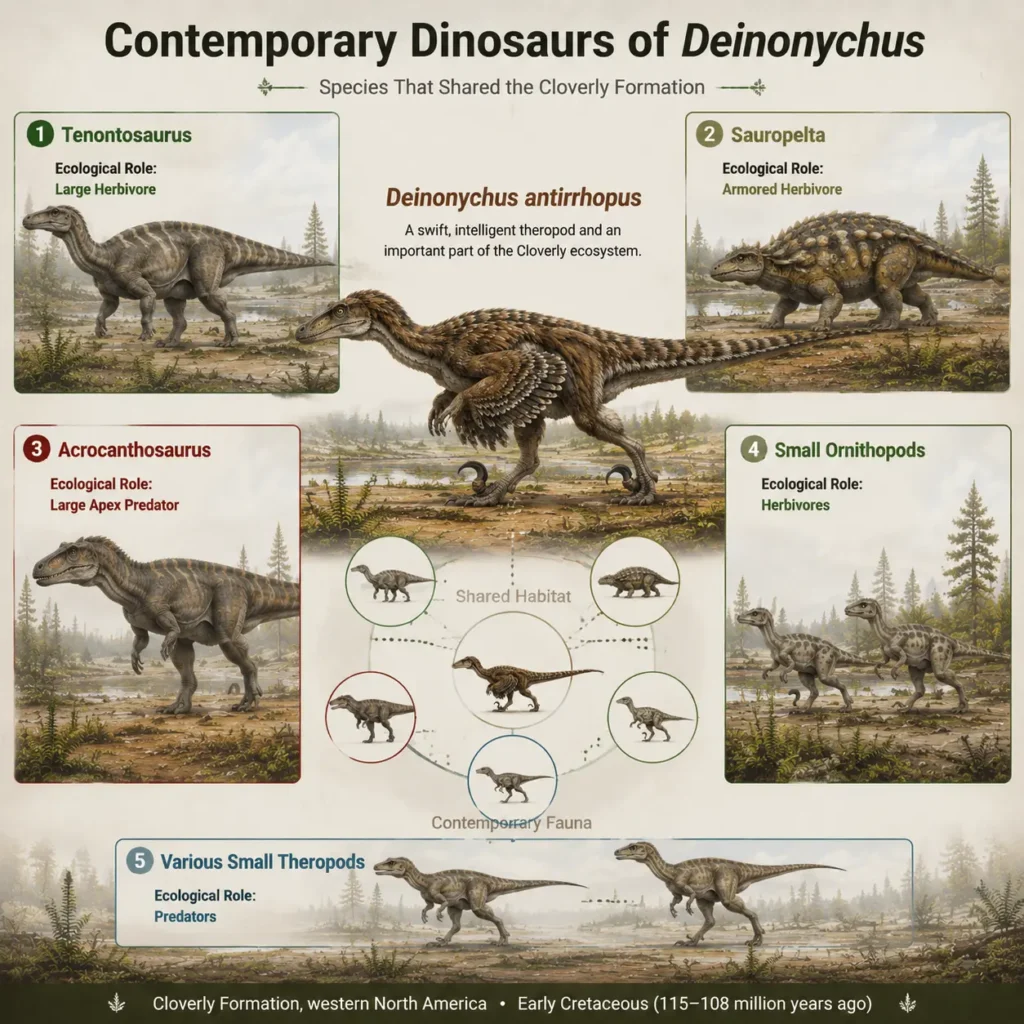
Contemporary Dinosaurs
| Taxon | Ecological Role |
|---|---|
| Tenontosaurus | Large herbivore |
| Sauropelta | Armored herbivore |
| Acrocanthosaurus | Large apex predator |
| Small Ornithopods | Herbivores |
| Various Theropods | Predators |
The most famous ecological association involves Tenontosaurus, which occurs repeatedly in deposits containing Deinonychus remains.
Other Vertebrates
| Group | Presence |
|---|---|
| Crocodilians | Common |
| Turtles | Common |
| Fishes | Common |
| Mammals | Present |
| Amphibians | Present |
| Small Reptiles | Present |
These animals contributed to complex food webs and indicate the presence of stable freshwater ecosystems.
Scientific Interpretation
Ecological Role
| Ecological Characteristic | Assessment |
|---|---|
| Trophic Level | Carnivore |
| Ecosystem Position | Medium-sized predator |
| Habitat Flexibility | Moderate |
| Geographic Range | Broad |
| Environmental Adaptability | Probable |
The available evidence suggests that Deinonychus occupied the ecological role of a versatile terrestrial predator. Its anatomy indicates mobility and hunting capability across a range of terrestrial environments rather than specialization for a narrowly defined habitat.
Why Habitat Matters
Habitat reconstruction helps explain several aspects of Deinonychus biology, including:
- Prey availability
- Predator-prey interactions
- Geographic distribution
- Evolutionary adaptations
- Community structure
The floodplain ecosystems of the Cloverly Formation likely provided abundant opportunities for predation and ecological diversification.
How Do Scientists Reconstruct Ancient Habitats?
Because ancient environments are no longer preserved in their original form, paleontologists reconstruct them using multiple independent lines of geological and biological evidence. Sedimentology reveals whether rocks were deposited by rivers, lakes, floodplains, or other environments, while the arrangement of rock layers provides clues about changes in landscapes through time. Fossil plants, pollen, and spores help identify the types of vegetation that once grew in an area, offering insights into climate and ecosystem structure.
Paleosols (ancient fossil soils) preserve evidence of soil formation, drainage, and seasonal conditions. The remains of associated animals—including dinosaurs, crocodilians, turtles, fishes, mammals, and amphibians—help reconstruct ancient food webs and ecological communities. In some cases, stable isotope analyses of rocks and fossils provide additional information about temperature, rainfall, and water sources. By combining these datasets and comparing them with modern ecosystems that formed under similar conditions, scientists can develop well-supported reconstructions of habitats inhabited by extinct animals such as Deinonychus.
Current Scientific Understanding
Current evidence indicates that Deinonychus inhabited warm, river-dominated environments across parts of western North America during the Early Cretaceous. Fossils occur primarily within the Cloverly Formation and related deposits that preserve extensive floodplains, river channels, and vegetated terrestrial habitats.
Although some details of local environmental conditions remain uncertain, there is broad scientific agreement that Deinonychus lived within productive ecosystems capable of supporting diverse vertebrate communities. These habitats contained numerous herbivorous dinosaurs, freshwater organisms, and other predators, creating complex ecological networks.
The strongest evidence comes from geological and sedimentological data combined with associated fossil assemblages. Together, these sources provide a relatively reliable picture of the environments in which Deinonychus lived.
Evidence Assessment
| Evidence Category | Assessment |
|---|---|
| Geographic Distribution | Strong Direct Evidence |
| Geological Age | Strong Direct Evidence |
| Formation Data | Strong Direct Evidence |
| Paleoenvironment Reconstruction | Moderate to Strong Evidence |
| Climate Interpretation | Moderate Evidence |
| Ecosystem Structure | Moderate Evidence |
| Microhabitat Preferences | Limited Evidence |
Habitat reconstructions are supported by multiple independent lines of geological and paleontological evidence. However, precise details regarding local environmental preferences and seasonal habitat use remain difficult to determine from the available fossil record.
Frequently Asked Questions
Where did Deinonychus live?
Deinonychus lived in western North America during the Early Cretaceous, primarily in regions represented today by Montana, Wyoming, Oklahoma, and Utah.
What type of habitat did Deinonychus inhabit?
Evidence suggests it lived in environments dominated by river systems, floodplains, forests, and open woodland habitats.
Did Deinonychus live in deserts?
There is currently no strong evidence that Deinonychus primarily inhabited desert environments. Most fossil occurrences come from wetter fluvial settings.
Which animals lived alongside Deinonychus?
Known contemporaries include Tenontosaurus, Sauropelta, Acrocanthosaurus, crocodilians, turtles, fishes, mammals, and numerous smaller vertebrates.
References
Primary Taxonomic Sources
Ostrom, J.H. (1969). Osteology of Deinonychus antirrhopus, an unusual theropod from the Lower Cretaceous of Montana. Bulletin of the Peabody Museum of Natural History, 30, 1–165.
Peer-Reviewed Scientific Literature
Maxwell, W.D., & Ostrom, J.H. (1995). Taphonomy and paleoecology of Deinonychus bonebeds from the Cloverly Formation (Lower Cretaceous) of Montana and Wyoming. Palaios, 10(3), 285–298.
Turner, A.H., Makovicky, P.J., & Norell, M.A. (2012). A review of dromaeosaurid systematics and paravian phylogeny. Bulletin of the American Museum of Natural History, 371, 1–206.
Roach, B.T., & Brinkman, D.L. (2007). A reevaluation of cooperative pack hunting and gregariousness in Deinonychus antirrhopus and other nonavian theropod dinosaurs. Bulletin of the Peabody Museum of Natural History, 48(1), 103–138.
Monographs and Academic Books
Weishampel, D.B., Dodson, P., & Osmólska, H. (Eds.). (2004). The Dinosauria (2nd ed.). University of California Press.
Paul, G.S. (2016). The Princeton Field Guide to Dinosaurs (2nd ed.). Princeton University Press.
Holtz, T.R. Jr. (2007). Dinosaurs: The Most Complete, Up-to-Date Encyclopedia for Dinosaur Lovers of All Ages. Random House.
Brusatte, S.L. (2018). The Rise and Fall of the Dinosaurs. William Morrow.
Museum and Institutional Sources
Yale Peabody Museum. Collections and historical information relating to Deinonychus antirrhopus.
United States Geological Survey (USGS). Geological resources relating to Early Cretaceous stratigraphy and sedimentary environments of western North America.
Databases
Paleobiology Database. Occurrence, locality, and taxonomic records for Deinonychus antirrhopus.
The Theropod Database. Taxonomic, anatomical, and bibliographic information for Deinonychus and related dromaeosaurids.
Featured Museum Collections
Museum-quality paleoart and educational poster
collections based on evidence-informed prehistoric
Life reconstructions.