

Styracosaurus shows substantial fossil evidence consistent with gregarious behavior, particularly from bonebeds in the Dinosaur Park Formation of Alberta. However, the fossil record does not establish that Styracosaurus lived in permanent, year-round herds or that its groups had a specific social structure. The strongest conclusion is that Styracosaurus albertensis was capable of forming groups, potentially including multiple age classes, at least under some circumstances.
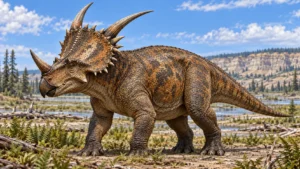
What Evidence Suggests That Styracosaurus Was Social?
The principal evidence comes from concentrations of Styracosaurus albertensis remains in the upper Dinosaur Park Formation of southern Alberta. The species is represented not only by isolated skulls and skeletons but also by bonebed material, including the Styracosaurus Bonebed commonly identified as BB42 and additional bonebed assemblages.
A concentration of individuals from the same taxon is relevant to social behavior because it can preserve animals that were living in proximity before death. However, a bonebed records a death and burial assemblage, not necessarily the complete social organization of the living population.
| Evidence | What it shows | Behavioral significance |
|---|---|---|
| Monodominant Styracosaurus bonebeds | Numerous remains attributable to S. albertensis occur together | Strong evidence for repeated occurrence of multiple individuals in the same depositional setting |
| BB42 material | A substantial concentration of Styracosaurus cranial elements and other remains | Consistent with a group-related accumulation |
| Additional Styracosaurus bonebeds | More than one bonebed is known from the Dinosaur Park Formation | Makes a single unusual aggregation less likely to explain the entire pattern |
| Different ontogenetic stages represented in the species’ bonebed sample | Juvenile/subadult and adult morphology is documented in bonebed material | Compatible with groups containing individuals of different ages |
| Isolated individuals also occur | Styracosaurus is not found exclusively in bonebeds | Shows that solitary fossil occurrences also formed and prevents assuming that every individual lived permanently in a herd |
| Ceratopsid tracksite evidence from the Dinosaur Park Formation | Multiple ceratopsid trackways can occur in association | Provides broader comparative support for gregarious movement, although it is not securely attributable to Styracosaurus |
The cumulative pattern is more informative than any single bonebed. Multiple monodominant centrosaurine bonebeds have been interpreted as evidence for gregarious behavior. A recent study of Dinosaur Park Formation tracksite evidence likewise identified associated ceratopsid trackways as evidence relevant to gregariousness in centrosaurines, although the trackways cannot be securely attributed to Styracosaurus specifically.
What Does the Styracosaurus Bonebed Evidence Actually Mean?
The most defensible interpretation is gregariousness, meaning that individuals could live or move in groups.
This is somewhat narrower than saying that Styracosaurus always lived in large herds.
The distinction is important because fossil bonebeds form through a combination of biological and geological processes. Animals may have aggregated while alive, but their remains can subsequently be concentrated, transported, reworked, or accumulated by environmental processes.
For BB42, Brown, Holmes, and Currie documented extensive variation in Styracosaurus frill morphology within the bonebed. Their analysis treated the assemblage as a penecontemporaneous sample and noted that the observed variation was compatible with a living population rather than requiring a directional evolutionary sequence within the deposit. The same study records BB42 as containing substantial Styracosaurus cranial material.
That evidence is consistent with the presence of a local population represented by the assemblage, but it does not by itself reconstruct the exact size, duration, or organization of the group.
Did Styracosaurus Form Large Herds?
Large-group behavior is plausible, but the exact size of a living Styracosaurus group cannot be securely reconstructed from the known bonebeds.
The strongest evidence is that multiple individuals could become concentrated at the same locality. In the Dinosaur Park Formation, Styracosaurus is represented by several bonebed occurrences rather than a single isolated concentration. Brown and colleagues list BB42 as containing 267 catalogued elements, including parietals, frill elements, squamosals, nasals, postorbitals, and horn material; another Styracosaurus bonebed, BB301, contains 144 listed elements. These counts are skeletal elements, not numbers of animals, so they should not be converted directly into herd size.
Consequently, statements that a particular Styracosaurus bonebed represents hundreds of living animals should not be presented as fact unless a dedicated census and taphonomic reconstruction supports that number.
Were Different Ages Present Together?
The available material is compatible with groups containing individuals at different stages of growth.
Styracosaurus bonebed specimens include immature and adult individuals, and BB42 contains specimens identified as subadult on the basis of cranial morphology and bone texture. Brown et al. used these specimens to document ontogenetic changes in the species.
This is important because an assemblage containing multiple age classes is more readily compatible with a living population than an accumulation consisting exclusively of one narrowly defined age class.
However, the presence of different age classes does not demonstrate a particular family structure. It does not establish that parents remained with offspring, that juveniles were deliberately protected by adults, or that all age classes traveled together continuously.
Could the Bonebeds Have Formed Without Herding?
Yes.
Bonebed interpretation requires taphonomic analysis because a concentration of fossils can have more than one cause. Environmental events such as flooding, water transport, drought-related aggregation, or concentration around particular landscape features can influence where animals and their remains accumulate.
This does not make the social interpretation invalid. Instead, it means that the strength of the behavioral inference depends on the complete geological and taphonomic context.
This distinction is particularly important for Styracosaurus. The existence of a bonebed is evidence of aggregation or concentration at the time represented by the deposit, but aggregation at the time of death is not automatically equivalent to a permanent herd existing throughout the animals’ lives.
For this reason, the strongest formulation is that Styracosaurus has fossil evidence consistent with gregarious behavior, rather than that every bonebed proves a permanent herd.
Were Styracosaurus Groups Permanent?
There is no direct fossil evidence establishing permanent, year-round herds.
A more cautious interpretation is that group formation may have been temporary, seasonal, or context-dependent. A recent study of a ceratopsid tracksite in the Dinosaur Park Formation specifically noted that inferred herding behavior in centrosaurines may have occurred temporarily or at particular times of year.
Possible group formation could therefore have occurred under particular ecological circumstances without requiring Styracosaurus to maintain a permanent herd throughout its life.
The fossil record currently cannot determine how frequently individuals lived alone, in small groups, or in larger aggregations.
Did Styracosaurus Have a Complex Social Hierarchy?
A complex hierarchy has not been demonstrated directly for Styracosaurus.
The species possessed elaborate cranial ornamentation, including a large nasal horn and prominent frill spikes. Such structures are potentially relevant to visual signaling and social interactions, but their presence does not independently demonstrate a hierarchy, dominance system, mating structure, or specific social ranking.
Those questions belong partly to the functional interpretation of the horns and frill and should not be inferred solely from the existence of bonebeds.
Likewise, the variation in frill morphology documented within BB42 should not be interpreted automatically as evidence for male-versus-female differences or dominance status. Much of the observed variation is associated with individual and ontogenetic differences.
What About Protection From Predators?
Group living could potentially have provided ecological benefits such as increased detection of predators or dilution of individual risk, but these benefits are behavioral hypotheses, not directly demonstrated features of Styracosaurus social behavior.
The fossil record does not currently establish that Styracosaurus formed defensive circles, deliberately placed juveniles in the center of groups, or coordinated collective attacks against predators.
These behaviors are sometimes proposed for horned dinosaurs by analogy with living herd-forming animals, but they should not be presented as demonstrated Styracosaurus behavior.
Evidence Assessment
| Question | Evidence strength | Assessment |
|---|---|---|
| Could Styracosaurus aggregate in groups? | High | Multiple bonebed occurrences provide strong evidence for repeated occurrence of multiple individuals in the same depositional settings |
| Was Styracosaurus generally gregarious? | Moderate–High | The bonebed record is consistent with gregarious behavior and fits broader centrosaurine evidence |
| Did groups contain multiple age classes? | Moderate | Immature and adult material occurs in the bonebed sample |
| Did Styracosaurus form large herds? | Moderate | Large concentrations are compatible with this interpretation, but exact living group sizes are uncertain |
| Were herds permanent? | Low / unsupported | No direct evidence establishes year-round herd membership |
| Were groups seasonal or temporary? | Plausible inference | Compatible with bonebed and tracksite evidence, but not demonstrated for Styracosaurus specifically |
| Did Styracosaurus have a formal social hierarchy? | Low / unsupported | No direct evidence establishes a hierarchy |
| Did adults protect juveniles? | Low / unsupported | Possible ecological consequence of group living, but not directly demonstrated |
| Did groups coordinate predator defense? | Low / unsupported | No direct species-specific evidence establishes coordinated defensive behavior |
| Did horns and frills participate in social signaling? | Moderate inference | Cranial ornamentation is consistent with visual/social signaling, but exact behavior remains uncertain |
Current Scientific Understanding
The fossil record supports the interpretation that Styracosaurus albertensis was capable of gregarious behavior. Multiple bonebed occurrences in the Dinosaur Park Formation provide stronger evidence than would a single isolated aggregation, and bonebed material includes individuals representing different stages of growth.
The evidence does not justify reconstructing a rigid or permanent herd system. The fossil record cannot currently establish typical herd size, year-round group membership, family organization, dominance hierarchies, parental care, or coordinated predator defense.
The most evidence-based reconstruction is therefore that Styracosaurus was capable of forming groups, potentially including multiple age classes, while the frequency, duration, and internal organization of those groups remain uncertain.
Evidence Strength
Overall evidence strength: Moderate–High for gregariousness; Low for detailed social structure.
The strongest evidence is the repeated occurrence of Styracosaurus remains in bonebed assemblages within the Dinosaur Park Formation. Interpretation beyond aggregation becomes progressively more inferential. Permanent herding, precise herd size, social hierarchy, parental care, and coordinated defense are not established directly by the current fossil record.
References
Brown, C. M., Holmes, R. B., & Currie, P. J. (2020). A subadult individual of Styracosaurus albertensis (Ornithischia: Ceratopsidae) with comments on ontogeny and intraspecific variation in Styracosaurus and Centrosaurus. Vertebrate Anatomy Morphology Palaeontology, 8, 67–95.
Ryan, M. J., Holmes, R. B., & Russell, A. P. (2007). A revision of the Late Campanian centrosaurine ceratopsid genus Styracosaurus from the Western Interior of North America. Journal of Vertebrate Paleontology, 27(4), 944–962.
Visser, J. (1986). Sedimentology and taphonomy of a Styracosaurus bonebed in the Late Cretaceous Judith River Formation, Dinosaur Provincial Park, Alberta. M.Sc. thesis, University of Calgary.
Wilson, J. P., Ryan, M. J., & Evans, D. C. (2020). A new, transitional centrosaurine ceratopsid from the Upper Cretaceous Two Medicine Formation of Montana and the evolution of the “Styracosaurus-line” dinosaurs. Royal Society Open Science, 7, 200284.
Bell, P. R., Pickles, B. J., Ashby, S. C., Walker, I. E., Hurst, S., Rampe, M., Durkin, P., & Brown, C. M. (2025). A ceratopsid-dominated tracksite from the Dinosaur Park Formation (Campanian) at Dinosaur Provincial Park, Alberta, Canada. PLOS ONE, 20(7), e0324913. https://doi.org/10.1371/journal.pone.0324913
Recommended Paleontology & Natural History Books
As an Amazon Associate, Extinct Atlas may earn from qualifying purchases.
The Rise and Fall of the Dinosaurs
A compelling history of dinosaurs, tracing their origins, diversification, 200-million-year reign, extinction, and enduring legacy.
Dinosaurs and Prehistoric Life
A richly illustrated visual reference exploring dinosaurs, fossils, evolution, and prehistoric life across geological time.
Encyclopedia Prehistorica: Dinosaurs
An interactive dinosaur book featuring spectacular three-dimensional pop-ups, particularly suited to young readers and families.
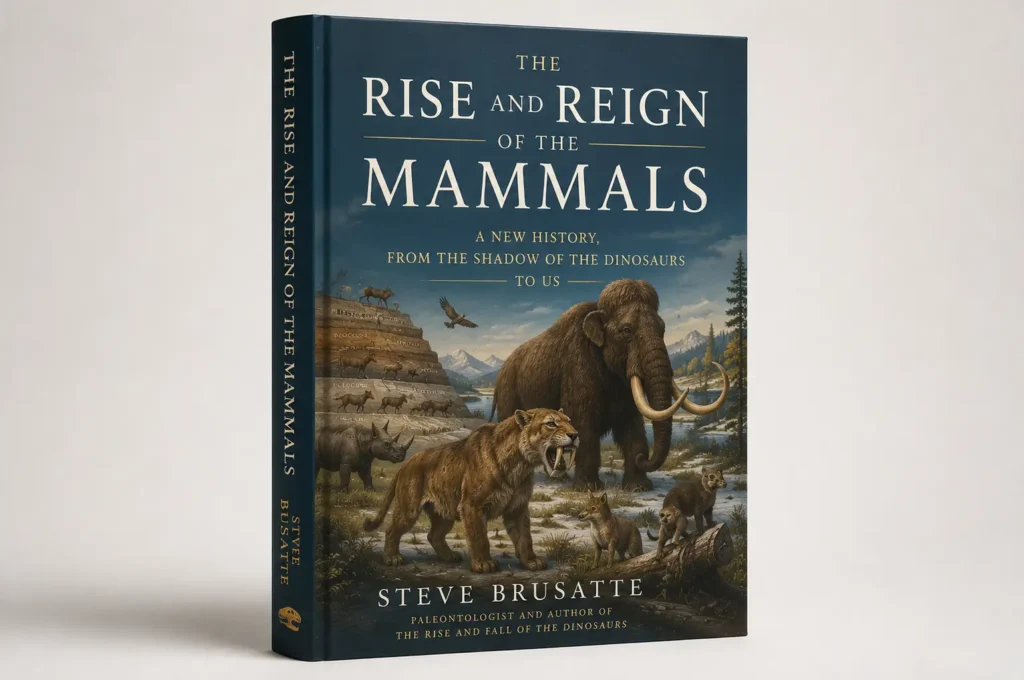
The Rise and Reign of the Mammals
A sweeping history of mammalian evolution, from their origins alongside dinosaurs through the Cenozoic and the emergence of humans.