
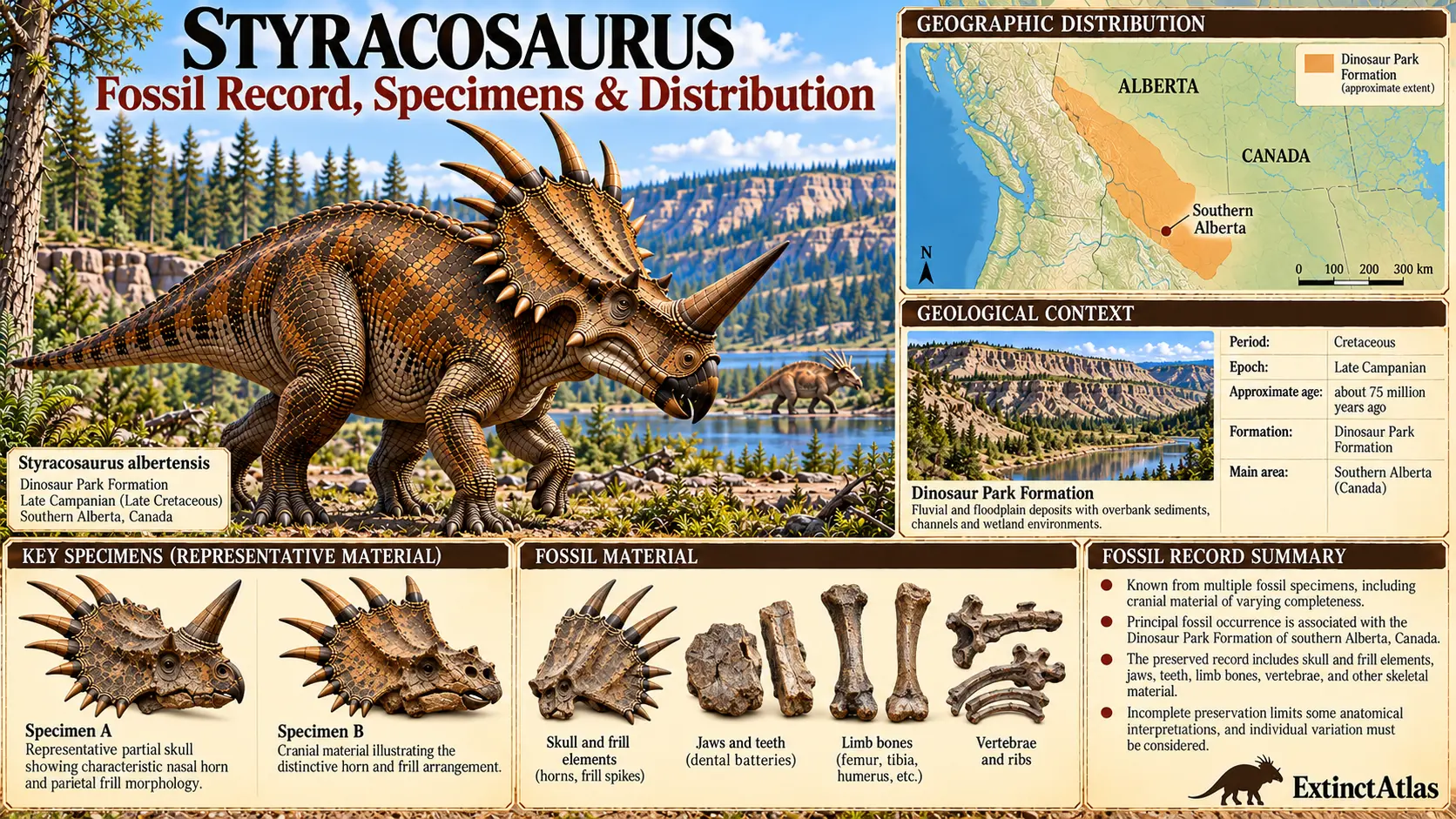
The fossil record of Styracosaurus albertensis is concentrated in the upper Dinosaur Park Formation of southern Alberta, Canada. The record includes the holotype CMN 344, several relatively complete skulls and skeletons, partial skulls and frills, isolated cranial elements, and material from ceratopsid bonebeds.
The stratigraphically distributed specimen sample is particularly useful for documenting anatomical variation through the upper Dinosaur Park Formation. It provides evidence not only for anatomy, but also for changes in cranial morphology through the sampled interval.
The best-supported current species-level distribution is therefore geographically restricted: southern Alberta, principally Dinosaur Provincial Park and nearby areas within the upper Dinosaur Park Formation.
At a Glance
| Fossil-record feature | Current evidence |
|---|---|
| Valid species | Styracosaurus albertensis |
| Type specimen | CMN 344 |
| Type locality | Dinosaur Provincial Park region, Alberta, Canada |
| Principal formation | Dinosaur Park Formation |
| Principal stratigraphic position | Upper Dinosaur Park Formation |
| Geological age | Late Cretaceous, Campanian |
| Principal fossil region | Southern Alberta, Canada |
| Core concentration | Dinosaur Provincial Park and immediate surroundings |
| Additional confirmed region | Sage Creek area, southeastern Alberta |
| Important outlying specimen | UALVP 55900, Matzhiwin Creek near Duchess, Alberta |
| Fossil material | Skulls, frills, postcranial skeletons, isolated elements and bonebed material |
| Major bonebed evidence | Diagnostic Styracosaurus material occurs in mixed ceratopsid bonebeds |
| Montana material | S. ovatus / historically associated material; not treated here as uncomplicated S. albertensis |
| Fossil record certainty | High for Alberta occurrence; substantially lower outside Alberta |
Discovery of Styracosaurus
Styracosaurus was named by Lawrence Morris Lambe in 1913 from material collected in Alberta.
The holotype, CMN 344, was recovered from what is now Dinosaur Provincial Park. It became the principal reference specimen for the species and provided a large amount of anatomical information because the find included the skull and associated postcranial skeleton.
The discovery was especially significant because the skull displayed a combination of a large nasal horn and prominent frill processes that distinguished the animal from other known ceratopsids.
The specimen was subsequently used extensively in anatomical descriptions and reconstructions of Styracosaurus.
The Holotype: CMN 344
CMN 344 is the holotype of Styracosaurus albertensis and remains the central specimen for the species.
It was discovered in 1913 in the Dinosaur Provincial Park region of Alberta. The skull is substantially preserved, and most of the postcranial skeleton is also represented.
| Attribute | CMN 344 |
|---|---|
| Taxon | Styracosaurus albertensis |
| Status | Holotype |
| Collection | Canadian Museum of Nature |
| Discovery | 1913 |
| Region | Dinosaur Provincial Park, Alberta |
| Formation | Dinosaur Park Formation |
| Geological age | Campanian |
| Fossil material | Skull and substantial postcranial skeleton |
| Importance | Type specimen and principal anatomical reference |
The specimen is not an absolutely complete, untouched skeleton. Parts of the skull were incomplete or reconstructed during preparation, and this must be considered when using the specimen for detailed anatomical or size reconstructions.
CMN 344 is nevertheless exceptionally important because it combines substantial cranial and postcranial evidence in a single individual.
Early Additional Material: AMNH 5372
A second historically important specimen is AMNH 5372, collected in 1915 by the American Museum of Natural History expedition.
Barnum Brown and Erich Maren Schlaikjer originally described this material as a separate species, Styracosaurus parksi.
Later taxonomic work synonymized S. parksi with S. albertensis. The specimen’s occurrence in the upper Dinosaur Park Formation supports its close relationship with the type species, although its heavily reconstructed skull makes some detailed morphological comparisons more difficult.
| Attribute | AMNH 5372 |
|---|---|
| Historical identification | Styracosaurus parksi |
| Current treatment | Styracosaurus albertensis |
| Collection | American Museum of Natural History |
| Region | Dinosaur Provincial Park, Alberta |
| Formation | Dinosaur Park Formation |
| Material | Partial skull and substantial postcranial material |
| Importance | Historically important second major skeleton |
The synonymy is important to the fossil record because older literature may list AMNH 5372 under S. parksi. Modern species-level treatments should not count it as evidence for a separate currently recognized species without explaining the historical nomenclature.
Additional Skeletons and Skulls
Later collecting substantially expanded the known fossil record.
Among the most important specimens are:
| Specimen | General material | Significance |
|---|---|---|
| TMP 1986.126.0001 | Skull | Important cranial specimen from the Dinosaur Park Formation |
| TMP 1989.097.0001 | Skull and substantial postcranial skeleton | Large, relatively complete individual; important for anatomy and ontogeny |
| TMP 1988.036.0020 | Partial parietal | High-stratigraphic occurrence |
| TMP 1987.052.0001 | Partial parietal | Upper Dinosaur Park Formation occurrence |
| TMP 2005.012.0058 | Cranial material including nasal horn | Additional adult cranial evidence |
| TMP 2009.080.0001 | Partial skull | Important immature/subadult material |
| UALVP 52612 | Partial skull and postcranial material | Upper Dinosaur Park Formation material |
| UALVP 55900 | Most of skull and partial skeleton | Important large adult from outside the core Dinosaur Provincial Park area |
The known sample therefore extends beyond the original type specimen and includes individuals of different sizes and growth stages.
TMP 1989.097.0001
TMP 1989.097.0001 is particularly important because it includes a substantial skeleton together with cranial material.
The specimen was collected from the upper Dinosaur Park Formation near Sage Creek and represents an individual somewhat smaller and less mature than some of the largest adults.
Its stratigraphic position near the upper part of the formation makes it useful for studying the temporal distribution and morphological variation of S. albertensis.
TMP 2009.080.0001
TMP 2009.080.0001 represents a much smaller individual and has been important for understanding ontogenetic change.
Its skull preserves evidence of the cranial ornamentation in an immature individual, allowing researchers to compare developing horn and frill structures with those of larger adults.
The specimen was collected from the Dinosaur Park Formation in the Princess Coulee area south of Dinosaur Provincial Park.
This specimen is especially important because it demonstrates that the spectacular adult cranial ornamentation of Styracosaurus developed progressively during growth.
UALVP 55900
UALVP 55900, nicknamed “Hanna,” represents one of the more significant recent additions to the Styracosaurus fossil record.
The specimen was discovered in 2015 along Matzhiwin Creek near Duchess, Alberta, approximately 18 km from the western edge of Dinosaur Provincial Park. The skull was prepared and described after excavation, while postcranial preparation has continued.
The specimen is important because it provides another large S. albertensis individual and expands the documented occurrence beyond the core Dinosaur Provincial Park localities.
Its skull also provides important evidence for individual asymmetry and variation in the frill.
UALVP 52612
UALVP 52612 represents another Styracosaurus occurrence within Dinosaur Provincial Park.
It was collected from the upper part of the Dinosaur Park Formation and includes a partial skull and associated postcranial material.
Together with the other upper-formation specimens, it contributes to the evidence that S. albertensis was concentrated in the upper part of the formation rather than being distributed uniformly through the entire Dinosaur Park Formation.
Bonebed Evidence
The fossil record includes Styracosaurus material from bonebeds as well as isolated individuals.
One historically important locality is Bonebed 42, which contains diagnostic Styracosaurus material within a mixed ceratopsid and hadrosaur assemblage.
The 2007 revision emphasized an important distinction: not every historical “Styracosaurus bonebed” designation remained valid after re-examination. Some reported bonebeds contain non-diagnostic ceratopsid material that cannot securely be assigned to Styracosaurus.
This distinction is essential because fragmentary frill elements can be difficult to distinguish from those of other centrosaurines when diagnostic characters are absent.
Representative Bonebed Material
| Bonebed/locality | Evidence status |
|---|---|
| Bonebed 42 | Diagnostic Styracosaurus material documented |
| Princess Coulee bonebed material | Styracosaurus material represented |
| Fryerberg bonebed material | Styracosaurus material represented |
| Some historically reported bonebeds | Require caution because diagnostic assignment may not be secure |
| Undiagnostic centrosaurid fragments | Should not automatically be assigned to Styracosaurus |
A bonebed containing Styracosaurus fossils does not by itself establish a single catastrophic event, permanent herd structure, or a particular social behavior. Those interpretations belong to the separate social-behavior question-led spoke.
Stratigraphic Distribution
The strongest species-level fossil evidence places Styracosaurus albertensis in the upper part of the Dinosaur Park Formation.
This stratigraphic distribution is one of the most important features of the fossil record.
The 2007 revision found S. albertensis concentrated in the upper approximately 20–30 m of the Dinosaur Park Formation, while later work refined the specimen-level stratigraphic record.
The 2020 Wilson, Ryan and Evans study concluded that S. albertensis is known solely from the upper Dinosaur Park Formation of Alberta.
| Stratigraphic position | S. albertensis evidence |
|---|---|
| Lower Dinosaur Park Formation | Not securely documented |
| Middle Dinosaur Park Formation | Not the principal occurrence |
| Upper Dinosaur Park Formation | Main fossil record |
| Uppermost Dinosaur Park Formation | Several important occurrences |
| Lethbridge Coal Zone vicinity | Highest occurrences occur below or relative to the uppermost dated interval |
| Two Medicine Formation | Not assigned here to S. albertensis |
Temporal Range
The fossil record places S. albertensis in the Campanian Stage of the Late Cretaceous.
A radiometric date of approximately 76.1 Ma has been reported from the Lethbridge Coal Zone at the top of the Dinosaur Park Formation. Because the highest S. albertensis specimens occur below that dated horizon, the highest occurrences of the species are slightly older than 76.1 Ma under this stratigraphic framework.
This is a stratigraphic constraint, not a direct radiometric date obtained from a Styracosaurus bone.
The distinction is important when reporting numerical ages.
Stratigraphic Pattern Within the Species
The stratigraphic sample contains specimens at several levels within the upper Dinosaur Park Formation.
Comparative analysis has identified possible morphological trends through the stratigraphic sequence, including changes in the shape of the posterior median parietal embayment and variation in the P5 process.
These observations have contributed to discussions of morphological change through time within S. albertensis.
However, stratigraphic trends should not automatically be interpreted as evolutionary transformation without considering individual variation, ontogeny, preservation, and sampling.
Geographic Distribution
The strongest confirmed distribution of S. albertensis is geographically restricted.
Most specimens come from:
- Dinosaur Provincial Park and nearby areas of southern Alberta;
- the Sage Creek region of southeastern Alberta;
- other documented localities within southern Alberta, including Matzhiwin Creek near Duchess.
One important occurrence, TMP 1989.097.0001, comes from the Sage Creek badlands approximately 130 km southeast of the holotype locality.
Another important occurrence, UALVP 55900, comes from Matzhiwin Creek near Duchess, Alberta, approximately 18 km from the western edge of Dinosaur Provincial Park.
Thus, the fossil record extends beyond a single quarry or park locality, but remains concentrated within southern Alberta.
| Region | S. albertensis status |
|---|---|
| Dinosaur Provincial Park, Alberta | Strongly confirmed |
| Immediate Dinosaur Provincial Park region | Strongly confirmed |
| Sage Creek, southeastern Alberta | Strongly confirmed by referred specimen |
| Matzhiwin Creek near Duchess, Alberta | Strongly supported by UALVP 55900 |
| Other southern Alberta localities | Some material referred to or compared with Styracosaurus |
| Montana | Not treated as uncomplicated S. albertensis |
| Other U.S. regions | No secure species-level occurrence established |
Styracosaurus and Montana Material
The historical fossil record of Styracosaurus includes USNM 11869, originally described as Styracosaurus ovatus from the Two Medicine Formation of Montana.
Its taxonomic history is complex.
The 2007 revision retained S. ovatus as a valid species, while subsequent work has proposed alternative interpretations of its relationship to S. albertensis. Wilson, Ryan and Evans (2020) retained S. ovatus as a distinct species and treated the Montana form as separate from S. albertensis.
For this reason, Montana should not be presented on the S. albertensis distribution map as though it were an uncontested extension of the Alberta species.
The fossil-record page should instead distinguish:
- confirmed S. albertensis in Alberta;
- historically associated Styracosaurus material from Montana; and
- competing taxonomic interpretations.
The Styracosaurus ovatus Problem
USNM 11869 consists principally of a partial frill and was originally described as Styracosaurus ovatus.
It was later assigned to the genus Rubeosaurus and has subsequently been incorporated into different phylogenetic and taxonomic interpretations.
The 2020 analysis by Wilson, Ryan, and Evans retained S. ovatus as a separate species and emphasized differences in parietal ornamentation and stratigraphic position.
This means that the phrase “Styracosaurus fossils are found in Alberta and Montana” is potentially misleading if it implies that both regions represent the same current species.
For the S. albertensis fossil record, Alberta is the secure geographic foundation.
Fossil Record and Taxonomic Confidence
Not every fossil historically labeled Styracosaurus should be included in the modern species sample.
Fragmentary centrosaurine material can be difficult to identify when the diagnostic parts of the skull are missing. In particular, isolated frill fragments and remodeled supraorbital elements may not preserve enough information to distinguish Styracosaurus from other centrosaurines.
The 2007 revision specifically reassessed older museum material and cautioned that some previously assigned specimens lacked adequate locality, stratigraphic, or morphological information.
This creates an important hierarchy:
| Evidence level | Interpretation |
|---|---|
| Diagnostic specimen | Secure species occurrence |
| Fragmentary but informative specimen | Qualified referral |
| Non-diagnostic centrosaurid fragment | Not secure evidence for S. albertensis |
Representative Fossil Record
| Specimen/locality | Region | Formation | Material | Record significance |
|---|---|---|---|---|
| CMN 344 | Dinosaur Provincial Park, Alberta | Dinosaur Park Formation | Skull and postcranial skeleton | Holotype |
| AMNH 5372 | Dinosaur Provincial Park, Alberta | Dinosaur Park Formation | Partial skull and substantial skeleton | Historically S. parksi; now generally treated as S. albertensis |
| TMP 1986.126.0001 | Dinosaur Provincial Park, Alberta | Dinosaur Park Formation | Skull | Important cranial specimen |
| TMP 1989.097.0001 | Sage Creek region, Alberta | Dinosaur Park Formation | Skull and substantial skeleton | Major outlying Alberta occurrence |
| TMP 1988.036.0020 | Dinosaur Provincial Park region | Dinosaur Park Formation | Partial parietal | Upper-formation occurrence |
| TMP 1987.052.0001 | Dinosaur Provincial Park region | Dinosaur Park Formation | Partial parietal | Upper-formation occurrence |
| TMP 2005.012.0058 | Dinosaur Provincial Park, Alberta | Dinosaur Park Formation | Cranial material including horn | Additional adult evidence |
| TMP 2009.080.0001 | Princess Coulee, Alberta | Dinosaur Park Formation | Partial skull | Important immature specimen |
| UALVP 52612 | Dinosaur Provincial Park, Alberta | Dinosaur Park Formation | Partial skull and postcranial material | Upper-formation occurrence |
| UALVP 55900 | Matzhiwin Creek near Duchess, Alberta | Dinosaur Park Formation | Most of skull and partial skeleton | Major additional adult specimen |
| Bonebed 42 | Dinosaur Provincial Park, Alberta | Dinosaur Park Formation | Diagnostic ceratopsid material | Important bonebed occurrence |
| USNM 11869 | Montana | Two Medicine Formation | Partial frill | S. ovatus; taxonomically separate in the current treatment |
Fossil Record and Preservation
The Styracosaurus record is dominated by skeletal material rather than soft tissues.
The most informative specimens preserve combinations of skull and postcranial bones. Skull material is especially abundant because the elaborate frill and robust cranial bones provide conspicuous diagnostic elements.
Nevertheless, many isolated fossils are incomplete.
Consequently, the fossil record should not be represented as though every individual provides the same anatomical or taxonomic information.
A nearly complete skeleton can establish relationships among anatomical regions that isolated bones cannot. Conversely, a partial frill may preserve a highly diagnostic character even when most of the skeleton is absent.
What the Fossil Record Establishes
| Question | Evidence assessment |
|---|---|
| Where is S. albertensis securely known? | Southern Alberta, especially the upper Dinosaur Park Formation |
| Is CMN 344 the type specimen? | Yes |
| Is the species represented by multiple individuals? | Yes |
| Are both skull and postcranial fossils known? | Yes |
| Are immature individuals known? | Yes |
| Are bonebed occurrences known? | Yes |
| Is the species concentrated in the upper Dinosaur Park Formation? | Yes |
| Does the fossil record extend beyond Dinosaur Provincial Park? | Yes, within southern Alberta |
| Is Montana securely part of the S. albertensis distribution? | No |
| Is S. ovatus automatically synonymous with S. albertensis? | No; taxonomic interpretations differ |
| Can every historical Styracosaurus referral be accepted? | No |
| Does every bonebed prove herd behavior? | No |
Evidence Assessment
| Fossil-record topic | Evidence strength | Assessment |
|---|---|---|
| Holotype CMN 344 | Very high | Direct, diagnostic type material |
| Alberta occurrence | Very high | Multiple diagnostic specimens |
| Upper Dinosaur Park Formation occurrence | Very high | Repeated stratigraphically documented specimens |
| Dinosaur Provincial Park concentration | Very high | Numerous specimens and bonebed material |
| Sage Creek occurrence | High | Well-documented diagnostic specimen |
| Matzhiwin Creek occurrence | High | UALVP 55900 provides important additional evidence |
| Multiple growth stages | High | Adult and subadult specimens documented |
| Bonebed occurrence | High | Diagnostic material present in documented bonebeds |
| Exact total number of individuals | Moderate | Collection and referral boundaries vary |
| Exact geographic limits | Moderate | Sampling and taxonomic identification constrain the record |
| Exact numerical temporal range | Moderate | Stratigraphic framework is strong, but numerical boundaries are indirect |
| Montana as S. albertensis | Low/contested | Depends on taxonomic interpretation |
| All historical museum referrals | Low | Some material is non-diagnostic or inadequately documented |
Scientific Uncertainty
Three limitations are particularly important when interpreting the fossil record of Styracosaurus.
1. Fragmentary material
Many centrosaurine fossils consist only of isolated cranial elements. Without diagnostic morphology, these specimens cannot always be assigned confidently to S. albertensis.
2. Stratigraphic sampling
The Dinosaur Park Formation has been extensively sampled, but fossil abundance is not equivalent to continuous sampling through time. Apparent gaps or changes in abundance may reflect preservation, collecting history, or depositional conditions.
3. Taxonomic interpretation
The treatment of historically named forms such as S. parksi and S. ovatus has changed through time.
A modern fossil-record summary therefore needs to distinguish historical identifications from the current species framework rather than simply reproducing every historical occurrence.
Current Scientific Understanding
The secure fossil record of Styracosaurus albertensis is centered on the upper Dinosaur Park Formation of southern Alberta.
CMN 344, the 1913 holotype, provides the foundational skull and postcranial evidence. Subsequent specimens—including AMNH 5372, TMP 1986.126.0001, TMP 1989.097.0001, TMP 2009.080.0001, UALVP 52612 and UALVP 55900—have expanded the known anatomical, ontogenetic, and geographic sample.
The record also includes diagnostic material from bonebeds, although some historically reported Styracosaurus bonebeds contain non-diagnostic centrosaurine material and therefore require caution.
Stratigraphically, the species is concentrated in the upper part of the Dinosaur Park Formation. The highest occurrences are slightly older than the approximately 76.1 Ma date associated with the Lethbridge Coal Zone at the top of the formation; this is an indirect stratigraphic constraint rather than a direct date from a Styracosaurus fossil.
The current species-level distribution should therefore be presented conservatively: southern Alberta, Canada, principally the upper Dinosaur Park Formation.
Montana material historically assigned to Styracosaurus should be handled separately because S. ovatus has a distinct taxonomic history and is retained as a separate species in the Wilson, Ryan and Evans treatment.
The fossil record consequently provides strong evidence for the occurrence, stratigraphic position, and specimen diversity of S. albertensis, while leaving some historical referrals and the exact limits of its geographic and temporal range subject to taxonomic and stratigraphic refinement.
References
Lambe, L. M. (1913). A new genus and species of horned dinosaur from the Belly River Formation of Alberta. Ottawa Naturalist, 27, 109–116.
Brown, B., & Schlaikjer, E. M. (1937). The skeleton of Styracosaurus with the description of a new species. American Museum Novitates, 955, 1–15.
Ryan, M. J., Holmes, R. B., & Russell, A. P. (2007). A revision of the Late Campanian centrosaurine ceratopsid genus Styracosaurus from the Western Interior of North America. Journal of Vertebrate Paleontology, 27(4), 944–962.
Holmes, R. B., & Ryan, M. J. (2013). The postcranial skeleton of Styracosaurus albertensis. Kirtlandia, 58, 5–37.
Brown, C. M., Holmes, R. B., & Currie, P. J. (2020). A subadult individual of Styracosaurus albertensis with comments on ontogeny and intraspecific variation in Styracosaurus and Centrosaurus. Vertebrate Anatomy Morphology Palaeontology, 8, 67–95.
Holmes, R. B., Persons, W. S., Rupal, B. S., Qureshi, A. J., & Currie, P. J. (2020). Morphological variation and asymmetrical development in the skull of Styracosaurus albertensis. Cretaceous Research, 107, 104308.
Wilson, J. P., Ryan, M. J., & Evans, D. C. (2020). A new, transitional centrosaurine ceratopsid from the Upper Cretaceous Two Medicine Formation of Montana and the evolution of the “Styracosaurus-line” dinosaurs. Royal Society Open Science, 7, 200284.
Recommended Paleontology & Natural History Books
As an Amazon Associate, Extinct Atlas may earn from qualifying purchases.
The Rise and Fall of the Dinosaurs
A compelling history of dinosaurs, tracing their origins, diversification, 200-million-year reign, extinction, and enduring legacy.
Dinosaurs and Prehistoric Life
A richly illustrated visual reference exploring dinosaurs, fossils, evolution, and prehistoric life across geological time.
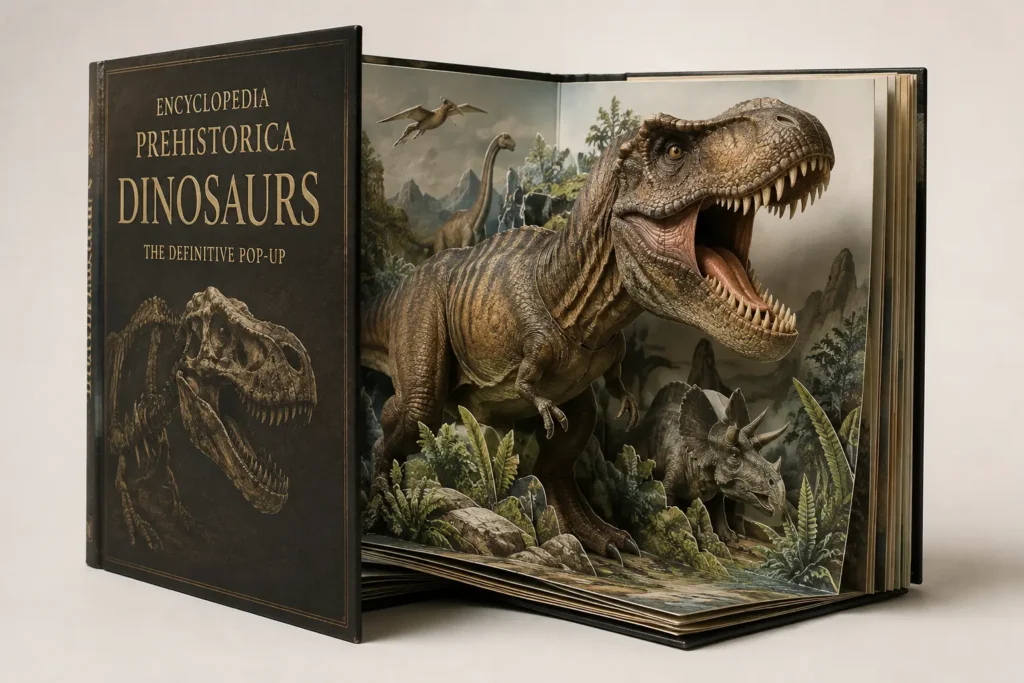
Encyclopedia Prehistorica: Dinosaurs
An interactive dinosaur book featuring spectacular three-dimensional pop-ups, particularly suited to young readers and families.
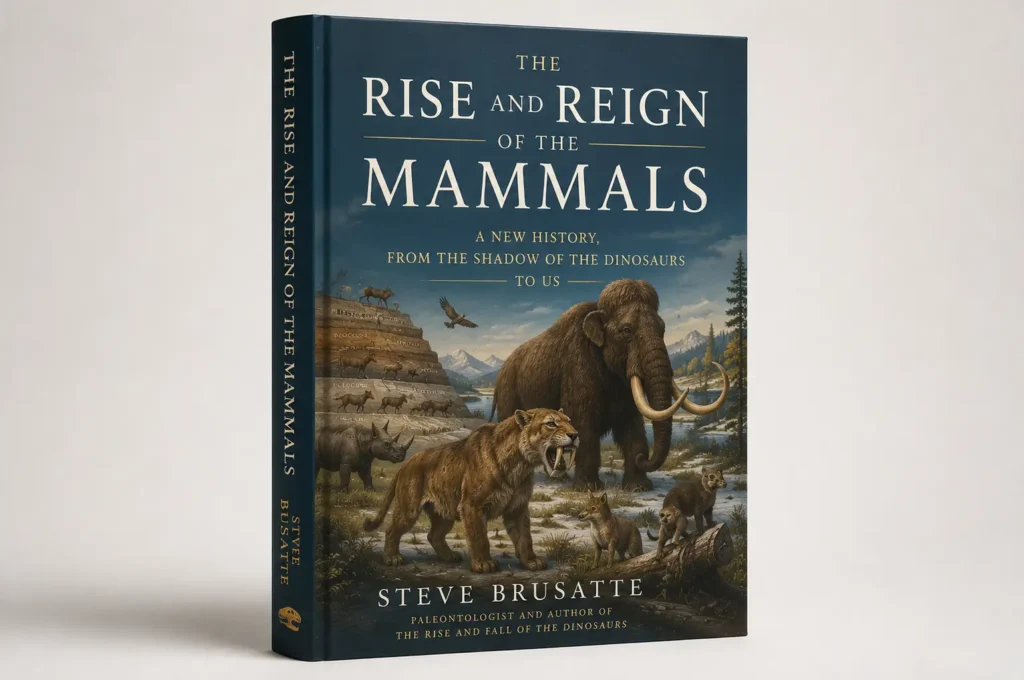
The Rise and Reign of the Mammals
A sweeping history of mammalian evolution, from their origins alongside dinosaurs through the Cenozoic and the emergence of humans.