
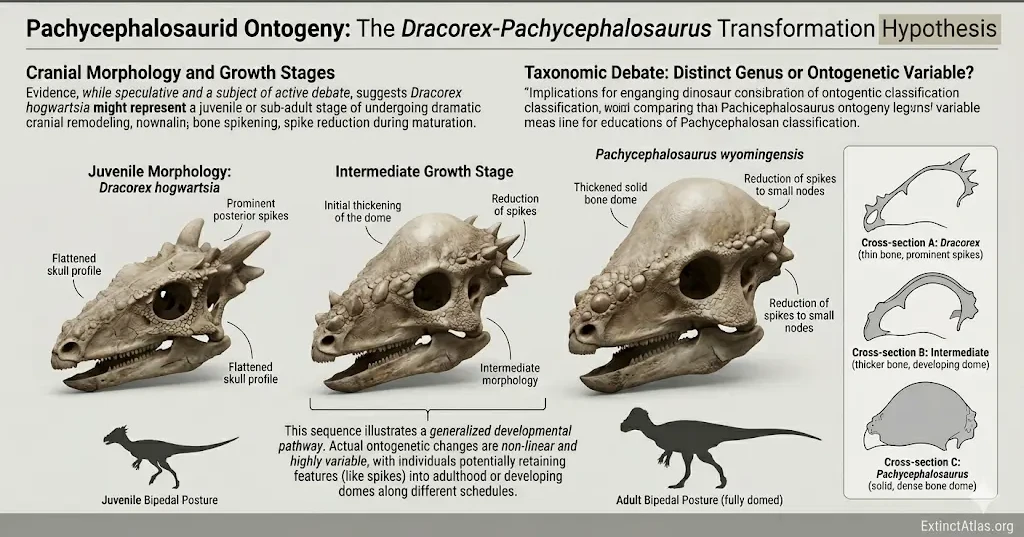
One of the most significant debates in pachycephalosaur paleontology centers on whether Dracorex hogwartsia and Stygimoloch spinifer—two dinosaurs with dramatically different skull shapes from Pachycephalosaurus—represent distinct species or simply juvenile and subadult growth stages of Pachycephalosaurus wyomingensis. If the ontogenetic (growth-based) hypothesis is correct, it would eliminate two dinosaur species from the fossil record while revealing one of the most dramatic skull transformations known in any vertebrate.
The Three Skull Forms
The debate exists because three very different skull types have been found in the same geological formation (Hell Creek Formation, Late Cretaceous) and time period, all belonging to pachycephalosaurs of similar overall body proportions but with strikingly different cranial features.
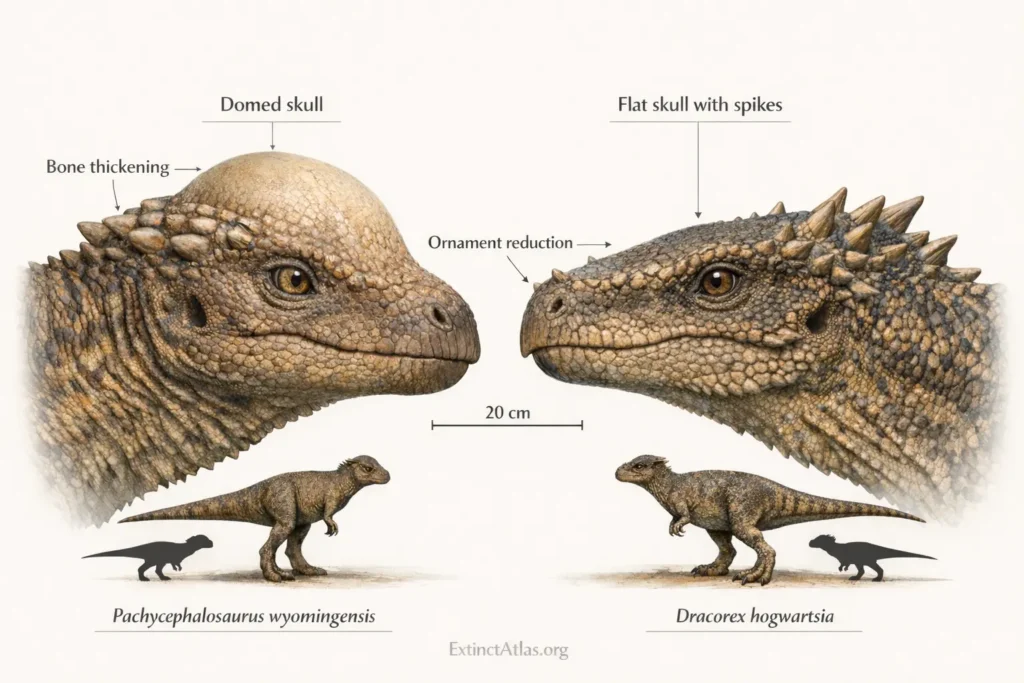
Dracorex hogwartsia: Named in 2006 from a single well-preserved skull found in South Dakota, Dracorex (meaning “dragon king of Hogwarts,” named by young visitors to the Indianapolis Children’s Museum) possesses a flat skull roof with no dome development. Instead, the skull is adorned with prominent bony spikes and horns projecting backward and to the sides, giving it a dragon-like appearance. The skull is relatively small, suggesting a younger or smaller individual.
Stygimoloch spinifer: Described in 1983 based on material from Montana and Wyoming, Stygimoloch (meaning “demon from the river Styx”) shows an intermediate skull form. It possesses a partially developed dome that rises above the skull roof but is much less pronounced than in adult Pachycephalosaurus. The skull retains prominent spikes, particularly around the back of the skull, though they are somewhat reduced compared to Dracorex. The overall skull is larger than that of Dracorex but smaller than that of adult Pachycephalosaurus.
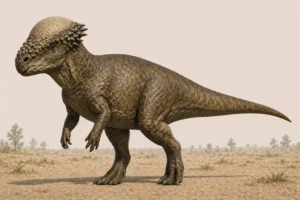
Pachycephalosaurus wyomingensis: The classic form, with a fully developed, thick skull dome reaching up to 25 centimeters thick, minimal to no bony spikes or ornamentation, and a smooth, rounded skull profile. These specimens are consistently the largest of the three forms.
| Feature | Dracorex | Stygimoloch | Pachycephalosaurus |
|---|---|---|---|
| Dome development | Absent (flat skull) | Partial (low dome) | Full (high, thick dome) |
| Bony spikes/horns | Prominent and numerous | Moderate, partially resorbed | Minimal or absent |
| Skull size | Smallest | Intermediate | Largest |
| Specimens known | Very few (primarily one complete skull) | Several partial skulls | Multiple specimens, mostly fragmentary |
These three forms were initially interpreted as three separate species, each occupying slightly different ecological niches or time periods within the Hell Creek ecosystem.
Jack Horner’s Ontogenetic Hypothesis
In 2009, paleontologist Jack Horner and his colleague Mark Goodwin published a study proposing that all three forms represent growth stages of a single species: Pachycephalosaurus wyomingensis. According to this hypothesis, Dracorex represents the juvenile stage, Stygimoloch the subadult stage, and classic Pachycephalosaurus the fully mature adult.
The hypothesis was based on several lines of evidence:
- Histological analysis: Bone microstructure examination of Dracorex and Stygimoloch specimens revealed tissue patterns consistent with actively growing, immature animals. The bone showed extensive vascularization and the fibrolamellar bone type associated with rapid juvenile growth, rather than the slower-growing bone seen in mature adults.
- Continuous morphological spectrum: When skulls were arranged by size from smallest to largest, they formed a continuous series of forms from flat-skulled Dracorex through partially domed Stygimoloch to fully domed Pachycephalosaurus, with no clear gaps or discontinuities. This pattern matches what would be expected from an ontogenetic sequence rather than distinct species.
- Ornament remodeling: The reduction and eventual disappearance of bony spikes from juveniles to adults requires active bone resorption—a process documented in the growth of other dinosaurs and modern animals. Evidence of bone resorption is visible on intermediate specimens, showing the spikes being broken down and the bone surface smoothing as dome development proceeds.
- Stratigraphic and geographic overlap: All three forms occur in the same geological formation and time period, with no evidence of temporal or spatial separation that would be expected if they were separate species filling different ecological roles or occupying different time slices.
TIER 2 EVIDENCE: The ontogenetic hypothesis is supported by multiple independent lines of evidence and has gained wide acceptance in the paleontological community. However, sample sizes remain limited, particularly for Dracorex (known primarily from one excellent skull), and some researchers continue to question whether all observed variation can be explained by growth alone.
Evidence Supporting the Ontogenetic Model
Beyond Horner and Goodwin’s initial proposal, additional evidence has accumulated supporting the single-species interpretation:
- Lack of coexistence evidence: Despite extensive collecting in the Hell Creek Formation, no site has yielded definitive evidence of adult Dracorex or Stygimoloch coexisting with adult Pachycephalosaurus in a way that would demonstrate they were distinct, contemporaneous species. All three forms occur in the same deposits, but size distributions suggest growth stages rather than separate species.
- Comparison with other dinosaur growth series: Well-documented growth series in other dinosaurs, such as Tyrannosaurus rex and hadrosaurs, show similarly dramatic changes in skull proportions and ornamentation as animals mature. The Dracorex-to-Pachycephalosaurus transformation is unusual but not unprecedented.
- Biomechanical constraints: The shift from flat-skulled juveniles with defensive spikes to domed adults with reduced ornamentation makes functional sense. Juveniles, more vulnerable to predation, benefit from spiky deterrents. Adults, engaged in intraspecific competition, invest in dome development for display or combat while resorbing metabolically expensive spikes that no longer provide significant defensive value against predators large enough to threaten them.
- Phylogenetic analysis: When the three forms are included in phylogenetic analyses as separate species, they consistently group as extremely close relatives—far more closely related to each other than to any other pachycephalosaur. This tight clustering is consistent with them being growth stages of a single lineage rather than distinct evolutionary branches.
The 2018 discovery of additional juvenile pachycephalosaur material with intermediate characteristics has further supported the ontogenetic model, showing specimens that fall between the classic Dracorex and Stygimoloch morphologies in ways consistent with continuous developmental change.
Counterarguments and Skepticism
Despite widespread acceptance of the ontogenetic hypothesis, some researchers remain skeptical or suggest the evidence is not yet conclusive:
- Limited sample size: The primary Dracorex material consists of a single, exceptionally well-preserved skull. Basing an entire growth stage interpretation on one specimen is scientifically precautionary, particularly given natural variation within species. Additional Dracorex-like specimens are needed to confirm the morphology is consistent across multiple individuals rather than representing individual variation or pathology.
- Extreme morphological transformation: The remodeling required to transform a flat, spiky Dracorex skull into a smooth, domed Pachycephalosaurus skull represents one of the most dramatic ontogenetic changes known in vertebrates. While not impossible, skeptics argue this level of transformation should be demonstrated with more intermediate specimens before being accepted as definitive.
- Potential for sexual dimorphism: Some researchers propose that at least some of the variation could reflect sexual differences (males vs. females) rather than age differences. In this model, one sex might retain reduced dome development and more extensive ornamentation throughout life, while the other develops the classic thick dome. However, no method currently exists to reliably sex pachycephalosaur specimens, making this hypothesis difficult to test.
- Taxonomic conservatism: Paleontology has historically been cautious about synonymizing species without overwhelming evidence. The burden of proof lies with demonstrating that separate names should be collapsed into one species, rather than maintaining them as distinct until proven otherwise. Some researchers prefer to maintain Dracorex and Stygimoloch as valid pending additional specimens and analyses.
- Possible niche partitioning: While less commonly argued, some researchers have suggested the three forms could represent closely related species that partitioned resources or habitats within the Hell Creek ecosystem, explaining their morphological and temporal overlap while maintaining species boundaries.
TIER 3 EVIDENCE: Definitive proof of the ontogenetic hypothesis would require finding a bone bed or death assemblage with multiple individuals showing the complete growth series together, or discovering a single individual at an intermediate growth stage that unambiguously shows transitional features. Such discoveries would eliminate alternative explanations, but they have not yet been made.
Implications for Pachycephalosaur Diversity
If the ontogenetic hypothesis is correct, it has significant implications for understanding pachycephalosaur diversity in the Late Cretaceous of North America.
The Hell Creek Formation, once thought to contain three pachycephalosaur species, would be reduced to just one: Pachycephalosaurus wyomingensis. This would make Pachycephalosaurus the sole dome-headed dinosaur in its ecosystem, rather than one of several coexisting forms.
This reduced diversity might reflect ecological constraints—perhaps the Hell Creek ecosystem could support only one large herbivorous pachycephalosaur, with competition excluding other species. Alternatively, it might indicate that dome-headed dinosaurs were genuinely rare components of their ecosystems, with individual species occupying large geographic ranges rather than multiple species coexisting locally.
The synonymization also affects our understanding of pachycephalosaur evolution more broadly. The Middle Campanian deposits (slightly older than Hell Creek) preserve multiple pachycephalosaur genera, suggesting higher diversity earlier in the Late Cretaceous. If later faunas contained only a single species, it might indicate declining diversity approaching the end-Cretaceous extinction, though this pattern could also reflect incomplete fossil sampling.
Current Scientific Consensus
TIER 2 EVIDENCE: Scientific consensus in paleontology is measured through peer-reviewed publications, conference presentations, and treatment in technical literature. The assessment below reflects the majority view as of 2025 but does not represent unanimous agreement.
As of 2025, the majority of pachycephalosaur specialists and paleontologists working on Hell Creek fauna accept the ontogenetic hypothesis as the most parsimonious (simplest) explanation for the observed variation. Major reference works, including technical paleontology handbooks and museum displays, increasingly treat Dracorex and Stygimoloch as junior synonyms of Pachycephalosaurus.
However, this remains an active research area. Discoveries of additional specimens, particularly complete skulls at various growth stages, could either strengthen the consensus or reveal variation inconsistent with the simple ontogenetic model. Some taxonomic databases maintain all three names pending further evidence, reflecting the ongoing uncertainty.
The debate illustrates a broader challenge in dinosaur paleontology: distinguishing ontogenetic variation, sexual dimorphism, individual variation, and genuine species-level differences when working with fragmentary fossils from extinct animals whose biology and behavior cannot be directly observed.
How Ontogenetic Remodeling Works
The transformation from Dracorex to Pachycephalosaurus requires extensive bone remodeling—the simultaneous deposition of new bone in some areas (dome growth) and resorption of existing bone in others (spike reduction).
Bone remodeling is a normal biological process in vertebrates, controlled by two cell types: osteoblasts (which build bone) and osteoclasts (which break down bone). During growth, these cells respond to hormonal signals, mechanical stress, and developmental programming to reshape skeletal elements.
In Pachycephalosaurus, dome development involves massive bone deposition on the skull roof, with osteoblasts laying down layer after layer of compact bone tissue. Simultaneously, the bony spikes present in juveniles undergo resorption, with osteoclasts breaking down the spike bone and allowing it to be remodeled into the smooth adult skull surface.
This process requires significant metabolic investment. Bone tissue is metabolically expensive to produce, and the calcium and phosphorus needed for dome construction must be obtained from the diet or mobilized from other skeletal elements. The evolutionary benefit of dome development must have outweighed these costs for the trait to persist.
Modern analogs exist in deer antler growth, though antlers are annual structures that are shed and regrown each year, whereas the Pachycephalosaurus dome was permanent. Nonetheless, antler growth demonstrates that rapid bone deposition and shaping are biologically feasible in vertebrates.
What This Debate Teaches Us About Paleontology
- The Dracorex/Stygimoloch/Pachycephalosaurus debate exemplifies several important principles in paleontological research:
- The importance of growth series: Understanding dinosaur biology requires specimens of different ages, not just adults. Juvenile and subadult material provides critical context for interpreting adult anatomy and reveals developmental processes invisible when only mature animals are known.
- Limitations of fragmentary material: Much of the debate stems from the rarity of complete pachycephalosaur skulls. With more specimens, particularly complete skulls spanning the entire size range, the question could be resolved more definitively. Paleontology frequently operates at the limits of available evidence.
- Evolving interpretations: Scientific understanding changes as new evidence accumulates and new analytical techniques become available. The initial descriptions of Dracorex and Stygimoloch as separate species were reasonable based on the evidence available at the time. Subsequent discoveries and analyses led to refined interpretations, illustrating how science self-corrects.
- The value of accessible museum specimens: The Indianapolis Children’s Museum’s Dracorex specimen, displayed publicly while also available for research, exemplifies how public institutions contribute to scientific knowledge while making paleontology accessible to general audiences. The specimen’s visibility and accessibility have enabled detailed study and public engagement with the underlying scientific questions.
Frequently Asked Questions
Are Dracorex and Stygimoloch still considered real dinosaurs?
The animals themselves were certainly real, but most paleontologists now consider Dracorex hogwartsia and Stygimoloch spinifer to be junior synonyms (invalid names) for juvenile and subadult Pachycephalosaurus wyomingensis. The specimens still exist and are scientifically valuable, but they represent growth stages rather than separate species. However, some taxonomic references maintain the names pending additional evidence.
How many Dracorex fossils have been found?
Very few. The primary Dracorex specimen is a well-preserved skull discovered in South Dakota and housed at the Indianapolis Children’s Museum. Additional fragmentary material possibly attributable to Dracorex-stage Pachycephalosaurus exists but has not been formally described in detail. The limited sample size is one reason some researchers remain cautious about fully accepting the ontogenetic hypothesis.
Could they still turn out to be different species?
While possible, it would require evidence contradicting the current interpretations. Discovery of a demonstrably adult individual with Dracorex-type skull features (flat with spikes) or clear evidence of sexual dimorphism could revive the separate species hypothesis. Alternatively, genetic material (highly unlikely to preserve but theoretically possible) could definitively resolve the question. Based on current evidence, the ontogenetic interpretation is most strongly supported.
Recommended Paleontology & Natural History Books
As an Amazon Associate, Extinct Atlas may earn from qualifying purchases.
The Rise and Fall of the Dinosaurs
A compelling history of dinosaurs, tracing their origins, diversification, 200-million-year reign, extinction, and enduring legacy.
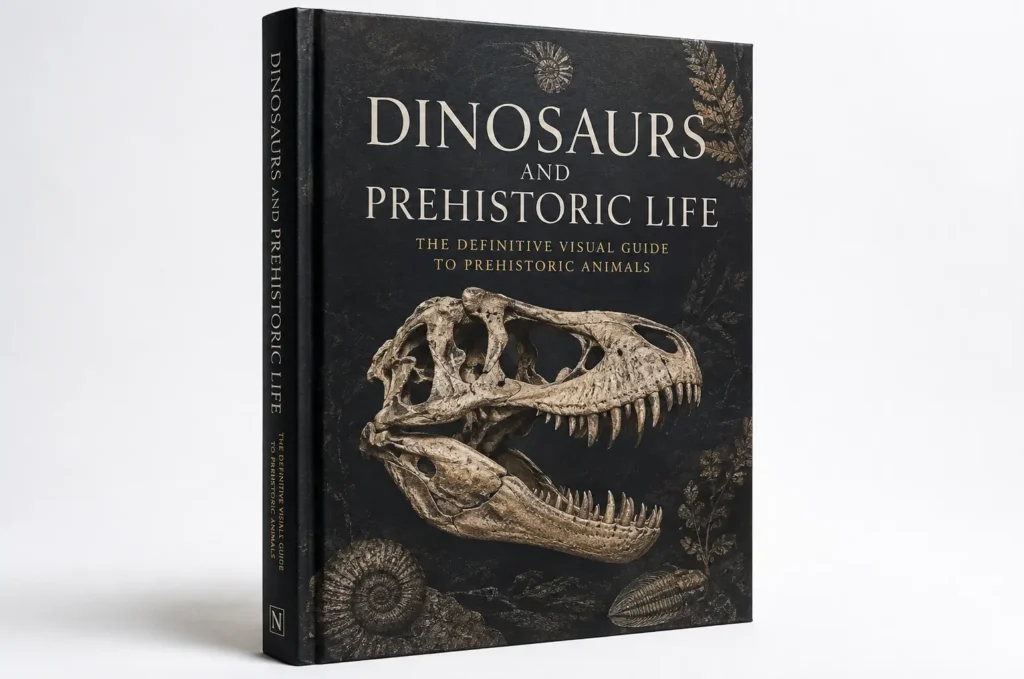
Dinosaurs and Prehistoric Life
A richly illustrated visual reference exploring dinosaurs, fossils, evolution, and prehistoric life across geological time.
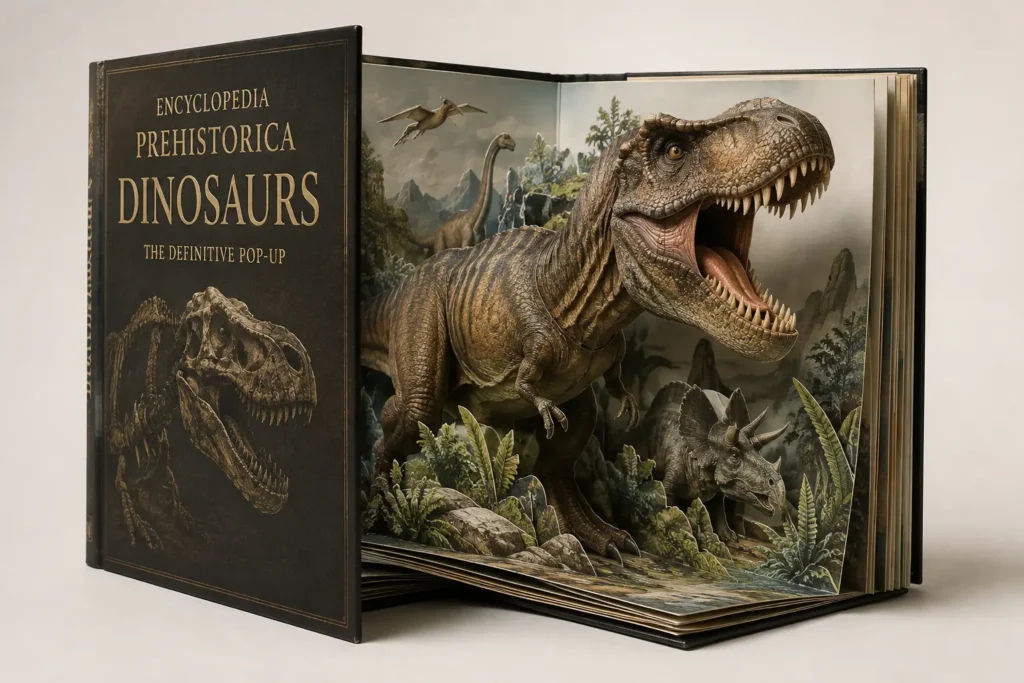
Encyclopedia Prehistorica: Dinosaurs
An interactive dinosaur book featuring spectacular three-dimensional pop-ups, particularly suited to young readers and families.
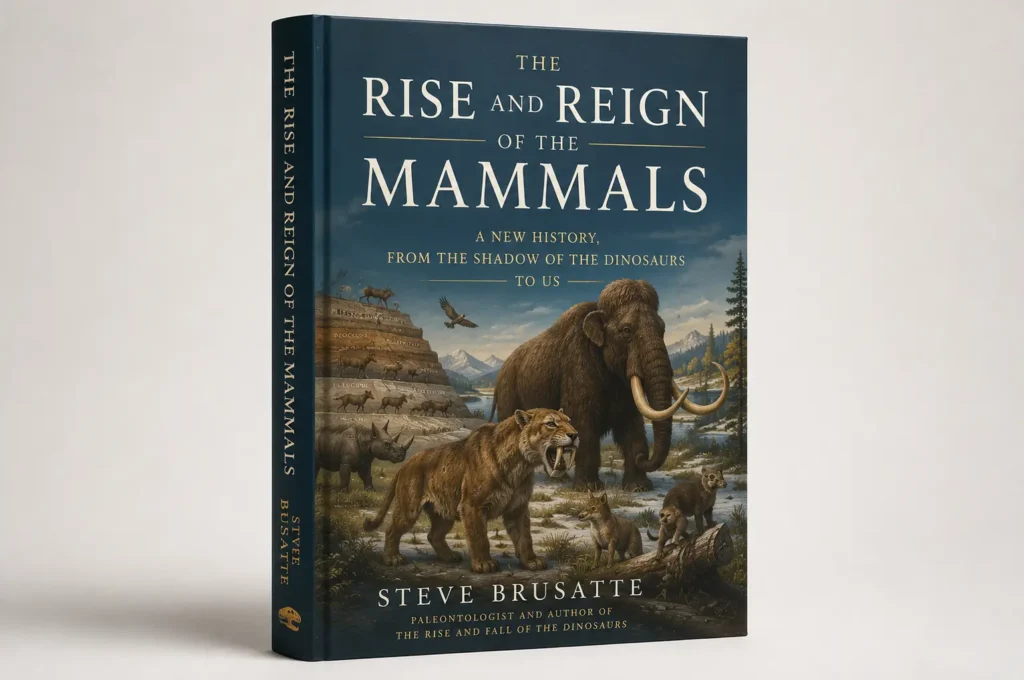
The Rise and Reign of the Mammals
A sweeping history of mammalian evolution, from their origins alongside dinosaurs through the Cenozoic and the emergence of humans.