The skull dome of Pachycephalosaurus is one of the most distinctive features in the entire dinosaur fossil record—a massive, rounded structure of solid bone rising from the top of the skull, reaching thicknesses of up to 25 centimeters (10 inches) in the largest adults. This extraordinary cranial architecture has fascinated paleontologists for decades and sparked ongoing debates about its function, from weaponized head-butting to visual display, and everything in between.
Dome Anatomy and Bone Structure
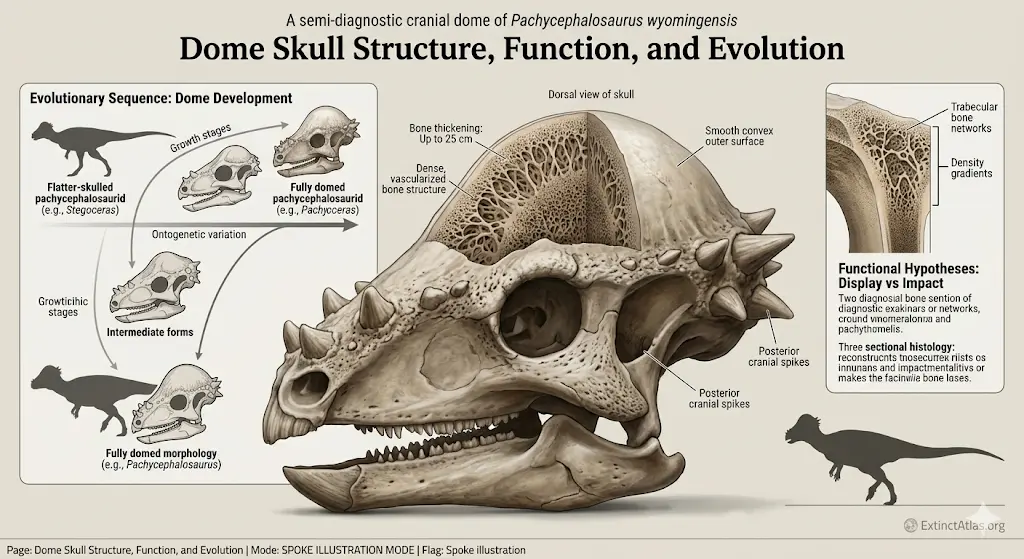
The dome is formed from the frontoparietal bones of the skull roof, which become dramatically thickened and fused in adult Pachycephalosaurus. Unlike the skull domes of some other vertebrates, which contain internal air spaces (pneumatization) or spongy bone, the Pachycephalosaurus dome is composed almost entirely of compact, solid bone tissue.
| Anatomical Feature | Description |
|---|---|
| Bone composition | Solid cortical bone with minimal trabecular (spongy) bone |
| Maximum thickness | Approximately 25 cm (10 inches) in largest specimens |
| Structural elements | Fused frontoparietal bones forming a single dome unit |
| Surface texture | Smooth in adults, with vascular grooves suggesting blood vessel pathways |
| Growth pattern | Continuous thickening from juvenile to adult stages |
The bone microstructure, revealed through histological analysis of thin sections, shows densely packed bone tissue with growth lines (similar to tree rings) that record the animal’s development. These growth lines indicate that the dome was not a one-time developmental event but grew continuously throughout the animal’s life, with growth rates varying with age and possibly environmental factors.
The surface of adult domes is relatively smooth, though it bears shallow grooves and pits that likely housed blood vessels. These vascular channels suggest the dome was covered by living tissue (skin and possibly keratinous covering) during life rather than being exposed bone. The pattern of vascularization has been used to argue both for and against combat functions—some researchers interpret a rich blood supply as evidence of a sensitive display structure, while others suggest it could support rapid healing after combat injuries.
The dome’s geometry is not perfectly hemispherical but shows individual variation and some asymmetry in many specimens. This variation may reflect developmental plasticity, injury, or pathology, and complicates efforts to determine a single “typical” dome shape for the species.
Thickness Measurements and Records
The thickest Pachycephalosaurus domes measure approximately 25 centimeters (10 inches) from the outer surface to the brain case below. This represents one of the thickest bone structures relative to body size in the entire vertebrate fossil record. For comparison, the skull bones of most dinosaurs measure only a few centimeters thick, even in very large species.
TIER 2 EVIDENCE: Precise thickness measurements require complete, undamaged domes, which are rare. Published measurements come from the handful of well-preserved specimens available for study, and some variation exists in how thickness is measured (outer surface to brain case vs. maximum thickness at any point).
The thickness varies across the dome surface. The apex (highest point) tends to be the thickest region, with bone thinning somewhat toward the edges where the dome transitions to the base of the skull. This distribution suggests the dome’s center bore the highest loads, whether from impact forces or simply developmental emphasis on maximizing the dome’s visual profile.
Smaller individuals and juveniles possess much thinner domes—in the earliest growth stages, the skull roof is nearly flat, making dome thickness a strong indicator of ontogenetic stage and potentially age.
Ontogenetic Changes: From Flat to Domed
One of the most dramatic transformations in Pachycephalosaurus development is the shift from the flat, spiky skull of juveniles to the smooth, domed skull of adults. This transformation has been central to the debate over whether Dracorex and Stygimoloch represent separate species or growth stages of Pachycephalosaurus.
In the youngest known individuals (historically classified as Dracorex), the skull roof is essentially flat, lacking any significant dome. Instead, the skull bears prominent bony spikes and nodes arranged around the back and sides of the skull, giving it a dramatically different appearance from adults. The bone is relatively thin, and the overall skull proportions differ from those of mature animals.
As growth proceeds (the Stygimoloch stage in the ontogenetic hypothesis), the skull roof begins to thicken and round, though it has not yet achieved the full dome of an adult. The spikes and nodes begin to resorb (be broken down and remodeled), and the skull takes on an intermediate appearance between the flat juvenile form and the fully domed adult.
In fully mature adults, the dome reaches its maximum development, the spikes are largely or entirely resorbed, and the skull achieves the classic Pachycephalosaurus appearance. The surface becomes smooth, and the dome dominates the skull’s profile.
| Growth Stage | Skull Roof | Ornamentation | Dome Thickness | Historical Classification |
|---|---|---|---|---|
| Juvenile | Flat or slightly raised | Prominent spikes and nodes | <3 cm | Dracorex hogwartsia |
| Subadult | Partially domed | Reduced spikes, some resorption | 5–10 cm | Stygimoloch spinifer |
| Adult | Fully domed | Minimal or absent | Up to 25 cm | Pachycephalosaurus wyomingensis |
This ontogenetic sequence, if correct, demonstrates extraordinary developmental plasticity. The skull is not simply growing larger but fundamentally restructuring itself, with bone being deposited in some areas (the dome) while simultaneously being resorbed in others (the spikes).
The functional implications of this transformation are significant. Juveniles and subadults would have lacked the thick dome entirely, suggesting the dome’s function—whatever it was—became relevant only in adulthood. This pattern is consistent with structures involved in reproduction, social dominance, or other adult-specific behaviors.
Histological Studies and Growth Rates
Examination of bone microstructure through thin-section histology has revealed detailed information about how the dome grew and how quickly bone was deposited.
TIER 2 EVIDENCE: Histological data come from a small number of sectioned specimens. Sectioning requires destroying part of the fossil, so it is performed only on select specimens where scientific value justifies the loss, or on fragments that are already damaged.
The bone tissue shows well-defined growth marks (annuli) similar to tree rings, which likely represent seasonal or annual growth cycles. By counting these marks and measuring the distance between them, researchers can estimate growth rates and potentially the age of individual animals at death.
Growth appears to have been rapid during juvenile and subadult stages, with wide spacing between growth marks indicating fast bone deposition. In older individuals, growth marks become closely spaced, suggesting growth slowed as the animal approached maximum size. This pattern matches what is seen in many modern vertebrates, where rapid juvenile growth gives way to slower adult growth.
The bone tissue is classified as fibrolamellar bone—a type associated with rapid growth and common in dinosaurs and modern birds. This contrasts with the slow-growing lamellar bone typical of modern reptiles like crocodiles and tortoises, confirming that Pachycephalosaurus, like other dinosaurs, maintained relatively high metabolic rates.
Some specimens show evidence of bone remodeling—areas where bone tissue was broken down and re-deposited, creating a secondary osteon structure. Remodeling is common in bones subjected to mechanical stress and also occurs during pathological conditions (disease or injury). The presence of remodeling in dome bones has been interpreted as evidence of mechanical loading, though it could also reflect normal maintenance of the thick bone structure.
Combat vs. Display Function
The debate over dome function has dominated Pachycephalosaurus research for decades. Two primary hypotheses—combat weapon vs. display structure—are not mutually exclusive, and the dome may have served both functions to varying degrees.
Evidence supporting a combat function:
- The extreme thickness of solid bone suggests resistance to high-impact forces
- Pathological lesions on some dome specimens indicate that the structure sustained injuries during life
- Comparable structures in modern animals (bighorn sheep horns, giraffe ossicones) serve combat functions
- Sexual selection often drives weapon development, and dome size variation could reflect male competition
Evidence supporting a display function:
- Lack of specialized shock-absorbing features in the neck and skull base that characterize modern head-butting animals
- Visual prominence and individual variation in size and shape make the dome effective for signaling
- Ontogenetic development pattern (appearing only in adults) consistent with sexually selected display traits
- Vascularization patterns suggesting the dome was covered in visually distinctive skin or keratin
TIER 3 EVIDENCE: The behavior associated with the dome cannot be directly observed in extinct animals. Both the combat and display hypotheses are inferred from anatomy, pathology, and comparison with modern species—all indirect lines of evidence subject to interpretation.
Some researchers propose that the dome primarily served display functions, with physical combat being rare but possible. In this model, dome size and shape advertised fitness to potential mates and warned rivals, with most contests resolved through visual assessment. Physical combat would occur only when rivals were closely matched and visual signals could not determine a winner.
The flank-butting hypothesis, discussed in detail in the behavioral spoke, offers a middle ground. In this model, the dome functioned as an impact weapon, but not in the head-to-head collision manner traditionally depicted. Instead, animals struck each other’s flanks with the dome, using it as a club while protecting their own domes from reciprocal strikes.
Recent Fossil Discoveries
CONTENT CURRENCY NOTE: Major Pachycephalosaurus skull discoveries and acquisitions occurred in 2024 and 2025. The significance and scientific descriptions of these specimens may be further refined in ongoing and future publications.
In 2024, the Smithsonian Institution acquired an exceptionally complete Pachycephalosaurus skull representing one of the most intact dome specimens ever found. This acquisition provides new opportunities for detailed study of dome structure, pathology, and individual variation.
The specimen’s completeness allows for better reconstruction of the dome’s three-dimensional geometry and more accurate measurement of thickness across the entire structure. Previous studies often relied on fragmentary material or partial domes where the exact shape had to be inferred.
Early examination of the Smithsonian specimen reportedly shows surface features consistent with vascularization patterns seen in other domes, supporting the interpretation that the dome was covered by living tissue during life. A full scientific description of the specimen was ongoing as of early 2025.
Additionally, discoveries of pachycephalosaur material in Mongolia (representing different genera but providing comparative context) have expanded understanding of dome skull evolution and function across the family. These discoveries show that dome development patterns are consistent across pachycephalosaurs from different continents and time periods, suggesting that strong selective pressure maintained this cranial architecture.
Comparison with Other Pachycephalosaurs
Pachycephalosaurus possesses the largest and thickest dome of any known pachycephalosaur, but it is not the only member of the family to develop this structure. Other genera show variations on the theme:
Stegoceras (Middle Campanian, North America) developed a more modest dome, proportionally smaller and less dramatically thickened than in Pachycephalosaurus. Its ornamentation (spikes and nodes around the dome) is less extensive, and the overall skull is more conservative in appearance.
Prenocephale (Late Cretaceous, Mongolia) shows a dome intermediate in development between Stegoceras and Pachycephalosaurus, with moderate thickness and well-developed but not extreme ornamentation.
The trend across pachycephalosaur evolution suggests progressive elaboration of the dome structure, with later, larger species developing more extreme versions. This pattern could reflect intensifying sexual selection, ecological factors favoring display or combat capabilities, or developmental constraints that were gradually overcome.
What the Dome Reveals About Behavior
While the dome’s exact function remains debated, its presence and characteristics constrain behavioral interpretations. The dome indicates that adult Pachycephalosaurus engaged in some form of intraspecific interaction (interaction with members of its own species) where a prominent cranial structure provided fitness advantages.
Whether this interaction was primarily visual (display and assessment) or physical (combat) or both, the dome’s development only in adults suggests it was tied to reproductive behavior, territorial defense, or social hierarchy establishment—activities typically concentrated in mature individuals.
The absence of domes in juveniles indicates that young animals did not participate in whatever behaviors the domes facilitated. This could mean juveniles occupied different social niches, were excluded from adult dominance hierarchies, or simply had not yet reached reproductive maturity.
The extreme bone investment required to build a 25-centimeter-thick dome represents a high metabolic cost. For such a structure to evolve and persist, it must have provided substantial fitness benefits—whether through increased mating success, better resource access, or improved survival odds.
Frequently Asked Questions
How thick was the thickest part of the Pachycephalosaurus skull?
The thickest Pachycephalosaurus domes measure approximately 25 centimeters (10 inches) from the outer surface to the brain case. This represents solid bone tissue, making it one of the thickest skull structures relative to body size in any known vertebrate.
Did the dome grow throughout the animal’s life?
Yes. Histological analysis shows continuous bone deposition throughout life, with growth rates that vary with age. The dome grew most rapidly during juvenile and subadult stages and continued to thicken more slowly in adults, though it never stopped growing entirely as long as the animal lived.
Were Dracorex and Stygimoloch really just young Pachycephalosaurus?
The current scientific consensus favors this interpretation, based on the continuous spectrum of skull forms from flat (Dracorex-like) to fully domed (adult Pachycephalosaurus), consistent with ontogenetic transformation. However, this remains debated, and some researchers argue these represent distinct species. The classification debate is covered in detail in a separate article.
Featured Museum Collections
Museum-quality paleoart and educational poster
collections based on evidence-informed prehistoric
Life reconstructions.