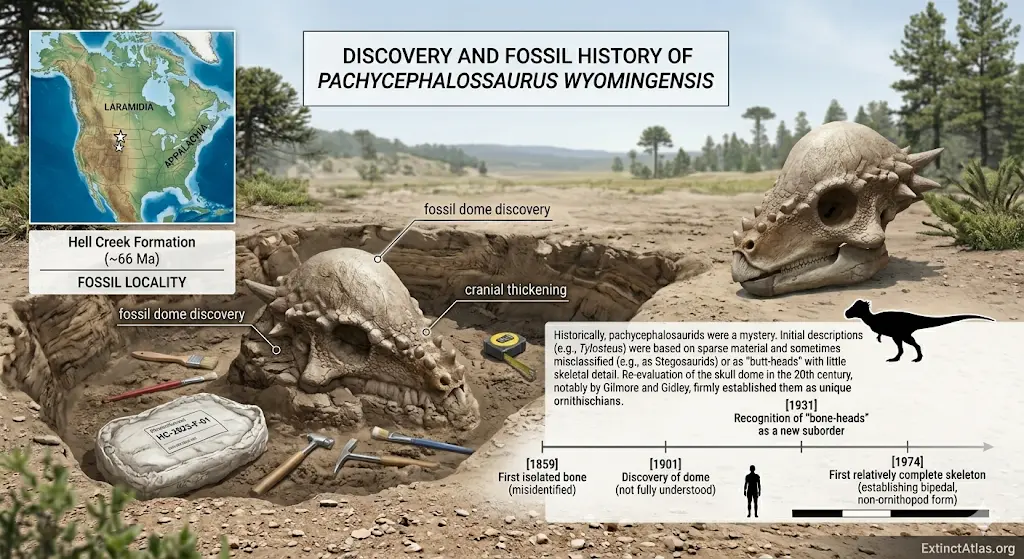
The fossil history of Pachycephalosaurus is a story of patience and incremental progress, spanning over 150 years from the first fragmentary discoveries to remarkably complete skulls acquired in 2024. Unlike dinosaurs known from multiple complete skeletons, Pachycephalosaurus remains are represented primarily by skull material, with the rest of the skeleton still poorly understood. This fragmentary record has shaped—and constrained—scientific understanding of the species from the beginning.
Early Fragmentary Discoveries (1850s–1930s)
The first Pachycephalosaurus fossils were discovered long before the animal received its current name, and the earliest finds were not recognized as belonging to a distinct dinosaur species.
TIER 2 EVIDENCE: The exact chronology of early pachycephalosaur discoveries is complicated by poor documentation, specimen misidentification, and material that was collected but not formally described for decades. The timeline below represents the currently accepted sequence based on published records, but gaps and uncertainties remain.
Fragmentary dome material was recovered from Late Cretaceous deposits in Montana and Wyoming as early as the 1850s, during the initial wave of dinosaur fossil discovery in western North America. These isolated dome fragments were taxonomically enigmatic—their thick, solid bone structure did not obviously correspond to any known animal, and the lack of associated skeletal material prevented confident identification.
Some early finds were misidentified as belonging to other dinosaur groups or dismissed as pathological (diseased) bone rather than normal anatomy. The distinctive dome structure, when preserved as isolated fragments without the surrounding skull, was difficult to interpret correctly.
In 1872, paleontologist Ferdinand Vandeveer Hayden collected dome fragments during geological surveys in Montana, but the material was not formally described or assigned to a new taxon at that time. The specimens entered museum collections, where they remained largely unstudied for decades.
The fragmentary nature of early pachycephalosaur material and the focus of 19th-century paleontology on larger, more complete specimens meant these fossils received less attention than contemporary discoveries of sauropods, theropods, and hadrosaurs.
Gilmore’s Naming and Early Classification (1931)
The formal description and naming of Pachycephalosaurus came in 1931, when paleontologist Charles Whitney Gilmore examined skull material collected from the Hell Creek Formation in Montana. Gilmore recognized the distinctiveness of the thick-domed skull fragments and assigned them to a new genus and species: Pachycephalosaurus wyomingensis.
The type specimen (the individual specimen on which the species name is formally based) consists of a partial skull preserving the characteristic dome, along with portions of the surrounding bone. While fragmentary, it was sufficient to demonstrate that this represented a unique dinosaur unlike any previously described.
Gilmore’s original description correctly identified Pachycephalosaurus as an ornithischian (bird-hipped) dinosaur and noted the extraordinary thickness of the skull dome, which he interpreted as potentially related to combat or display behavior. However, the lack of postcranial material (bones from the rest of the body) left many questions about the animal’s overall anatomy and lifestyle unanswered.
The species name wyomingensis refers to Wyoming, though the type specimen actually came from Montana—an example of the geographic confusion common in early paleontology when state boundaries and exact collection localities were not always carefully recorded.
Following Gilmore’s description, Pachycephalosaurus was recognized as a member of Pachycephalosauria (dome-headed dinosaurs), a group that includes several other genera from North America and Asia. However, Pachycephalosaurus remained poorly understood for decades due to the scarcity of new material.
Mid-20th Century: Slow Accumulation of Material
Between the 1930s and 1980s, Pachycephalosaurus specimens accumulated slowly. Occasional skull fragments and dome pieces were recovered from Hell Creek Formation sites, but complete or near-complete skulls remained elusive.
This period saw incremental improvements in understanding pachycephalosaur anatomy and relationships, but Pachycephalosaurus itself—the largest and latest member of the group—remained enigmatic. Most paleontological attention focused on better-known Hell Creek dinosaurs like Triceratops, Edmontosaurus, and Tyrannosaurus rex, which were represented by more complete fossils.
The fragmentary nature of available material created challenges for understanding basic aspects of biology. Skull roof fragments could demonstrate dome thickness and structure, but without complete skulls showing jaw anatomy, tooth positions, and cranial ornamentation patterns, detailed dietary and behavioral reconstructions remained speculative.
Some isolated teeth and limb bones potentially attributable to Pachycephalosaurus were collected during this period, but secure association between scattered elements is difficult without articulated (connected) skeletons. Many specimens labeled as “possible Pachycephalosaurus postcranial material” remain tentatively assigned, pending discovery of associated skeletons that definitively link dome skulls to specific body proportions.
The Dracorex and Stygimoloch Complication (1983–2006)
TIER 2 EVIDENCE: The taxonomic history of Stygimoloch and Dracorex and their relationship to Pachycephalosaurus is addressed in detail in a separate article on the ontogeny debate. This section provides only the discovery and naming context.
In 1983, paleontologists described Stygimoloch spinifer based on skull material from Montana and Wyoming showing a partially developed dome with prominent backward-pointing spikes. The specimen was interpreted as a distinct pachycephalosaur species coexisting with Pachycephalosaurus in Hell Creek ecosystems.
Then in 2006, the remarkably complete and well-preserved Dracorex hogwartsia skull was described from South Dakota. This specimen showed a flat skull roof with no dome development but extensive bony ornamentation, again interpreted as a separate species.
For a time, paleontologists believed the Hell Creek Formation contained three coexisting pachycephalosaur species with dramatically different skull morphologies. Museum displays and popular media featured all three as distinct animals.
The subsequent reinterpretation of Dracorex and Stygimoloch as juvenile and subadult growth stages of Pachycephalosaurus (proposed in 2009 based on histological and morphological evidence) collapsed this apparent diversity. However, the specimens themselves remain scientifically valuable as they preserve growth stages rarely seen in dinosaur fossils and demonstrate the dramatic ontogenetic transformation Pachycephalosaurus underwent.
The Dracorex holotype (primary specimen) is housed at the Indianapolis Children’s Museum, where it remains accessible to researchers and the public. The specimen’s excellent preservation and completeness make it one of the most important pachycephalosaur fossils known, regardless of its taxonomic status.
21st Century: Improved Understanding Through New Specimens
The early 2000s through 2020s have seen gradual improvements in Pachycephalosaurus fossil material quality and quantity, though the species remains much rarer in collections than other Hell Creek herbivores.
- Partial skull discoveries: Several partial skulls preserving more complete dome structures and associated cranial material have been described, allowing better reconstruction of skull anatomy and individual variation. These specimens show that dome thickness and shape varied among individuals, likely reflecting age, sex, or individual differences.
- Juvenile material: The recognition of juvenile Pachycephalosaurus (previously classified as separate genera) has provided unprecedented insight into growth and development. Specimens spanning from very young individuals to fully mature adults now exist in collections, enabling ontogenetic studies previously impossible.
- Improved preparation techniques: Modern preparation methods using air abrasives, acid preparation, and CT scanning have allowed researchers to extract additional information from existing specimens that was not accessible with older mechanical preparation approaches. Subtle features of dome microstructure, vascular channels, and bone growth patterns have become visible through these techniques.
- Histological sampling: Thin-section analysis of dome bone has revealed growth rates, tissue types, and remodeling patterns that inform understanding of how the dome developed and whether it sustained injuries during life. These studies have been critical to debates about the dome function and combat behavior.
2024–2025: The Smithsonian Acquisition
CONTENT CURRENCY NOTE: The Smithsonian skull acquisition occurred in 2024, with initial announcements made in 2024–2025. Full scientific description and detailed analysis of this specimen were ongoing as of early 2025, and published findings may refine or expand the preliminary observations noted here.
In 2024, the Smithsonian Institution acquired what curators described as one of the most complete and best-preserved Pachycephalosaurus skulls ever discovered. The specimen represents a significant addition to the limited number of high-quality Pachycephalosaurus skulls available for study.
Initial reports indicated the skull preserves exceptional detail in the dome surface texture, including fine-scale features potentially related to blood vessel pathways (vascularization patterns). The completeness of the specimen allows researchers to examine regions of the skull often missing or poorly preserved in fragmentary material.
The acquisition expands research opportunities for studying individual variation, dome development, and pathological features. With more complete skulls, paleontologists can begin to assess how much morphological variation existed within the species and whether patterns such as sexual dimorphism or geographic variation can be detected.
The Smithsonian specimen also provides baseline data for future discoveries. As additional complete skulls are found, comparisons with well-documented specimens like the Smithsonian acquisition will enable more robust analyses of population-level variation and evolutionary patterns.
The specimen’s institutional home at the Smithsonian’s National Museum of Natural History ensures long-term curation, accessibility to researchers, and potential for public display—all critical factors for maximizing the scientific and educational value of rare fossils.
Geographic Distribution of Discoveries
Pachycephalosaurus fossils have been recovered from a relatively restricted geographic area corresponding to the Hell Creek Formation of Montana, North Dakota, South Dakota, and Wyoming. This distribution reflects the species’ actual range, the Late Cretaceous paleoenvironment, and the limits of where appropriate rock formations are exposed today.
| State | Specimen Types Found | Notable Localities |
|---|---|---|
| Montana | Skull domes and fragments, possible postcranial material | Hell Creek Formation type section |
| South Dakota | Complete and partial skulls including Dracorex holotype | Various Hell Creek sites |
| Wyoming | Skull fragments, dome material | Scattered localities |
| North Dakota | Limited material, primarily fragments | Less extensively collected than neighboring states |
The concentration of finds in Montana and South Dakota likely reflects both actual ancient distribution patterns and modern collecting efforts. These states have extensive Hell Creek Formation exposures and long histories of paleontological fieldwork, increasing the probability of discovery.
No Pachycephalosaurus material has been definitively identified outside the Hell Creek Formation, suggesting the species had a relatively restricted geographic range or existed for a limited time period. This contrasts with some contemporaneous species like Tyrannosaurus rex, which is known from multiple formations across a broader geographic area.
What We Still Lack: The Postcranial Skeleton
Despite over 150 years of collecting, the postcranial skeleton of Pachycephalosaurus remains poorly known. While skulls—particularly dome fragments—are distinctive and thus readily recognized, body bones are difficult to attribute to Pachycephalosaurus with confidence unless found in direct association with skulls.
TIER 3 EVIDENCE: Various isolated limb bones, vertebrae, and pelvic elements have been tentatively attributed to Pachycephalosaurus based on size, formation context, and exclusion of other known species. However, without articulated skeletons or multiple elements found in close association with diagnostic skulls, these assignments remain provisional.
The lack of postcranial material creates significant gaps in understanding:
- Body proportions: While overall size can be estimated from skull size and comparison with related pachycephalosaurs, the exact proportions of limbs, tail length, and body depth remain uncertain.
- Locomotor capabilities: Limb bone structure, muscle attachment sites, and joint articulation inform biomechanical reconstructions of speed and agility. Without definitive Pachycephalosaurus limb material, these reconstructions rely on related species as proxies.
- Sexual dimorphism: If males and females differed in body proportions (common in modern animals), this cannot be detected without associated skeletons showing both skull and postcranial variation.
The discovery of an articulated or semi-articulated Pachycephalosaurus skeleton—preserving the dome skull in association with significant postcranial material—would represent one of the most significant pachycephalosaur finds possible, answering longstanding questions about the animal’s anatomy and potentially revealing new ones.
Preservation Bias and Rarity
Pachycephalosaurus is genuinely rare in Hell Creek deposits compared to Triceratops and Edmontosaurus, which are known from hundreds of specimens. This rarity reflects both ecological factors (population density and habitat preferences) and taphonomic biases (how different animals become fossilized).
The dome skull’s solid, dense bone construction makes it resistant to decay and weathering, increasing preservation probability relative to more delicate skeletal elements. This creates a sampling bias where skulls are disproportionately preserved compared to the rest of the skeleton, explaining why Pachycephalosaurus is known primarily from cranial material.
Pachycephalosaurus may have occupied specific ecological niches—particular habitat types or dietary specializations—that reduced population sizes relative to more generalist herbivores. Lower population density directly translates to fewer fossils entering the geological record.
Additionally, taphonomic processes favor large, robust bones. The relatively small size of Pachycephalosaurus (compared to multi-ton hadrosaurs and ceratopsians) may reduce preservation probability, as smaller carcasses are more easily scattered by scavengers or destroyed by environmental processes before fossilization occurs.
Major Specimens and Their Institutional Homes
Several key Pachycephalosaurus specimens are housed in major museums where they remain accessible to researchers:
- Type specimen (USNM 12031): Housed at the Smithsonian National Museum of Natural History, this partial skull remains the name-bearing specimen for the species.
- Dracorex holotype (TCMI 2004.17.1): The Children’s Museum of Indianapolis holds this exceptionally complete skull, now interpreted as juvenile Pachycephalosaurus.
- Stygimoloch specimens (various): Multiple museums hold Stygimoloch material, now considered subadult Pachycephalosaurus, including specimens at the Museum of the Rockies.
- 2024 Smithsonian acquisition: The recently acquired complete skull adds to the Smithsonian’s pachycephalosaur holdings.
These specimens collectively provide the data foundation for all Pachycephalosaurus research. Their curation in major institutions ensures long-term preservation and accessibility to the scientific community.
Frequently Asked Questions
When was Pachycephalosaurus discovered?
The first Pachycephalosaurus fossils were collected as early as the 1850s from Montana and Wyoming, but the species was not formally named and described until 1931 by paleontologist Charles Whitney Gilmore. Early specimens were fragmentary dome pieces that were not initially recognized as belonging to a distinct dinosaur species.
Why are complete Pachycephalosaurus skeletons so rare?
Several factors contribute to rarity: the animal appears to have had a lower population density than other Hell Creek herbivores, its relatively small size reduced preservation probability compared to larger dinosaurs, and its ecological habits (possibly living in specific, less commonly preserved environments) may have limited fossilization opportunities. The dome skull’s solid bone construction is preserved better than other skeletal elements, creating sampling bias toward skull material.
What is the most complete Pachycephalosaurus specimen ever found?
As of 2025, the most complete Pachycephalosaurus skulls include the Dracorex holotype (juvenile stage) and the 2024 Smithsonian acquisition. However, no specimen preserves a complete or near-complete skeleton with both skull and substantial postcranial material articulated together. This remains the primary gap in the Pachycephalosaurus fossil record and a priority for future discoveries.
Featured Museum Collections
Museum-quality paleoart and educational poster
collections based on evidence-informed prehistoric
Life reconstructions.