What Did Smilodon Eat?

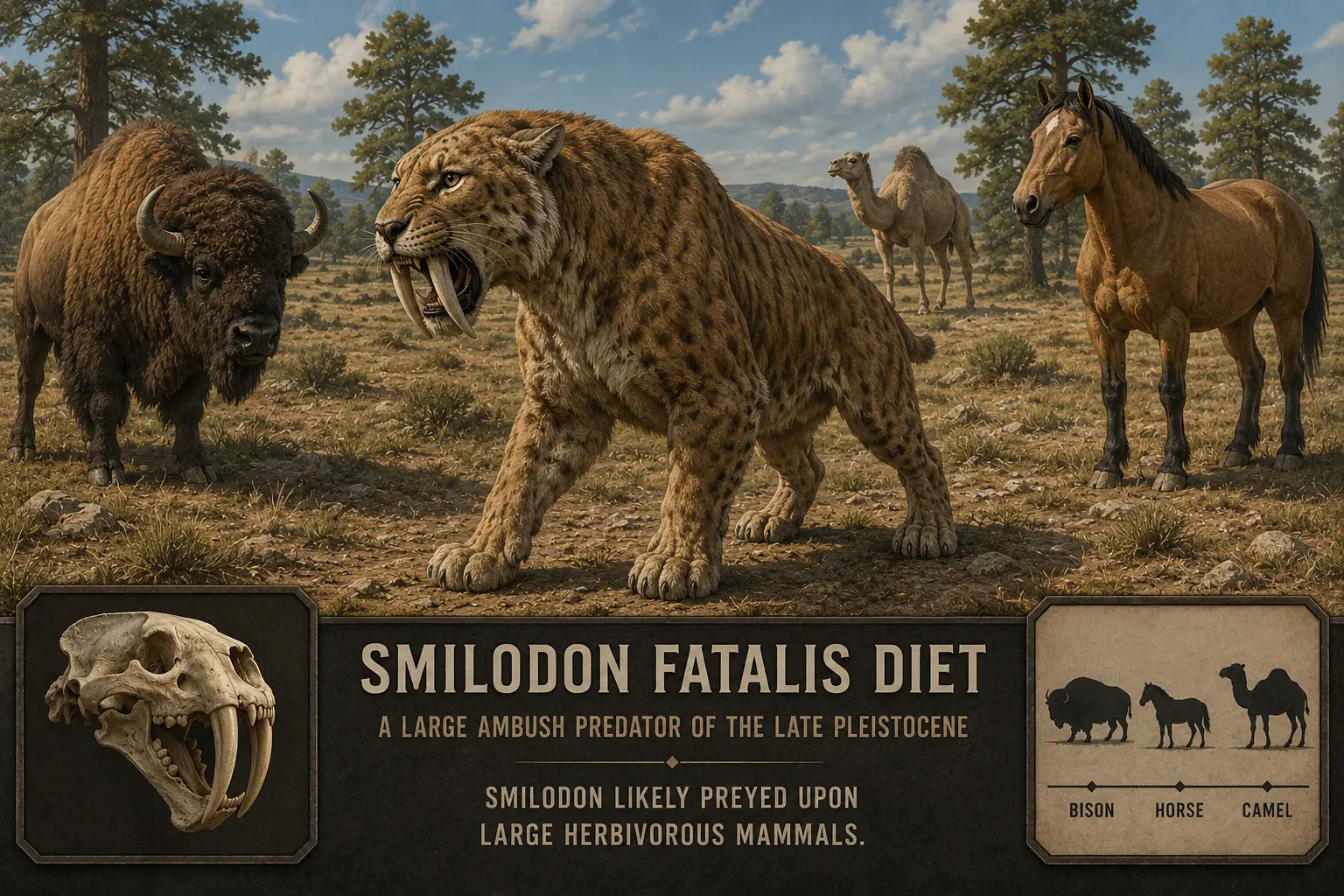
Photorealistic educational spoke image showing Smilodon fatalis alongside three likely prey animals from the Late Pleistocene: a bison, a horse, and a camel. The saber-toothed cat stands prominently in the center with elongated upper canines and powerful forequarters clearly visible. Insets show a Smilodon skull and prey silhouettes. The composition teaches that Smilodon likely preyed upon large herbivorous mammals including bison, horses, and camels.

Quick Info Field Information Species Smilodon fatalis — Carnivora, Felidae Period Pleistocene, 2.5 Ma–10,000 years ago Diet type Hypercarnivore Primary prey Large-bodied Pleistocene megafauna Quick Answer: Smilodon ate large herbivorous mammals, including horses, bison, camels, ground sloths, and young or weakened mammoths and mastodons. Isotopic evidence and dental microwear from fossil specimens confirm a diet … Read more
Smilodon Hunting Behaviour: Did It Hunt in Packs?

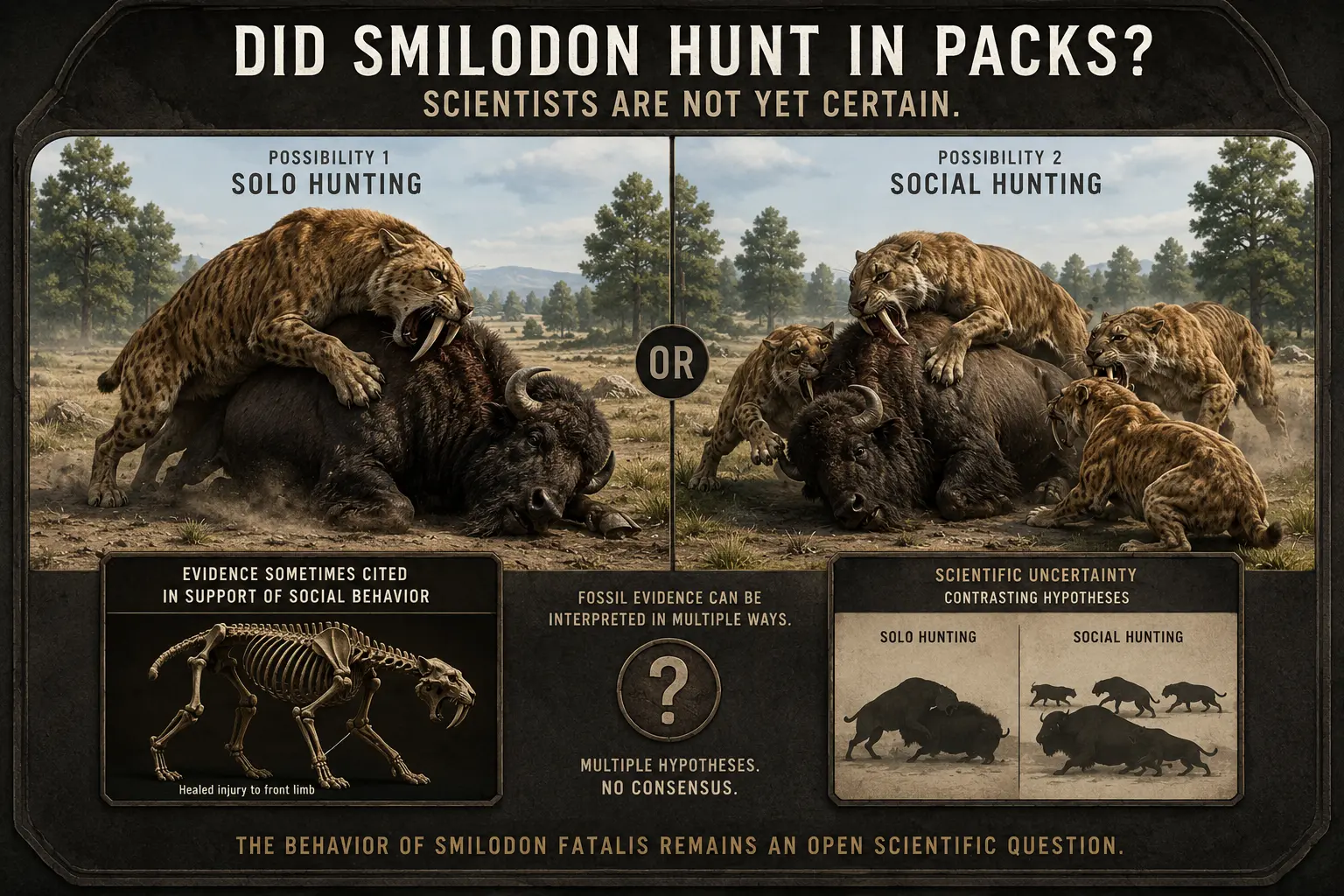
Photorealistic educational spoke image comparing two competing hypotheses for the hunting behavior of Smilodon fatalis. On the left, a single saber-toothed cat restrains a bison, representing solitary hunting. On the right, several Smilodon individuals surround a similar bison, representing social hunting. Supporting insets show a healed-injury fossil specimen and a visual comparison of the two hypotheses. The composition teaches that scientists have not reached a consensus on whether Smilodon hunted alone or in groups, and that the behavior remains an open scientific question.

Quick Info Field Information Species Smilodon fatalis — Carnivora, Felidae Period Pleistocene, approximately 2.5 million–10,000 years ago Social Evidence Healed injuries in fossil specimens have been interpreted as evidence consistent with social behaviour Key Behaviour Debate Solitary versus social lifestyle remains actively debated Quick Answer Smilodon behaviour remains one of the most debated topics in … Read more

Is a Woolly Mammoth a Dinosaur?

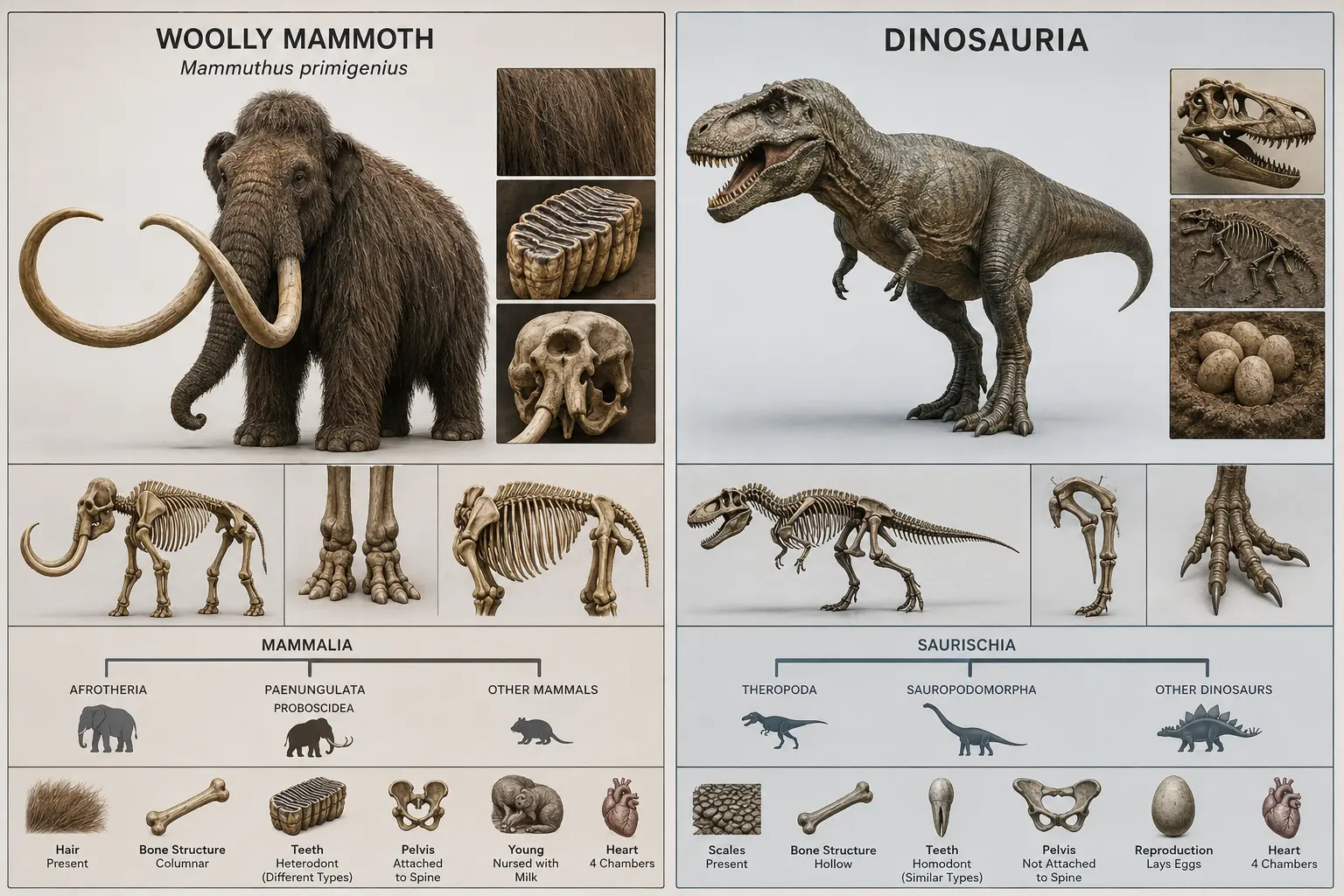
Educational comparison showing why the Woolly Mammoth is not a dinosaur. The left side presents a Woolly Mammoth within Mammalia, including hair, mammalian teeth, skull, skeleton, and nursing-young characteristics. The right side presents a dinosaur within Dinosauria, including dinosaur skulls, skeletons, scales, eggs, and limb anatomy. Side-by-side organization visually demonstrates that mammoths are mammals rather than dinosaurs.

Quick Info Field Information Species Mammuthus primigenius Class Mammalia Order Proboscidea Family Elephantidae Time Period Late Pleistocene–Holocene (approximately 400,000–4,000 years ago) Dinosaur? No Closest Living Relative Asian elephant (Elephas maximus) Quick Answer No, a woolly mammoth was not a dinosaur. Woolly mammoths were mammals—warm-blooded, fur-covered animals that gave birth to live young and nursed their … Read more

When Did Woolly Mammoths Live?

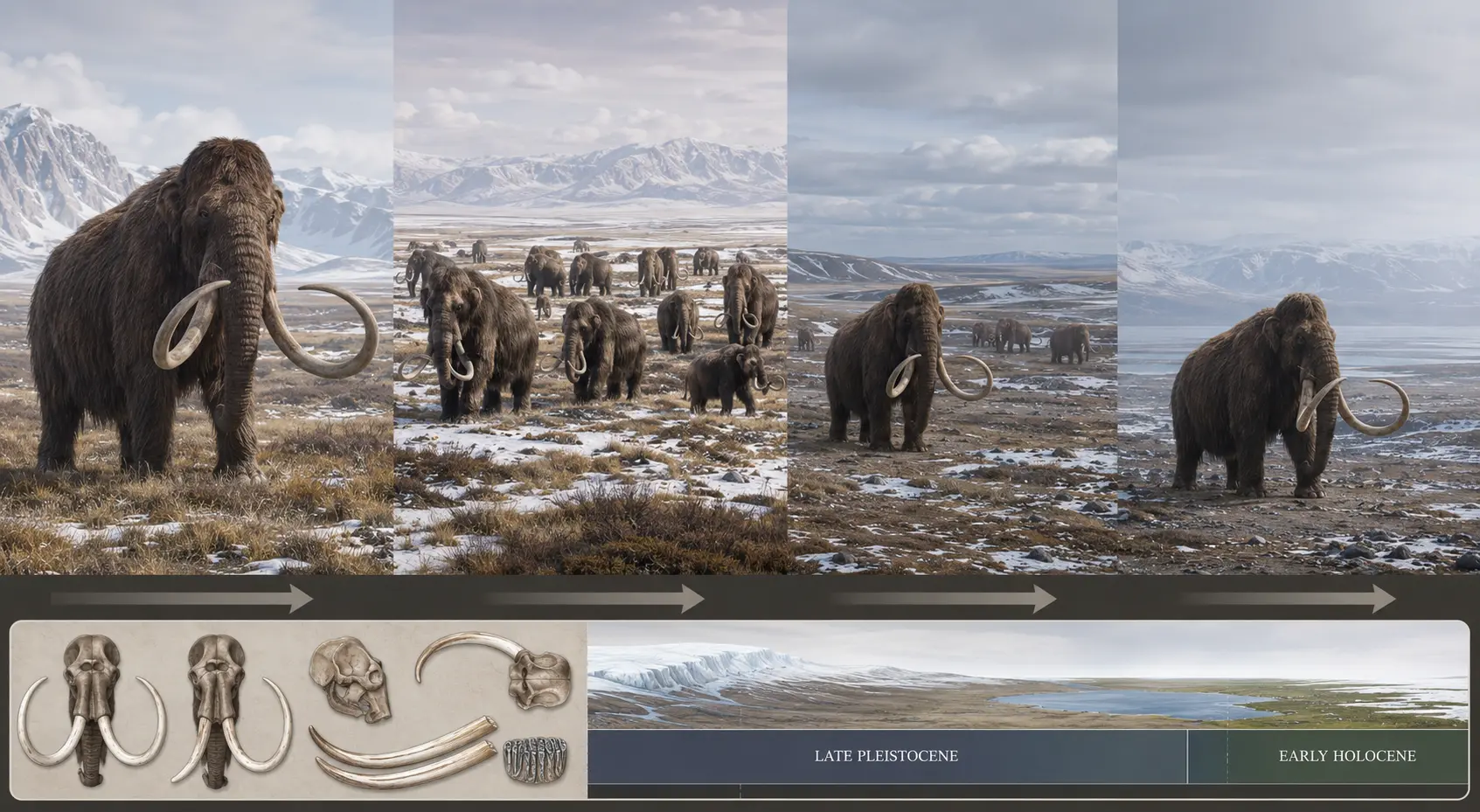
Educational timeline-style composite showing the Woolly Mammoth across the Late Pleistocene and Early Holocene. Multiple panels progress from large thriving mammoth populations in Ice Age steppe environments to smaller later populations and a final solitary mammoth. A geological timeline and environmental progression illustrate the passage of time, while anatomical reference specimens appear in supporting insets. The image teaches that Woolly Mammoths lived throughout the Late Ice Age and survived into the beginning of the Holocene.

Quick Info Field Information Species Mammuthus primigenius — Proboscidea, Elephantidae First appearance Approximately 400,000 years ago (Middle Pleistocene) Extinction (mainland) Approximately 10,000 years ago (early Holocene) Extinction (Wrangel Island) Approximately 4,000 years ago (mid-Holocene) Total temporal range Approximately 400,000–4,000 years ago Quick Answer: Woolly mammoths lived from approximately 400,000 years ago until around 4,000 years … Read more

Woolly Mammoth Discovery: Fossils, Finds, and Famous Specimens

Educational documentary-style composite showing how Woolly Mammoth (Mammuthus primigenius) reconstructions are derived from physical evidence. The image progresses from an excavated mammoth fossil in sediment, to a mounted skeleton, to a preserved frozen carcass with surviving hair and soft tissues, and finally to a fully reconstructed living Woolly Mammoth with a dense shaggy coat and strongly curved tusks. Insets display preserved mammoth hair and tusk structure, illustrating the fossil and preserved evidence used to reconstruct the appearance of the animal.

Field Information Species Mammuthus primigenius — Proboscidea, Elephantidae Period Pleistocene–Holocene, 400,000–4,000 years ago Formal scientific description Blumenbach, 1799 Most productive fossil region Siberia, Russia Notable specimen types Frozen soft-tissue mummies, articulated skeletons, isolated teeth and tusks Quick Answer:Woolly mammoth fossils have been recovered across northern Eurasia and North America since at least the seventeenth century, … Read more

Woolly Mammoth Habitat and Geographic Range

Photorealistic educational reconstruction of an adult and juvenile woolly mammoth (Mammuthus primigenius) standing within the Mammoth Steppe, a vast cold grassland ecosystem of the Late Pleistocene. Open plains dominated by grasses, sedges, and low-growing vegetation stretch across the landscape beneath distant mountains. Educational insets show the mammoth’s geographic range across northern Europe, Siberia, Beringia, Alaska, and northern North America, as well as representative steppe vegetation. The image illustrates the habitat, ecosystem, and transcontinental distribution of woolly mammoths across the northern Ice Age world.

Quick Info Field Information Species Mammuthus primigenius — Proboscidea, Elephantidae Period Pleistocene–Holocene, approximately 400,000–4,000 years ago Primary ecosystem Mammoth steppe (cold grassland) Geographic range Northern Eurasia, Beringia, and North America Climate Cold, dry, continental environments with mean annual temperatures typically below 0°C (32°F) Quick Answer:Woolly mammoths lived primarily within the mammoth steppe, a vast cold-grassland … Read more

What Did Woolly Mammoths Eat?

Photorealistic educational reconstruction of a woolly mammoth (Mammuthus primigenius) feeding in the Mammoth Steppe. The mammoth uses its trunk to gather large mouthfuls of grasses and sedges before bringing them to its mouth, illustrating its role as a specialized grazer. A close-up inset shows abrasive steppe vegetation, while a second inset shows the mammoth’s high-crowned molars with enamel ridges adapted for grinding tough, silica-rich plants. The image communicates how woolly mammoths fed primarily on grasses and sedges and possessed dental adaptations for processing abrasive vegetation.

Quick Info Field Information Species Mammuthus primigenius — Proboscidea, Elephantidae Period Pleistocene–Holocene, approximately 400,000–4,000 years ago Diet category Herbivore — primary grazer with a seasonal browse component Primary food sources Grasses, sedges, and herbaceous plants Evidence types Dental microwear, stable isotope analysis, gut contents, coprolites, and pollen Quick Answer Woolly mammoths primarily consumed grasses, sedges, … Read more

Woolly Mammoth vs Mastodon

Photorealistic educational comparison of a woolly mammoth (Mammuthus primigenius) and an American mastodon (Mammut americanum) shown side by side at equal scale. The woolly mammoth stands in an open grassland steppe while feeding on grasses and sedges, displaying a dense shaggy coat, strongly curved tusks, small ears, and a prominent shoulder hump. The mastodon stands in a woodland-edge environment browsing leaves and shrubs, with a stockier body, larger ears, and less curved tusks. A central inset compares their teeth, showing the mammoth’s high-ridged molars adapted for grinding abrasive grasses and the mastodon’s cusped molars adapted for crushing leaves, twigs, and woody browse. The image illustrates differences in habitat, diet, anatomy, and feeding adaptations between these two Ice Age proboscideans.

Quick Info Feature Mammuthus primigenius (Woolly Mammoth) Mammut americanum (American Mastodon) Order / Family Proboscidea, Elephantidae Proboscidea, Mammutidae Period Pleistocene–Holocene, approximately 400,000–4,000 years ago Pliocene–Late Pleistocene, approximately 3.5 million–10,000 years ago Shoulder height (males) 2.7–3.4 m (8.9–11.2 ft) 2.3–2.8 m (7.5–9.2 ft) Body mass (males) 5,500–8,000 kg (12,100–17,600 lb) 3,600–5,400 kg (7,900–11,900 lb) Tooth type … Read more

Woolly Mammoth Size: Height, Weight, Tusk Length, and Anatomy

Educational anatomy illustration of a woolly mammoth standing in an Ice Age steppe environment. The central reconstruction highlights the mammoth's shaggy fur, large body, small ears, shoulder hump, and enormous curved tusks. Insets compare mammoth size with a human, show the skeleton and body mass, examine tusk structure, compare mammoth and elephant ears, and illustrate the insulating fur layers that helped mammoths survive cold climates.

Quick Information Field Information Species Mammuthus primigenius — Proboscidea, Elephantidae Period Pleistocene–Holocene, approximately 400,000–4,000 years ago Shoulder Height (Males) 2.7–3.4 m (8.9–11.2 ft) Body Mass (Males) 5,500–8,000 kg (12,100–17,600 lb) Maximum Known Tusk Length More than 4 m (13 ft) in exceptional individuals Quick Answer Woolly mammoths stood approximately 2.7–3.4 metres (8.9–11.2 ft) at the … Read more

Why Did the Woolly Mammoth Go Extinct?

Educational three-panel illustration showing the extinction of the woolly mammoth. The left panel depicts large mammoth herds thriving on Ice Age grasslands. The center panel shows warming climates transforming the mammoth-steppe into wetter tundra and woodland habitats. The right panel shows a small remnant mammoth population living alongside expanding human groups. Insets illustrate habitat change, archaeological evidence of human interaction, and declining mammoth population size, explaining how climate change and human pressures likely contributed to mammoth extinction.

Quick Facts Field Information Species Mammuthus primigenius — Proboscidea, Elephantidae Time Range Late Pleistocene to Holocene, approximately 400,000–4,000 years ago Mainland Extinction Approximately 10,000 years ago Final Known Population Wrangel Island, Arctic Ocean, until approximately 4,000 years ago Extinction Classification Terminal extinction (no living descendants) Quick Answer The woolly mammoth most likely went extinct as … Read more