Quick Info
| Field | Information |
|---|---|
| Species | Smilodon fatalis — Carnivora, Felidae |
| Period | Pleistocene, approximately 2.5 million–10,000 years ago |
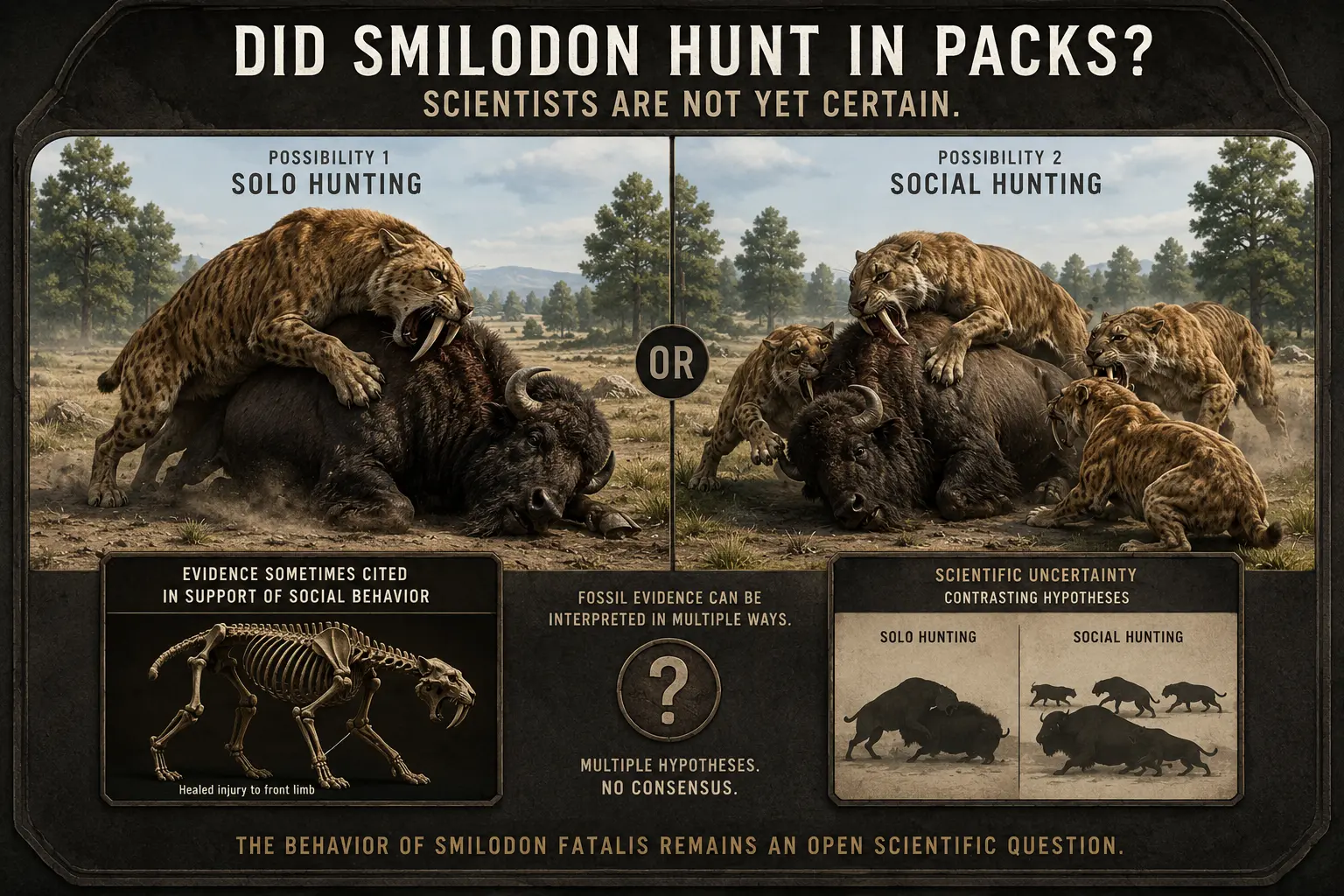
| Social Evidence | Healed injuries in fossil specimens have been interpreted as evidence consistent with social behaviour |
| Key Behaviour Debate | Solitary versus social lifestyle remains actively debated |
Quick Answer
Smilodon behaviour remains one of the most debated topics in sabre-toothed cat research. Fossil evidence suggests that Smilodon fatalis may have exhibited some degree of social behaviour, but definitive proof is lacking. Several individuals survived severe injuries that would likely have limited their ability to hunt, leading some researchers to propose that injured animals received assistance from other Smilodon. Whether this behaviour extended to coordinated pack hunting remains uncertain.

Fossils can sometimes preserve evidence of behaviour long after soft tissues have vanished. Among the most significant discoveries are injured Smilodon skeletons from the Rancho La Brea tar pits in California. Some individuals show healed fractures, damaged vertebrae, and other serious injuries that would have required prolonged survival after the initial trauma. These specimens have become a central piece of evidence in discussions about Smilodon sociality.
Did Smilodon Hunt in Packs?
There is currently no direct fossil evidence demonstrating that Smilodon hunted in packs. However, several lines of indirect evidence have been interpreted as consistent with some form of social behaviour.
The strongest evidence comes from multiple Rancho La Brea specimens that survived severe injuries. Some palaeontologists argue that individuals with debilitating wounds may have relied on assistance from conspecifics while recovering. Others note that alternative explanations, including scavenging opportunities or ecological conditions unique to the tar-pit environment, cannot be ruled out. As a result, healed injuries are widely regarded as suggestive of sociality rather than definitive proof.
Additional support for social behaviour has been proposed from the unusually large number of Smilodon individuals preserved at Rancho La Brea. Similar concentrations are often associated with social carnivores, although this interpretation remains debated and may not reflect behaviour across the species’ entire range.
Biomechanical studies indicate that Smilodon possessed exceptionally powerful forelimbs and a hunting style adapted for subduing large prey at close range. Some researchers have suggested that cooperative hunting could have enabled groups to tackle very large herbivores more efficiently. However, this hypothesis is based on functional inference rather than direct behavioural evidence.
Current evidence, therefore, suggests that Smilodon may have been more social than most modern big cats, but whether it lived in stable groups comparable to lion prides remains unresolved.
Social Structure and Family Groups
The social structure of Smilodon cannot be observed directly and must be reconstructed from fossil evidence and comparisons with living carnivores. Modern lions are often used as a behavioural analogue because they are among the few highly social cats alive today. However, Smilodon belonged to a separate evolutionary lineage of felids and was not closely related to modern lions. Similarities in behaviour, if they existed, would therefore represent convergent evolution rather than close ancestry.
Evidence for social behaviour primarily comes from healed injuries documented in multiple specimens from Rancho La Brea. Some researchers interpret these fossils as suggesting that injured individuals may have survived with assistance from conspecifics. Others argue that alternative explanations remain possible. Consequently, most palaeontologists regard the evidence as consistent with some degree of sociality, but insufficient to determine the exact structure of any social groups.
Whether Smilodon lived in family units, temporary associations, or larger stable groups comparable to lion prides remains unknown.
Maternal Care and Juvenile Development
Juvenile Smilodon specimens are well documented from the Rancho La Brea fossil assemblage. Like modern cats, young individuals would have depended on adults for food and protection during early development.
Studies of tooth growth indicate that the elongated upper canines developed gradually and did not reach full adult size until several years after birth. This extended developmental period suggests prolonged parental investment compared with many smaller felids. Juveniles would likely have required continued support while learning to hunt and while their specialised dentition matured.
Although extended maternal care is strongly supported by developmental evidence, the broader social context remains uncertain. Fossils cannot currently determine whether young were raised solely by their mothers, within family groups, or as part of larger social units.
Related and Contemporary Species
- Smilodon gracilis — the earliest and smallest recognised species of Smilodon, known from North America during the Early Pleistocene.
- Smilodon populator — the largest species of the genus, distributed across much of South America during the Pleistocene.
- Panthera atrox (American lion) — a contemporary apex predator that shared parts of Smilodon fatalis‘ range and may have competed for similar prey resources.
- Canis dirus (dire wolf) — another major predator from the Rancho La Brea ecosystem, likely exploiting many of the same herbivore species.
- Homotherium serum — a contemporary sabre-toothed cat with a more cursorial body plan and a hunting strategy that differed from that of Smilodon.
Frequently Asked Questions
Did Smilodon hunt in packs?
There is no direct fossil evidence that Smilodon hunted in coordinated packs. The strongest evidence for social behaviour comes from individuals that survived severe injuries, leading some researchers to suggest that injured animals may have received assistance from conspecifics. While cooperative hunting is a plausible hypothesis, it remains unconfirmed.
How did Smilodon care for its young?
Young Smilodon likely depended on adults for several years while their specialised saber canines developed. Fossil evidence supports prolonged parental care, but it does not reveal whether juveniles were raised solely by their mothers or within larger social groups.
Scientific Note:The social behaviour of
Smilodonremains an active area of research. Interpretations of healed injuries, population structure, and juvenile development continue to be debated, and future discoveries may refine current understanding.
Conclusion
Smilodon’s behaviour cannot be read directly from the fossil record, but the evidence points away from obligate solitary living. Healed injuries, isotopic data, and the developmental demands of growing saber teeth together build a circumstantial case for social bonds. How complex those bonds were remains one of palaeontology’s genuinely open questions.
References
Peer-Reviewed Literature
Carbone, C., Maddox, T., Funston, P.J., Mills, M.G.L., Grether, G.F., & Van Valkenburgh, B. (2009). Parallels between playbacks and Pleistocene tar seeps suggest sociality in an extinct sabretooth cat, Smilodon. Biology Letters, 5(1), 81–85. https://doi.org/10.1098/rsbl.2008.0526
McHenry, C.R., Wroe, S., Clausen, P.D., Moreno, K., & Cunningham, E. (2007). Supermodeled sabercat, predatory behaviour in Smilodon fatalis revealed by high-resolution 3D computer simulation. Proceedings of the National Academy of Sciences, 104(41), 16010–16015. https://doi.org/10.1073/pnas.0706086104
Meachen-Samuels, J., & Van Valkenburgh, B. (2010). Radiographs reveal exceptional forelimb strength in the sabertooth cat, Smilodon fatalis. PLOS ONE, 5(7), e11412.
Van Valkenburgh, B., & Sacco, T. (2002). Sexual dimorphism, social behavior, and inbreeding in the Rancho La Brea Smilodon. Journal of Vertebrate Paleontology, 22(3), 681–684.
DeSantis, L.R.G., Schubert, B.W., Scott, J.R., & Ungar, P.S. (2012). Implications of diet for the extinction of saber-toothed cats and American lions. PLOS ONE, 7(12), e52453. https://doi.org/10.1371/journal.pone.0052453
Featured Museum Collections
Museum-quality paleoart and educational poster
collections based on evidence-informed prehistoric
Life reconstructions.