Quick Info
| Field | Information |
|---|---|
| Genus | Smilodon |
| Classification | Mammalia → Carnivora → Felidae |
| Geological Age | Pleistocene Epoch |
| First Appearance | Approximately 2.5 million years ago |
| Dinosaur? | No |
| Closest Living Relatives | Modern cats (Felidae) |
Quick Answer
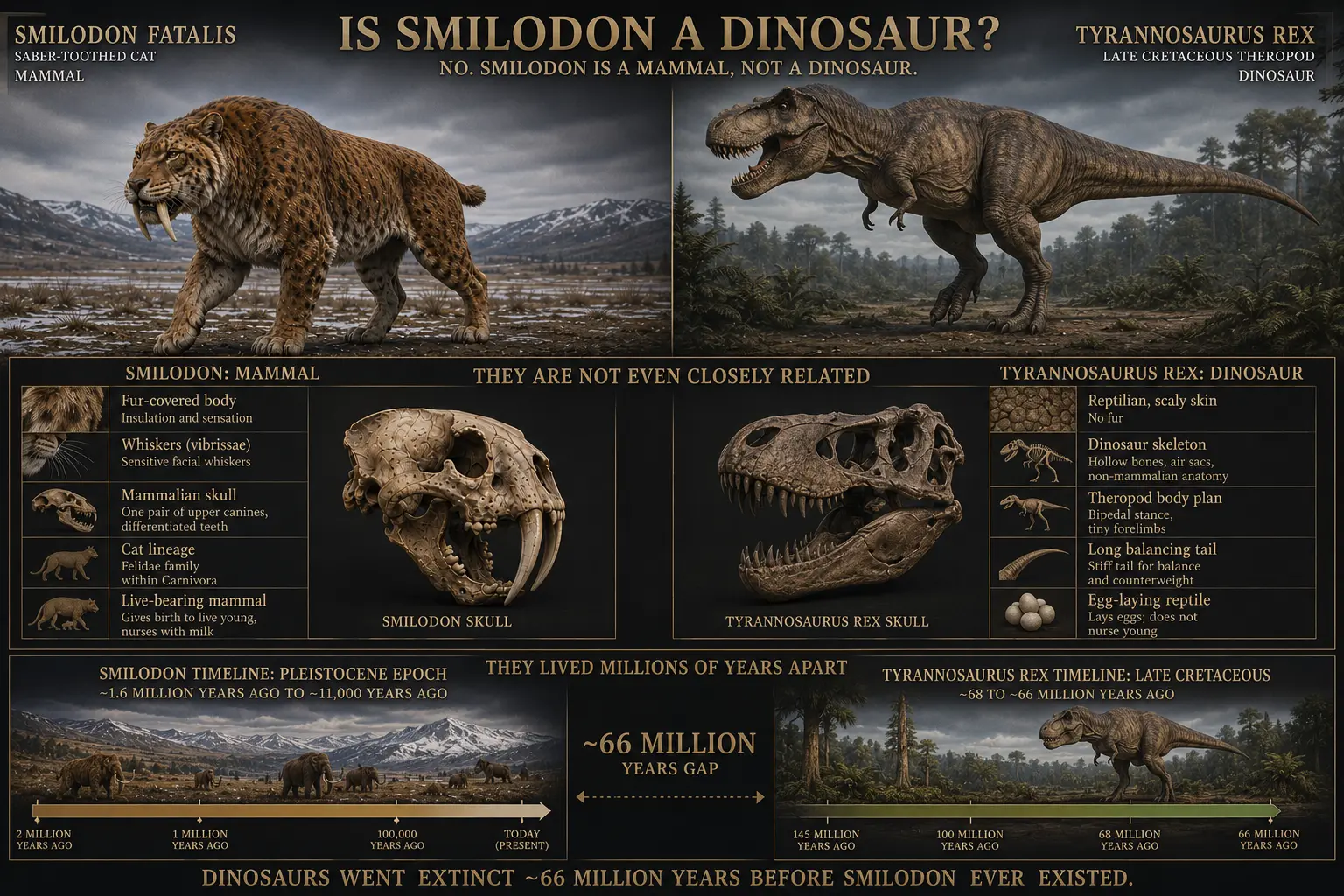
Smilodon was not a dinosaur. It was a mammal—specifically a placental carnivore belonging to the cat family (Felidae). Non-avian dinosaurs became extinct approximately 66 million years ago at the end of the Cretaceous Period, whereas Smilodon first appeared around 2.5 million years ago during the Pleistocene Epoch. The two groups were separated by more than 60 million years of evolutionary history.

The confusion is understandable. Smilodon was prehistoric, large, powerful, and extinct—characteristics often associated with dinosaurs in popular culture. However, “prehistoric animal” and “dinosaur” are not interchangeable terms. Many prehistoric animals, including mammoths, giant ground sloths, and Smilodon, lived millions of years after the last non-avian dinosaurs disappeared.
Is Smilodon a Dinosaur?
No. Smilodon was a mammal, not a dinosaur.
More specifically, Smilodon was a placental mammal belonging to the order Carnivora and the family Felidae, making it part of the same broader evolutionary lineage as modern cats. Although highly specialized, Smilodon was fundamentally a mammalian predator rather than a reptilian dinosaur.
Non-avian dinosaurs belonged to the clade Dinosauria and dominated terrestrial ecosystems throughout much of the Mesozoic Era. Their extinction occurred approximately 66 million years ago during the Cretaceous–Paleogene extinction event.
By contrast, Smilodon first appeared around 2.5 million years ago during the Pleistocene Epoch. The enormous time gap between these events means that Smilodon and non-avian dinosaurs never coexisted and were separated by tens of millions of years of evolutionary change.
From a biological perspective, Smilodon was far more closely related to living cats than to any dinosaur species. Its anatomy, physiology, reproduction, and evolutionary history were all characteristic of mammals rather than reptiles.
What Is the Difference Between a Mammal and a Dinosaur?
Mammals and dinosaurs are distinct groups of vertebrate animals that diverged from one another hundreds of millions of years ago. Although both include active, land-dwelling species with upright postures and complex behaviors, they differ in several important anatomical and biological characteristics.
Key differences include:
- Hair and skin — Mammals possess hair or fur at some stage of their lives, whereas dinosaurs bore scales, feathers, or a combination of both.
- Reproduction and parental care — Most mammals give birth to live young and nourish them with milk produced by mammary glands. Dinosaurs reproduced by laying eggs.
- Jaw and ear anatomy — Mammals possess a single lower jaw bone (the dentary) and three middle-ear bones. Dinosaurs had a different jaw structure and ear anatomy inherited from their reptilian ancestors.
- Body covering and insulation — Mammalian hair and dinosaur feathers evolved independently and served different evolutionary functions, although both could provide insulation.
- Evolutionary ancestry — Mammals belong to the synapsid lineage, while dinosaurs belong to the archosaur lineage, which also includes crocodilians and birds.
Smilodon possessed the defining characteristics of a mammal, including fur, mammary glands, live birth, a mammalian jaw structure, and mammalian ear anatomy. It was therefore a mammal in every biological sense, not a dinosaur.
Why Do People Think Smilodon Is a Dinosaur?
The confusion largely stems from the way prehistoric animals are portrayed in popular culture.
First, many people use the word “dinosaur” as a catch-all term for any extinct animal. In reality, dinosaurs represent only one branch of prehistoric life. Mammoths, giant ground sloths, dire wolves, and Smilodon all lived long after the extinction of non-avian dinosaurs.
Second, Smilodon often appears alongside dinosaurs in children’s books, toys, films, and educational media, even though the animals were separated by more than 60 million years of evolutionary history.
Finally, Smilodon’s enormous saber teeth and powerful build give it an appearance that many people associate with ancient monsters. Because it looks dramatic and unfamiliar, it is frequently grouped with dinosaurs in the public imagination despite belonging to a completely different branch of the vertebrate family tree.
A useful rule of thumb is simple: if the animal had fur, nursed its young with milk, and lived during the Ice Age, it was a mammal rather than a dinosaur.
What Was Smilodon, Then?
Smilodon was a saber-toothed cat belonging to the extinct subfamily Machairodontinae within the cat family (Felidae).
Machairodonts were a diverse group of predatory cats characterized by elongated upper canine teeth. They evolved during the Miocene and spread across multiple continents, occupying apex-predator roles for millions of years before disappearing at the end of the Pleistocene.
Among the best-known members of this group, Smilodon was one of the largest and most specialized. It was a true felid and shared a common ancestry with all living cats, including lions, tigers, leopards, jaguars, and domestic cats.
Although Smilodon was not a direct ancestor of any living cat species, it belonged to the same broader evolutionary family and was far more closely related to modern felids than to dinosaurs, reptiles, or any other living animal group outside the cat lineage.
When Did Dinosaurs and Smilodon Live?
| Group | Time Period | Approximate Date |
|---|---|---|
| Non-avian dinosaurs | Triassic to end-Cretaceous | ~252–66 million years ago |
| Dinosaur extinction event | Cretaceous–Paleogene boundary | ~66 million years ago |
| Smilodon appears | Early Pleistocene | ~2.5 million years ago |
| Smilodon becomes extinct | End-Pleistocene | ~10,000 years ago |
The last non-avian dinosaurs disappeared approximately 66 million years ago, whereas Smilodon did not appear until around 2.5 million years ago. As a result, the two were separated by more than 63 million years of evolutionary history and never coexisted.
This enormous time gap means that Smilodon lived much closer in time to modern humans than it did to any non-avian dinosaur.
Related and Contemporary Species — All Mammals, Not Dinosaurs
- Mammuthus columbi (Columbian mammoth) — a large proboscidean mammal that lived alongside Smilodon fatalis in North America during the Late Pleistocene.
- Aenocyon dirus (dire wolf) — a large canid and one of the most common carnivores of Late Pleistocene North America.
- Megatherium americanum (giant ground sloth) — one of the largest terrestrial mammals of South America and a contemporary of Smilodon populator.
- Panthera atrox (American lion) — a large felid that shared many North American ecosystems with Smilodon.
- Homo sapiens — modern humans overlapped with the final populations of Smilodon during the Late Pleistocene.
Frequently Asked Questions
Was Smilodon alive at the same time as Tyrannosaurus rex?
No. Tyrannosaurus rex lived approximately 68–66 million years ago during the Late Cretaceous, whereas Smilodon first appeared around 2.5 million years ago during the Pleistocene. The two were separated by more than 63 million years and never coexisted.
Is a saber-toothed tiger a type of dinosaur?
No. The animal commonly called the “saber-toothed tiger” was Smilodon, an extinct member of the cat family (Felidae). Dinosaurs belong to an entirely different branch of the vertebrate family tree and became extinct long before Smilodon evolved.
Was Smilodon more closely related to cats or dinosaurs?
Smilodon was far more closely related to modern cats. It was a felid mammal and shared a common ancestor with living cats millions of years after the mammalian and dinosaur lineages had already diverged.
Conclusion
Smilodon was a mammal—specifically a saber-toothed cat—and had no direct connection to the dinosaur lineage. Although both are prehistoric animals, they lived in vastly different eras and belonged to entirely different branches of vertebrate evolution.
By the time Smilodon appeared during the Ice Age, more than 60 million years had passed since the extinction of the last non-avian dinosaurs. Rather than sharing the world with dinosaurs, Smilodon lived alongside mammoths, dire wolves, giant ground sloths, and the first humans in the Americas.
References
Peer-Reviewed Literature
Luo, Z.-X. (2007). Transformation and diversification in early mammal evolution. Nature, 450, 1011–1019. https://doi.org/10.1038/nature06277
Books and Reference Works
Benton, M.J. (2014). Vertebrate Palaeontology (4th ed.). Wiley-Blackwell.
Brusatte, S.L. (2018). The Rise and Fall of the Dinosaurs: A New History of a Lost World. William Morrow.
Turner, A., & Antón, M. (1997). The Big Cats and Their Fossil Relatives: An Illustrated Guide to Their Evolution and Natural History. Columbia University Press.
Werdelin, L., McDonald, H.G., & Shaw, C.A. (2018). Smilodon. In C. A. Shaw & J. P. Harris (Eds.), Smilodon: The Iconic Sabertooth (pp. 25–65). Indiana University Press.
Featured Museum Collections
Museum-quality paleoart and educational poster
collections based on evidence-informed prehistoric
Life reconstructions.