
Quick Info
| Field | Information |
|---|---|
| Genus | Smilodon (Saber-Toothed Cat) |
| Time Range | Early Pleistocene–Late Pleistocene (approximately 2.5 million–10,000 years ago) |
| Geographic Range | North America and South America |
| Primary Habitats | Grasslands, savannas, shrublands, woodland margins, and mixed open habitats |
Quick Answer
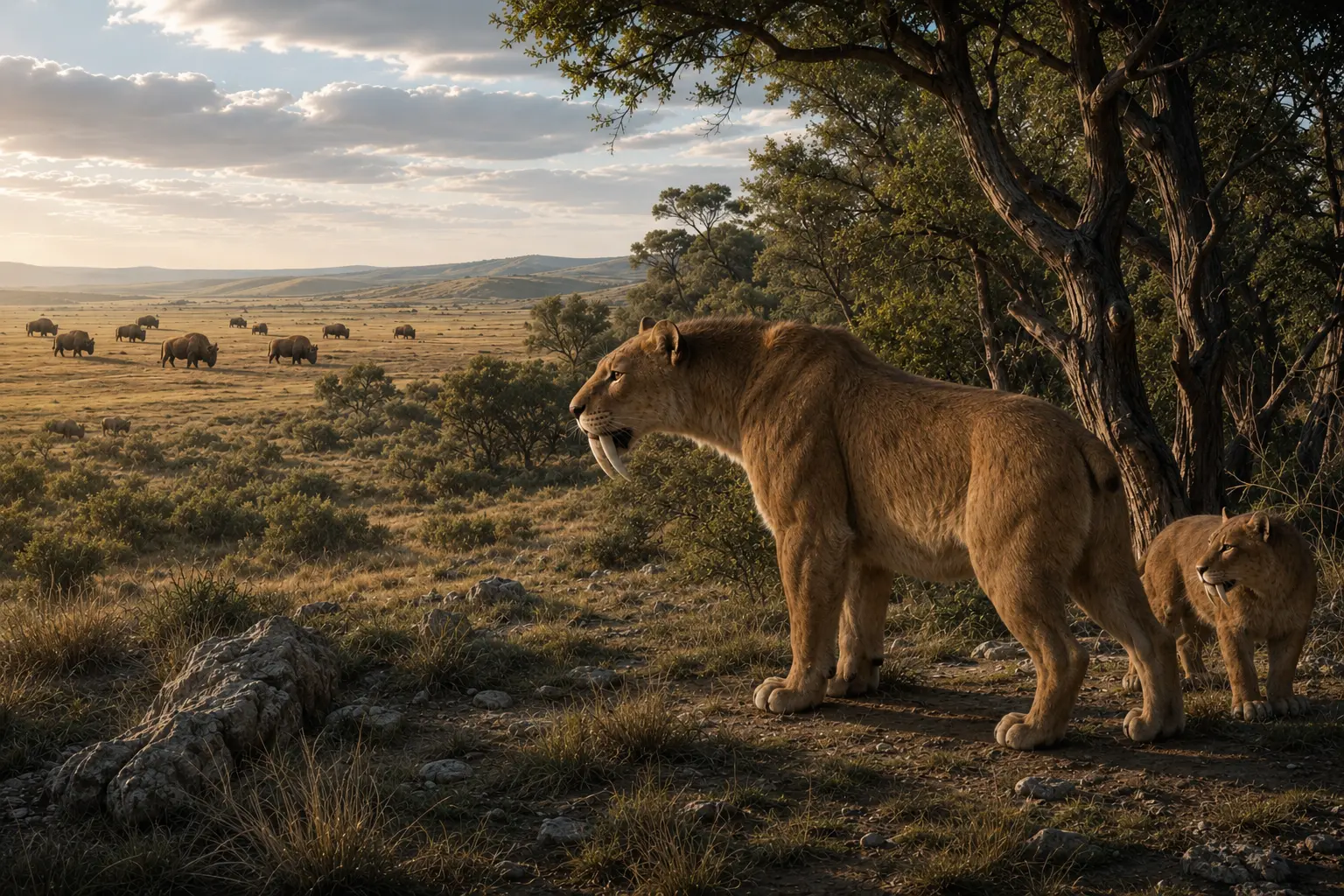
Smilodon inhabited much of North and South America during the Pleistocene Epoch. Fossil evidence indicates that these saber-toothed cats occupied a variety of environments, including grasslands, savannas, shrublands, woodland edges, and mixed open habitats that supported abundant populations of large herbivorous mammals. The genus included three recognized species: Smilodon gracilis, Smilodon fatalis, and Smilodon populator. S. gracilis and S. fatalis are best known from North America, while S. populator became widespread across much of South America.

One of the most famous Smilodon localities is Rancho La Brea in present-day Los Angeles, California. During the Late Pleistocene, this region consisted of a mosaic of grasslands, chaparral, oak woodland, and riparian habitats that supported a rich community of herbivores and predators.
What Was Smilodon’s Habitat?
Evidence from fossil assemblages, stable isotope studies, and paleoenvironmental reconstructions suggests that Smilodon occupied a broad range of habitats rather than a single environmental type. Fossils have been recovered from regions that once contained grasslands, savannas, woodland-grassland mosaics, parklands, and, in some cases, more densely wooded environments.
Across its range, Smilodon is frequently associated with large herbivorous mammals, including horses, camels, bison, deer, ground sloths, and gomphotheres. These prey communities indicate a strong ecological connection to productive landscapes capable of supporting substantial megafaunal biomass.
Although Smilodon is often portrayed as a predator of open grasslands, recent isotopic and paleoecological studies suggest a more complex picture. Some populations, particularly those represented at Rancho La Brea, may have hunted extensively in woodland and mixed habitats rather than exclusively in open plains.
North American Range and Environments
California and the Pacific Coast
The best-known population of Smilodon fatalis comes from Rancho La Brea in southern California. Fossils recovered from asphalt deposits dating approximately 40,000–10,000 years ago reveal an ecosystem composed of grasslands, chaparral, oak woodland, and riparian habitats under a Mediterranean-type climate. These environments supported diverse herbivore populations as well as a rich predator guild that included dire wolves, American lions, and short-faced bears.
Florida and the Southeastern United States
Numerous fossils of Smilodon fatalis and S. gracilis have been discovered in Florida and elsewhere in the southeastern United States. During the Pleistocene, these regions contained a mixture of grasslands, pine woodlands, scrub habitats, wetlands, and riverine forests. Fossil assemblages indicate that saber-toothed cats coexisted with dire wolves, American lions, mammoths, mastodons, and a diverse array of herbivorous mammals.
Central North America
Fossils attributed to Smilodon have been recovered from numerous localities across the central United States. These regions were dominated by extensive grasslands and parkland habitats that supported large populations of grazing mammals, providing abundant prey resources for large carnivores.
The known range of Smilodon fatalis extended from southern Canada through much of the United States and into parts of Central America.
South American Range and Environments
Smilodon populator was the largest and most widespread South American representative of the saber-toothed cat lineage. Fossils have been recovered from numerous localities across Argentina, Brazil, Uruguay, Bolivia, Venezuela, and neighbouring regions, demonstrating a broad distribution throughout much of eastern and southern South America during the Late Pleistocene.
Paleoenvironmental evidence indicates that S. populator occupied a variety of habitats, including pampas grasslands, savannas, shrublands, and seasonally dry woodlands. These ecosystems supported diverse megafaunal communities that included toxodonts, giant ground sloths, glyptodonts, native ungulates, and horses. The abundance of large herbivores across these environments provided the prey base necessary to sustain large apex predators such as Smilodon.
The presence of Smilodon in South America is linked to the Great American Biotic Interchange, a major faunal exchange that followed the emergence of the Isthmus of Panama approximately three million years ago. This land connection allowed numerous mammalian lineages to disperse between North and South America. Members of the Smilodon lineage subsequently became established in South America, where S. populator evolved into one of the continent’s dominant large carnivores.
Microhabitat and Hunting Environment
The specific microhabitats used by Smilodon cannot be observed directly and must be inferred from anatomy, biomechanics, and associated paleoenvironmental evidence. Studies of its skeletal proportions indicate a predator adapted for strength and prey restraint rather than sustained high-speed pursuit.
Its robust forelimbs, powerful shoulder girdle, and heavily built body suggest an ambush-oriented hunting strategy involving close-range attacks on large prey. Consequently, many researchers infer that Smilodon frequently utilized habitats offering some degree of concealment, including woodland margins, shrub-dominated landscapes, riparian corridors, and tall grasslands.
Comparisons with modern ambush predators such as lions and tigers support this interpretation, although no direct behavioural evidence exists. Current reconstructions of Smilodon hunting behaviour, therefore, remain informed hypotheses derived from functional morphology, biomechanical modelling, and ecological comparisons with living carnivores.
Related and Contemporary Species
Smilodon populator
The largest known species of Smilodon was distributed across much of South America and associated with grassland, savanna, and open woodland ecosystems.
Panthera atrox (American Lion)
A large felid that overlapped extensively with Smilodon fatalis across North America and likely competed for similar prey resources in many regions.
Canis dirus (Dire Wolf)
A widespread North American predator frequently found in the same fossil assemblages as Smilodon, particularly at Rancho La Brea, indicating significant ecological overlap.
Mammuthus columbi (Columbian Mammoth)
One of the dominant herbivores of many North American Pleistocene ecosystems and an important component of the environments inhabited by Smilodon.
Equus spp. (Pleistocene Horses)
Among the most widespread grazing mammals of the Americas during the Pleistocene and a major component of the prey communities associated with Smilodon throughout much of its range.
Frequently Asked Questions
Did Smilodon live in the jungle?
Current evidence suggests that Smilodon was primarily associated with grasslands, savannas, shrublands, woodland margins, and other open to semi-open environments. Most fossil localities occur in ecosystems that supported abundant populations of large herbivorous mammals.
There is little evidence that Smilodon was a specialized inhabitant of dense tropical rainforests. However, some populations may have occupied mixed woodland environments, and the full extent of habitat use across the genus remains an active area of research.
Did Smilodon live in cold climates?
Smilodon occupied a broad geographic range that included regions affected by the climatic fluctuations of the Pleistocene. Smilodon fatalis occurred across much of temperate North America, including areas that experienced cooler conditions during glacial periods.
Despite this broad climatic tolerance, Smilodon was not a specialized Arctic predator like the woolly mammoth (Mammuthus primigenius) or woolly rhinoceros (Coelodonta antiquitatis). Likewise, Smilodon populator inhabited a variety of South American environments ranging from warm savannas to the temperate pampas. No confirmed fossils are known from polar or permafrost-dominated ecosystems.
Scientific Uncertainty
Paleoenvironmental reconstructions of Smilodon habitats are based on fossil assemblages, isotopic analyses, geological evidence, and comparisons with modern ecosystems. As discoveries and analytical techniques emerge, interpretations of habitat preferences and geographic distributions may continue to be refined.
Conclusion
Smilodon was one of the most successful large predators of the Pleistocene Americas, occupying a wide range of habitats across two continents. Fossil evidence indicates that it thrived in grasslands, savannas, shrublands, and woodland-dominated landscapes that supported abundant populations of large herbivorous prey.
Although the exact habitat preferences of individual species remain an area of ongoing study, the distribution of Smilodon appears to have been closely tied to the presence of productive megafaunal ecosystems. The widespread decline and extinction of many large herbivores near the end of the Pleistocene likely played a major role in the disappearance of these iconic saber-toothed cats.
References
Peer-Reviewed Literature
Barnosky, A.D., Koch, P.L., Feranec, R.S., Wing, S.L. & Shabel, A.B. (2004). Assessing the causes of Late Pleistocene extinctions on the continents. Science, 306(5693), 70–75. https://doi.org/10.1126/science.1101476
DeSantis, L.R.G., Schubert, B.W., Scott, J.R. & Ungar, P.S. (2012). Implications of diet for the extinction of saber-toothed cats and American lions. PLOS ONE, 7(12), e52453. https://doi.org/10.1371/journal.pone.0052453
Fiedel, S. (2009). Sudden deaths: The chronology of terminal Pleistocene megafaunal extinction. In G. Haynes (Ed.), American Megafaunal Extinctions at the End of the Pleistocene (pp. 21–37). Springer.
Koch, P.L. & Barnosky, A.D. (2006). Late Quaternary extinctions: State of the debate. Annual Review of Ecology, Evolution, and Systematics, 37, 215–250. https://doi.org/10.1146/annurev.ecolsys.37.091305.110059
Martin, P.S. (1984). Prehistoric overkill: The global model. In P.S. Martin & R.G. Klein (Eds.), Quaternary Extinctions: A Prehistoric Revolution (pp. 354–403). University of Arizona Press.
Prescott, G.W., Williams, D.R., Balmford, A., Green, R.E. & Manica, A. (2012). Quantitative global analysis of the role of climate and people in explaining Late Quaternary megafaunal extinctions. Proceedings of the National Academy of Sciences, 109(12), 4527–4531. https://doi.org/10.1073/pnas.1113875109
Featured Museum Collections
Museum-quality paleoart and educational poster
collections based on evidence-informed prehistoric
Life reconstructions.